
Definition
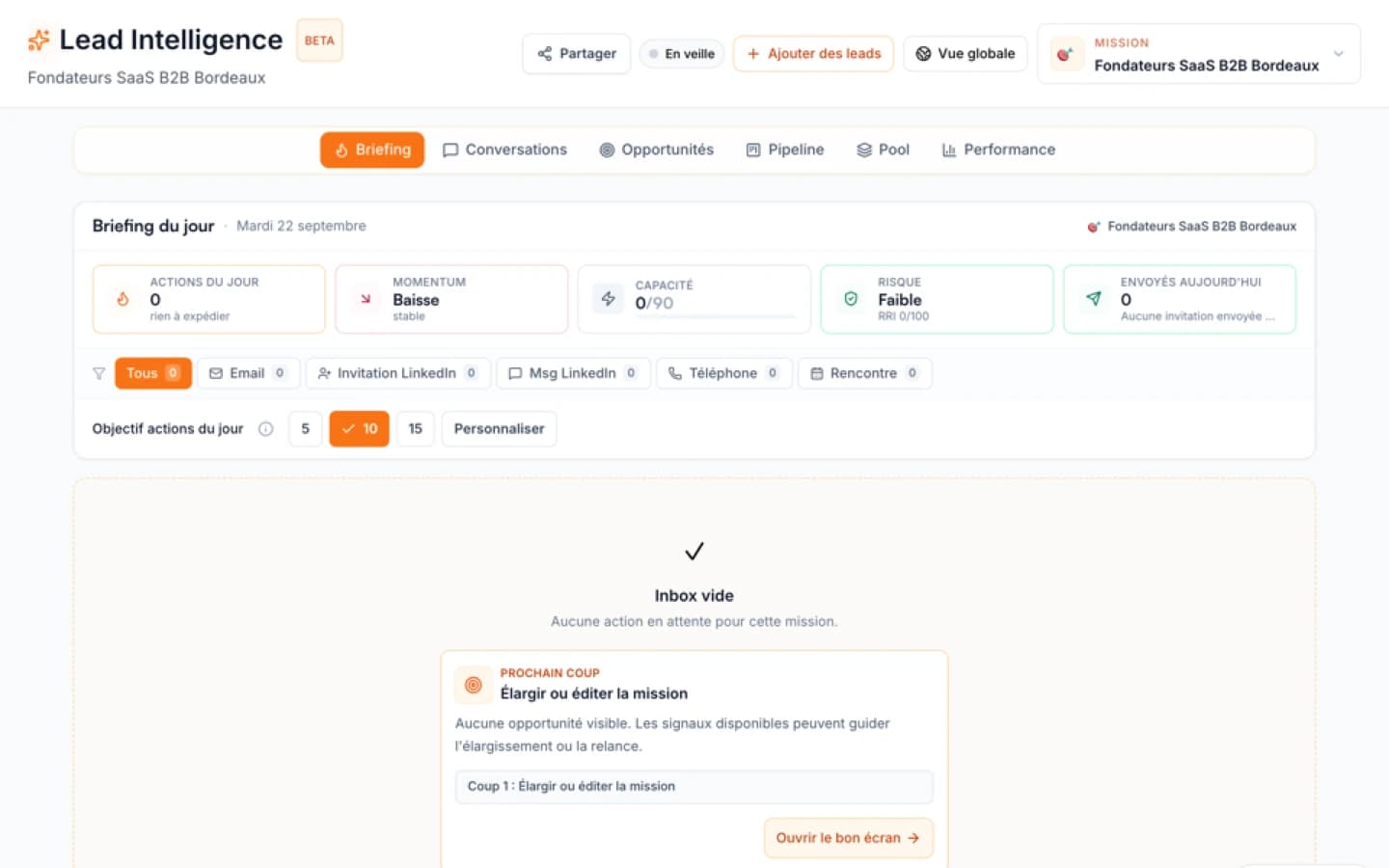
Using artificial intelligence and intent signals in B2B prospecting in 2026 requires a shift from raw volume to contextual relevance. In modern outbound sales for startups and established sales teams, intent signals represent digital footprints, such as hiring patterns, technology changes, or content consumption, that indicate a company might be ready to buy. However, relying solely on automated triggers often leads to a critical failure mode where teams generate a high volume of leads that look qualified on paper but fail to convert because they lack a genuine human connection. The goal is to scale outbound activity without losing the personal touch that builds trust. When considering how to qualify B2B leads early, teams must balance automation with human intuition. Platforms like monday.com frame artificial intelligence as a powerful way to scale without sacrificing quality, as outlined on monday.com. Yet, many organizations fall into the trap of using these tools to simply blast larger lists. For instance, Apollo has built a massive business around volume-driven outbound, reaching 150 million dollars in annual recurring revenue, according to Apollo’s history page. While Apollo is highly effective for broad channel coverage and rapid list building, its credit-based pricing model can turn every export and enrichment into a metered decision, as noted by Factors.ai and Coldreach. This volume-first approach often forces a Sales Development Representative (SDR) to focus on quantity over quality, which can clutter the Customer Relationship Management (CRM) system and dilute the sales pipeline. For those wondering how does a founder qualify B2B leads without a sales team, or who should an early-stage founder contact first, the answer lies in starting with a highly defined Ideal Customer Profile (ICP) and layering on deep context rather than broad searches. Instead of building a prospect list from scratch using generic filters, founders and sales teams should look for tools that make priority explainable from context, signals, and opportunity readiness. This is where Lead Intelligence from Ember changes the dynamic. By reusing the Ember Fund Your Growth, ICP, offer, and strategy to prepare a sales mission, Lead Intelligence helps teams prioritize the conversations that deserve attention now. It reduces noise and makes the first value actually produced by the mission visible, ensuring that cold outreach remains deeply relevant, highly targeted, and fundamentally human.
To place this decision in context, the Knowledge guides for sales brings together deeper guidance on the same field.
Prerequisites
Before a Business-to-Business (B2B) sales team or an early-stage founder can successfully deploy Artificial Intelligence (AI) and intent signals, they must establish clear operational prerequisites. The primary prerequisite is shifting the focus from raw outbound volume to contextual relevance. Platforms like monday.com frame AI as a way to scale without sacrificing quality, yet many teams still face the common failure mode of AI-sourced leads that look qualified on paper but ultimately do not convert, as discussed by monday.com. To avoid this trap, teams must understand the mechanics of lead qualification and how to build a prospect list from scratch without losing the human read.
Understanding how to qualify B2B leads early is essential for maintaining a healthy sales pipeline. For outbound sales for startups, a common question arises: how does a founder qualify B2B leads without a sales team? The answer lies in establishing a strict Ideal Customer Profile (ICP) and mapping intent signals directly to specific pain points before any cold outreach begins. Instead of relying on massive databases to blast thousands of generic messages, founders must prioritize their efforts. When deciding who should an early-stage founder contact first, the priority must always be accounts experiencing active, verifiable changes, such as leadership shifts or technology updates, rather than static lists.
Another prerequisite is recognizing the structural tradeoffs of volume-first tools. For instance, Apollo provides a massive contact database and sequence automation built for volume-driven outbound, and reported $150 million in annual recurring revenue in 2025, according to Apollo. However, a volume-first approach means that credit-based pricing turns every export, enrichment, and verification into a metered decision where costs compound rapidly as a team scales, a challenge noted by Factors.ai. If a Sales Development Representative (SDR) team relies solely on automated volume, they risk paying more for wasted exports and bounced emails without improving actual conversion rates.
Therefore, the final prerequisite for integrating AI into your sales process is making each priority explainable through customer fit, relevant signals and opportunity readiness. A person should review that context before any message is sent.
Steps
Start with a clear ideal customer profile and one reason to contact each account. Use AI to find relevant companies and gather sources, then have a person check whether the signal is timely and the proposed message fits the recipient. Record the outcome in your sales process and adjust the criteria when conversations show that the initial signal was weak.
To explore this point further, Apollo vs Ember Lead Intelligence for Founder Conversion details a step directly related to this decision.
Worked example
Consider a founder with no dedicated sales team. She defines the customer profile, reviews a short list of accounts with relevant public changes and asks which contact owns the problem. An AI tool helps gather context, but she checks the source and writes the first message herself. She then compares replies and qualified conversations with her previous approach before expanding the campaign.
Common mistakes
The primary mistake modern Business-to-Business (B2B) sales teams make when adopting Artificial Intelligence (AI) is treating automation as a license to increase outbound volume at the expense of human context. While platforms like monday.com frame Artificial Intelligence as a way to scale without sacrificing quality, many teams face the real failure mode of AI-sourced leads that look qualified on paper but fail to convert (monday.com blog). This volume-first trap often results in a cluttered sales pipeline where Sales Development Representatives (SDR) spend their days chasing low-intent contacts rather than engaging in meaningful B2B prospecting.
This reliance on raw volume is heavily reinforced by traditional database tools. For example, Apollo reported $150 million in annual recurring revenue in May 2025 (source). However, this model encourages teams to prioritize quantity over quality. A team should check whether metered usage is improving qualified conversations, not just contact volume. Every export, enrichment or verification consumes credits, so the overall cost climbs with usage (factors.ai alternatives). This metered pricing turns every step of lead qualification and list building into a transactional expense, forcing reps to ration their data usage instead of focusing on deep research.
Another common error is building a prospect list before agreeing on the ideal customer profile. Automated scores are less useful when the underlying account and signal have not been checked. Start with a small list and review why each contact belongs on it.
This approach also connects with Bootstrapped founder outreach: who, why now, what to say, which clarifies the next choice.
Tools
AI can help a B2B team research accounts at scale, but the sales team still needs to check customer fit and the reason to approach each person. Apollo reported $150 million in annual recurring revenue in 2025, a company result that does not prove that a volume-first campaign will work for every customer. Apollo.
When to use this method
This balanced method of combining Artificial Intelligence (AI) with deep intent signals is not a universal replacement for all outbound sales, but rather a strategic framework for specific business phases. Traditional volume-based platforms are highly effective when a company already knows its Ideal Customer Profile (ICP) perfectly and has the resources to run broad outbound campaigns. For example, Apollo reported $150 million in annual recurring revenue in 2025 Apollo. However, when a sales team must protect its sales pipeline from low-quality noise, or when building a prospect list from scratch, a purely volume-driven approach often leads to high bounce rates and wasted budget.
This qualitative approach is particularly critical when executing outbound sales for startups, where every lead must be carefully nurtured. For teams wondering how to qualify B2B leads early, relying on automated sequencing without a human read can quickly damage brand reputation. Instead, integrating intent signals with contextual lead scoring allows a Sales Development Representative (SDR) to identify exactly when a prospect is experiencing a relevant pain point. This ensures that cold outreach is timed perfectly, transforming a cold interaction into a warm, consultative conversation.
For early-stage companies, this methodology directly addresses the fundamental question of who should an early-stage founder contact first? An early-stage founder should contact prospects who have recently exhibited clear, verifiable organizational changes or intent signals, rather than attempting to reach thousands of unverified contacts. Furthermore, this approach explains how does a founder qualify B2B leads without a sales team? By utilizing intelligent systems to analyze signals and prioritize opportunities, a founder can act as their own highly efficient sales team, focusing their limited time only on accounts that are ready to engage.
As sales teams look to update their strategies for 2026, a year highlighted by monday.com as a critical turning point for driving results, the primary challenge is balancing scale with quality. This is where Ember and its Lead Intelligence capability provide a distinct advantage over traditional credit-metered databases. Rather than forcing teams to pay for every single contact export or email verification, Lead Intelligence focuses on reducing noise and identifying the opportunities that deserve immediate action. By connecting intent signals directly to the broader Business-to-Business (B2B) prospecting context, it helps founders and sales teams understand who to contact, why now, and which angle to use, ensuring that the human element remains at the center of every conversation.
In practice, How to decide who to contact, why now, and what to say completes this framework with another angle on the same topic.
When not to use it
This context-driven, signal-led approach is not a fit for every Business-to-Business (B2B) sales team or organizational stage. If your primary objective is to maximize raw outbound volume regardless of relationship quality, a traditional database-first platform is more appropriate. For instance, Apollo reported $150 million in annual recurring revenue in May 2025 for volume-driven outbound where unit economics depend on sending more emails and booking more meetings per representative (Apollo’s history page). If your Sales Development Representative (SDR) team is structured to run broad, multi-step outbound campaigns across email, phone, and social from a single tool, a high-volume database is the logical choice. However, the tradeoff is that credit-based pricing turns every action into a metered decision, where exporting contacts, enriching records, and verifying emails each consume credits (Factors.ai). According to Coldreach, the entry price is low, but costs climb with seats and credits (Coldreach).
Furthermore, this method should not be used if you have not yet defined your basic target market. When considering how does a founder qualify B2B leads without a sales team, the answer is not to deploy complex Artificial Intelligence (AI) intent-monitoring systems too early. Without a clear Ideal Customer Profile (ICP), intent signals become mere background noise, surface-level indicators that lead to wasted sales cycles. If you are wondering who should an early-stage founder contact first, the priority should always be direct, manual conversations with high-conviction profiles in your immediate network rather than relying on automated lead scoring. Deploying advanced signal tracking before you have validated your core value proposition will only result in highly optimized outreach to the wrong people.
Finally, if your Revenue Operations (RevOps) and sales leadership are strictly evaluated on activity metrics, such as the sheer number of emails sent daily, rather than conversion outcomes, a deep-context tool like Lead Intelligence will clash with your internal incentives. Lead Intelligence is designed to reduce noise and focus attention on opportunities that deserve action now. It is built for teams that prioritize precision over raw volume, meaning it is not suitable for organizations that measure success purely by the size of their database exports.
Action plan
To execute a modern Business-to-Business (B2B) prospecting strategy that balances automated efficiency with human intuition, sales teams and founders must move away from generic, high-volume email blasts. The transition to signal-led outbound sales for startups requires a structured action plan that treats data enrichment and lead qualification as continuous, context-driven processes rather than one-off database exports.
First, connect the sales mission to the customer profile, offer and current business goals. Teams using Ember can use context from Fund Your Growth to prepare a mission, then review the accounts and reasons for priority before contacting anyone.
Before deciding, Lead Intelligence for bootstrapped founders: who and why now helps connect this method with adjacent priorities.
Sources and methodology
To build a reliable framework for Business-to-Business (B2B) prospecting and outbound sales for startups, we analyzed real-world performance data, market benchmarks, and leading sales methodologies. Our analysis of modern lead qualification and cold outreach strategies is grounded in the tension between volume and quality. For instance, platforms like monday.com frame Artificial Intelligence (AI) as a powerful way to scale operations without sacrificing the quality of interactions, as discussed in their guide on B2B sales lead generation strategies. At the same time, the market demand for sheer volume remains massive. According to financial data, the outbound platform Apollo reached 150 million dollars in annual recurring revenue, which highlights how heavily modern sales teams still rely on database-driven, high-volume sequencing tools (Apollo’s history page).
However, when building a prospect list from scratch, relying solely on volume often leads to a cluttered sales pipeline and low conversion rates. This raises a critical question for early-stage companies: how does a founder qualify B2B leads without a sales team? The methodology presented in this article relies on signal-led prioritization rather than manual database filtering. Instead of hiring a dedicated Sales Development Representative (SDR) to clean lists, founders can leverage tools like Lead Intelligence to automatically find accounts based on their Ideal Customer Profile (ICP) and verify useful sources directly (Lead Intelligence). This approach makes lead scoring and priority explainable through up-to-date context, signals, and opportunity readiness, allowing lean teams to maintain a human touch.
When deciding who should an early-stage founder contact first, the methodology prioritizes accounts showing active, verifiable intent signals over cold, static contacts. By integrating these insights directly into a Customer Relationship Management (CRM) workflow, startups can avoid the compounding costs of wasted data enrichment credits and focus their energy on conversations that are actually ready to convert.
Sources
FAQ
Free diagnostic
Test your sales file
Drop an Excel or CSV and check its readiness without sending its rows to Ember.