
| Criterion | Apollo | Ember (Lead Intelligence) |
|---|---|---|
| Positioning | "The AI GTM System for Go-to-Market Teams": one connected system for go-to-market teams | Helps decide who to contact, why now and with which angle, from the context of a mission |
| Contact database | 240 million contacts and 30 million companies announced on the home page [Apollo data](https://www.apollo.io/product/data) | Finds and prioritizes accounts from the mission's target and signals, from 10, 100 or 1,000 contacts with no minimum threshold; Excel or CSV import up to 3,500 contacts |
| Channels and outreach | Email, calls with a parallel dialer, Chrome extension; agents write outreach, follow up and book meetings | Proposes the next action and channel for each lead; sending stays manual: the person validates and sends |
| AI and prioritization | Agents research accounts, prioritize leads and write outreach; an "AI Context Center" trains them on your ICP and product | Ranks accounts as opportunities to watch, act on or set aside, with the reasons; monitors signals on people and companies |
| Integrations and import | 200+ integrations, including Salesforce and HubSpot [Apollo integrations](https://www.apollo.io/product/execution) | Excel or CSV import and LinkedIn or Sales Navigator search from a connected account; does not automatically sync every CRM |
| Pricing model | Credit-based, with extra credits available; free Starter plan with no time limit; unlimited plans governed by a Fair Use Policy | No estimate before a discovery is launched; actual consumption appears in the usage history |
Why look for an alternative
Apollo built its reputation as a sales intelligence and engagement platform organized around a large business to business (B2B) contact database, email sequences, and prospecting workflows, and it has scaled that model to real commercial results: annual recurring revenue (ARR) reached 150 million dollars in 2025, with a 1.6 billion dollar valuation (company history and Series D announcement). That growth tells you the underlying mechanic works, but it also tells you what the mechanic optimizes for. Apollo is built for volume driven outbound, where unit economics depend on sending more emails and booking more meetings, and its own homepage frames it as a unified sales platform meant to simplify pipeline and closing across the stack source. For an early stage founder still shaping an ideal customer profile (ICP), that volume logic can work against you: even unlimited email plans stay bound by a fair use policy that caps effective throughput source, so the real constraint is not sending more, it is knowing who deserves the next message. If your conversion problem is actually a prioritization problem, that is the moment to look past a database and sequencer toward something that starts from your context and tells you who to contact, why now, and with which angle.
To place this decision in context, the Knowledge guides for sales brings together deeper guidance on the same field.
Decision criteria
When you are choosing between Apollo and an alternative for this exact question, who to contact, why now, and with what message, four criteria matter more than feature lists.
The first is what the tool optimizes for by default. Apollo is built around a large B2B contact database, email sequences, and prospecting workflows, and its own homepage frames it as a unified AI sales platform meant to consolidate pipeline, closing, and tooling for sales and marketing teams source. That is a strength if your bottleneck is finding enough contacts. It is a weaker fit if your bottleneck is deciding which of the contacts you already have deserve a call this week, because volume and priority are different problems.
The second criterion is pricing shape, since it changes behavior, not just cost. Apollo's unlimited plans remain subject to a Fair Use Policy, with unlimited email credits still bounded by credit limits source. More broadly, credit based pricing turns every action into a metered decision: exporting contacts, enriching records, and verifying emails each draw down credits, and buyers researching alternatives consistently flag this as a real cost driver once a team scales past a single seat source. A separate review of the same dynamic makes the same point about credit consumption compounding as usage grows source. If your team is early and small, ask whether you want to pay per action on a growing list, or whether you want the system to narrow the list first.
The third criterion is what happens after you have contacts. Apollo's model was built for outbound at volume, where sequences and a large database are the point. Lead Intelligence starts from a different question: it is meant to give a clear next action, who to contact, why now, through which channel, and with which angle, rather than a longer list to work through. Ember's own positioning states this as knowing who to contact, why now, and which action to take.
The fourth criterion is honesty about fit. If your current problem really is contact coverage, a database first tool like Apollo may already do what you need, and switching would not solve a priority problem you do not have. If your problem is that you have contacts but no confident order of who to call first and why, that is the decision point where Lead Intelligence is worth a direct comparison, and where Apollo itself describes, on its home page read on 29 September 2026, agents that prioritize leads, write outreach and book meetings source.
Quick decision table
If you want the short version: pick Apollo when your priority is building and running high volume outbound email campaigns from a large contact database, and consider Lead Intelligence when your priority is figuring out who to contact, why now, and with what message, without first assembling a database yourself.
Apollo describes itself on its own homepage as a unified AI sales platform for modern sales and marketing teams, covering pipeline, closing, and consolidating the sales stack source. That positioning matches its scale: Apollo reported 150 million dollars in annual recurring revenue in 2025, according to its own company history. For a founder, that scale is a signal the platform works for high volume outbound motions, not a signal that it will tell you which lead deserves a call this week.
The pricing model is where the decision usually gets made. Apollo's unlimited plans remain subject to a Fair Use Policy, with unlimited email credits still bounded by underlying credit limits according to its own pricing page source. That matters for conversion rate work specifically: if your bottleneck is not sending more emails but choosing the right five accounts to call this week, a credit metered database does not solve that problem by itself, it just gives you more raw material to sort through manually.
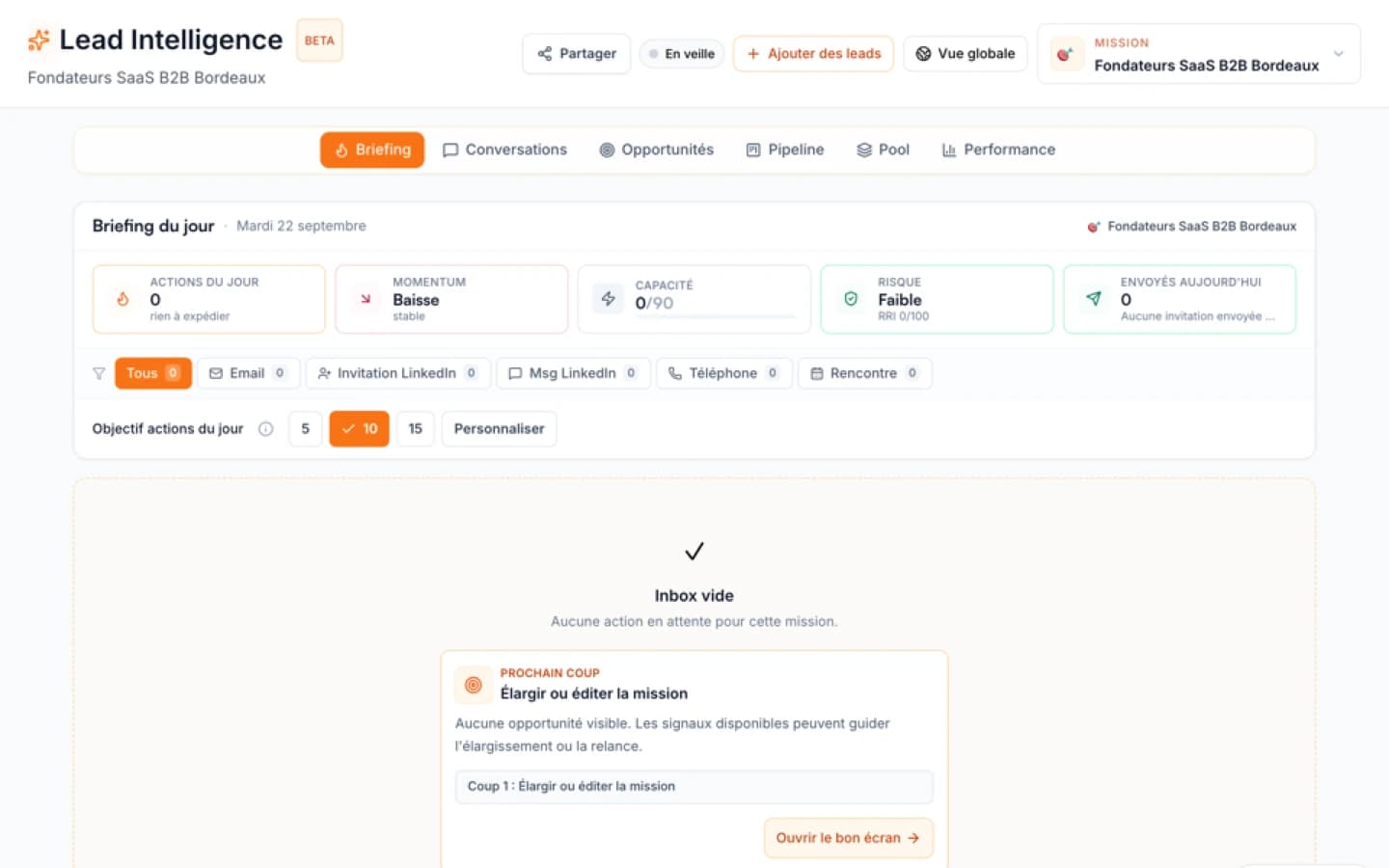
Lead Intelligence starts from the opposite end of that same question. Its job is to help you know who to contact, why now, and which action to take next, using the context of your own project rather than a generic list of contacts. Concretely, that means it is built to give a clear next action such as who to contact, why now, through which channel, and with which angle, instead of a database you still have to interpret yourself.
Use this as your quick filter: if your current problem is that you do not have enough contacts, Apollo's database and sequencing are a reasonable place to start, and admitting that is fair. If your current problem is that you have contacts but no clear read on which ones deserve attention this week and why, that is a prioritization problem, and it is the one Lead Intelligence is built to answer.
To explore this point further, Clay vs Ember: when each one fits details a step directly related to this decision.
Neutral presentation of the competitor
Apollo presents itself as a unified AI sales platform for modern sales and marketing teams, built to help them manage pipeline, close deals, and simplify their tool stack source. In practice this means the product is organized around a contact database, email sequencing, and outreach automation rather than around a single lead's readiness or timing. Pricing combines seats and credits. Free includes 900 credits per user per year; with annual billing, Basic costs $49 per user per month with 30,000 credits per year, Professional $79 with 48,000 credits, and Organization $119 with 72,000 credits and a three-user minimum Apollo plan breakdown. Even Apollo's unlimited email tiers remain governed by a Fair Use Policy that caps effective volume despite the "unlimited" label source. This is a mature, widely adopted platform: Apollo reported 150 million dollars in annual recurring revenue in 2025, alongside a 1.6 billion dollar valuation and about 250 million dollars raised (company history and Series D announcement). An independent review from 2026 also flags data accuracy questions and friction in the credit system as recurring concerns for buyers evaluating the product source. For a founder asking who to contact, why now, and with what message, that scale is real, but it also signals a tool designed first for teams running high volume outbound motions, not for surfacing the single next priority action from a smaller, still forming pipeline.
Neutral presentation of Ember
Ember presents itself as an AI team for entrepreneurship, and within that scope Lead Intelligence is the module built for this exact question: who to contact, why now, and with what message. Rather than asking you to assemble a database first, Lead Intelligence reuses the context you already have in Ember, your ideal customer profile, your offer, and your strategy, to prepare a sales mission around your actual project instead of a generic prospect list.
From that starting context, Lead Intelligence runs market discovery itself. It searches for accounts that match your target profile and relevant signals, then checks which sources are actually useful before anything reaches you. It works the same way whether you start from a short list or a long one: there is no minimum number of contacts below which the tool stops being relevant, so an early founder testing a niche and a small sales team covering a defined territory both go through the same discovery and prioritization step.
The result is not just a ranked list. Ember sorts accounts into opportunities to watch, act on, or set aside, and explains that priority using the context, the signals detected, and how ready the opportunity looks. For each one it proposes a next action and a channel suited to the situation, which is the direct answer to the founder question of who to contact, why now, and with what message. Once a mission runs, Ember shows the contacts actually analysed and the signals actually detected, and it reports honestly when nothing useful was found instead of inventing a result to fill the gap.
Connections to outside data stay deliberately narrow for now. You can search and import profiles through LinkedIn or Sales Navigator from a connected account, or bring your own list as an Excel or CSV file, with a local readiness score before anything is enriched. Reading a sample from a customer relationship management (CRM) tool such as HubSpot or Salesforce, or from a spreadsheet, to see what is missing for a sales decision, is a diagnostic capability still being developed, sitting behind access flags that are off by default, and it does not synchronize any CRM automatically. This is aimed primarily at founders and sales teams, with smaller companies as a secondary use case, rather than at teams whose main need is a very large contact database to run high volume outbound on their own.
This approach also connects with What does a defensible B2B lead generation process look like in 2026 for a team that cannot rely on a single channel?, which clarifies the next choice.
Approach comparison
Look at what each tool actually asks you to do first, because that is where the real difference sits. Apollo asks you to start from a database: pick filters, pull a list, load it into a sequence, and let volume do the work. Lead Intelligence asks a different first question, closer to what an early-stage founder actually needs before sending anything: who deserves a message this week, why now, and what that message should say, drawing on the context and prioritization already available in Ember rather than a fresh list you have to assemble and qualify yourself.
That contrast in starting point explains most of the practical differences downstream. Apollo's engine is built for teams that already know roughly who they are targeting and want to reach more of them faster, with a contact database, sequencing, and a Chrome extension for LinkedIn (Long-in) prospecting sitting at the center of the product. Even Apollo's own unlimited plans keep this volume model in check with a Fair Use Policy that caps email credits rather than leaving usage truly open ended (source). Apollo also carries real scale behind this approach, with a database of 240 million contacts and 30 million companies and 150 million dollars in annual recurring revenue according to its own company history, which is a reasonable proxy for how many sales teams already trust the volume playbook for at least some of their pipeline.
Lead Intelligence optimizes for the opposite end of that same funnel: instead of asking you to define and load a target list before anything happens, it uses the ideal customer profile (ICP), offer, and strategy context already present in Ember to surface a next action, meaning who to contact, why now, and with which channel and angle, as the deliverable itself rather than a byproduct of sending more emails.
When the competitor is the better fit
Apollo is the stronger choice when a founder already knows the shape of the list they need and simply wants a large, searchable contact database with built in sequencing. Apollo describes itself as a unified artificial intelligence sales platform built for modern sales and marketing teams to manage pipeline, close deals, and simplify their tool stack source, and that framing fits a founder who has already done the targeting work and now wants volume, not a first answer to who to contact. The pricing structure also tells you who Apollo is built for. The Free plan includes 900 credits per user per year, while Basic costs $49 per user per month with annual billing and includes 30,000 credits per year Apollo plan breakdown. If your conversion problem is really a coverage problem, meaning you need many verified emails fast and you already know your ideal customer profile well enough to filter for it, that entry price is hard to beat for a solo founder testing outreach volume. Apollo's scale is real: the company reported 150 million dollars in annual recurring revenue in 2025, with a valuation of 1.6 billion dollars and about 250 million dollars raised (company history and Series D announcement). That kind of scale means the credit based model works commercially for a huge number of sales teams, and if your team already runs on that model comfortably, switching tools is its own cost. Where the tradeoff shows up is at the edges of that credit system. Unlimited email plans remain governed by a Fair Use Policy with underlying credit limits source, and independent reviews note that credit based pricing turns every action, export, enrichment, and verification into a metered decision that does not scale linearly as a team grows from one seat to five source. A separate review makes the same point about compounding costs from wasted exports and re enrichment source. For an early-stage founder who already has a defined list and just needs to run sequences at volume, that tradeoff is manageable and Apollo remains a reasonable default. The decision changes when the real bottleneck is not database size but knowing which of the contacts you already have deserve attention this week, and why now.
When Ember is the better fit
Ember fits better when the real bottleneck is not the size of a contact list but the clarity of what to do with it. An early-stage founder trying to raise a conversion rate usually does not need more names; they need to know which of the names they already have deserve a message this week, and why. Apollo's own pricing page confirms that even its unlimited plans stay bound by a fair use policy, with credit limits attached to unlimited email credits (source). That detail is not cosmetic for a founder who is still testing messaging: every export, every enrichment, every verification draws down credits, and one comparison of Apollo alternatives notes that this cost does not scale in a straight line once a team grows from one seat to five, since wasted exports and re-enrichment compound the bill (source). A separate review of Apollo alternatives makes the same point about credit consumption becoming a real constraint as usage grows (source). A metered model like that rewards having your list right before you start, which is a poor fit for a founder who is still shaping who the right contact even is. Lead Intelligence starts from a different place. It reuses the context already built in Ember, the offer and the strategy behind the sales motion, to prepare a sales mission and hand back a concrete next action: who to contact, why now, through which channel, and with what angle. That answer keeps updating as new signals appear, so the founder is not re-running a database query every time something changes; they are told who moved and why it matters now. Scale is where the two tools diverge most plainly. Apollo has grown into a large platform, reporting 150 million dollars in annual recurring revenue in 2025, a 1.6 billion dollar valuation, and about 250 million dollars raised (company history and Series D announcement). That is the profile of a tool built for high-volume outbound at scale, not necessarily for a founder deciding which five conversations matter most this week. If the constraint is finding names, Apollo's database earns its keep. If the constraint is choosing which of the names already on hand deserve attention now, and being able to say why, that is the decision Lead Intelligence is built around.
In practice, Apollo vs Ember Lead Intelligence for Founder Conversion completes this framework with another angle on the same topic.
Limits
Apollo's own limits show up fastest once you look past the size of its database. The plans marketed as unlimited email credits are still governed by a Fair Use Policy that caps practical usage, so "unlimited" does not mean unmetered in practice source. Apollo positions itself as a unified artificial intelligence sales platform for pipeline, closing and consolidating the sales stack, which is a different promise than telling a founder which specific contact to message this week source. That gap matters for an early-stage founder trying to raise a conversion rate: a bigger list without a reason to contact each name does not, by itself, change who replies.
The honest limit on the Ember side is scope, not intent. Lead Intelligence is built to answer who to contact, why now and which action to take, using the context already available rather than asking you to build a database from scratch first. If a founder's real problem is that they have no list at all in a brand new market, Apollo's searchable contact base and sequencing can still be the faster starting point for that specific gap, and it would be dishonest to pretend otherwise. Where Lead Intelligence earns its place is right after: once there is a set of contacts, however small, the question shifts from "how many names can I get" to "which of these deserve a message now, and what should that message say."
So the practical way to weigh the two is not database size against database size. It is asking whether the current bottleneck is volume of contacts or clarity about which contact matters this week and why, since that second question is the one a bigger list does not answer on its own.
Contextual recommendation
For an early-stage founder trying to raise a conversion rate, the real question is whether the bottleneck is the size of the contact list or the clarity of what to do with it. If the gap is volume, Apollo's positioning as a unified artificial intelligence sales platform for modern sales and marketing teams, built to manage pipeline and closing while simplifying the sales stack, still answers that need directly source. Apollo's scale backs that model commercially: the company reported an annual recurring revenue (ARR) of 150 million dollars in 2025, alongside a valuation of 1.6 billion dollars (company history and Series D announcement). A founder who already knows exactly who to target and just needs more names in a sequence will find that scale reassuring. But raising a conversion rate rarely comes from adding more contacts to an outbound sequence; it comes from knowing, among the contacts already available, who to reach, why now, and with what message. That is the exact frame Lead Intelligence works from: it turns the available context into a clear next action, naming who to contact, why now, which channel and which angle, rather than handing back a longer list to sort through manually. Before deciding, a founder can ask a concrete question: is the current problem a shortage of contacts, or a shortage of clarity about which contacts already on file deserve a message this week? For the first case, worth noting that Apollo's plans marketed as unlimited email credits still sit under a Fair Use Policy that caps practical usage, so unlimited does not mean unmetered in daily practice source. For the second case, the recommendation is simpler: start from the prioritization question itself, since that is what actually moves a conversion rate, and let the list follow the priority rather than the other way around.
Before deciding, What Does a Realistic Weekly Outbound Workload Look Like for a B2B Rep in 2026? helps connect this method with adjacent priorities.
Sources and updates
The Apollo facts used in this comparison come from a handful of dated snapshots, not a live feed, so treat them as a checkpoint rather than a permanent record. Apollo's own pricing page, captured July 22 2026, is the source for the Fair Use Policy that still caps the plans marketed as unlimited email credits source, and the same capture date applies to the homepage line that positions Apollo as a unified artificial intelligence sales platform built around pipeline, closing and stack simplification source. The revenue and funding figures, 150 million dollars in annual recurring revenue for 2025, a valuation of 1.6 billion dollars, and about 250 million dollars raised, come from Apollo itself (company history and Series D announcement). Credit systems, fair use caps and plan names are exactly the parts a vendor changes most often, so an early-stage founder who needs the current terms should confirm them directly on Apollo's pricing page before deciding, rather than treating any comparison, including this one, as the final word. The same caution runs both ways: Ember's Lead Intelligence page describes its own current features and limits, and that page moves as the product does, which makes it the place to check what Ember itself supports right now rather than relying on a snapshot.
Sources
FAQ
Free diagnostic
Analyse your Apollo data
Check whether your Apollo contacts are complete and recent enough to prioritise.