
Symptom or signal
Small Business-to-Business (B2B) sales teams operating without a dedicated marketing department or a full-time Sales Development Representative (SDR) frequently fall into a high-activity trap. When pipeline pressure mounts, the default reaction is often to purchase massive contact lists and launch generic, automated email sequences. However, this volume-first approach rarely yields sustainable results. In fact, industry benchmarks indicate that roughly 83% of reps miss their quota each month, according to data from SalesHive. This systemic challenge forces lean teams to ask critical strategic questions, such as how does a founder qualify B2B leads without a sales team? For an early-stage founder or a lean sales team, the immediate challenge is knowing who to contact first. Instead of attempting to replicate the massive infrastructure of larger organizations, small teams must focus on precision and timing. Attempting to manage four to six tools that do not communicate with each other, as highlighted by Extrovert, only introduces operational noise. When a team has no dedicated SDR to filter out irrelevant accounts, sending high volumes of untargeted messages results in wasted effort. To build a functional 30-day outbound cadence, teams must shift from raw volume to highly contextual, signal-based prospecting.
To place this decision in context, the Knowledge guides for sales brings together deeper guidance on the same field.
What changed
Outbound sales has undergone a fundamental shift. The traditional playbook of scaling cold outreach through sheer volume is no longer effective for small teams. Buyers are increasingly fatigued by automated touchpoints, and the tools designed to automate these processes often create more noise than pipeline. According to a 2026 guide by Extrovert, most Business-to-Business (B2B) sales teams run four to six tools that do not talk to each other, paying for overlapping features while still missing quota because their systems are optimized for volume rather than trust Extrovert Guide.
This reliance on high-volume automation has led to a significant performance gap. Data from SalesHive indicates that roughly 83% of sales development representatives (SDRs) miss their quota each month, even though the benchmark for a productive outbound SDR remains about 15 booked meetings per month SalesHive Blog. For a small sales team or a startup without a dedicated marketing function, attempting to replicate this heavy, high-volume model is a recipe for wasted budget. Historically, building an outbound SDR team required defining an Ideal Customer Profile (ICP), structuring roles around SDRs and Account Executives (AEs), and setting up a repeatable outreach process within a Customer Relationship Management (CRM) system, as outlined by Xynario. A small team has neither the time nor the headcount for that blueprint.
Facts and sources
To build a sustainable outbound sales pipeline without a dedicated marketing function or a full-time Sales Development Representative (SDR), small Business-to-Business (B2B) sales teams must confront the inefficiencies of traditional high-volume playbooks. According to research published by SalesHive, roughly 83% of reps miss their quota each month, despite industry benchmarks setting the standard for a productive outbound SDR at about 15 booked meetings per month with an 80% show rate. This gap highlights the systemic failure of relying solely on raw activity metrics.
Many small teams attempt to solve this pipeline pressure by stacking software, but this often compounds the problem. A guide by Extrovert notes that most B2B sales teams run four to six tools that do not communicate with each other, and that prospects get 80 automated touchpoints before a single person shows up in their feed. Platforms built for large-scale prospecting respond to that volume. On its official website, Apollo presents itself as an AI GTM system for go-to-market teams. Similarly, Clay positions its platform as infrastructure for Go-To-Market (GTM) teams and GTM engineers to run agentic workflows and launch GTM plays.
While these platforms excel at scale, they often require dedicated Revenue Operations (RevOps) resources to manage. For a small team, building an outbound SDR function requires defining an Ideal Customer Profile (ICP), structuring roles around SDRs and Account Executives (AEs), and installing a repeatable outreach process within a Customer Relationship Management (CRM) system, as outlined by Xynario.
When considering who to contact first as a founder, or how does a founder qualify B2B leads without a sales team, the strategy must pivot from volume to precision. Building a prospect list from scratch should not mean exporting thousands of unverified contacts. Instead, early-stage lead qualification relies on identifying immediate signals of intent and fit, allowing a lean team to execute cold outreach that feels personal, timely, and highly relevant.
To explore this point further, Which Lead Qualification Framework Works Best for Small B2B? details a step directly related to this decision.
Why the common explanation is incomplete
The standard advice for launching an outbound sales program assumes a level of specialization that small teams simply do not possess. Traditional playbooks suggest that building an outbound Sales Development Representative (SDR) team requires hiring dedicated SDRs and Account Executives (AEs), setting up a Customer Relationship Management (CRM) platform like HubSpot Sales Hub, and running a repeatable outreach process, as detailed by Xynario. However, this blueprint is built for organizations with dedicated marketing functions and deep pockets, making it highly impractical for a small Business-to-Business (B2B) sales team trying to build a 30-day outbound cadence from scratch. This high-volume, specialized model is failing even the teams that can afford it. According to SalesHive, roughly 83% of reps miss quota each month, even though the benchmark for a productive outbound SDR is about 15 booked meetings per month with an 80% show rate. When small teams try to replicate this model without dedicated reps, nobody has the time to filter accounts, follow up or maintain the tools, and the result is more noise than pipeline.
The real problem
The real problem for a small sales team is not a lack of effort, but the structural design of modern outbound playbooks. Traditional strategies assume that a company has the resources to hire dedicated personnel and purchase a complex web of software. According to SalesHive, roughly 83% of sales development representatives miss their quota each month, even though the standard benchmark for a productive outbound Sales Development Representative (SDR) is only about 15 booked meetings per month with an 80% show rate. This high failure rate points to a deeper systemic issue. Small teams try to replicate the high-volume playbooks of larger enterprises, but they lack the operational support to manage the resulting noise.
This operational drag is compounded by tool sprawl. A report by The Extrovert Team notes that most Business-to-Business (B2B) sales teams run four to six tools that do not communicate with each other, paying for overlapping features while still missing quota. The problem is rarely effort: the tools are optimized for volume rather than trust.
This approach also connects with Apollo vs Ember Lead Intelligence for Founder Conversion, which clarifies the next choice.
How the mechanism works
Traditional outbound setups rely on high-volume automation, where the primary objective is to blast thousands of prospects. Platforms like Apollo, whose homepage advertises access to 240M contacts and 30M companies, are excellent for sales teams that already know their Ideal Customer Profile (ICP) cold and want to run broad multi-channel sequences. However, this volume-first approach often creates immense noise. According to The Extrovert, prospects get 80 automated touchpoints before a single real person shows up in their feed. For a small B2B sales team without a marketing function or a dedicated SDR, that noise makes early lead qualification and building a prospect list from scratch particularly hard.
Concrete examples
To see how a small B2B sales team can run outbound without a marketing function or a dedicated SDR, take a four-week cadence built around a short list rather than a large database.
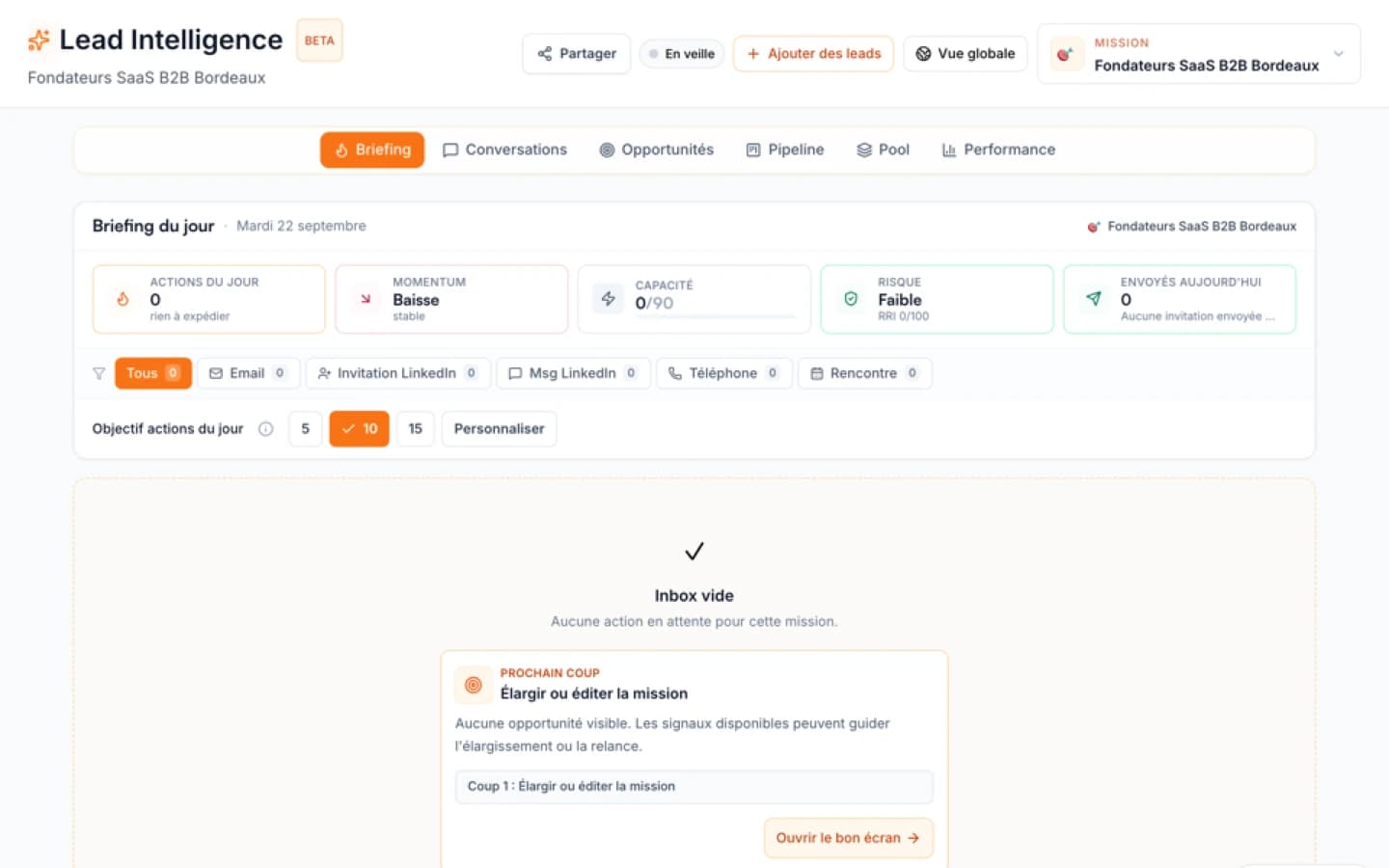
Week 1: write your ideal customer profile in two lines and pick the accounts that match it best. No minimum number of contacts is required to start: Lead Intelligence finds and prioritizes the contacts itself, whether the team starts with 10, 100 or 1,000 contacts. With usable targeting context, the first prioritized leads can appear in about 30 minutes.
Week 2: contact first the accounts that Lead Intelligence classifies as worth acting on, using the suggested channel and angle for each one, and keep every message specific to that account's situation.
Week 3: follow up, note which messages get replies, and move the accounts that stay silent to a watch list.
Week 4: review what worked, adjust your criteria and decide which accounts deserve more work. Lead Intelligence is not reserved for founders: it also fits sales teams like yours.
In practice, Lead Scoring for Small B2B Sales Teams Without a Marketing Team completes this framework with another angle on the same topic.
When to use this diagnosis
This diagnosis is designed for small business-to-business (B2B) sales teams that need to launch a structured 30-day cold outreach campaign but lack a dedicated marketing department or a specialized Sales Development Representative (SDR). In many early-stage companies, the responsibility of building a sales pipeline falls directly on the founders or a lean sales team. This raises critical strategic questions: how does a founder qualify B2B leads without a sales team, and who should an early-stage founder contact first?
When you are building a prospect list from scratch, running a high-volume outbound playbook is often a recipe for wasted budget. According to SalesHive, roughly 83% of reps miss quota each month under traditional volume-heavy setups, even though the benchmark for a productive outbound SDR is about 15 booked meetings per month with an 80% show rate. For teams with established operations, massive databases like Apollo or data orchestration platforms like Clay are excellent. Clay describes itself on its homepage as infrastructure to get any data, run agentic workflows and launch GTM plays. However, for a small team without dedicated operations support, managing these tools can become overwhelming. Research from Extrovert indicates that most B2B sales teams run four to six tools that do not talk to each other, often paying for overlapping features while still missing their pipeline targets.
You should run this outbound data diagnosis when you have an existing list of contacts or a connected platform but suspect your targeting is noisy, incomplete, or misaligned with your Ideal Customer Profile (ICP). To help lean teams identify these gaps before spending money on outreach, Ember offers a dedicated diagnostic capability within its Lead Intelligence module. It is not enabled by default. This provider Application Programming Interface (API) diagnostic uses read-only APIs to analyze a sample from Apollo, Lemlist, Clay, HubSpot, Salesforce, or Pipedrive, or a local Excel or Comma-Separated Values (CSV) file. The analysis identifies what data is missing from a sales decision, such as missing contact signals or unverified emails, without synchronizing any CRM. In file mode, the raw file and its rows do not leave your browser before you sign in.
When not to use it
When considering how a founder qualifies Business-to-Business (B2B) leads without a sales team, this lean, context-first approach is effective, but it is not universally applicable. There are distinct scenarios where a small team should avoid this 30-day outbound framework.
If you already have a dedicated SDR or an operations team running an outbound process that works, this guide adds little. If your ideal customer profile or your offer is still unclear, talk to customers first: an outbound cadence only amplifies that confusion. And if your pipeline already comes from inbound requests or referrals that you cannot follow up fast enough, fix that before opening a new channel. Ember publishes Lead Intelligence, so weigh this advice with that in mind.
Before deciding, How should a small B2B sales team build a repeatable lead generation system in 2026 without a marketing function or a dedicated SDR? helps connect this method with adjacent priorities.
Next step
To execute a structured cold outreach campaign without a dedicated Sales Development Representative (SDR) or a marketing team, business-to-business (B2B) sales teams must shift from high-volume noise to context-driven prioritization. Traditional high-volume outbound platforms often encourage sending thousands of generic emails, but this approach frequently leads to missed targets, with research indicating that roughly 83% of reps miss their quota each month as documented by SalesHive. Instead of trying to manage complex, disconnected tools, a small team can build a highly effective thirty-day outbound cadence by focusing on immediate, high-intent opportunities, making this streamlined approach to B2B prospecting essential for qualifying leads early, defining your ideal customer profile and building a prospect list from scratch, without depending on an expensive CRM or a complex scoring model.
Sources
This guide draws on public pages: SalesHive for SDR performance benchmarks, Extrovert for sales tool stacks, Xynario for building an outbound SDR team, and the homepages of Apollo and Clay. Ember publishes this guide and builds Lead Intelligence, described above.
Sources
FAQ
Free diagnostic
Test your sales file
Drop an Excel or CSV and check its readiness without sending its rows to Ember.