
Definition
For a small Business-to-Business (B2B) sales team operating without a marketing department or a dedicated Sales Development Representative (SDR), a repeatable lead generation system is a structured, automated workflow that identifies, enriches, and prioritizes high-value prospects without relying on inbound content or massive budgets. Instead of blasting generic lists, this system relies on precise lead qualification and contextual outreach to keep the Customer Relationship Management (CRM) sales pipeline healthy.
If you are wondering how does a founder qualify B2B leads without a sales team, the answer lies in shifting from volume-based prospecting to context-driven scoring. When deciding who should an early-stage founder contact first, the priority must always be companies exhibiting active buying signals rather than a random list built from scratch.
Traditional lead generation playbooks often assume a marketing team exists, but the reality for small teams is typically one or two reps, no content engine, and no events budget, A repeatable five-step system fits that reality better: monday.com describes in its B2B lead generation guide a process running from Ideal Customer Profile (ICP) definition to results measurement and optimization, through channel selection.
To place this decision in context, the Knowledge guides for sales bring together deeper guidance on the same field.
Prerequisites
Building a repeatable lead generation system in 2026 requires a shift in how small teams approach outbound sales for startups. Most traditional lead generation playbooks assume a dedicated marketing team exists to support the sales pipeline. However, the reality for many small businesses is a lean setup of one or two representatives, no content engine, and no events budget. To establish a consistent flow of opportunities without a dedicated Sales Development Representative (SDR) or a marketing function, sales teams must define a tight Ideal Customer Profile (ICP), pick a small number of channels, and industrialize a simple, repeatable qualification routine before adding more tools.
Steps
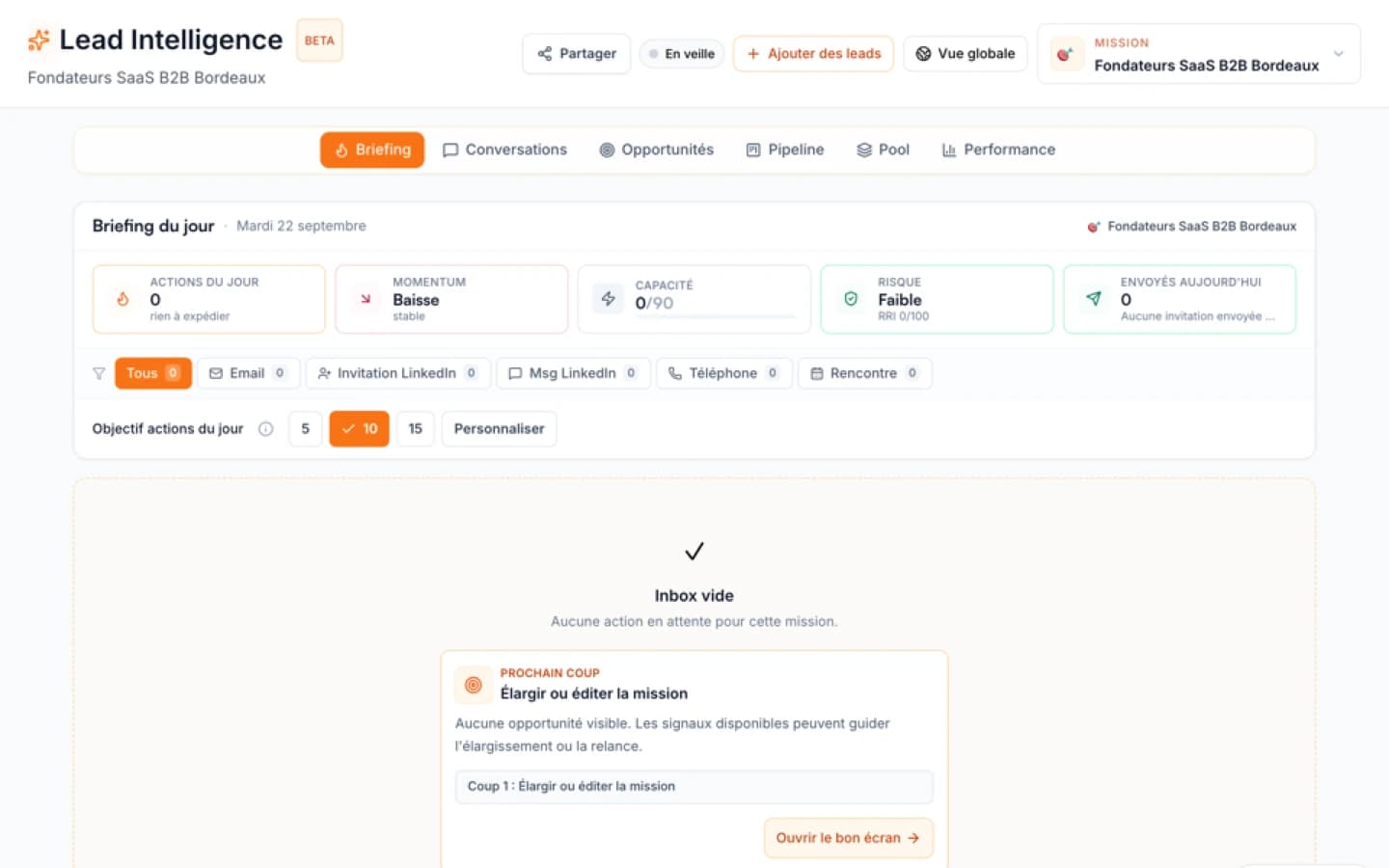
Credit-based pricing forces a team to measure every action. According to an analysis by Factors.ai, costs rise as you scale because usage-based limits bite. For a founder trying to qualify B2B leads without a sales team, this mechanism can quickly strain the budget. By contrast, Ember Lead Intelligence finds and prioritizes contacts itself, whether the team starts with a handful of contacts or several hundred, with no minimum contact threshold, as shown on the Ember Lead Intelligence page. This makes it possible to build a prospect list from scratch without wondering how many contacts you need to start, focusing instead on lead scoring and the sales pipeline. The question of who an early-stage founder should contact first then gets a practical answer: let the tool identify the most relevant profiles, with no volume constraint.
To explore this point further, Apollo vs Ember Lead Intelligence for Founder Conversion details a step directly related to this decision.
Worked example
To understand how this operates in practice, consider a small Business-to-Business (B2B) software firm with two sales representatives and no marketing budget. Instead of trying to execute dozens of complex campaigns, the team must focus on a lean, repeatable outbound sales for startups methodology. When building a prospect list from scratch, an early-stage founder often asks: who should I contact first? The answer lies in identifying high-intent accounts that match a tightly defined Ideal Customer Profile (ICP) rather than exporting thousands of unverified records. Traditional platforms focus heavily on volume-driven outbound sales. For instance, Apollo has built its platform to help teams automate massive sequences, and generated 150 million dollars in annual recurring revenue in 2025, according to Apollo. However, for a small team without a dedicated Sales Development Representative (SDR), managing thousands of automated emails quickly becomes overwhelming. Additionally, with credit-based pricing, costs rise as you scale because usage-based limits bite, according to an analysis by Factors.ai. For teams that want to build deep Go-To-Market (GTM) workflows, platforms like Clay offer data infrastructure, including an official LinkedIn Sales Navigator integration, as detailed on the Clay integration page. When resources are limited, the critical question becomes: how does a founder qualify B2B leads without a sales team? Instead of manual lead scoring or hiring an external agency, a small team can leverage Lead Intelligence from Ember. This capability allows the team to focus on lead qualification and b2b prospecting by analyzing signals directly from the project context. Whether the team starts with 10, 100, or 1,000 contacts, Lead Intelligence finds and prioritizes the contacts itself with no minimum contact threshold, as explained on the Ember Lead Intelligence page. This eliminates the noise of traditional cold outreach and ensures that the sales pipeline is populated only with accounts that show active, verifiable signals. In a typical workflow, the two reps begin by importing a small, highly targeted list of 100 contacts into their Customer Relationship Management (CRM) system. Rather than blasting these contacts with generic sequences, they use Lead Intelligence to determine who to contact first, why they should reach out now, and what specific angle to use. This system transforms outbound prospecting from a numbers game into a series of timely, highly relevant conversations. By focusing on how to qualify b2b leads early, the team maintains a healthy sales pipeline without the overhead of a marketing function or a dedicated SDR team, proving that precision beats volume every time.
Common mistakes
When small sales teams attempt to build a repeatable lead generation system, they frequently fall into predictable traps. The most common error is treating outbound sales for startups as a pure volume game, relying heavily on massive contact databases. Platforms like Apollo operate as a classic Business-to-Business (B2B) sales engagement platform where you build lists and sequence outreach. While this is highly effective for teams that already know their Ideal Customer Profile (ICP) cold, credit-based pricing turns every action into a metered decision. According to Factors.ai, costs rise as you scale because usage-based limits bite, and Coldreach lists tight pricing and credits that run out faster than expected among the common complaints about Apollo. This volume-first approach often leads to high activity but low conversion. Apollo generated 150 million dollars in annual recurring revenue in 2025, according to Apollo. However, a credit model tends to reward volume rather than outcomes: a team that sends a lot of emails uses more credits than one that targets precisely. For a small team without a dedicated Sales Development Representative (SDR) or a marketing function, managing this level of noise is unsustainable. Another critical mistake is overcomplicating lead qualification and lead scoring before establishing a baseline of traction. When considering how does a founder qualify B2B leads without a sales team, the answer lies in focusing on context over volume. Instead of building complex scoring matrices in a Customer Relationship Management (CRM) system, founders should look for immediate, actionable signals such as organizational changes or specific hiring patterns. Similarly, when deciding who should an early-stage founder contact first, the priority should always be high-intent prospects who match a tightly defined niche, rather than a broad, cold list. Starting with a massive, unverified list leads to high bounce rates and domain reputation damage. Finally, many small teams delay their b2b prospecting efforts because they believe they lack the scale to run a proper system. They assume that outbound sales require thousands of leads to be effective. In reality, a lean team can achieve significant results by focusing on highly personalized cold outreach to a small, curated group. Modern solutions like Lead Intelligence from Ember find and prioritize contacts directly, whether the team starts with 10, 100, or 1,000 contacts, with no minimum contact threshold as detailed on the Ember Lead Intelligence page. By avoiding the trap of artificial volume, small teams can maintain a healthy pipeline.
This approach also connects with Lead Intelligence Use Cases for Product-Market Fit, which clarifies the next choice.
Tools
To execute successful B2B prospecting and build a healthy sales pipeline without a dedicated marketing function, choosing the right technology stack is critical. Small sales teams must transition away from manual, disjointed workflows and adopt tools that streamline lead qualification and cold outreach.
For teams focused on volume-driven outbound sales for startups, Apollo serves as a unified Artificial Intelligence (AI) sales platform designed for modern sales and marketing teams to simplify their stack, manage their pipeline, and close deals, as stated on the Apollo website. With such a tool, a founder can qualify B2B leads from day one by defining their ICP and using an automated outbound platform, without needing a dedicated marketing team or Sales Development Representative (SDR).
When to use this method
This lean, repeatable outbound methodology is not a universal cure for every sales challenge, but it is highly effective under specific constraints. Sales teams should adopt this system when they must generate a predictable sales pipeline without the support of a dedicated marketing function or an army of Sales Development Representatives (SDRs). It is particularly vital during the early stages of a company when building a prospect list from scratch is the only way to initiate conversations.
If you are wondering who should an early-stage founder contact first, the answer lies in targeting high-intent decision-makers who match your Ideal Customer Profile (ICP) and exhibit immediate, observable pain points. Instead of blasting a massive database, founders must focus on precision. This approach answers a critical operational question: how does a founder qualify B2B leads without a sales team? By shifting from volume-based cold outreach to context-driven lead qualification, you can run a highly efficient process directly from your Customer Relationship Management (CRM) system.
This method is ideal when you need to understand how to qualify b2b leads early before committing budget to expensive, complex marketing campaigns. Traditional playbooks often assume a marketing team exists to feed the pipeline. For small teams, relying on bloated databases with credit-based pricing can push costs up as volume grows, as Factors.ai points out.
Instead of wasting resources on unverified lists, this system is best deployed when your primary goal is to establish a sustainable B2B prospecting rhythm. By using intelligent lead scoring based on real-time company signals rather than arbitrary volume, small teams can protect their time and focus only on the accounts most likely to convert. For instance, Ember Lead Intelligence helps small teams identify and prioritize opportunities directly, whether they start with 10, 100, or 1,000 contacts, with no minimum contact threshold required to see value, as detailed on the Ember Lead Intelligence page. This makes the method perfect for lean teams that need to maximize the impact of every single interaction in their outbound sales for startups.
In practice, Who to Contact for Product-Market Fit as a Founder completes this framework with another angle on the same topic.
When not to use it
This lean, highly targeted system is not a universal solution for every Business-to-Business (B2B) company. There are distinct scenarios where attempting to build a repeatable, low-volume outbound sales for startups system without a dedicated Sales Development Representative (SDR) or marketing function will fail to deliver results.
First, this approach is ineffective if your product or service has a low average contract value. When the lifetime value of a customer is too small, the unit economics of personalized B2B prospecting and manual lead qualification do not support the effort. If your business model relies on high-volume, low-ticket transactions, you require a broad-reach marketing engine or a massive, automated database. For example, a classic sales engagement platform like Apollo is built specifically for that high-volume use case, backed by a team able to feed massive sequences, which does not match the reality of a small team without a dedicated SDR or marketing function.
Action plan
Most traditional lead generation playbooks assume a marketing team exists to feed the sales pipeline, which is rarely the case for small teams or early-stage startups. monday.com's guide on B2B sales lead generation lays out a five-step process, from Ideal Customer Profile (ICP) definition to measuring and optimizing performance, through channel selection. A small team with one or two reps, no content engine, and no events budget can draw on it to run efficient cold outreach without a dedicated Sales Development Representative (SDR).
To address how a founder qualifies B2B leads without a sales team, the priority is to build a prospect list from scratch by first targeting the most relevant contacts. The founder should define their own ICP, identify the first decision-makers to approach, and structure a simple outreach sequence before considering a scoring tool or a CRM. The goal is to validate market hypotheses quickly with a limited volume of prospects, without waiting for a complete marketing infrastructure.
Before deciding, Who to Contact for Product-Market Fit as a Founder helps connect this method with adjacent priorities.
Sources and methodology
This analysis is grounded in real-world sales data and established industry methodologies to help small and medium-sized enterprise (SME) sales teams build repeatable pipelines. We began by examining the strategic framework for Business-to-Business (B2B) sales lead generation outlined by monday.com, which describes a five-step lead generation process running from defining the ideal customer profile to measuring and optimizing performance. To compare tooling options, we analyzed the workflow and pricing models of leading platforms. For instance, we reviewed how Apollo operates as a volume-oriented platform that generated 150 million dollars in annual recurring revenue in 2025, according to data from Apollo. We also evaluated the common friction points associated with credit-based pricing models, where Factors.ai notes that costs rise with volume and Coldreach lists tight pricing and credits among the common complaints about Apollo. These sources help clarify who a founder or Revenue Operations (RevOps) manager should target first and how to qualify B2B leads early without wasting budget. Additionally, we looked at how modern go-to-market (GTM) platforms like Clay integrate with external data sources, such as their official LinkedIn Sales Navigator integration detailed on Clay's integration page, to understand how teams build prospect lists from scratch. Finally, we contrasted these volume-heavy databases with the agentic approach of Ember. As shown in the Ember Lead Intelligence capabilities, the system finds and prioritizes contacts whether a sales team starts with 10, 100, or 1,000 contacts, completely removing the need for a minimum contact threshold or complex manual list building in your Customer Relationship Management (CRM) system.
The Ember capabilities cited in this article describe what Lead Intelligence does today. Claims about Apollo, Clay, and the other tools come from the public pages cited above.
Sources
FAQ
Free diagnostic
Test your sales file
Drop an Excel or CSV and check its readiness without sending its rows to Ember.