
Symptom or signal
The transition from product builder to active seller is the most jarring pivot a solo Business-to-Business (B2B) founder must make. You have spent weeks or months refining the code, polishing the interface, and talking to friends who nod politely out of courtesy. Yet, the moment you open your laptop to launch, you are met with a quiet reality: you have no email list, no brand authority, and no incoming leads.
When you are a solo founder starting with 0 customers, the gap between building a product and securing your first 10 clients can feel insurmountable, a common pain point highlighted in community discussions on Reddit. The temptation is to resort to passive tactics like publishing blog posts or tweaking landing page copy, hoping someone will stumble upon your site. In reality, these efforts rarely yield immediate results for early stage Software as a Service (SaaS) projects. Getting to your first 100 customers is rarely just a marketing or product problem, but rather a test of patience and direct execution, as discussed by practitioners analyzing early growth strategies on Floatboat.
The core signal that your approach needs to change is the realization that generic, high volume marketing playbooks do not work for a team of one. Without an existing audience, your primary challenge is not scaling a broad message, but finding the exact individuals who suffer from the specific pain your product solves today. Staring at a blank database and waiting for signups is a clear symptom that you are treating a direct sales challenge as a passive marketing exercise.
To place this decision in context, the Knowledge guides for sales brings together deeper guidance on the same field.
What changed
You are met with a silent inbox and the realization that traditional marketing playbooks do not fit your reality.
The Business-to-Business (B2B) customer acquisition landscape has shifted dramatically. Historically, founders believed that launching required a massive list and automated email sequences. Today, according to practitioner feedback shared on Reddit, getting those first 10 customers requires unscalable, highly manual, and deeply personalized outreach rather than automated volume. This shift is as much psychological as it is tactical. As highlighted on floatboat.ai, getting your first 100 customers is not primarily a marketing or product problem, but a patience and ego challenge that requires doing direct, manual work.
At the same time, the tooling ecosystem has bifurcated. For teams with the technical bandwidth to design and maintain complex workflows, platforms like Clay are well suited for Revenue Operations (RevOps) and growth teams that want to combine multiple data sources and write custom enrichment logic, as discussed by Derrick App. Meanwhile, traditional databases like Apollo offer structured plans, ranging from a Free plan at USD 0 that provides 75 credits per seat per month on monthly billing to their Professional plan at USD 99 per seat per month on monthly billing, according to the Apollo Pricing Page.
However, solo founders rarely have the time to manage complex data pipelines or spend hours filtering through thousands of cold profiles. The real change lies in moving away from sheer volume toward immediate, contextual priority. Instead of spending days configuring databases, modern tools allow solo founders to leverage their existing business context to surface prioritized opportunities. For instance, with a usable targeting context, the first prioritized leads can appear quickly.
Facts and sources
When using Lead Intelligence, if a founder has a usable targeting context, the first prioritized leads can appear quickly, as detailed on the Ember Lead Intelligence page.
To explore this point further, What does a realistic 30-day B2B outbound pipeline look like for a small team with no brand and no list: and which activities actually produce meetings? details a step directly related to this decision.
Why the common explanation is incomplete
The standard playbook for Business-to-Business (B2B) customer acquisition assumes you already have resources, data, and market validation. It tells you to buy massive lists, set up complex sequencing tools, and automate your outreach from day one. This advice is incomplete because it mistakes a search for product-market fit for a pure distribution problem.
For established companies, traditional platforms work well. For instance, Apollo operates as a classic B2B sales engagement platform that is highly effective for teams that already know their Ideal Customer Profile (ICP) cold. Similarly, Clay is an excellent tool for growth teams that want to combine multiple data sources and write custom enrichment logic, provided they have the technical bandwidth to design and maintain those workflows, as highlighted by Derrick App.
However, as a solo founder starting with 0 customers and trying to find your first 10, as discussed in community discussions on Reddit, these high-volume or highly complex setups create more noise than clarity. Reaching your first 100 customers is not primarily a marketing or product problem, but rather a patience and ego challenge where the initial work simply does not scale, as explained by Floatboat. When you automate too early, you end up scaling a message that does not resonate to an audience you do not yet fully understand.
Instead of building complex data pipelines, solo founders need to focus on immediate, high-intent conversations. This requires a shift from volume to precision. When you begin with a clear, usable targeting context, the first prioritized leads can appear quickly, as shown on the Ember Lead Intelligence page. This allows you to spend your limited time talking to the right people instead of managing databases.
The real problem
The core challenge for solo founders is the transition from builder to seller. When you have no existing list, the natural temptation is to look at established sales technology stacks. You might look at Apollo, which operates as a classic Business-to-Business (B2B) sales engagement platform where you define your Ideal Customer Profile (ICP), build lists from a massive contact database, and sequence outreach. Alternatively, you might consider Clay, which is highly effective for revenue operations teams that want to combine multiple data sources and write custom enrichment logic, but requires significant technical bandwidth to design and maintain those workflows, as explained on Derrick App.
However, these volume-oriented and highly technical approaches are designed for established teams with validated messages. For a solo founder starting with 0 customers, trying to run these complex systems usually results in wasted effort, whereas securing your first 10 clients requires doing unscalable, deeply personalized work, according to real-world experiences shared by founders on Reddit.
The real problem is not a lack of tools, but a mismatch of strategy. As Nova points out on Floatboat, getting your first 100 customers is not primarily a marketing or product problem,
This approach also connects with Which reference data helps a pre-seed startup founder decide who to contact, why now, and with what message?, which clarifies the next choice.
How the mechanism works
The mechanism of acquiring early customers without an existing list relies on turning raw market signals into highly personalized conversations. For teams with dedicated technical resources, platforms like Clay are excellent for combining multiple data sources, writing custom enrichment logic, and pushing results into an existing software stack. As discussed in the review of Clay alternatives on Derrick-App, this approach works well if you have the technical bandwidth to design and maintain complex workflows. However, solo founders rarely have the time to act as database administrators. They need a mechanism that bypasses setup complexity and delivers immediate, actionable starting points.
This is where a context-driven approach changes the dynamic. Instead of building a massive database, the mechanism starts with the founder's strategic context: their specific offer, their target audience, and their positioning. Lead Intelligence uses this context to search for accounts and detect relevant signals across people and companies. Because the search is guided by strategy rather than generic keywords, it eliminates the noise of traditional list-building. When a founder has a usable targeting context, the first prioritized leads can appear quickly, as shown on the Ember Lead Intelligence page.
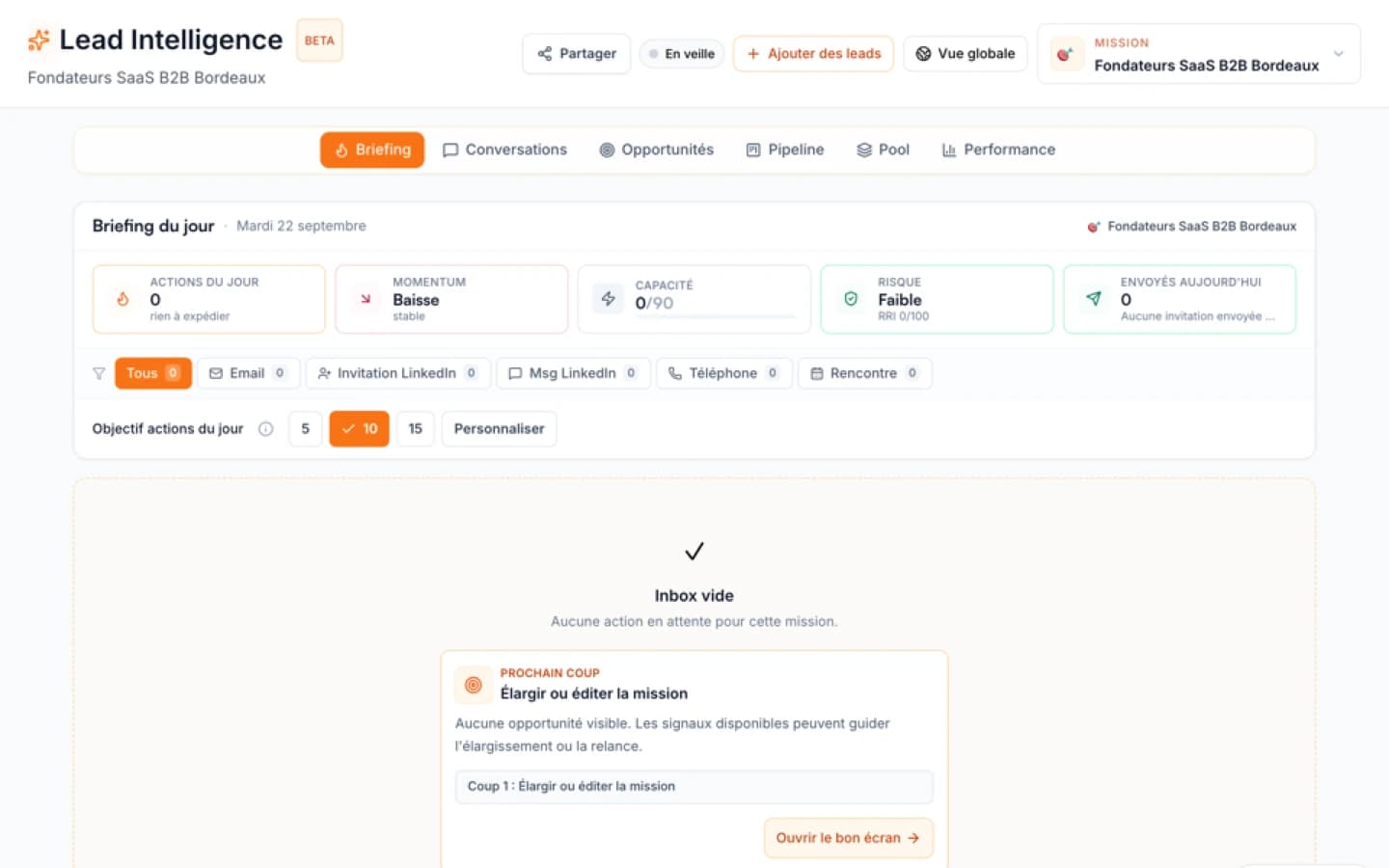
Once these signals are identified, the mechanism translates them into a clear next action. This means the founder does not just get a list of names, but a specific recommendation on who to contact, why the timing is right, which channel to use, and what angle to take. According to practitioner feedback on Reddit, solo founders starting with 0 customers succeed when they treat early outreach as a manual, relationship-driven learning process to secure their first 10 clients. By focusing on high-relevance signals, founders can initiate these conversations with genuine context. After the outreach mission, the system displays the contacts analyzed, signals detected, and priority actions actually recorded, as detailed on the Ember Lead Intelligence page. This clear visibility ensures the founder can immediately see the value produced and focus their limited hours on the conversations most likely to convert.
Concrete examples
To understand how solo founders successfully navigate this initial phase, we can look at real-world strategies that bypass traditional, high-volume marketing. According to practitioner testimonies shared on Reddit, solo founders starting with 0 customers often secure their first 10 clients by engaging directly in niche online communities, answering specific technical questions, and offering direct help before ever pitching a product. This hands-on approach shifts the focus from selling to solving.
This community-first approach is echoed by industry guides. Insights from the Floatboat blog suggest that acquiring your first 100 customers as a solo founder is less of a marketing or product problem and more of a patience challenge, requiring you to do the unscalable work that automated systems cannot replicate. Instead of relying on broad, impersonal email sequences, successful solo founders identify specific individuals who are actively feeling the pain their product addresses.
For founders who want to transition from manual searching to structured outreach without losing this highly personalized touch, modern tools offer alternative paths. While platforms like Apollo operate as classic Business-to-Business (B2B) sales engagement platforms focused on volume, they often require an established Ideal Customer Profile (ICP) to be effective. Alternatively, platforms like Clay are highly suited for growth teams that want to combine multiple data sources and write custom enrichment logic, as discussed on Derrick App, though they require the technical bandwidth to design and maintain those complex workflows.
Ember provides a different path by focusing on immediate, context-driven action. Through Lead Intelligence, founders can run targeted sales missions that prioritize opportunities based on actual buying signals rather than sheer volume. When a founder provides a usable targeting context, the first prioritized leads can appear quickly, as documented on the Ember Lead Intelligence page. After running a mission, the platform clearly displays the contacts analysed, signals detected, and priority actions actually recorded, making the initial value of the outreach immediately visible to the founder. This allows solo entrepreneurs to maintain a highly personalized, signal-based approach to acquiring their first customers without getting bogged down in complex database management.
In practice, Which signals should alert a traction-stage startup founder? completes this framework with another angle on the same topic.
When to use this diagnosis
This diagnosis is specifically designed for solo founders who find themselves with a completed product or service but no audience to sell it to. It is highly relevant when you are tempted to invest in expensive sales engagement platforms but realize that credit-based pricing models can quickly penalize early-stage experimentation by charging for every single export and verification, as noted on Coldreach. Instead of building massive, unverified lists, this playbook should be used when your goal is to find your very first customers through highly targeted, signal-based outreach.
According to real-world discussions on Reddit, solo founders who start with zero customers find the most success by focusing on manual, high-conviction interactions rather than automated spam. This signal-first approach is also critical when you want to avoid the common trap where getting to your first 100 customers becomes an ego and patience problem rather than a product problem, a challenge highlighted by experienced founders on Floatboat.
You should apply this framework when you need to see immediate, actionable results without spending weeks on technical setup. For instance, by leveraging Ember and its Lead Intelligence capability, you can bypass complex data engineering. When you have a usable targeting context, the first prioritized leads can appear quickly, as documented on the Ember Lead Intelligence page. This allows you to focus entirely on starting conversations rather than managing databases.
When not to use it
This highly targeted, manual approach to securing your first customers is not a universal solution for every stage of business growth. If you already have a validated, repeatable sales playbook and a clearly defined Ideal Customer Profile (ICP), you may be better served by high-volume outbound platforms. For instance, Apollo operates as a classic Business-to-Business (B2B) sales engagement platform where you build large lists from a contact database and sequence outreach, which is highly effective for teams that already know their target market cold.
Similarly, if your team has the technical bandwidth to design and maintain complex data pipelines, you might require a more customizable tool. Platforms like Clay are excellent for revenue operations and growth teams that want to combine multiple data sources, write custom enrichment logic, and push results into their existing software stack, according to analysis on Derrick App. If you want to orchestrate these intricate enrichment steps yourself, a specialized data builder is the correct choice.
Additionally, if your primary goal is to scale rapidly past your first 100 customers using broad marketing channels rather than unearthing individual high-intent signals, the playbooks discussed on Floatboat suggest transitioning to volume-based strategies.
Ember is not built for unguided, high-volume spamming or complex database engineering. Instead, it is designed to help you focus on the opportunities that deserve action right now. Through Lead Intelligence, you can see your first prioritized leads quickly once you have a usable targeting context, as explained on the Ember Lead Intelligence page. The platform makes the actual value of your sales mission visible by showing you the contacts analysed, signals detected, and priority actions actually recorded. If you prefer to manage raw data enrichment yourself or rely on mass credit-based exports, traditional volume-oriented platforms remain the better fit for your workflow.
Before deciding, Apollo vs Ember Lead Intelligence for Founder Conversion helps connect this method with adjacent priorities.
Next step
To move from theory to execution, your immediate next step is to transition from passive preparation to active, context-driven outreach. For a solo founder starting with 0 customers, finding what actually worked to secure those initial accounts is the first critical hurdle, as discussed in community testimonies on Reddit. According to these discussions on Reddit, solo founders often share what actually worked to get their first 10 customers when starting from scratch. This phase requires direct, unscalable conversations rather than complex automated systems. Indeed, getting your first 100 customers as a solo founder requires a completely different playbook than most generic guides suggest, according to insights from Floatboat.
While larger revenue operations and growth teams with dedicated technical resources might prefer platforms like Clay to combine multiple data sources, write custom enrichment logic, and push results into their existing stack, as noted in the tool analysis on Derrick App, solo founders rarely have the bandwidth to design and maintain those complex workflows. Instead, you need a system that minimizes setup overhead and immediately points you toward high-priority conversations.
This is where Ember's Lead Intelligence helps you focus. By reusing your core business context, it reduces the noise of outbound sales and proposes the next action and channel that fit each lead's specific situation. It makes the value actually produced by your prospecting mission visible by showing you the contacts analyzed, the signals detected, and the priority actions recorded. With usable targeting context, the first prioritized leads can appear quickly, as detailed on the Ember Lead Intelligence page. Your next move is to define your initial Ideal Customer Profile (ICP) within Ember, run a highly targeted prospecting mission, and let the system surface the exact people you should contact, why you should reach out now, and which angle to use.
Sources and methodology
To provide solo Business to Business (B2B) founders with practical, unvarnished insights, this article relies on direct practitioner experiences rather than theoretical growth frameworks. We focused our research on real world discussions where founders share their actual struggles and breakthroughs. Specifically, we analyzed community discussions regarding a solo founder starting with 0 customers and what actually worked to secure their first 10 accounts, as documented on Reddit. To complement these community testimonies, we also evaluated structured playbooks on how to get your first 100 customers as a solo founder, published by Floatboat.
Sources
FAQ
Free diagnostic
Test your sales file
Drop an Excel or CSV and check its readiness without sending its rows to Ember.