
Definition
For early-stage founders, securing the first 100 customers, as outlined by the Forbes Business Council, starts with the relationships you have already built: before investing in ads, SEO or large-scale marketing experiments, a personal network can be an early source of feedback, referrals and first sales. This milestone represents the critical shift from proving a basic product concept to establishing a repeatable sales motion. During this initial phase, founders often struggle because they attempt to automate their outreach too early instead of doing the unscalable work required to understand their buyers, a common pitfall highlighted in the Entrepreneurship Handbook regarding the acquisition of your first 100 customers.
To cross this threshold, founders must define a highly specific Ideal Customer Profile (ICP) and engage in direct, personalized conversations. Rather than relying on massive, noisy databases that prioritize volume over relevance, early-stage teams need to identify high-intent signals that indicate a prospect is ready to talk. This requires moving away from generic, automated sequences and focusing on high-conviction opportunities where the product can deliver immediate, observable value.
To place this decision in context, the Knowledge guides for sales brings together deeper guidance on the same field.
Prerequisites
Before reaching out to prospects, early-stage founders must establish a few critical prerequisites. The most common pitfall is rushing into broad outreach without a validated Ideal Customer Profile (ICP). As highlighted in the Entrepreneurship Handbook, founders trying to secure their first 100 customers often struggle because they do the exact opposite of what actually works, which is starting with highly targeted, manual relationships rather than premature automation.
Another prerequisite is having a clear mechanism to identify which prospects are actually ready to engage. Traditional Business-to-Business (B2B) sales engagement platforms like Apollo, which reported 150 million dollars in annual recurring revenue in 2025, with a 1.6 billion dollar valuation and about 250 million dollars in total funding according to Apollo (company history and Series D announcement), rely heavily on a high-volume credit model. However, for an early-stage startup, success depends on reducing noise and focusing attention on opportunities that deserve action now.
To execute this successfully, founders need access to usable targeting context. When this context is properly defined, prioritized leads can be identified quickly. For instance, with Ember, the first prioritized leads can appear in about 30 minutes. This allows founders to move forward with a clear next action, knowing exactly who to contact, why now, which channel to use, and which angle to take.
Steps
To acquire your first 100 customers, as outlined by the Forbes Business Council, founders must transition from random acts of marketing to a structured sequence. This journey requires moving from manual, high-touch learning to smart, context-driven prioritization.
First, founders must engage directly with their target market to gather qualitative feedback. According to Reddit discussions among early-stage entrepreneurs, the earliest leads are often generated through unscalable, manual outreach in niche communities, forums, and direct networks. This initial phase is not about automation, but about understanding the precise language prospects use to describe their pain points.
Second, founders need to refine their positioning based on these early conversations. Rushing to scale outreach too quickly is a common trap. As highlighted in the Entrepreneurship Handbook, founders often struggle because they attempt broad marketing strategies instead of focusing on the specific, immediate needs of a narrow group of users.
Third, once the ideal customer profile is validated, founders should shift from manual searching to structured lead prioritization. Many teams default to high-volume databases to build lists. While massive platforms like Apollo have built large businesses, reporting 150 million dollars in annual recurring revenue in 2025 according to Apollo, their volume-heavy credit model can create excessive noise for early-stage budgets and lead to generic, low-conversion campaigns.
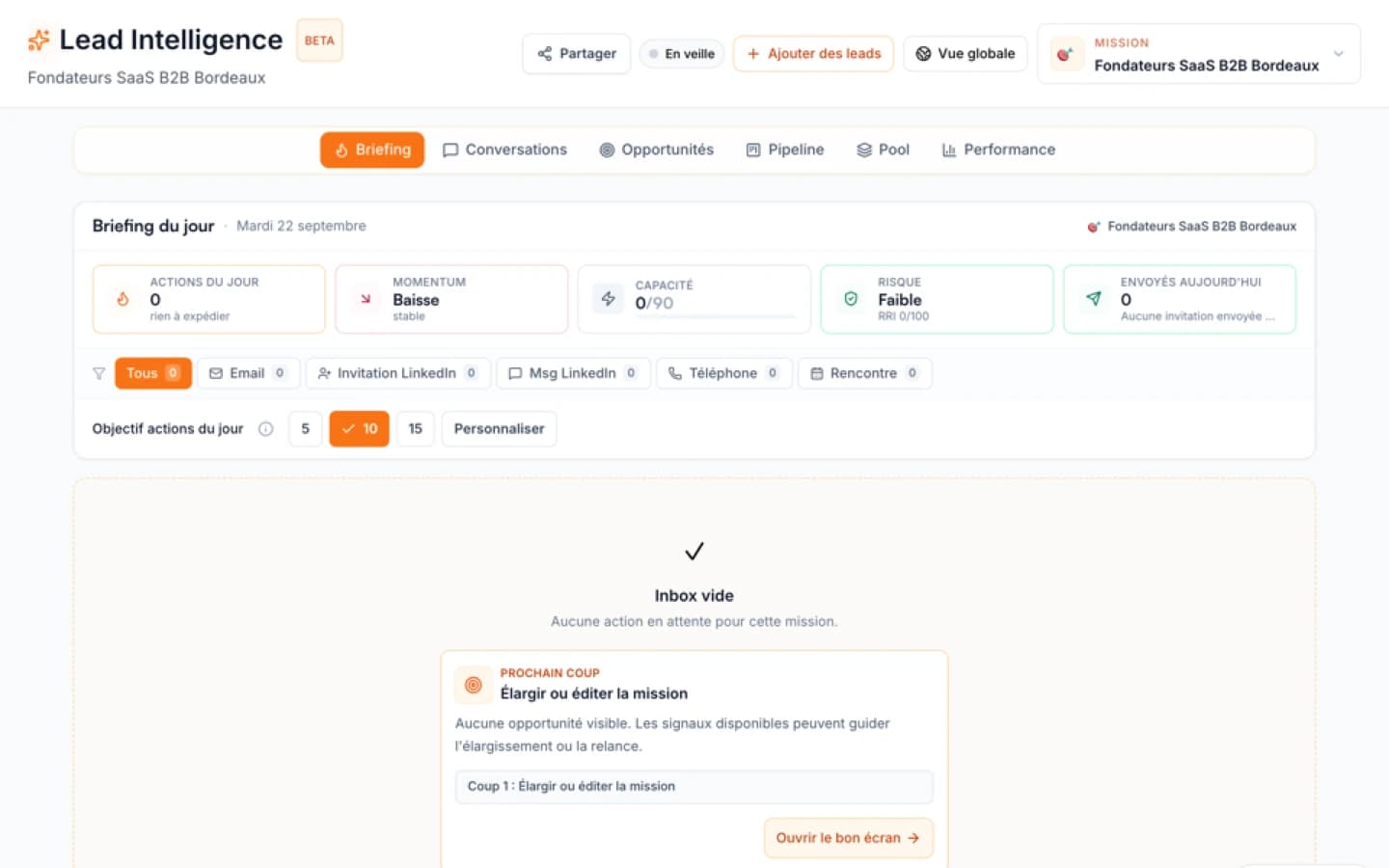
Instead of chasing volume, founders can leverage tools that prioritize opportunities based on actual context and intent signals. With Ember and its Lead Intelligence capability, founders can avoid the noise of generic databases. When you have a usable targeting context, the first prioritized leads can appear in about 30 minutes. This approach makes the first value actually produced by your sales mission visible, allowing you to see the exact contacts analyzed, signals detected, and priority actions required to secure those critical early accounts.
To explore this point further, Apollo vs Ember Lead Intelligence for Founder Conversion details a step directly related to this decision.
Worked example
To illustrate this in practice, consider a business to business (B2B) software startup attempting to secure its first 100 customers, a milestone that requires moving away from generic outreach as outlined by the Forbes Business Council. Instead of blasting a generic list, the founder must identify high-intent signals. For teams that already know their ideal customer profile (ICP) cold and have the budget for high-volume campaigns, traditional platforms are highly effective, which is why Apollo reported $150 million in annual recurring revenue in 2025, with a $1.6 billion valuation and about $250 million in total funding, as documented by Apollo (company history and Series D announcement).
However, early-stage startups often need to avoid the noise and high costs of unguided volume. This is where the Lead Intelligence capability in Ember changes the approach. By focusing on specific buyer signals rather than raw database size, founders can pinpoint exactly who to contact. When you configure your targeting, the first prioritized leads can appear in about 30 minutes. This workflow reduces noise by focusing attention on opportunities that deserve action now, providing a clear next action that details who to contact, why now, which channel to use, and which angle to take. Rather than guessing which tactics are working, the system makes the first value actually produced by the mission visible by displaying the contacts analysed, signals detected, and priority actions. This structured, signal-led execution prevents the common pitfalls where founders do the exact opposite of what actually works, a frustration documented in the Entrepreneurship Handbook when trying to acquire your first 100 customers.
Common mistakes
Many early-stage founders fail to secure their first 100 customers because they fall into predictable traps, often doing the exact opposite of what actually works at the beginning of a company's life, as discussed in the Entrepreneurship Handbook. A primary mistake is trying to scale outreach before establishing a clear, validated Ideal Customer Profile (ICP). When founders do not know exactly who they are targeting, they resort to generic messaging that fails to resonate with anyone, wasting precious time and resources on broad, ineffective campaigns.
Another frequent error is treating early-stage customer acquisition as a volume exercise rather than a learning process: each conversation should feed the next targeting and message.
This approach also connects with What to Look For When Hiring a B2B Lead Generation Agency in 2026?, which clarifies the next choice.
Tools
To successfully navigate the transition from initial strategy to execution, founders must choose the right software stack. Traditional business-to-business (B2B) sales engagement platforms like Apollo are highly effective for established teams. If a startup already knows its ideal customer profile (ICP) cold and wants to execute a volume-oriented outreach strategy, Apollo is an excellent choice. The commercial success of this credit-based model is clear, as Apollo reported $150 million in annual recurring revenue in 2025, with a $1.6 billion valuation and about $250 million in total funding, according to data from Apollo (company history and Series D announcement).
However, for early-stage founders who are still validating their market fit, a pure volume play often leads to high noise and wasted effort. Instead of exporting thousands of cold contacts, early-stage teams need to identify which opportunities deserve immediate action. This is where Ember's Lead Intelligence provides a different approach. Rather than relying on massive database exports, Lead Intelligence helps founders prioritize conversations based on context and active signals. With usable targeting context, the first prioritized leads can appear in about 30 minutes. This approach makes the first value actually produced by the mission visible by showing the contacts analyzed, signals detected, and priority actions. By focusing on high-intent signals rather than raw database volume, founders can secure their first 100 customers through meaningful, timely conversations rather than generic spam, as highlighted by the Forbes Business Council.
When to use this method
When early-stage founders are working to secure their first 100 customers, a milestone that requires moving away from generic outreach as outlined by the Forbes Business Council, they must transition from random marketing acts to a highly structured sequence. This method is most effective when a startup needs to move past founder-led sales from personal networks and begin building a repeatable, scalable pipeline. At this stage, broad campaigns fail because the product-market fit is still being refined, making precision far more valuable than sheer volume.
This signal-based approach is particularly necessary when traditional, credit-heavy database tools are a poor fit for your budget and workflow. While established sales teams might leverage massive database platforms like Apollo, which boasts a 1.6 billion dollar valuation according to Apollo, this volume-heavy model is rarely suitable for early-stage startups. Credit-based pricing models turn every search, export, and email verification into a metered expense. For a founder still validating their Ideal Customer Profile (ICP), this structure penalizes the natural experimentation required to find those initial buyers. You should use a signal-based method when your budget demands precision over wasted, expensive exports.
This method is also critical when you cannot afford to wait days or weeks to see if an outreach campaign is working. In the early days of a company, momentum is everything. Founders need to know exactly who to contact, why they should reach out right now, and what specific angle to use.
This is where Ember shifts the paradigm.
In practice, What Evidence Should a B2B Founder Verify Before Choosing Lead Intelligence over High-Volume Prospecting? completes this framework with another angle on the same topic.
When not to use it
High-volume, credit-based outreach is not suitable when an early-stage founder has not yet clearly defined and validated their ideal customer profile (ICP). Attempting to blast a massive database without a precise targeting strategy leads to wasted capital and high bounce rates. This is particularly true for startups operating on tight budgets where predictable expenses are critical.
While Apollo reported $150 million in annual recurring revenue in 2025, with a $1.6 billion valuation and about $250 million in total funding according to Apollo (company history and Series D announcement), this massive scale is built on a volume-oriented engine. For early-stage founders, the tradeoff of this model is that credit-based pricing turns every action into a metered decision, where exporting contacts, enriching records, and verifying emails each consume credits, compounding costs when scaling outreach. Apollo's pricing page states that export credits are consumed whenever a contact is exported outside Apollo.
If your business-to-business (B2B) startup requires deep context and immediate relevance rather than sheer volume, a credit-heavy database is the wrong choice. Instead of paying for wasted exports and managing complex lists, founders benefit from starting with high-intent signals. For example, with usable targeting context, the first prioritized leads can appear in about 30 minutes. This allows teams to focus on immediate opportunities that deserve action now, making the first value actually produced by the mission visible through analyzed contacts and detected signals without consuming restrictive credit budgets.
Action plan
To successfully secure your first 100 customers, you must shift from broad, unfocused marketing to highly targeted, direct engagement as detailed by the Forbes Business Council. This process begins by structuring your core business assumptions, validating your target market, and aligning your commercial strategy. Through the Fund Your Growth capability, Ember connects decisions to an action plan and items to validate, so that your initial growth strategy rests on evidence rather than mere assumptions.
Before deciding, How to Find Clients Quickly as an Early-Stage Founder? helps connect this method with adjacent priorities.
Sources and methodology
This guide is built on a rigorous synthesis of articles, market data and founder accounts. To understand the foundational steps of early-stage growth, this methodology incorporates structured strategies for acquiring your first 100 customers as detailed by the Forbes Business Council. Additionally, we analyzed tactical errors made by early-stage founders, such as those discussed in the Entrepreneurship Handbook. We also examined peer-to-peer discussions among early-stage founders sharing their direct experiences on how they secured their first 100 leads on Reddit.
Sources
FAQ
Free diagnostic
Test your sales file
Drop an Excel or CSV and check its readiness without sending its rows to Ember.