
Claim to verify
In the early stages of building a business, founders must establish a repeatable sales process, a phase commonly known as founder-led sales source. During this transition, many teams assume that the fastest way to generate pipeline is to acquire a massive database of contacts and launch automated email sequences source.
Traditional sales engagement and prospecting platforms, such as Apollo.io, have built large businesses on this premise. These platforms claim that scaling cold outreach across thousands of contacts is the optimal path to growth source.
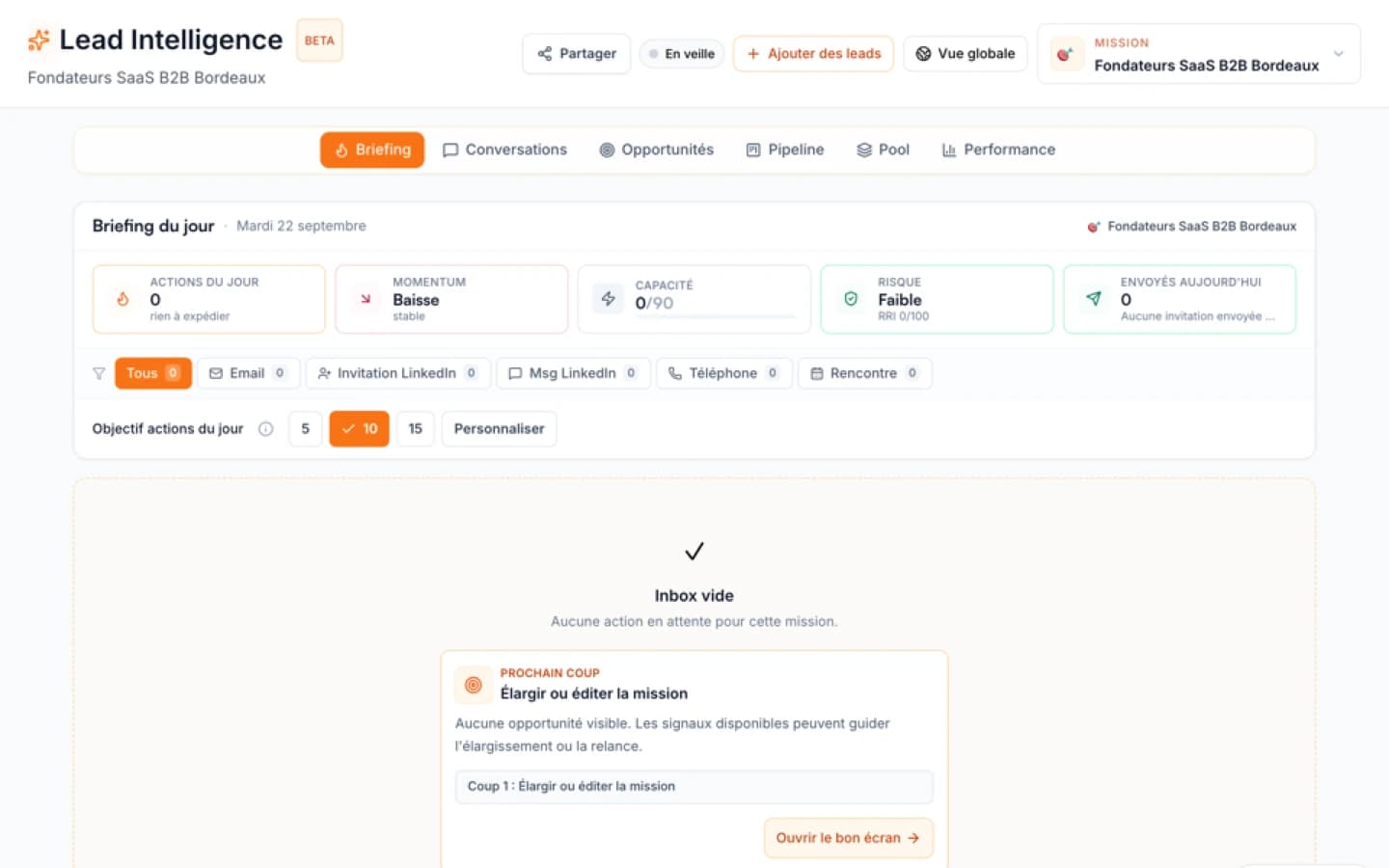
However, the core claim we need to verify is whether high-volume prospecting actually serves a lean sales team, or if a context-driven approach like Ember Lead Intelligence, which claims to reduce noise by focusing attention on opportunities that deserve action now, is more effective for converting high-value accounts.
To place this decision in context, the Knowledge guides for sales bring together deeper guidance on the same field.
Methodology
To evaluate these claims, we analyze the operational models, pricing structures, and daily workflows of two distinct categories of Go-To-Market (GTM) tools:
- High-Volume Prospecting Databases: Platforms that aggregate large Business-to-Business (B2B) contact databases and automate multi-step outbound campaigns source.
- Context-Driven Lead Intelligence: Agentic workflows, such as Ember, that research, analyze, and turn available business context into prioritized sales actions.
We examine how these tools handle data enrichment, lead prioritization, and workflow execution, specifically focusing on the friction points experienced by founders and sales teams.
To explore this point further, Clay vs Ember: when each one fits details a step directly related to this decision.
Evidence
Traditional platforms rely heavily on credit-based pricing models, where credits are consumed for actions like email verification, mobile number reveals, and export operations source. This model turns every prospecting action into a metered decision, which can cause costs to compound unpredictably as a sales team scales source. Furthermore, these platforms typically require the sales team to define their Ideal Customer Profile (ICP) and manually build and filter lists.
On the other hand, data orchestration platforms like Clay offer extensive enrichment capabilities source. While highly flexible, they require significant technical bandwidth to design and maintain custom enrichment workflows source.
Ember Lead Intelligence takes a different approach by reusing your existing Ember Business Plan, ICP, offer, and strategy to prepare a sales mission. Instead of requiring complex setup or credit management, it finds accounts from your mission ICP and signals, then verifies useful sources automatically.
Demonstration and examples
Consider an illustrative scenario: a B2B sales team trying to prioritize 100 target accounts.
In a traditional database, the team must manually apply filters, export the contacts, and place them into a generic email template. The system does not tell them which of those 100 accounts is most likely to buy today.
With Ember Lead Intelligence, the workflow is entirely context-driven:
- No Minimum Threshold: The system finds and prioritizes the contacts itself, whether the team starts with 10, 100, or 1,000 contacts.
- Explainable Priority: It classifies accounts into explained opportunities to watch, act on, or set aside.
- Actionable Angles: It proposes the next action and channel that fit the specific lead situation, answering the critical question: who should I contact, why now, and with which message?
This approach also connects with What Signals Actually Tell You a B2B Prospect Is Worth Contacting Now?, which clarifies the next choice.
Observed results
When evaluating Lead Intelligence, the speed and visibility of value are critical metrics for a sales team:
- Rapid Insights: With usable targeting context, the first prioritized leads can appear in about 30 minutes.
- Measurable Value: After a mission, Ember shows the exact contacts analyzed, signals detected, and priority actions actually recorded.
- Continuous Learning: The platform connects executed actions, replies, meetings, and outcomes to identify the specific situations that convert.
Limitations
While Ember Lead Intelligence provides deep context, it has specific operational boundaries:
- No Automatic CRM Sync: Ember does not automatically synchronize every Customer Relationship Management (CRM) platform.
- Import Limits: The platform prepares and imports up to 3,500 valid contacts from Excel or CSV files into the Pool, and each enrichment wave covers up to 200 contacts.
In practice, No brand or contact list: choose first B2B outreach targets completes this framework with another angle on the same topic.
Decision criteria
To choose the right tool for your sales team, evaluate your current operational bottleneck:
- Choose a traditional prospecting database if: Your primary goal is high-volume cold outreach across thousands of contacts source, and you have the sales development resources to manage high-volume email sequences and credit consumption.
- Choose a data orchestration tool if: You have dedicated revenue operations resources to build and maintain custom enrichment logic source.
- Choose Ember Lead Intelligence if: You need to prioritize the conversations that deserve attention now, reduce outbound noise, and receive clear, context-grounded recommendations on who to contact, why now, and which angle to use.
When evaluating opportunities, traditional sales methodologies like BANT (Budget, Authority, Need, Timeline), CHAMP (Challenges, Authority, Money, Prioritization), or MEDDICC (Metrics, Economic Buyer, Decision Criteria, Decision Process, Identify Pain, Champion, Competition) rely heavily on manual qualification. Ember helps automate this early-stage qualification by surfacing the context and signals that indicate opportunity readiness.
What remains unproven
While Ember Lead Intelligence optimizes the prioritization and personalization of your outreach, it does not guarantee that a prospect will agree to a meeting or sign a contract. The platform's performance proof relies strictly on actual, persisted mission results and never replaces missing data with invented outcomes. Ultimately, conversion success still depends on your team's execution and product-market fit source.
Before deciding, Does Real-Time Lead Qualification Replace BANT for Small Teams? helps connect this method with adjacent priorities.
Sources and updates
This analysis is based on published product capabilities and industry analyses. Ember is the publisher of this article and of Lead Intelligence:
- Ember Lead Intelligence product specifications source.
- Industry analyses of prospecting and enrichment alternatives source source.
- Established frameworks for founder-led sales strategies source source.
| Criteria | Apollo.io | Ember |
|---|---|---|
| Core philosophy | High-volume outreach and mass engagement | Relevance and contextual prioritization |
| Data source | Built-in proprietary B2B contact database | Your business context and detected buying signals |
| Pricing model | Credit-based, charged per action (enrichment, export) | Monthly AI credits included in each plan |
| Time to first leads | Immediate after filtering the database | First prioritized leads can appear in about 30 minutes with usable targeting context |
| Minimum contact threshold | Optimized for lists of thousands of rows | No minimum threshold (relevant from 10 to 1,000 contacts) |
Sources
FAQ
Lead Intelligence
Move from list to priority
Connect context, signals and human relationships to the next action.