
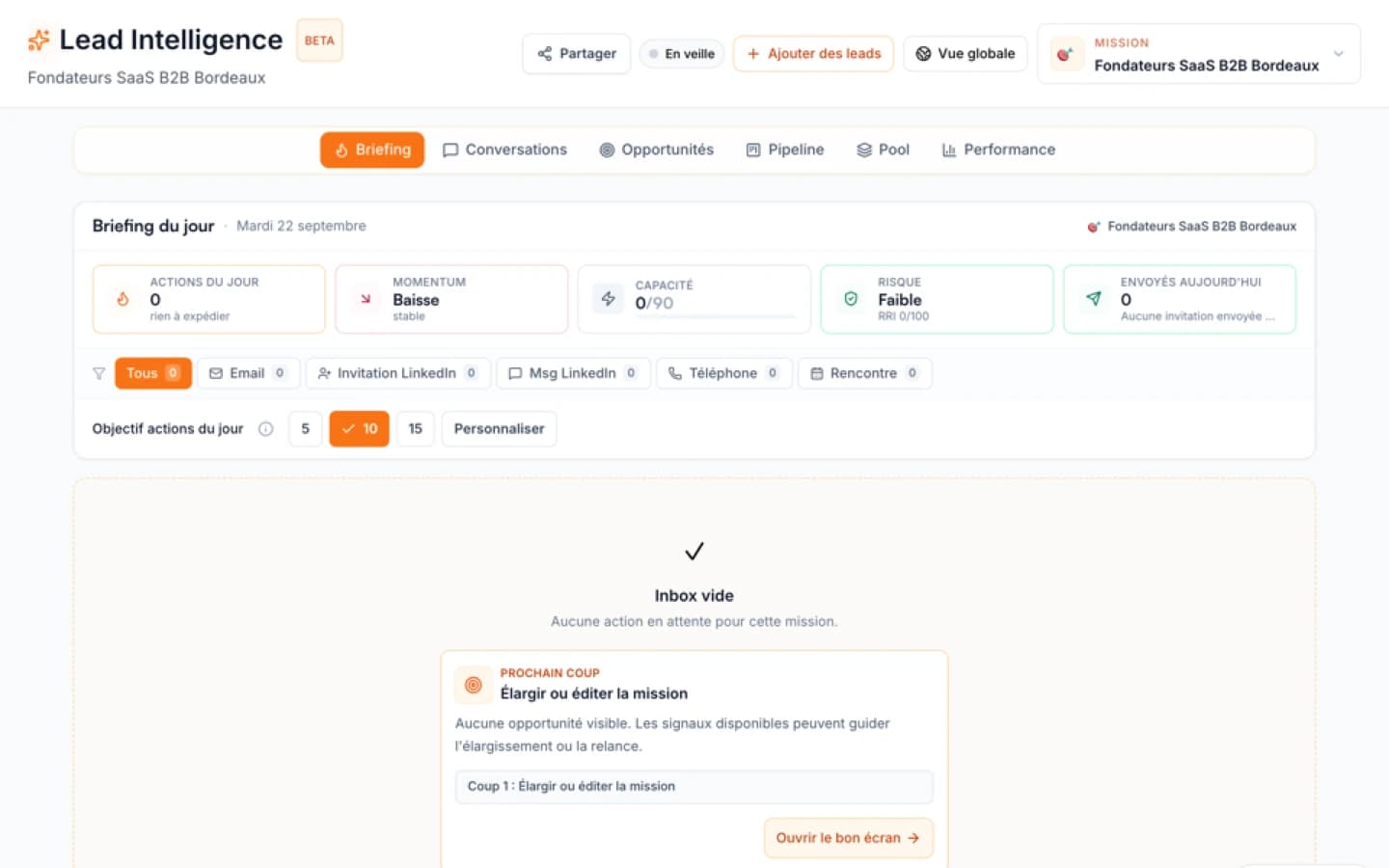
If you run a B2B company with fewer than ten people, you do not have a marketing team and a sales team. You have one person (often yourself) who writes emails, posts on LinkedIn, calls prospects, and updates the customer relationship management (CRM) system on the same Tuesday afternoon. A full-funnel B2B lead generation strategy for a small team is a single, repeatable pipeline that connects a narrow top-of-funnel channel to a clear next step at each stage, using exactly one metric and one tool per stage. It refuses the false choice between inbound and outbound and instead builds a funnel that a non-specialist can run without a lead scoring model, a demand gen agency, or a six-figure tech stack.
Definition
A full-funnel B2B lead generation strategy means you have a process that covers awareness, interest, consideration, and conversion in one continuous flow. For a small team, that translates to: you identify a limited set of ideal prospects (usually 20 to 50 per week), reach them with a personalized message, qualify their interest against a clear criteria, and move them to a meeting or trial. The funnel is not about volume; it is about sequence. Each stage has one job: top of funnel gets the right names, middle of funnel gets a response, bottom of funnel gets a decision.
The alternative is a scattershot approach that treats inbound leads from a blog post the same as cold outreach, which wastes time on people who will never buy. A full funnel forces you to choose one primary channel for each stage and measure only the metric that tells you whether that stage works.
To place this decision in context, the Knowledge guides for sales brings together deeper guidance on the same field.
Prerequisites
Before you build this funnel, you need three things that no tool can substitute:
A narrow ICP (Ideal Customer Profile). You cannot generate leads for "everyone in tech." Write down the industry, company size (revenue or headcount), role title, and a specific trigger event (e.g., "raised Series A," "hired a VP of Sales," "announced a new product line"). If you cannot name 10 real companies that fit, the ICP is too broad.
A clear offer. The prospect must understand within one sentence what you do and why it matters for them. If your first email or LinkedIn message requires a paragraph to explain, the offer is not clear enough.
A single source of truth for contacts. You need a place where you store names, companies, statuses, and notes. A spreadsheet works, but a CRM or a lead intelligence tool that keeps context is better. Without this, you will lose track of who you contacted and what happened.
Steps
A full-funnel B2B lead generation strategy for a small team has four stages. Stick to one channel per stage until you see consistent results.
Stage 1: Identify (Top of funnel). Channel: LinkedIn Sales Navigator or a similar source that lets you filter by ICP criteria. Metric: Number of prospects added per week. Goal: 20 to 50 new names that match your ICP. Do not try to contact every profile on the planet. Choose a manageable batch.
Stage 2: Engage (Middle of funnel). Channel: email (preferred) or LinkedIn InMail. Use a sequence of 3 to 5 messages over two weeks. Metric: Reply rate. Set an explicit target before you start, for example a first-email reply rate in the 10% to 20% range, as a working goal rather than a guaranteed benchmark. If replies stay far below your target, either the ICP is wrong or the message is too generic.
Stage 3: Qualify (Middle to bottom of funnel). Channel: a 15-minute call or a structured reply where you ask three questions: What is their current solution? What is missing? What would a change look like? Metric: Number of qualified opportunities per month. A qualified opportunity is one that passes the Budget, Authority, Need, Timing (BANT) check, or a simplified version of it. Do not score leads with a mathematical model; a yes/no on each of the four criteria is enough.
Stage 4: Convert (Bottom of funnel). Channel: a demo or a trial. Metric: Number of closed deals per quarter. If you have a small team, aim for 1 to 3 closed deals per month from this funnel. Every other stage feeds this one.
After the deal, return to Stage 1 and start again. The funnel is a loop, not a once-a-quarter activity.
To explore this point further, Inbound or Outbound? A One-Motion Test for Small B2B Teams details a step directly related to this decision.
Worked example
Take a hypothetical company that sells procurement software to mid-size manufacturing firms. The numbers below illustrate the mechanics, not a promised outcome. The ICP: manufacturing companies with 50 to 200 employees, headquartered in Germany, with a current manual process (spreadsheets or email).
Week 1, Identify: The founder searches LinkedIn Sales Navigator for "Head of Procurement" at manufacturing companies with 50 to 200 employees in Germany. She finds 30 names and adds them to her contact list (a simple CRM or a tool like Ember Lead Intelligence).
Week 2, Engage: She sends a personalized email: "Hi [Name], I saw you are leading procurement at [Company]. We help teams like yours cut vendor onboarding from three weeks to four days. Have 10 minutes this week to see if it fits?" She sends 30 emails. Six people reply. One says "not interested," three ask for more info, two book a call.
Week 3, Qualify: On the calls, she asks about their current process, pain points, and decision timeline. One prospect has a budget but no authority. Another has authority but no budget. The third has both and is actively looking. That is one qualified opportunity.
Week 4, Convert: She sends a demo tailored to that prospect's specific bottleneck. Two weeks later, the prospect signs a pilot. The funnel produced one deal from 30 names in less than two months.
In this hypothetical scenario, the total time invested stays on the order of ten hours across the four weeks.
Common mistakes
Trying every channel at once. Small teams spread too thin. Choose one channel (email, LinkedIn, events) and master it. If email replies stay well below your target, do not switch to LinkedIn calls yet; fix the message or the ICP first.
Qualifying too late. The most common time waste is booking a demo with anyone who replies. Qualify on the reply itself: ask the three questions in an email before scheduling a call. If they cannot answer, they are not ready.
Not tracking the source. If you do not know which channel produced the deal, you cannot repeat it. Tag every lead with the source (e.g., "LinkedIn Sales Navigator, 2026-07"). Review the tag every month.
Over-scoring. A complex lead scoring model with 20 variables is useless for a small team. Use a simple four-question checklist. If the answer is yes to all four, it is a qualified lead. If not, it needs more nurturing or dismissal.
Ignoring the ICP after first contact. A lead that was not ready three months ago might be ready today. Revisit the list every quarter with updated signals. Tools like Ember Lead Intelligence can automate this re-engagement by monitoring changes in company or contact status.
This approach also connects with How to Prioritise Lead Conversations: A Practical Guide for Sales Teams and Founders, which clarifies the next choice.
Tools
Small teams need tools that do not require a training budget. Here is a minimal stack for each stage:
Identify: LinkedIn Sales Navigator (paid; check current pricing on LinkedIn's site). It lets you filter by role, industry, company size, and geography. For a more automated approach, Ember Lead Intelligence can research accounts from your ICP, prioritize them, and present the next action without manual searching.
Engage: A simple email sequence tool like Lemlist or Mixmax (both offer affordable entry plans; check current pricing). They handle follow-ups automatically. If you prefer to write manually, a spreadsheet with a column for "email sent date" works.
Qualify: Ember Lead Intelligence or a simple CRM like HubSpot's free tier. The key is storing the BANT answers in a structured way. Ember's contextual prioritization can flag which leads are ready for a call based on signals and past interactions.
Convert: A calendar link (Calendly, free) and your own demo process. No special tool needed.
Monitor (ongoing): Ember Lead Intelligence monitors signals about people and companies to keep context current. This replaces the manual weekly check of "who changed jobs" or "who was funded."
In total, a small team can run this funnel on a modest monthly tool budget per user.
When to use this method
This full-funnel approach works when:
- You have a defined ICP. If you can describe your best customer in one sentence, this method will produce predictable results.
- You are the one doing the work. The method assumes the founder or a single sales person handles every stage. If you plan to delegate later, document the steps as you go.
- You need 1 to 5 deals per month. The method is calibrated for small volume but high conversion. If you need 50 deals a month, you need a different model (inbound marketing, partner channels, paid ads).
- Your product has a clear, easy-to-explain value. If the product requires a long sales cycle or a multi-person committee, the qualification stage must be longer, but the principle stays the same.
In practice, The Ember Brief #01 - Stop stacking sales frameworks. Pick the one that fits your deal size. completes this framework with another angle on the same topic.
When not to use it
The method breaks down if:
- You do not have a real ICP. If you are still validating who buys, spend a month doing exploratory calls instead of building a funnel. A funnel for a vague ICP produces nothing.
- Your sales cycle is longer than six months. The method relies on quick qualification. For enterprise deals with multiple stakeholders and a year-long timeline, you need a different pipeline that includes account-based marketing and a longer nurturing track.
- You are selling a commodity with price as the main differentiator. Full-funnel outbound works best for differentiated products. If the only thing that matters is price, inbound or marketplace channels are more efficient.
- You have zero budget for tools. The method requires at least a paid LinkedIn Sales Navigator seat and a paid email tool. If the budget is zero, use free LinkedIn search (limited) and manual email. It will be slower but possible.
Action plan
- This week: Write your ICP on a single page (industry, company size, role, trigger). Validate it by finding 10 real companies that fit.
- Next week: Choose one channel for identification (recommended: LinkedIn Sales Navigator). Spend two hours finding 30 prospects and adding them to a list.
- Week 3: Write a three-message email sequence. Test it on 10 people. Adjust the message based on reply rate.
- Week 4: Qualify every reply with the four BANT questions. Move only yes-yes-yes-yes leads to a demo.
- Month 2: Repeat the cycle. After the second month, review which ICP sub-segment gave the highest reply and conversion rates. Tighten the ICP around that segment.
- Quarter 2: Add a monitoring tool (e.g., Ember Lead Intelligence) to automatically detect signal changes in your existing list, so you do not have to manually re-check every contact.
Before deciding, Startup success rates and the next B2B sales decision helps connect this method with adjacent priorities.
Sources and methodology
This article synthesizes patterns used by owner-operators in B2B sales, based on practical experience and widely available guides. The general framework (identify, engage, qualify, convert) is borrowed from standard B2B lead generation models, as described in sources like The Small Business Expo guide, which emphasizes that small teams must combine marketing and sales roles. The specific recommendation to use one metric per stage and one tool per stage comes from operational best practices observed in startups with fewer than 10 employees.
FAQ
Free diagnostic
Test your sales file
Drop an Excel or CSV and check its readiness without sending its rows to Ember.