
Definition
Evaluating Business-to-Business (B2B) lead generation companies and services in 2026 requires moving beyond simple list-buying to analyzing how vendors align with your specific sales pipeline. For modern sales teams, a successful evaluation rests on five core pillars: Ideal Customer Profile (ICP) ownership, data sourcing transparency, lead qualification criteria, deliverable format, and contractual exit clauses. Before signing a long-term contract, such as a $10,000 monthly retainer used in an annual comparison in the Overloop Lead Gen Agency Guide, teams must verify whether a provider merely delivers raw contact data or actually helps qualify B2B leads early in the cycle. For established sales organizations running high-volume outbound sales, legacy databases and platforms remain highly effective. For instance, Apollo is an industry giant that reached 150 million USD in annual recurring revenue in May 2025, according to Apollo’s history page. Platforms of this scale excel at providing massive contact databases and automated email sequencing for structured Sales Development Representative (SDR) teams. However, as noted by Factors.ai and Coldreach, the tradeoff with these platforms is a credit-based pricing model that turns every export, email verification, and enrichment into a metered, compounding cost. Other tools, such as Clay, offer specialized integrations like their official LinkedIn Sales Navigator data point integration to assist with lead discovery, as detailed on the Clay Integrations Page. Meanwhile, agencies like Belkins are frequently vetted for mid-market execution, while boutique firms like GrowLeads focus on specialized Go-To-Market (GTM) consulting and outbound setups for software-as-a-service companies, as outlined by GrowLeads. When considering how to qualify B2B leads early, especially for early-stage startups, the evaluation criteria shift. A common question is: how does a founder qualify B2B leads without a sales team? Without dedicated SDRs to filter through thousands of cold prospects, founders must focus on high-intent signals. The first contacts to review are those whose role and company match the target profile.
To place this decision in context, the Knowledge guides for sales brings together deeper guidance on the same field.
Prerequisites
Before comparing offers, document your ideal customer profile, current conversion rates, available budget, and who will review delivered contacts. Ask each provider to show its data sources, qualification rules, reporting format, and exit terms. Compare the full cost of an agency, a contact database, and an in-house process over the same period. Overloop illustrates a $10,000 monthly agency engagement as $120,000 over twelve months; that is an annual example, not an upfront payment. Overloop agency guide.
Steps
Use the same five questions for every provider: who defines the ideal customer profile, where the data comes from, how a qualified lead is defined, what is delivered, and how the contract ends. Request a small sample and check it with the people who will actually make contact. Compare the total cost over the same period, then agree on a short pilot with an owner and measurable outcome. Overloop agency guide.
To explore this point further, Clay vs Ember: Which GTM Tool Wins for Your Team? 2026 details a step directly related to this decision.
Worked example
To understand how this evaluation works in practice, consider a Business-to-Business (B2B) software company deciding between hiring an external agency, purchasing a database subscription, or using an intelligent agentic system. If the sales team evaluates a traditional lead generation agency, they face significant upfront commitments. According to the Overloop Lead Gen Agency Guide, Overloop models a $10,000 monthly agency contract as $120,000 over twelve months. For startups running outbound sales, this represents a massive capital risk. The evaluation must scrutinize whether the agency owns the Ideal Customer Profile (ICP) strategy or simply executes generic cold outreach sequences. Alternatively, if the team evaluates database platforms like Apollo, they should compare its subscription and credit costs with the cost of a small agency pilot, using the same qualification standard.
Common mistakes
When Business-to-Business (B2B) sales teams evaluate lead generation companies and services, they frequently fall into predictable traps that drain budgets and stall pipelines. Avoiding these common mistakes is essential to establishing a highly efficient outbound sales motion.
The first mistake is over-indexing on database volume while ignoring the compounding costs of credit-based pricing. Many teams select vendors based on the sheer size of their contact lists, only to find that every export, enrichment, and verification action consumes a metered credit. According to Factors.ai, this credit-based pricing model turns every sales action into a metered decision, which can cause costs to compound rapidly as a team scales. This model inherently rewards database volume over actual sales outcomes. Apollo reported $150 million in annual recurring revenue in 2025, but that figure does not by itself establish the economics of a customer’s outreach. Apollo. While this approach works for broad market coverage, it often forces sales teams to absorb the financial risk of bounced emails and wasted exports, as noted by Coldreach.
The second mistake is committing to a long contract before checking a small sample of leads against the team’s own qualification criteria. Agree on the exit terms, ownership of the data and work, and the reporting cadence before signing.
This approach also connects with Apollo vs Ember Lead Intelligence for Founder Conversion, which clarifies the next choice.
Tools
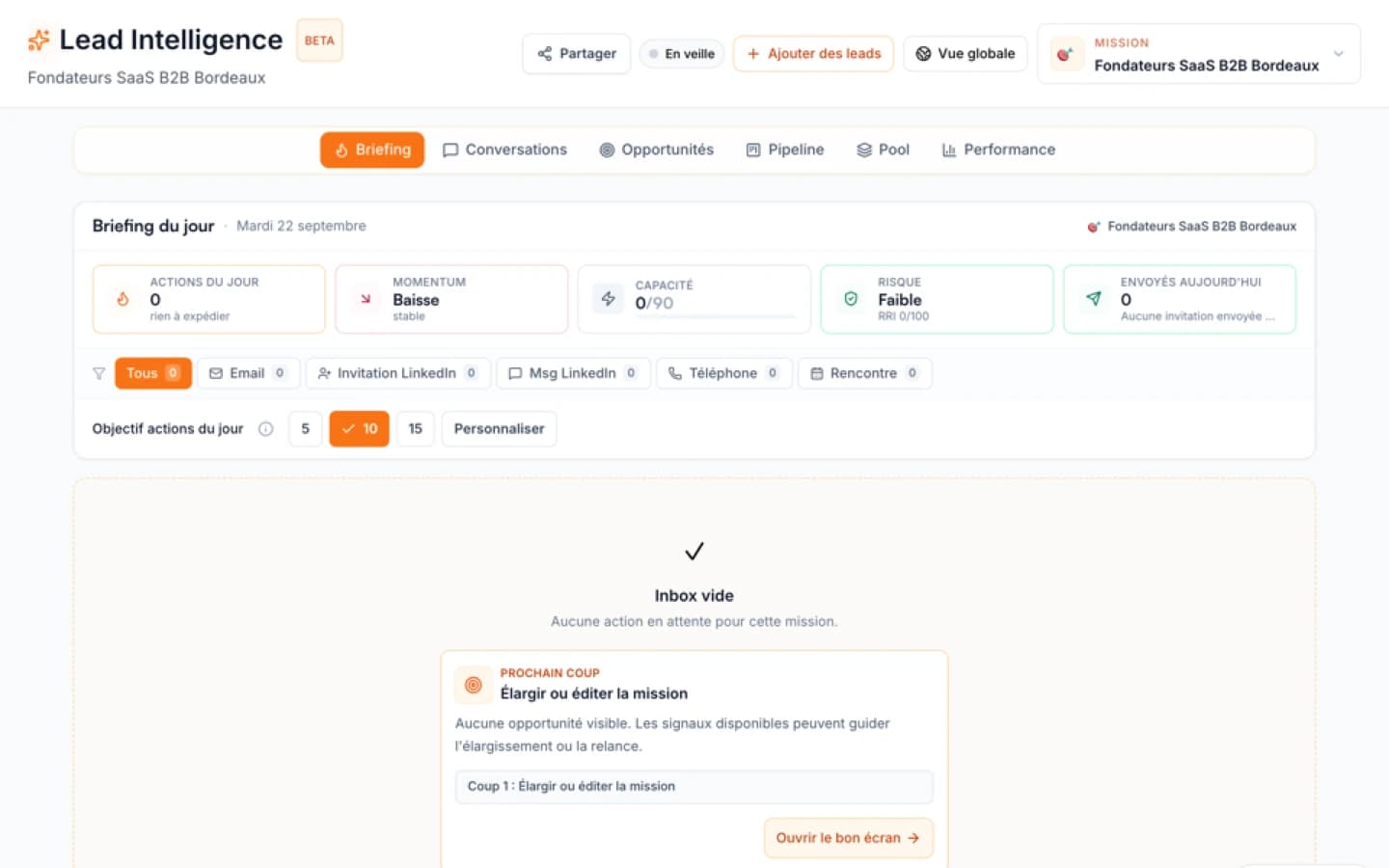
For smaller teams and founders, the evaluation criteria shift from volume to efficiency. Ask which accounts fit the customer profile and which contacts can move the conversation forward. Lead Intelligence can find and prioritise contacts without a minimum contact threshold, so a founder can review a focused set before increasing outreach. Lead Intelligence.
When to use this method
Use this method when several providers offer different mixes of data, outreach and qualification, and the team needs a common basis for comparison. Run a small pilot before committing to a larger contract.
In practice, How to Generate Qualified B2B Leads in 2026 for Sales Teams? completes this framework with another angle on the same topic.
When not to use it
Traditional lead generation services and agencies are not a universal cure. There are specific scenarios where signing a contract with an external provider will actively harm your sales pipeline and waste your budget. First, you should not hire a lead generation agency if you do not have a clearly defined and validated Ideal Customer Profile (ICP). When a company rushes into outbound sales without a proven market fit, they end up paying for expensive, unvetted outreach. According to industry analysis, Overloop models a $10,000 monthly agency engagement as $120,000 over twelve months overloop.com. If you are still building a prospect list from scratch and testing your messaging, committing to a heavy agency contract will only result in high costs and low conversion rates. Second, avoid high-volume database subscriptions if your sales team cannot support or justify a credit-metered, volume-driven model. Large platforms are built for massive outbound operations. For example, Apollo reported $150 million in annual recurring revenue in 2025 Apollo. However, the tradeoff is that credit-based pricing turns every action into a metered decision where exporting contacts, enriching records, and verifying emails each consume credits factors.ai. When a Sales Development Representative (SDR) team scales, wasted exports and bounced emails compound these costs rapidly factors.ai. If your Customer Relationship Management (CRM) system is not ready to handle this influx, or if your team prefers precision over sheer volume, these database services will create more noise than qualified opportunities. Finally, if you are an early-stage founder asking how does a founder qualify B2B leads without a sales team, traditional lead generation companies are rarely the right starting point. When deciding who to contact first as a founder, the goal is to establish deep, context-driven relationships rather than executing broad, impersonal campaigns. Instead of managing complex agency contracts or burning budget on credit-based platforms, founders need a way to identify high-priority opportunities without a minimum contact threshold. For instance, Lead Intelligence finds and prioritizes the contacts itself whether the team starts with 10, 100, or 1,000 contacts. This allows smaller teams to focus on lead scoring and precise next actions without the overhead of traditional sales databases.
Action plan
To build a predictable sales pipeline, B2B teams should compare providers on customer profile ownership, data sourcing, qualification, deliverables and contract exit terms. Overloop gives an example of a $10,000 monthly agency engagement costing $120,000 over twelve months. This is an annual comparison, not a fee due before leads arrive. Ask each provider for its actual scope and total cost. Overloop agency guide.
Before deciding, Using AI for B2B Lead Generation Without Losing Quality helps connect this method with adjacent priorities.
Sources and methodology
To establish a rigorous evaluation framework for sales teams, our methodology relies on analyzing real-world pricing models, data integration capabilities, and agency structures across the business-to-business (B2B) sales landscape. We examined how major platforms scale, such as Apollo, which reached $150 million in annual recurring revenue in May 2025, according to financial data from Apollo’s history page. This analysis helps sales teams understand the economic pressures that drive volume-based credit models in outbound sales.
We also reviewed the agency comparison in the Overloop guide and the Clay Sales Navigator data point. Those vendors describe their own products, so verify each contractual promise with the provider before making a purchase decision.
Sources
- Evaluation framework, not a vendor ranking. Walk through the five criteria that actually predict outcomes (ICP ownership, data sourcing transparency, qualification criteria, deliverable format, exit clause), then apply them to the categorie
- Lead Gen Agency: Complete Guide for B2B Sales Teams (2026)
- Best B2B Lead Generation Agencies for SaaS Companies in 2026
FAQ
Free diagnostic
Test your sales file
Drop an Excel or CSV and check its readiness without sending its rows to Ember.