
Claim to verify
To build a sustainable sales pipeline without losing message quality or budget control, small Business-to-Business (B2B) sales teams must shift from volume-driven prospecting to high-context prioritization. Traditional outbound sales platforms often encourage a high-volume approach. For instance, Apollo has reached 150 million dollars in annual recurring revenue (company history). However, this model relies heavily on credit-based pricing, and some organizations outgrow their credit limits as a team scales (source). When credit limits become a constraint, the focus shifts from genuine relationship-building to managing database costs.
For an early-stage founder or a small team wondering how to qualify B2B leads early, the answer lies in signal-driven lead scoring rather than mass database exports. Instead of scraping thousands of cold profiles, teams should identify who to contact first by monitoring real-time changes in target accounts. This is where modern Artificial Intelligence (AI) changes the playbook. Rather than acting as a generic list generator, AI can analyze the deep context of a business to surface the most receptive opportunities.
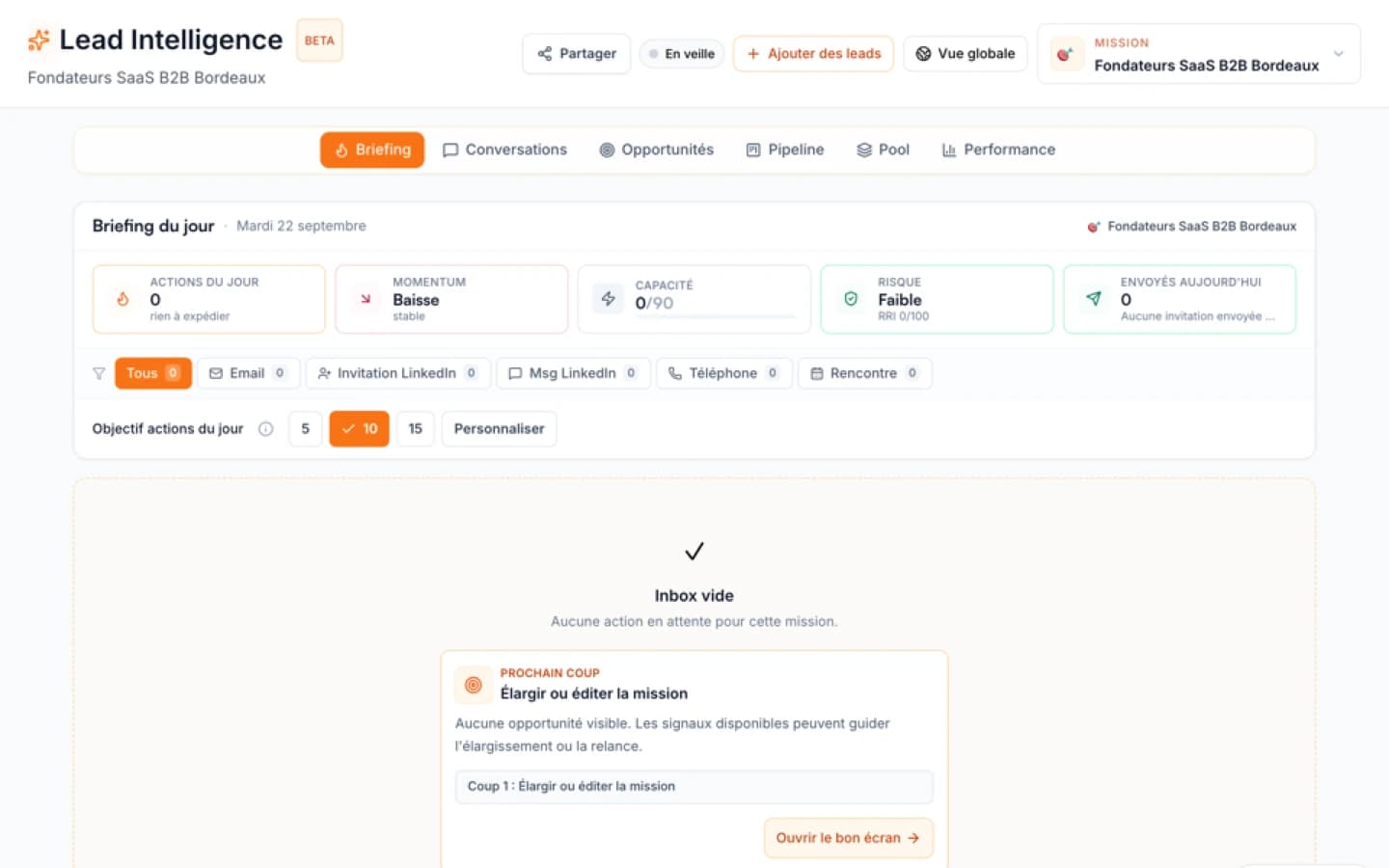
This context-first approach is central to how Ember helps teams scale their outbound efforts. Through its Lead Intelligence capability, Ember eliminates the friction of rigid database minimums. The system finds and prioritizes the contacts itself, whether the team starts with 10, 100, or 1,000 contacts, with no minimum threshold. By aligning lead discovery with the team's actual Ideal Customer Profile (ICP) and real-time signals, sales professionals and founders can focus their energy on high-probability conversations. This ensures that the Customer Relationship Management (CRM) system remains a clean source of truth, and every Sales Development Representative (SDR) spends their time on accounts that are actually ready to engage.
To place this decision in context, the Knowledge guides for sales bring together deeper guidance on the same field.
Methodology
To execute effective business-to-business (B2B) prospecting without a massive budget or a dedicated sales development representative (SDR) team, startups must adopt a structured, context-first methodology. Instead of scraping thousands of generic profiles, the modern approach to outbound sales for startups focuses on deep lead qualification before any message is drafted.
When considering how to qualify B2B leads early, especially when resources are tight, a founder must look for active intent signals rather than static firmographic data. How does a founder qualify B2B leads without a sales team? The answer lies in automating the discovery of situational triggers, such as leadership changes, hiring patterns, or technology shifts, and translating those signals into a dynamic lead scoring system. This ensures that the sales pipeline remains clean and that the customer relationship management (CRM) system is not flooded with unresponsive contacts.
This leads to the critical question of prioritization: who should an early-stage founder contact first? When building a prospect list from scratch, the first outreach should always target high-fit accounts experiencing an immediate, verifiable pain point that aligns with your core value proposition. Rather than reaching out to cold, generic lists, founders should tailor each first message to the specific trigger that makes that account relevant right now.
Evidence
When a small team or an early-stage founder operates without a dedicated Sales Development Representative (SDR) team, the critical question is: how does a founder qualify B2B leads without a sales team? The answer lies in shifting from broad database scraping to early lead qualification based on deep context. Instead of managing complex data pipelines or paying for wasted credits, founders can use AI to analyze existing business context and match it against their Ideal Customer Profile (ICP). This allows them to identify which opportunities are actually ready for a conversation. This leads to another essential decision: who should an early-stage founder contact first? When building a prospect list, Improvado lists over-reliance on volume rather than quality among the common failure modes of AI lead generation, which supports prioritizing context quality and qualifying leads early.
To explore this point further, Clay vs Ember: when each one fits details a step directly related to this decision.
Demonstration and examples
To understand how a small Business-to-Business (B2B) sales team or an early-stage founder can execute high-context prospecting, consider the practical workflow of building a prospect list from scratch. When looking at how to qualify b2b leads early, the critical question is often: how does a founder qualify B2B leads without a sales team? The answer lies in shifting from broad database scraping to context-driven lead scoring. Instead of hiring an expensive Sales Development Representative (SDR) team to manually filter records, small teams can use intelligent workflows to determine who to contact first as a founder.
In a typical scenario, a startup might begin with a small list of target accounts. Traditional platforms encourage high-volume outbound sales for startups, which often strains budgets and dilutes message quality. For example, Apollo reached $150 million in annual recurring revenue (company history), and many teams get genuine value from platforms like it. However, its credit-based pricing model can penalize smaller teams, since some organizations outgrow their credit limits (source).
Alternatively, modern data enrichment tools like Clay offer an LinkedIn Sales Navigator datapoint integration for lead discovery and connection insights (source), which helps teams build highly targeted lists. For small teams that want to maintain absolute pipeline control, Ember provides a different approach. Through its Lead Intelligence capability, the platform finds and prioritizes the contacts itself whether the team starts with 10, 100, or 1,000 contacts, with no minimum threshold.
This means an early-stage founder wondering who should an early-stage founder contact first can immediately identify high-priority opportunities without wasting budget on unverified data. By analyzing real-time signals and existing project context, the system ranks prospects based on their actual readiness to engage. This removes the noise from b2b prospecting, allowing a lean team to focus their cold outreach only on accounts that show genuine buying signals. The resulting lead qualification process ensures that the Customer Relationship Management (CRM) system remains clean, and the sales pipeline stays filled with high-value opportunities rather than dead ends.
Observed results
When evaluating how a small Business-to-Business (B2B) sales team should navigate Artificial Intelligence (AI) for lead generation, the observed results of different strategies reveal a clear divide between volume-centric automation and high-context prioritization. For teams focused on sheer outbound volume, traditional platforms like Apollo, which has reached 150 million dollars in annual recurring revenue (company history), are highly effective. These platforms excel at providing massive contact databases and sequence automation. However, credit-based models can become expensive as a team grows: credit allowances can feel tight and run out faster than expected (source). This raises a critical question for early-stage companies: how does a founder qualify B2B leads without a sales team? Relying on a massive Sales Development Representative (SDR) team to manually filter through thousands of cold profiles is rarely feasible for smaller operations. Instead of managing complex databases or risking high bounce rates, founders must identify who to contact first as a founder by focusing on signal-driven relevance. This is where a shift to context-grounded tools changes the equation. For example, Ember's Lead Intelligence finds and prioritizes the contacts itself whether the team starts with 10, 100, or 1,000 contacts, with no minimum threshold, removing the need for a minimum starting volume. By aligning lead qualification directly with the core Ideal Customer Profile (ICP) and existing Customer Relationship Management (CRM) context, small teams can maintain absolute control over message quality and pipeline health without drowning in administrative noise.
This approach also connects with What does a defensible B2B lead generation process look like in 2026 for a team that cannot rely on a single channel?, which clarifies the next choice.
Limitations
While AI can dramatically accelerate Business-to-Business (B2B) prospecting and cold outreach, small sales teams and early-stage founders must recognize the structural limitations of both legacy databases and emerging agentic systems. When building a prospect list from scratch, the immediate temptation is to rely on massive, volume-first databases. However, this approach introduces significant operational and financial trade-offs.
For instance, platforms like Apollo, which has scaled to 150 million dollars in annual recurring revenue according to Apollo, are designed primarily for high-volume outbound campaigns. The limitation here is that credit-based pricing turns every action into a metered decision.
Decision criteria
When choosing an Artificial Intelligence (AI) tool for Business-to-Business (B2B) prospecting, small sales teams face a fundamental choice between volume-driven database engines and context-first prioritization platforms. Traditional outbound sales for startups often relied on sheer volume, but modern deliverability constraints and buyer fatigue have made high-quality cold outreach the only sustainable path. For instance, a platform like Apollo, which reached 150 million dollars in annual recurring revenue (Apollo), is built primarily for volume-driven outbound where success is measured by sending more emails. However, for a small team, this volume-first approach can quickly degrade message quality and burn through domain reputation.
In practice, Apollo vs Ember Lead Intelligence for Founder Conversion completes this framework with another angle on the same topic.
What remains unproven
The promise that sheer volume in cold outreach automatically yields high-quality opportunities remains unproven for small teams. While platforms like Apollo present themselves as an Artificial Intelligence (AI) sales platform rebuilt as one connected go-to-market (GTM) system Apollo, the underlying model often optimizes for volume-driven outbound where unit economics depend on sending more emails and booking more meetings per Sales Development Representative (SDR). For a small team, this approach introduces a recurring tension. Credit-based pricing models turn every action into a metered decision, and some organizations outgrow their credit limits as the team scales Factors.ai.
Before deciding, What Does a Realistic Weekly Outbound Workload Look Like for a B2B Rep in 2026? helps connect this method with adjacent priorities.
Sources and updates
Keeping up-to-date with the evolving landscape of Business-to-Business (B2B) sales lead generation requires analyzing both established databases and modern context-driven platforms. According to an analysis of B2B sales lead generation strategies for 2026 published by Monday, revenue teams consistently seek a steady pipeline of qualified prospects. Industry reviews, such as the 2026 guide on the 15 best Artificial Intelligence (AI) lead generation tools by Amplemarket, highlight how modern platforms are shifting toward multi-channel engagement and deliverability optimization. Additionally, standard practices for data ownership and marketing data governance are detailed in the 2026 guide by Improvado.
For teams building a prospect list from scratch, understanding the trade-offs of legacy databases is critical. Platforms like Apollo present themselves as an AI sales platform rebuilt as one connected go-to-market (GTM) system, as detailed on the Apollo Homepage. For instance, Apollo reached 150 million dollars in annual recurring revenue, as documented by Apollo. However, Factors.ai notes that some organizations outgrow their credit limits as their outreach grows, which complicates prospect list-building for a founder who must qualify B2B leads early, without a dedicated sales team, and who must choose the right first contact to target.
Sources
FAQ
Lead Intelligence
Move from list to priority
Connect context, signals and human relationships to the next action.