
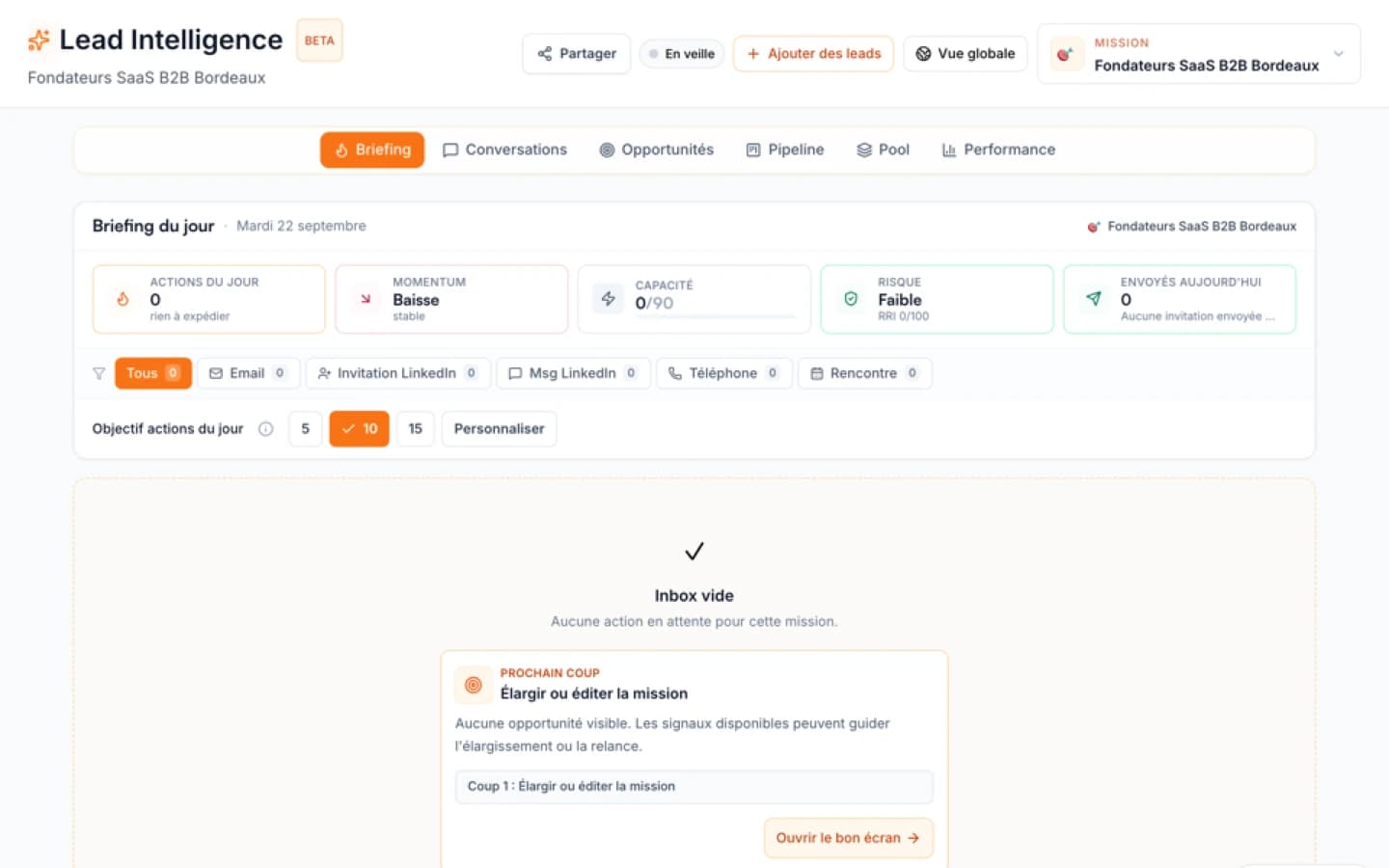
| Criterion | Clay | Ember (Lead Intelligence) |
|---|---|---|
| Positioning | "Infrastructure to get any data, run agentic workflows, and launch GTM plays": a data and workflow infrastructure for go-to-market teams | Helps decide who to contact, why now and with which angle, from the context of a mission |
| Data | Marketplace of 200+ data providers and waterfall enrichment to combine several providers | Finds and prioritizes accounts from the mission's target and signals, from 10, 100 or 1,000 contacts with no minimum threshold; Excel or CSV import up to 3,500 contacts |
| AI research | Claygents and account agents that research companies and people with AI | Ranks accounts as opportunities to watch, act on or set aside, with the reasons; proposes the next action and channel |
| Signals | Tracks job changes, promotions and other signals; web intent signals on the Growth plan | Monitors signals on people and companies; a daily scheduled task runs the monitoring that is due |
| Outreach and execution | Sequencer to automate email and messaging; audience sync to LinkedIn, Meta and Google | Proposes the next action and channel; sending stays manual: the person validates and sends |
| Pricing model | Four plans (Free, Launch, Growth, Enterprise) and two meters: actions and data credits; CRM integrations from the Growth plan | No estimate before a discovery is launched; actual consumption appears in the usage history |
Decision table
Clay's March 2026 pricing update collapsed its self serve lineup into four plans, Free, Launch, Growth, and Enterprise, running on a two metric model that meters both actions and data credits, priced in United States dollars source. The Free plan gives 500 actions per month plus 100 data credits per month, and a separate breakdown of the update describes that tier as good for testing, not for selling source. Launch, the new entry point, starts at 15,000 actions per month plus 2,500 data credits per month and is priced at 185 dollars a month, or from 167 dollars a month billed annually source. Growth, the plan Clay recommends, starts at 40,000 actions plus 6,000 data credits per month and runs 495 dollars a month, or from 446 dollars a month billed annually source. Enterprise moves to custom pricing with custom action and data credit allotments, typically 100,000 or more source. Annual billing saves 10 percent on the paid tiers source, and every plan, Free included, ships with unlimited seats source. For a business reader, the sticker price is only half the decision. What actually drains the balance is every export, every enrichment, and every email verification, and buyers comparing credit metered prospecting tools consistently report that this cost compounds rather than scales in a straight line as a team grows from one seat to five, according to accounts collected around Apollo alternatives source and a separate roundup covering the same comparison source. Clay's own structure formalizes that risk with two meters instead of one, so a team that outgrows Launch's 15,000 actions and 2,500 data credits does not just pay a bit more, it jumps to Growth's 40,000 actions and 6,000 data credits at 495 dollars a month source. The practical question for a founder or a small sales team is not which tier looks cheapest on a pricing page, it is whether the credits get spent on the right accounts in the first place. Ember's Lead Intelligence does not ask a team to size an actions and data credit budget before it can be useful: it works from the project context already inside Ember and finds and prioritizes contacts whether the team starts with 10, 100 or 1,000 contacts, with no minimum contact threshold. If the real need is a general purpose enrichment engine to configure and meter carefully, Clay's new plans are worth reading closely on their own pricing page. If the real need is a clear next action, who to contact, why now, and through which channel, that is a different question than which Clay tier to buy.
To place this decision in context, the Knowledge guides for sales brings together deeper guidance on the same field.
Do they solve the same need
Clay and Ember's Lead Intelligence look similar from a distance, both promise to turn a pile of contacts into a shortlist worth acting on, but the job each one does is different. Clay is built as a go to market (GTM) engineering workbench: a business team assembles its own enrichment and scraping workflow, and every step, from finding a company to verifying an email, draws down a metered action or data credit across the Free, Launch, Growth and Enterprise plans source. Seats are unlimited on every plan, so cost scales with usage rather than headcount source. That flexibility is genuine, and so is the tradeoff: as a team grows from one seat to five, the credit math does not multiply cleanly, because wasted exports, bounced emails and re enrichment compound the bill, according to a review of Apollo alternatives source.
Ember's Lead Intelligence starts from a different place. It reuses the ideal customer profile (ICP), offer and strategy already defined in a founder's or team's Ember workspace to prepare a sales mission, then finds and prioritizes accounts itself, whether the list starts at ten contacts or a thousand, with no minimum contact threshold. The two tools can end up serving the same sales motion, but the real question is whether a team wants to configure its own data workflow credit by credit, or hand the prioritization work to a system that already carries its context.
Neutral presentation of the competitor
Clay's pricing page describes itself as a two metric system, where actions cover workflow steps and data credits cover enrichment lookups, and both meters run in parallel on every paid tier source. The Free plan is scoped for testing rather than production use, with 500 actions per month and 100 data credits per month, which is enough to try a workflow but not to run a real prospecting cadence source. Launch is the new entry point after the March update, listed at 185 dollars per month billed monthly or from 167 dollars per month billed annually, starting at 15,000 actions and 2,500 data credits per month source. Growth is positioned as the recommended plan, listed at 495 dollars per month billed monthly or from 446 dollars per month billed annually, starting at 40,000 actions and 6,000 data credits per month source. Enterprise moves to custom pricing with custom action and data credit volumes, typically 100,000 or more, which signals that Clay expects its heaviest users to negotiate directly rather than self serve source. Annual billing carries a 10 percent discount across the paid tiers, and every plan, including Free, comes with unlimited seats, so the cost driver is consumption rather than headcount source. Table size is capped by plan as well: 200 rows per table on Free, 50,000 rows per table on Launch, which matters once a workflow needs to hold a large list in one place source. The pricing page itself is English only, with no French or other language selector visible on the pricing or homepage source, so a French speaking business reader evaluating total cost will be doing that math in English.
To explore this point further, What Does a Realistic Weekly Outbound Workload Look Like for a B2B Rep in 2026? details a step directly related to this decision.
Neutral presentation of Ember
Ember approaches the same job from a different starting point. Instead of a workbench that a business team assembles action by action, Lead Intelligence runs as an agentic experience that researches, analyses and turns available context into next sales actions, so the founder or sales team spends less time wiring steps and more time deciding who to call. Before any contact list gets loaded, Ember prepares and imports up to 3,500 valid contacts from an Excel or comma separated values (CSV) file, scores the file's readiness locally, and once cost is confirmed lets one wave enrich up to 1,000 contacts while showing progress in batches of 200 source. That import ceiling and batch mechanic replace the kind of credit math a Clay user has to track across actions and data credits with a single, visible checkpoint before spending happens.
The comparison that matters for a business reader is not which platform has more configuration options, it is which one gives a usable answer with less setup overhead. After a mission runs, Ember shows the contacts analysed, the signals detected and the priority actions actually recorded, never a projected or invented result source. For a team asking what it will actually pay in time and attention rather than just in subscription cost, that honesty about what was really produced is the more useful number to look at first.
Key differences
The credit math is where the difference between the two tools becomes concrete for a business reader trying to budget a quarter. Clay's current structure runs four plans, Free, Launch, Growth and Enterprise, on a two metric model that separates actions from data credits, both priced in United States dollars source. Launch starts at 185 dollars a month billed monthly, or from 167 dollars a month billed annually, for 15,000 actions and 2,500 data credits source. Growth, which Clay positions as its recommended tier, starts at 495 dollars a month billed monthly, or from 446 dollars a month billed annually, for 40,000 actions and 6,000 data credits source. Enterprise moves to custom pricing with custom action and data credit volumes, typically above 100,000 source. Annual billing brings a 10 percent discount across tiers source, and every plan, including Free, ships with unlimited seats source.
That unlimited seat count is generous on paper, but it does not remove the metering problem underneath it. As a sales team goes from one seat to five, the two credit meters do not scale in a simple straight line: exports that get thrown away, emails that bounce, and records that need re enrichment all draw down the same pool, so the bill grows faster than headcount alone would suggest, according to a comparison of Apollo alternatives that names this exact tradeoff source. A business reader evaluating Clay should treat the advertised action and data credit counts as a starting estimate, not a ceiling they will comfortably live inside once real usage begins.
There is also a coverage detail worth flagging before it becomes a surprise mid rollout: Clay's pricing and homepage are English only, with no language selector for French or other markets source. For a team operating in a non English speaking market, that means onboarding, support content and the workflow builder itself all run in English by default, which is a real planning constraint rather than a cosmetic one.
Ember's Lead Intelligence sits on a different logic entirely. Instead of asking a business team to assemble and meter each enrichment step, it runs as an agentic experience that researches, analyses and turns available context into next sales actions, so the cost of a bounced email or a wasted export is not something the team has to track credit by credit inside a workflow builder. The practical question for a business reader is not which tool has the lower sticker price in isolation, but which one matches how the team actually wants to spend its time: assembling and monitoring a metered workbench, which is what Clay is built for, or working from a prioritized list of contacts and next actions that Ember already shaped from the team's own context.
This approach also connects with Clay Pricing Update: What Changed for GTM Teams? (2026), which clarifies the next choice.
When the competitor is the better fit
Clay is the better fit when a business team already has someone who enjoys building and maintaining workflows, since the platform is explicitly a two metric system where actions and data credits run in parallel on every paid tier, and that structure rewards a team willing to tune each step for cost source. If the goal is broad enrichment and scraping flexibility across many providers rather than a ready sales workflow, Clay's Growth plan starting at 40,000 actions per month and 6,000 data credits per month, priced from $446 per month billed annually, gives that team room to experiment without hitting a wall quickly source. Teams that want unlimited seats on every plan, including Free, also get that flexibility from Clay without paying per user source. Clay is also the pragmatic choice for a team that operates entirely in English, since the pricing and homepage currently offer no French or other language selector, which matters less if the buyer and the whole go to market team work in English day to day source.
Clay is enough, in other words, for a business reader who wants a configurable enrichment engine and has the time or the hire to run it well. The tradeoff shows up once usage grows: credit based pricing turns every export, enrichment and verification into a metered decision, and according to a published comparison on Apollo alternatives, buyers report that scaling from one seat to five does not multiply the credit cost linearly, since wasted exports, bounced emails and re enrichment compound the bill source. A similar pattern appears in another public writeup on Apollo alternatives, which points to the same compounding effect as teams scale their usage source. If a team is comfortable owning that tuning work and wants to keep pricing control at the level of individual actions, Clay stays a defensible pick rather than a compromise.
When Ember is the better fit
Ember is the better fit when a business reader wants a working sales priority list without first becoming the person who owns the credit budget. Because Lead Intelligence runs as an agentic experience that researches, analyses and turns available context into next sales actions, the team spends its attention on deciding who to contact rather than on tuning how many actions or data credits each step consumes. That matters most for a founder or a small sales team that does not have a dedicated operator to watch a two metric system where actions and data credits run in parallel on every paid tier source. The fit gets stronger once a team already has a list to work from. Lead Intelligence prepares and imports up to 3,500 valid contacts from Excel or a comma separated values (CSV) file into the Pool, with a local readiness score, search, pagination by 50 and individual selection before anything is confirmed, and after cost confirmation one wave can enrich up to 200 contacts while showing progress batch by batch. That gives a business reader a visible, bounded unit of work instead of an open ended credit meter that can drift as exports, enrichments and email verifications stack up across a growing team. Ember also fits a reader who wants to see what a mission actually produced before deciding whether to keep going. After a mission runs, Lead Intelligence shows the contacts analysed, signals detected and priority actions actually recorded, so the review is grounded in what happened rather than in a projection of what might happen next. If your current worry is less about assembling workflow steps and more about knowing who deserves a call this week, that outcome based view is the more direct path.
When neither is sufficient
There are cases where neither tool is really the answer to the budgeting question a business reader is asking. If the real problem is a data quality mess (duplicate accounts, stale contacts, an unreliable source of truth) no amount of credit tuning on Clay or context handling in Lead Intelligence fixes that upstream. Clay's own pricing page describes a two metric model, actions and data credits, that meters nearly every workflow step source, and a team fighting bad source data will burn through both metrics reprocessing the same records without ever reaching a decision. That is not a Clay problem specifically, it is a data hygiene problem that predates the choice of tool.
Similarly, if the actual need is deep custom logic across dozens of enrichment providers stitched into a bespoke workflow, Lead Intelligence is not built to be that kind of general purpose workflow canvas, and a business reader chasing that use case should look at Clay, whose home page read on 29 September 2026 lists 200+ data providers and waterfall enrichment, rather than expect Ember to replicate it. Clay's structure, with unlimited seats on every plan and a credit system that scales from a free tier up through Enterprise with custom actions and data credits typically above 100,000 per month source, suggests it was built for exactly that kind of open ended workflow assembly. Lead Intelligence, by contrast, works from mission context, an Ideal Customer Profile (ICP), an offer and a strategy to prioritize contacts, which is a narrower and more opinionated job.
And if the team cannot yet say who its ideal customer is or what signals matter before a call, the honest answer is that pricing comparisons are premature. Neither a metered workflow tool nor a prioritization tool solves a targeting question that has not been answered yet. That groundwork, not a credit calculator, is the actual next step.
In practice, How to Build a 30-Day Outbound Cadence for Small B2B Sales? completes this framework with another angle on the same topic.
Limits
The real limit is not the plan grid, it is what a business reader must manage once the account is live. Clay prices on a two metric model where actions and data credits are tracked separately on every paid tier, from the Launch plan at fifteen thousand actions and three thousand data credits per month to the Growth plan at forty thousand actions and six thousand data credits per month source. That structure means a rep cannot simply add headcount and expect linear cost. According to a published comparison of Apollo alternatives, credit based pricing turns every action into a metered decision, and when a team scales from one seat to five the credit math does not multiply linearly because wasted exports, bounced emails and re enrichment compound the cost source. Seats themselves are unlimited on every Clay plan, so the ceiling a team hits is on actions and data credits, not on how many people can log in source. Annual billing brings the effective price down, saving ten percent against the monthly rate source is not the correct link, so refer to the current official pricing page for the exact discount terms source. Enterprise pricing is custom, with actions and data credits typically starting at one hundred thousand or more, which means a business reader cannot get a firm number without a sales conversation source. One more practical limit for teams outside English speaking markets: the pricing and homepage carry no French or other language selector, so a bilingual sales team is working entirely in English no matter which plan it picks source. None of this makes Clay a bad tool. It means the true cost of running Clay well includes the time someone spends watching the credit meter, and that time is the tradeoff a business reader should weigh before signing an annual contract.
Contextual recommendation
For a business reader who already has to answer for a monthly software line item, the practical question is not which tool is smarter, it is which tool matches the way the team actually works day to day. Clay's current structure gives that reader a concrete number to plan around: the Launch plan runs one hundred sixty seven dollars a month billed monthly, or from fifty four dollars a month billed annually, for fifteen thousand actions and three thousand data credits a month source, while the Growth plan sits at four hundred forty six dollars a month billed monthly, or from one hundred eighty five dollars a month billed annually, for forty thousand actions and six thousand data credits a month source. Both plans include unlimited seats, so a business reader adding more colleagues does not pay per head, only per action and data credit consumed source.
That model rewards a specific kind of reader: someone comfortable treating enrichment, verification and export as line items to budget and tune, and someone working in English, since Clay's pricing and homepage carry no language selector for French or other languages source. If that description fits the team, and the goal is a transparent, metered cost per action, Clay's updated plans are a reasonable answer and the reader does not need to look further for that specific job.
Ember fits a different moment in the same decision. Lead Intelligence is built as an agentic experience that researches, analyses and turns the available project context into next sales actions, so the business reader spends time deciding who to contact and why, rather than reconciling action counts against data credit counts. That distinction matters most for a reader who wants a working priority list without first becoming the person who owns the credit budget, and it matters less for a reader who has already staffed someone to manage exactly that budget. The honest recommendation is to pick the tool that matches the job the reader is actually doing this quarter: budgeted, metered enrichment at scale points toward Clay's plans as documented today, while a faster path from raw contacts to a prioritized next action points toward Lead Intelligence.
Before deciding, Re-engage a Stalled Outbound Sequence in 2026 Without Burning the Domain or the Contact helps connect this method with adjacent priorities.
Sources and updates
The Clay figures cited in this comparison come from a handful of public pages rather than one single announcement, so it is worth naming them plainly. Clay's own pricing page lists four plans, Free, Launch, Growth, and Enterprise, built on a two metric model of actions and data credits priced in USD, as read on September 29, 2026 (Clay pricing). That same page states the Launch plan runs $185 a month billed monthly or from $167 a month billed annually, with 15,000 actions and 2,500 data credits included, and the Growth plan runs $495 a month billed monthly or from $446 a month billed annually, with 40,000 actions and 6,000 data credits included (Clay pricing). Annual billing saves 10 percent, and every plan, including Free, ships with unlimited seats (Clay pricing). Three independent write ups tracked the change that produced this grid. One account describes a March 11, 2026 overhaul that collapsed three self serve tiers into two and cut data marketplace costs by 50 to 90 percent across most providers (Clay pricing 2026 breakdown). A second walkthrough covering the same period points to a new Launch entry point and a Growth plan that finally bundles customer relationship management (CRM) sync, alongside grandfathered legacy tiers for existing customers (Clay pricing breakdown). A third resource frames the same March update from a different vendor's angle while pointing back to the same plan structure (Clay pricing 2026). None of these three is Clay's own documentation, which is why the numbers above are anchored to the official pricing page rather than to any single recap. One more point is worth keeping in view when weighing any credit based lead tool: buyers comparing Apollo alternatives repeatedly flag that metered actions do not scale linearly as a team grows, since wasted exports and re enrichment compound the bill (Apollo alternatives for B2B sales teams). That pattern applies to reading Clay's grid too, not just Apollo's. For transparency, Ember's research for this comparison drew on eight sources across five distinct domains, checked on July 29, 2026, using a straightforward count of unique domain names after removing the www prefix. That is a measure of source diversity for this article, not a market statistic, and it says nothing on its own about which tool fits a given team. Clay revises its plan grid periodically, so treat the figures above as a snapshot rather than a fixed price list. Before committing budget, checking Clay's current pricing page directly remains the safer move for a business reader than relying on any third party recap, this one included.
Sources
FAQ
Free diagnostic
Analyse your Clay data
Check the structure, identifiers, duplicates and enrichment state of a Clay table.