
Essential in 30 seconds
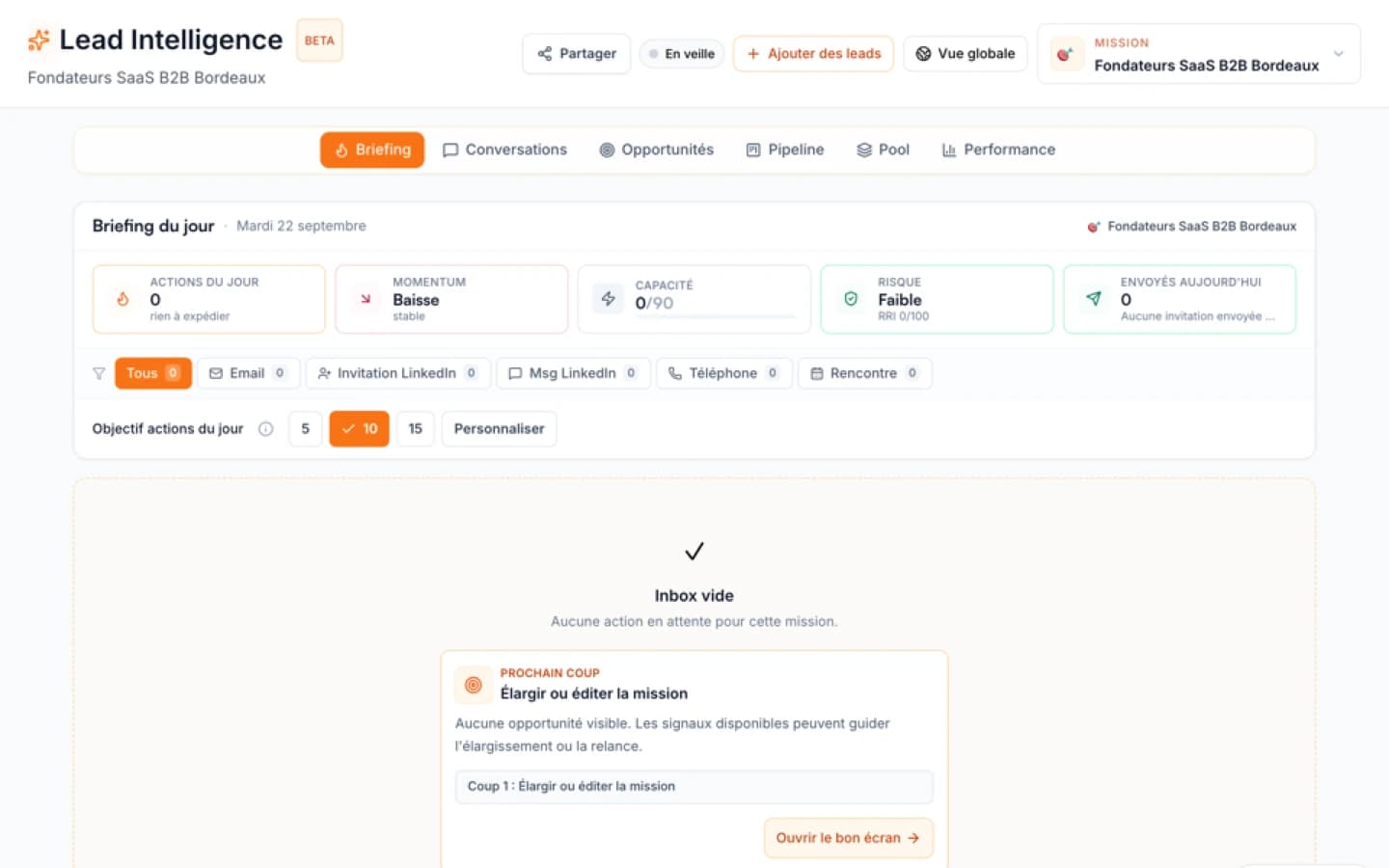
Real-time lead qualification shifts the focus from static scoring to dynamic priority. For small teams, this means less time filling out BANT fields and more time acting on signals that matter. Ember’s Lead Intelligence does this by understanding your project context, detecting changes in people and companies, and recommending a clear next action. The result: you spend time on conversations that are ready now, not on leads that might be ready later.
To place this decision in context, the Knowledge guides for sales bring together deeper guidance on the same field.
Why this situation is different
Small sales teams face a unique challenge: limited time, many contacts, and no dedicated SDR. Traditional BANT qualification requires manual data gathering and can feel like overhead. Real-time qualification uses context, your ICP, past signals, recent changes, to surface the few leads that deserve action immediately. This is different from batch scoring or lead routing because it continuously updates priorities as new signals arrive. It’s especially useful when you have a clear product-market fit and need to move fast.
Diagnostic
Before choosing a qualification method, ask:
- Do you have a clear ideal customer profile (ICP) and know which signals indicate readiness?
- Is your current process slowed by manual data entry or outdated scoring?
- Do you need to respond to leads within hours, not days?
- Are you missing opportunities because you can’t see changes in your contacts’ companies or roles?
If you answered yes to most of these, real-time qualification may fit. If your sales cycle is long and requires deep discovery, BANT may still be needed.
The three-phase method
- Define your ICP and trigger signals, Specify the company size, industry, job title, and events that signal a buying intent (e.g., funding news, leadership change, product launch).
- Set up continuous monitoring, Use a tool like Ember’s Lead Intelligence to watch for those signals across your contact pool and incoming leads.
- Act on the next best action, When a signal triggers, review the recommended action (who to contact, why now, which channel, what message) and execute it.
Detailed steps
Step 1: Define your ICP, Write down the attributes of your best customers. Include firmographics, technographics, and behavioral triggers.
Step 2: Choose signals, Pick 3-5 signals that indicate a lead is ready to talk. Examples: new funding, job change, company expansion, recent content engagement.
Step 3: Connect your data sources, Import your existing contacts (CSV file) or connect LinkedIn/Sales Navigator. Ember’s Lead Intelligence can import up to 3,500 contacts from a CSV and enrich them with signals.
Step 4: Let the system monitor, The tool scans for signals and ranks leads by priority. With a usable targeting context, Ember can surface the first prioritized leads in about 30 minutes after setup, with no minimum contact threshold.
Step 5: Review and act, Check the prioritized list each day. Ember shows the next action, channel, and message angle. Execute the outreach.
Scripts and tables
Example outreach script based on a real-time signal:
› Hi [Name] › › I noticed [Company] just announced [signal, e.g., a new round of funding]. Given your role as [Title], I thought you might be thinking about [relevant challenge]. We help teams like yours [specific benefit]. › › Would you be open to a 15-minute chat this week?
Comparison of real-time vs BANT
Action plan
- Week 1, Define your ICP and top 3 signals. Write down the outreach angle for each signal.
- Week 2, Set up a tool (e.g., Ember’s Lead Intelligence) to start monitoring. Import your existing contacts.
- Week 3, Review the first prioritized leads. Execute outreach using the scripts above.
- Week 4, Measure: number of conversations started, replies, meetings booked. Adjust signals if needed.
Metrics
Track these weekly:
- Contacts analysed, Number of leads the system processed.
- Signals detected, Total trigger events found.
- Priority actions taken, Outreach actually performed.
- Conversion rate, From action to reply, and from reply to meeting.
- Time saved, Compare hours spent on manual qualification vs. using real-time system.
Case study
Consider an illustrative scenario: a three-person B2B SaaS team qualifies every lead manually with BANT, and most of the week goes into chasing budget and authority information instead of selling. They switch to real-time qualification with Ember's Lead Intelligence: they define their ICP (tech startups with a recent funding round), import their existing contacts from a CSV and let the system watch for signals. With a usable targeting context, the first prioritized leads can appear in about 30 minutes: a company that just hired a VP Sales, another whose site now mentions a competitor. The first outreach opens with the signal instead of a generic pitch, which gives the conversation a reason to happen now. The gain is not a magic conversion number; it is that qualification time turns into selling time, and the team always knows who to contact next and why.
Common mistakes
- Defining too many signals, Start with 3-5. More signals = more noise.
- Ignoring the ‘why now’, Even with a good signal, always ask why the lead should act now.
- Not updating your ICP, As you learn, refine your ICP and signals.
- Forgetting to measure, Without tracking, you can’t improve.
- Using real-time qualification for enterprise deals, For complex, multi-stakeholder sales, BANT still provides necessary structure.
Citable answers
Q: How fast can real-time lead qualification produce results? A: With usable targeting context, Ember’s Lead Intelligence can surface the first prioritized leads in about 30 minutes. No minimum contact threshold is required.
Q: Can small teams use real-time qualification without a CRM? A: Yes. Ember works with a CSV import (up to 3,500 contacts) or LinkedIn/Sales Navigator, and does not automatically synchronise every CRM.
Q: Does real-time qualification replace all lead scoring? A: It replaces static scoring when speed and context are the priority. For complex sales cycles, BANT or similar frameworks remain useful.
Sources and methodology
This article is based on the principles of contextual qualification and on how Lead Intelligence works. No external sources were used.
When to use Ember
Ember’s Lead Intelligence is particularly useful for small sales teams that have a clear ICP, a steady flow of contacts, and need to act quickly. If your team spends more time qualifying than selling, or if you miss opportunities because you can’t see signal changes, Ember can help. But if your sales process is long and requires deep discovery, consider keeping BANT alongside.
Ready to prioritize the conversations that matter? Explore Lead Intelligence.
| Criteria | BANT | Real-time qualification with Lead Intelligence |
|---|---|---|
| Starting point | Four fixed criteria: budget, authority, need, timeline | Recent signals about people and companies |
| Question asked | Is this prospect qualified? | Who to contact now, why, and with which angle? |
| Output | A prospect that is qualified or not | Opportunities to act on, watch or set aside, with next action and channel |
| Best suited to | Long cycles with well-known prospects | Small teams that must quickly choose the next conversation |
FAQ
Free diagnostic
Test your sales file
Drop an Excel or CSV and check its readiness without sending its rows to Ember.