
Definition
For a small sales team that must both prospect and close without a dedicated marketing function, a defensible lead qualification framework is not a single method. The 2026 guide from Superhuman Prospecting reminds readers that frameworks such as Budget, Authority, Need, and Timeline (BANT), MEDDIC, CHAMP or SPIN must be adapted to this reality: each model has a specific purpose, and the team must choose the one that fits its sales cycle and its resources. Without a Customer Relationship Management (CRM) system and a marketing team, the approach is to prioritize contacts manually or with a lightweight lead intelligence tool, relying on simple criteria such as budget, authority, need and timing (BANT) or the prospect's level of pain (CHAMP). The key is to be able to qualify a lead from the first exchanges, without waiting for an automated score that only a sophisticated CRM could provide. For a founder or an early sales team, the first question is: who should I contact first? The answer starts with defining an Ideal Customer Profile (ICP) and identifying the decision makers who hold the power to buy. The Highspot lead qualification checklist offers a step by step approach to validate each lead before it enters the pipeline. In practice, a small team can combine these frameworks and simplify them to keep only the criteria that really matter: immediate need, accessible budget and the ability to decide.
To place this decision in context, the Knowledge guides for sales brings together deeper guidance on the same field.
Prerequisites
For small sales teams navigating the Business-to-Business (B2B) landscape of 2026, establishing a defensible lead qualification framework is critical, as outlined in the Superhuman Prospecting guide. When operating without a dedicated marketing function, a lean team must cut through the noise of traditional lead qualification frameworks such as Budget, Authority, Need, and Timeline (budget authority need timeline (BANT)), Metrics, Economic Buyer, Decision Criteria, Decision Process, Identify Pain, and Champion (MEDDIC), Challenges, Authority, Money, and Prioritization (CHAMP), or Situation, Problem, Implication, and Need-payoff (SPIN). Instead of letting these complex frameworks dictate the workflow, the team should map qualification to the reality of reps who handle both prospecting and closing, as the guide recommends.
Steps
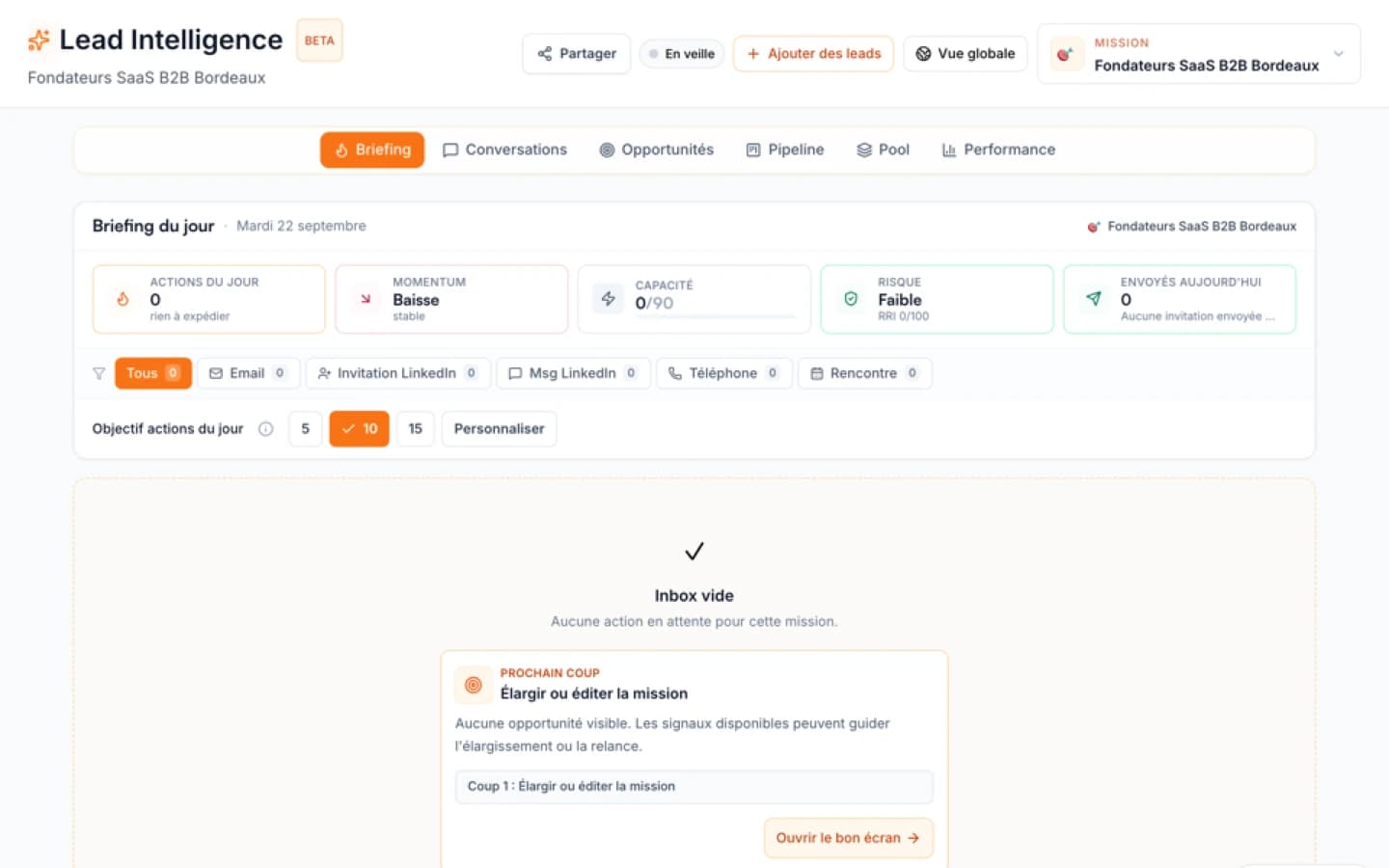
For example, for a small team that is getting started, a tool like Ember's Lead Intelligence can find and prioritize contacts itself, whether the team starts from a handful of contacts or several thousand, with no minimum threshold, as detailed on the Ember Lead Intelligence page. This approach avoids the hidden costs of credit-based pricing, often cited by buyers looking for Apollo alternatives, where every export, enrichment or verification consumes credits and where going from one seat to five makes costs climb non-linearly.
To explore this point further, Clay vs Ember: Which GTM Tool Wins for Your Team? 2026 details a step directly related to this decision.
Worked example
To understand how this operates in practice, consider a small Business-to-Business (B2B) software team launching a new service without a marketing department. In this scenario, the team must answer several critical questions: How does a founder qualify B2B leads without a sales team? Who should an early-stage founder contact first? Instead of relying on complex enterprise frameworks, the team uses a signal-based qualification method. They define their Ideal Customer Profile (ICP) not by vague industry codes, but by active triggers, such as recent executive hires or public technology shifts. This approach directly addresses the challenge of how to qualify B2B leads early, ensuring that cold outreach is directed only at accounts with an active, verifiable reason to engage.
Common mistakes
When small Business-to-Business (B2B) sales teams operate without a dedicated marketing function, they frequently fall into predictable traps that stall their sales pipeline. The most common error is adopting complex enterprise frameworks without adapting them to a lean environment. For instance, trying to force a dual-role Sales Development Representative (SDR) who handles both prospecting and closing to run a heavy qualification methodology can paralyze outbound sales. As noted in the Superhuman Prospecting guide, small teams must map qualification directly to their daily execution reality rather than copying enterprise structures.
Another critical mistake is over-relying on massive, untargeted list exports that drain budgets. Many small teams treat lead scoring as a pure volume play, building a prospect list from scratch without clear intent signals. This approach becomes highly expensive under traditional data models. As explained in a market analysis by Factors.ai, credit-based pricing models turn every sales action into a metered decision where exporting contacts, enriching records, and verifying emails each consume credits. When a lean sales team scales from one seat to five, this credit math compounds non-linearly due to wasted exports, bounced emails, and repetitive enrichment, as also detailed by Coldreach.ai.
This volume-first mindset often leads to confusion around how a founder qualifies B2B leads without a sales team. Founders and small teams often assume they need a massive database to begin qualifying. In reality, modern qualification is volume-independent. For example, Ember's Lead Intelligence capability finds and prioritizes contacts itself whether the team starts with 10, 100, or 1,000 contacts, with no minimum contact threshold, as outlined on the Ember Lead Intelligence page.
Finally, teams frequently fail to align their Customer Relationship Management (CRM) tracking with real-time buyer signals. Instead of identifying who to contact first as a founder, they treat every contact in their database with equal priority. According to the Highspot lead qualification checklist, a defensible qualification process must connect immediate buyer engagement with structured sales plays. Without this connection, small teams waste valuable hours chasing cold accounts that do not fit their Ideal Customer Profile (ICP), ultimately damaging their outbound efficiency.
This approach also connects with Apollo vs Ember Lead Intelligence for Founder Conversion, which clarifies the next choice.
Tools
Selecting the right technology stack determines whether a small Business-to-Business (B2B) sales team can successfully execute a lead qualification framework without a dedicated marketing team. Traditional platforms like Apollo are highly effective for structured outbound campaigns, serving as a unified Artificial Intelligence (AI) sales platform for modern sales and marketing teams to manage pipelines and simplify their software stack, as detailed on the Apollo homepage. This approach is ideal for established Sales Development Representative (SDR) teams where a Revenue Operations (RevOps) manager or Vice President of Sales prioritizes broad pipeline coverage. However, the typical buyer must carefully evaluate the credit-based pricing model, which can turn every action into a metered decision and create friction for finance contacts, as noted in the Factors.ai analysis of Apollo alternatives. When a lean sales team scales from one seat to five, the credit math does not multiply linearly because wasted exports, bounced emails, and re-enrichment rapidly compound the overall cost, according to the Coldreach.ai guide on Apollo alternatives.
For teams that require deep data customization, Clay provides a powerful alternative. It functions as an infrastructure for Go-To-Market (GTM) teams and GTM engineers to retrieve data, run agentic workflows, and launch highly targeted GTM plays, as explained on the Clay homepage. Clay excels at integrating with existing sales engagement tools such as Salesloft, Outreach, Instantly, Smartlead.ai and HubSpot Sequencer, as listed on the Clay integrations directory.
When to use this method
Choosing the right lead qualification framework depends entirely on your team structure and lead volume. For a small Business-to-Business (B2B) sales team operating without a marketing department, traditional frameworks must be applied selectively to avoid wasting precious sales hours.
If your team is managing complex, high-value deals with multiple stakeholders, heavy frameworks like Metrics, Economic Buyer, Decision Criteria, Decision Process, Identify Pain, and Champion (MEDDIC) can be useful, but they require significant manual input. Conversely, Budget, Authority, Need, and Timeline (budget authority need timeline (BANT)) is highly effective when qualifying active inbound inquiries where a budget already exists, but it is notoriously difficult to use during cold outreach because cold prospects rarely share budget details early in a conversation. According to the Superhuman Prospecting Guide, small teams must map these frameworks to the reality of reps who handle both prospecting and closing, rather than blindly adopting enterprise-level checklists.
When considering how to qualify B2B leads early, or how a founder qualifies B2B leads without a sales team, the priority shifts from rigid qualification to identifying immediate relevance. Instead of waiting for inbound leads, an early-stage founder must ask: who should an early-stage founder contact first? The answer lies in targeting prospects who exhibit clear, observable signals of need. Building a prospect list from scratch using a structured approach like the Highspot Lead Qualification Checklist can help organize your thinking, but executing this manually without a Customer Relationship Management (CRM) platform or marketing support quickly leads to administrative overload.
This is precisely when a context-driven, automated qualification method is required. When you lack a marketing team to generate inbound interest, you cannot afford to waste time on massive, uncalibrated outbound lists. Instead of spending hours manually researching prospects, small teams can use dedicated tools to surface high-priority opportunities. For example, Ember's Lead Intelligence capability helps founders and sales teams identify and prioritize contacts directly from their strategic context. This method is highly flexible, finding and prioritizing contacts whether the team starts with 10, 100, or 1,000 contacts, with no minimum contact threshold required to deliver value, as detailed on the Ember Lead Intelligence page. This approach allows lean teams to bypass the noise of traditional databases and focus entirely on the conversations most likely to convert.
In practice, How to Generate Qualified B2B Leads in 2026 for Sales Teams? completes this framework with another angle on the same topic.
When not to use it
Rigid, multi-layered lead qualification frameworks are not a one-size-fits-all solution for Business-to-Business (B2B) prospecting. For a lean team operating without a marketing department, attempting to implement heavy enterprise methodologies like Budget, Authority, Need, and Timeline (budget authority need timeline (BANT)) or MEDDIC (Metrics, Economic Buyer, Decision Criteria, Decision Process, Identify Pain, Champion) can actively damage your sales pipeline. These frameworks are designed for organizations with dedicated Sales Development Representatives (SDRs) and a continuous flow of inbound marketing leads. When a small team tries to force these structures onto cold outreach, they spend more time filling out administrative fields in their Customer Relationship Management (CRM) system than actually speaking to prospects. You should avoid complex, manual qualification frameworks when you are building a prospect list from scratch or testing a new Ideal Customer Profile (ICP). How does a founder qualify B2B leads without a sales team? Instead of relying on rigid corporate checklists, a founder must focus on rapid, conversational validation of pain points. Who should an early-stage founder contact first? An early-stage founder should contact highly accessible decision-makers within their immediate professional network first, rather than launching broad, uncalibrated outbound sales campaigns that require deep qualification steps. Additionally, heavy frameworks are counterproductive when your data acquisition model relies on strict credit limits. For instance, unified platforms like Apollo are excellent for structured outbound sales when you have dedicated operations support. However, as highlighted by Factors.ai, credit-based pricing turns every action into a metered decision, meaning that wasted exports, bounced emails, and re-enrichment compound the cost when a sales team scales from one seat to five. If your team is forced to qualify leads by exporting massive, unverified lists, the financial waste of credit consumption quickly outpaces the utility of the framework. Finally, you should steer clear of traditional lead scoring systems if you do not have a minimum volume threshold to make the data statistically meaningful. According to the lead qualification guide by Highspot, enterprise qualification processes require consistent data inputs to drive predictable Go-To-Market (GTM) productivity. When you lack these inputs, a lightweight, context-driven approach is far more effective. For teams operating at a smaller scale, tools like Ember's Lead Intelligence can find and prioritize contacts whether the team starts with a handful of contacts or several thousand contacts, with no minimum contact threshold.
Action plan
To build a defensible Business-to-Business (B2B) lead qualification framework without a marketing department, small sales teams must transition from passive lead scoring to active, situation-based prioritization. When executing outbound sales for startups, the goal is to prevent the sales pipeline from becoming clogged with unresponsive contacts. This requires a structured, step-by-step action plan designed to qualify leads early and maximize the efficiency of limited sales resources.
First, establish a lean qualification standard that replaces heavy enterprise frameworks. While traditional methodologies like Budget, Authority, Need, and Timeline (budget authority need timeline (BANT)) or MEDDIC are highly documented, they often fail lean teams because they require multiple discovery calls just to establish basic fit. According to the lead qualification frameworks guide by Superhuman Prospecting, these frameworks must be adapted to the reality of a small team that owns both prospecting and closing. For a founder wondering how to qualify B2B leads without a sales team, the answer is to focus on a single, actionable criterion: does the prospect have an urgent problem that your solution solves, and the authority to decide? That is how you decide who to contact first as a founder, building a prospect list from scratch around that strong signal rather than multiplying criteria.
Before deciding, Using AI for B2B Lead Generation Without Losing Quality helps connect this method with adjacent priorities.
Sources and methodology
This analysis of Business-to-Business (B2B) lead qualification frameworks is built on a systematic review of contemporary sales methodologies and Go-To-Market (GTM) platform structures. To establish a defensible framework for small sales teams operating without a dedicated marketing function, we synthesized industry benchmarks and product capabilities.
We anchored our framework evaluation on the lead qualification guide from Superhuman Prospecting, which maps traditional qualification structures to modern outbound environments. This was supplemented by the GTM enablement checklists from Highspot to understand how structured plays keep the sales pipeline clean.
Sources
- Cut through the framework proliferation (BANT, MEDDIC, CHAMP, SPIN) by mapping each to the reality of a small team that owns both prospecting and closing. Use the Superhuman guide as the anchor for what frameworks actually do, then add the
- How should a small B2B sales team qualify a lead in 2026 ... - Ember
- Lead Qualification Process: The 2026 Sales Checklist
FAQ
Free diagnostic
Test your sales file
Drop an Excel or CSV and check its readiness without sending its rows to Ember.