
Symptom or signal
When a team relies solely on a single channel, whether it is outbound sales for startups, inbound marketing, or partnerships, they build a highly fragile sales pipeline. Outbound channels suffer from declining response rates as buyers reject generic volume. Inbound channels require months of compounding content to yield results, and partnerships often stagnate without continuous manual nurturing. This vulnerability is particularly acute for small teams where every wasted hour directly impacts survival. The signal that your lead generation strategy is failing is not just a quiet inbox, it is the rising cost of activity. Many teams attempt to solve pipeline dryness by scaling up cold outreach volume. However, this volume-driven approach introduces a severe tradeoff. Credit-based pricing models turn exporting contacts, enriching records, and verifying emails into metered decisions where wasted exports and bounced emails compound the operational cost. When a small team tries to scale activity without precision, they spend more on database credits than they generate in actual customer value. This structural bottleneck forces a fundamental shift in how teams approach B2B prospecting. Instead of building a prospect list from scratch and blasting thousands of unverified contacts, teams must learn how to qualify B2B leads early. This challenge is even more pronounced for early-stage companies. When considering how does a founder qualify B2B leads without a sales team, the answer lies in moving away from manual database filtering. Without a dedicated Sales Development Representative (SDR) to manually clean lists, founders and small teams require contextual lead scoring that connects directly to their Customer Relationship Management (CRM) data. To break the single-channel dependency, teams must first identify who should an early-stage founder contact first. The priority should always be high-intent prospects who exhibit active buying signals and match a clearly defined Ideal Customer Profile (ICP), rather than a broad list of static accounts. When a small team can pinpoint these high-priority opportunities, they can orchestrate a balanced mix of targeted outbound, warm inbound qualification, and partner introductions without running all three channels poorly.
To place this decision in context, the Knowledge guides for sales brings together deeper guidance on the same field.
What changed
The landscape of Business-to-Business (B2B) lead generation has fundamentally shifted. Historically, small sales teams and early-stage startups relied on a single, high-volume channel to fill their sales pipeline. The traditional playbook for outbound sales for startups was straightforward: buy a massive list, set up automated email sequences, and push prospects toward a demo. These platforms made it easy to sync contacts with a Customer Relationship Management (CRM) platform like Salesforce or HubSpot (source).
However, relying solely on high-volume cold outreach has become highly inefficient. This shift has forced a transition from raw volume to highly targeted B2B prospecting. Modern Go-To-Market (GTM) teams are moving toward data-rich orchestration. For example, Clay has emerged as a key infrastructure for GTM teams to run agentic workflows (source), integrating deeply with LinkedIn Sales Navigator (source) and routing enriched leads directly to engagement tools like Salesloft, Outreach, Instantly, Smartlead.ai, or HubSpot Sequencer (source).
This evolution directly impacts how early-stage companies operate. For instance, when considering who should an early-stage founder contact first, the answer is no longer just any contact in a broad directory. Instead, when building a prospect list from scratch, founders must target highly specific accounts showing active buying signals or organizational changes that align with their Ideal Customer Profile (ICP).
Furthermore, this raises an essential operational question: how does a founder qualify B2B leads without a sales team? Without a dedicated Sales Development Representative (SDR) to manually filter prospects, founders must implement automated lead qualification and lead scoring early in the cycle. By analyzing contextual signals before launching any cold outreach, small teams can run a balanced mix of outbound, inbound, and partner-led plays without spreading themselves too thin or relying on a single fragile channel.
Facts and sources
Apollo's own Engage page describes contact discovery, sequences, calls, LinkedIn tasks and signal-triggered outreach. It does not establish that sending more messages is the only way to use Apollo. Ember's Lead Intelligence page describes contextual opportunity priorities and proposed next actions. Both are vendor descriptions, not a controlled comparison of meetings or revenue. To compare channels in your own team, record for each one the source of an account, time spent, useful replies, qualified conversations and progress to an agreed next step. Use the same period and definitions. A partner introduction, an inbound request and a cold message may serve different buyer situations; their raw response rates need context.
Why the common explanation is incomplete
The common explanation for how to scale Business-to-Business (B2B) sales pipelines is fundamentally incomplete because it treats lead generation as a simple volume game. Traditional advice suggests that if your sales pipeline is empty, you simply need to purchase a larger database, hire more Sales Development Representatives (SDRs), and increase your cold outreach volume. This perspective assumes that outbound sales for startups is purely a numbers game. However, this high-volume approach ignores the compounding costs and declining returns that modern sales teams face.
When teams rely on legacy platforms to scale their b2b prospecting, they often run into a structural trap. Some data actions may use plan-specific credits. Compare the current plan cost with useful conversations rather than treating every action as equally valuable.
This volume-centric model fails to address the strategic questions that early-stage companies must answer. For example, how does a founder qualify B2B leads without a sales team? The common advice of blasting thousands of cold emails does not work when you lack the resources to clean lists, manage a complex Customer Relationship Management (CRM) system, or handle manual lead scoring. Understanding how to qualify b2b leads early, rather than relying on automated blast tools, prevents budget waste and keeps the sales pipeline clean. Instead of building a prospect list from scratch and hoping for the best, founders must focus on deep lead qualification from the very beginning.
Another critical question that remains unanswered by the high-volume playbook is: who should an early-stage founder contact first? The standard explanation suggests targeting any company that fits a broad industry classification. In reality, a successful campaign requires identifying high-signal accounts that match a highly specific Ideal Customer Profile (ICP). Without this precision, teams waste valuable time and budget chasing cold leads that have no immediate intent or need.
Relying solely on one channel, whether it is cold outreach, inbound marketing, or partnerships, creates a fragile revenue model. As outlined in the channel-mix decision framework by the Small Business Expo, running all three channels poorly is a recipe for failure. Sales teams must understand when outbound alone is sufficient, when inbound compounding begins to take effect, and how to transition between channels based on clear, qualitative criteria rather than arbitrary volume.
The real problem
The real problem for a small Business-to-Business (B2B) sales team is that relying on a single lead generation channel creates an incredibly fragile sales pipeline. When a team relies solely on high-volume cold outreach or a single inbound source, they become highly vulnerable to algorithm changes, rising platform costs, and declining response rates. To build a resilient strategy, teams need a clear channel-mix decision framework that outlines when outbound alone is enough, when inbound compounds, and when partnerships beat both, allowing them to pick a primary channel for the quarter instead of executing all three poorly, as highlighted by The Small Business Expo.
This fragility is compounded by the tools teams use for b2b prospecting. Apollo combines a large B2B contact database, email sequences, call dialing, and a Chrome extension for LinkedIn prospecting inside one platform, making it a common choice for a Sales Development Representative (SDR) or a Revenue Operations (RevOps) manager, as described by Apollo.
This approach also connects with What does a defensible B2B lead generation process look like in 2026 for a team that cannot rely on a single channel?, which clarifies the next choice.
How the mechanism works
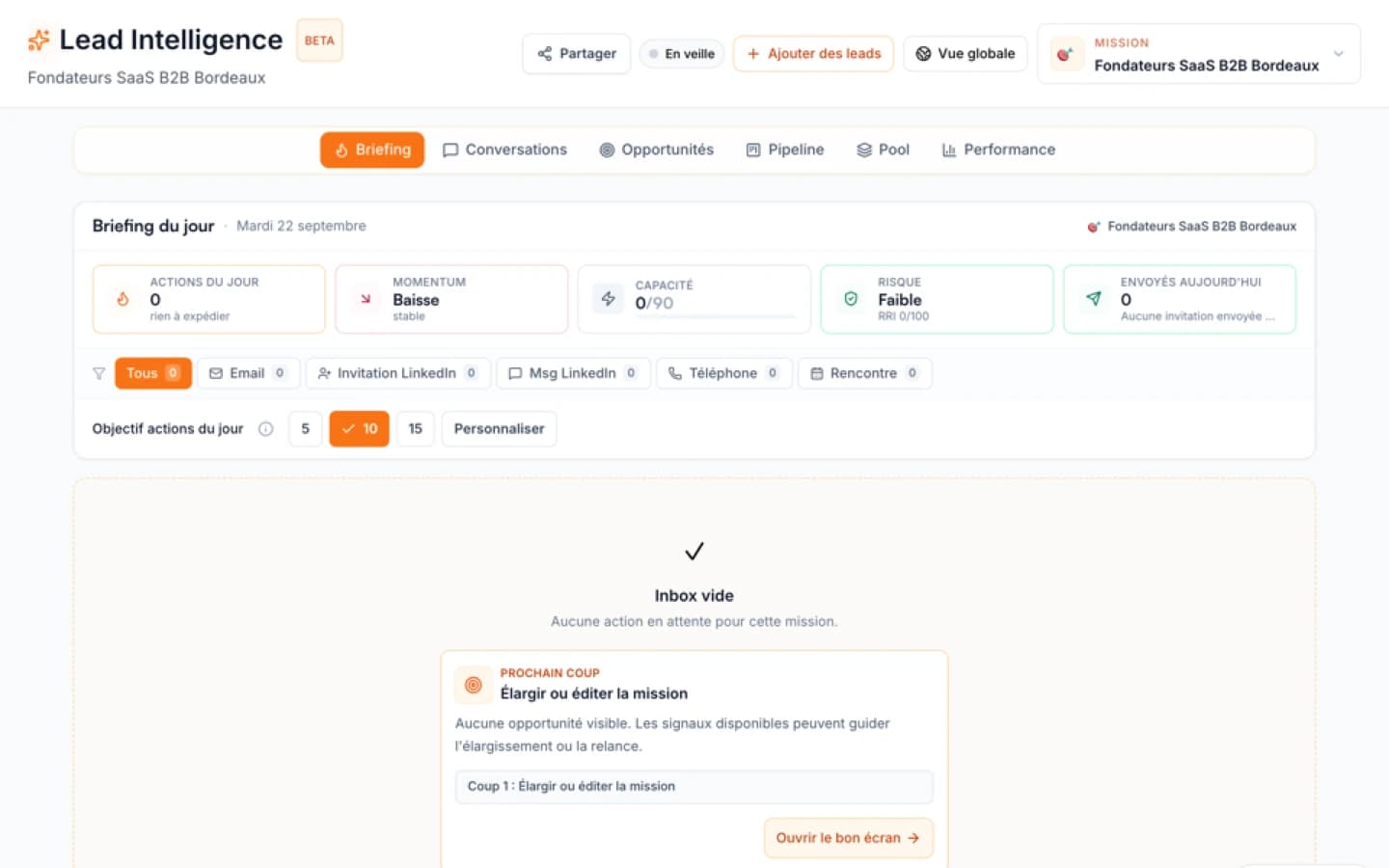
Instead, it coordinates outbound sales, inbound signals, and partnership opportunities into a single, context-driven workflow. For teams focused on pure volume, traditional platforms are highly effective. For example, Apollo can support structured outbound with contact discovery, signals, sequences and calling. However, for a small team without a dedicated Sales Development Representative (SDR) or a complex Customer Relationship Management (CRM) setup, managing credit-based exports and high-volume cold outreach can quickly become a metered, expensive distraction. The alternative mechanism relies on situational intelligence. To answer how does a founder qualify B2B leads without a sales team, the solution is to connect your Ideal Customer Profile (ICP) directly to live market signals. Instead of building a prospect list from scratch and guessing who is ready to buy, modern lead qualification tools monitor changes across companies and people to identify active buying windows. When deciding who should an early-stage founder contact first, the priority should always be accounts experiencing specific triggers, such as leadership changes, hiring surges, or technology shifts. This shifts B2B prospecting from a numbers game to a timing game. Ember Lead Intelligence operates on this exact mechanism. It reuses your strategic context and ICP to run targeted sales missions. It classifies accounts into explained opportunities to watch, act on, or set aside, and proposes the next action and channel that fit the lead's actual situation. This ensures your sales pipeline remains active and focused on the conversations that deserve attention now, without the overhead of a traditional outbound setup.
Concrete examples
To understand how this multi-channel approach works in practice, consider how a small Business-to-Business (B2B) sales team or an early-stage founder structures their workflow. When building a prospect list from scratch, the traditional impulse is to purchase a massive database and run high-volume cold outreach. Structured outbound can be useful when the target, message and follow-up are clear. Check the cost and result of each channel in your own plan and pipeline. A modern, resilient alternative relies on a balanced channel-mix decision framework. According to insights from The Small Business Expo, teams must evaluate when outbound alone is sufficient and when inbound or partnerships can compound their efforts. Instead of running all three channels poorly, a small team can use available signals to coordinate their efforts. For example, a team can monitor when a target account hires a new executive or secures funding, using that inbound signal to trigger a highly personalized cold outreach campaign. This can make B2B prospecting more relevant than an unreviewed volume target, which is a core pillar of modern revenue generation as detailed by Martal Solutions. This raises a critical question for resource-constrained startups: how does a founder qualify B2B leads without a sales team? Without a dedicated Sales Development Representative (SDR) to manually filter contacts, founders must rely on automated lead scoring and signal monitoring. Instead of guessing who to contact first as a founder, the priority should always be accounts that exhibit active buying signals or lookalike characteristics of your best existing customers. By aligning your Customer Relationship Management (CRM) system with real-time intent data, you can automatically bubble up high-priority opportunities to the top of your sales pipeline. This is where Ember's Lead Intelligence capability changes the dynamic for small teams. Rather than forcing you to manage complex databases or burn through expensive credits, Lead Intelligence uses your specific Ideal Customer Profile (ICP), offer, and strategy to prepare a targeted sales mission. By classifying accounts into explained opportunities to watch, act on, or set aside, it provides a clear next action, helping you know exactly who to contact, why now, and which channel to use. This allows founders and small sales teams to maintain a highly efficient pipeline without the overhead of a traditional, volume-heavy sales team.
In practice, Apollo vs Ember Lead Intelligence for Founder Conversion completes this framework with another angle on the same topic.
When to use this diagnosis
A diagnostic is essential when a small Business-to-Business (B2B) sales team feels the friction of credit-based pricing models. For teams that already know their Ideal Customer Profile (ICP) cold and run structured, high-volume outbound sales, platforms like Apollo are highly effective. As a team adds users, it should compare its actual plan terms and time spent per useful conversation. This is the exact moment to run a lead qualification and data diagnostic to identify where your pipeline is losing efficiency.
For early-stage companies, the challenge is often different. How does a founder qualify B2B leads without a sales team? Instead of hiring a dedicated Sales Development Representative (SDR) or building a prospect list from scratch using brute force, founders must identify the exact data missing from their sales decisions. When deciding who should an early-stage founder contact first, the answer is never a random list of names. A founder should contact prospects who show immediate situational readiness or active organizational changes first. Without a large sales team, relying on manual lead scoring or guessing who is ready to buy leads to wasted effort and a fragile sales pipeline.
To help teams identify these gaps before launching expensive campaigns, Ember offers a dedicated diagnostic capability within its Lead Intelligence module. By running this diagnostic, founders and Revenue Operations (RevOps) managers can pinpoint exactly what data is missing from their sales decisions. This allows teams to shift from blind outbound sales for startups to a highly targeted, multi-channel approach that respects unit economics and focuses on high-priority conversations.
When not to use it
A context-driven, multi-channel approach is not the right fit for every organization. If your sales strategy is built entirely around high-volume prospecting and your unit economics depend on sending massive quantities of cold outreach to book meetings, traditional database platforms are highly effective. If you have a dedicated team of Sales Development Representatives (SDR) and a Revenue Operations (RevOps) manager focused on maximizing raw pipeline coverage across email, phone, and social, a broad database tool is the logical choice.
However, this volume-first model introduces significant friction for smaller teams. Credit-based pricing models turn every export, enrichment, and verification into a metered decision.
This friction is particularly acute when considering how a founder qualifies Business-to-Business (B2B) leads without a sales team. A founder lacks the hours to clean massive databases or manage complex Customer Relationship Management (CRM) workflows. When deciding who should an early-stage founder contact first, the answer is never a random list of thousands of cold contacts. They must target high-intent prospects who match their Ideal Customer Profile (ICP) and show active buying signals.
If your goal is to build a highly automated, high-volume outbound machine that relies on sheer numbers, a specialized database provider is the superior option. But if you need to reduce the noise and focus your limited time on opportunities that deserve action right now, a different approach is required. Ember and its Lead Intelligence capability are built specifically for this latter scenario. Instead of forcing you to manage credit-metered databases, Ember uses your business context to prioritize the conversations that actually deserve your attention today.
Before deciding, What Does a Realistic Weekly Outbound Workload Look Like for a B2B Rep in 2026? helps connect this method with adjacent priorities.
Next step
To transition from a single-channel dependency to a balanced multi-channel system, the immediate next step for a small Business-to-Business (B2B) sales team is to shift from volume-based prospecting to context-driven qualification. When considering how does a founder qualify B2B leads without a sales team, the answer lies in automating the detection of buying signals rather than manually sorting through massive databases. Instead of hiring an army of Sales Development Representatives (SDR) or deploying complex Customer Relationship Management (CRM) workflows, early-stage teams must focus their limited energy on high-intent opportunities that align with their Ideal Customer Profile (ICP).
If you are wondering who should an early-stage founder contact first, the priority should always be prospects who have recently exhibited specific trigger events, such as leadership changes, technology shifts, or public expansion plans, rather than a cold list built entirely from scratch. This targeted approach ensures that your initial outreach is highly relevant and timely, allowing you to bridge outbound sales and inbound signals without exhausting your resources.
To execute this strategy without getting overwhelmed by manual research, teams can leverage specialized tools designed to surface these opportunities. For organizations looking to operationalize this process, Ember provides a dedicated capability called Lead Intelligence. This module helps small teams prioritize their conversations by analyzing available context and signals. Instead of leaving you to guess the best path forward, Lead Intelligence proposes the next action and channel that fit the lead situation, providing a clear next action regarding who to contact, why now, which channel, and which angle. By focusing on these high-probability opportunities, a small team can build a resilient, multi-channel pipeline that does not rely on the brute-force volume of traditional outbound databases.
What Ember describes
Lead Intelligence is presented as a way to use project context and available signals to explain which opportunity deserves attention and what to do next. The public product page does not provide a verified result for this article's hypothetical team, a guaranteed time to first priority, or a universal saving in outreach costs. A small team can test whether the reasons shown for suggested actions match its customer knowledge, and record where a human disagrees. That feedback is more useful than an unsupported performance claim. For each channel, record whether the buyer initiated the exchange, whether a colleague made an introduction, and whether the proposed next step was accepted. Those details explain why two equal reply rates may lead to different decisions.
Sources and methodology
Apollo Engage and Apollo Sales Engagement describe Apollo's current channels, signals and message tools. Ember Lead Intelligence describes contextual priorities. These sources support product descriptions, not a comparison of commercial outcomes. The channel-mix method in this article is a proposed test to run with your own accounts and records. No cited source proves that every team needs all three channels or that any single channel has stopped working.
Sources
- A channel-mix decision framework: when outbound alone is enough, when inbound compounds, and when partnerships beat both — with criteria to pick the primary channel for the next quarter instead of running all three badly.
- How should a B2B sales team generate leads in 2026 without ...
- B2B Lead Generation Strategies That Drive Revenue in 2026
FAQ
Free diagnostic
Test your sales file
Drop an Excel or CSV and check its readiness without sending its rows to Ember.