
Question and scope
For an early-stage founder building a sales pipeline from scratch, a realistic 30-day B2B outbound pipeline focuses on precision over raw volume. Instead of relying on a generic lead generation funnel, founders must commit to a structured, week-by-week plan with explicit activity quotas and realistic conversion benchmarks, as outlined in the outbound strategies from the Small Business Expo. This plan answers two key questions: how a founder qualifies B2B leads without a sales team, and who to contact first. By focusing on the Ideal Customer Profile (ICP) and using tools like a CRM or a lead scoring system, the founder can prioritize prospects from the first weeks, starting with the most reachable decision-makers, for example a sales manager or a RevOps lead, to maximize the efficiency of cold outreach. The goal is not email volume but qualified meetings, which requires rigorous upfront lead qualification, with no minimum contact threshold.
To place this decision in context, the Knowledge guides for sales bring together deeper guidance on the same field.
Dataset
For an early-stage founder building a sales pipeline from scratch, executing outbound sales for startups requires a transition from chaotic emailing to a structured, week-by-week 30-day plan. Instead of relying on a generic funnel, founders must commit to explicit activity quotas and understand the conversion benchmarks a small team should expect, as outlined in the Small Business Expo B2B Lead Generation Funnel. When considering how to qualify B2B leads early and who an early-stage founder should contact first, the initial step is defining a tight Ideal Customer Profile (ICP). Without a dedicated SDR team or an established CRM, this focused approach helps prioritize effort and avoid scattering it.
Methodology
For an early-stage founder building a sales pipeline from scratch, executing outbound sales for startups requires a transition from chaotic emailing to a structured, week-by-week 30-day plan. Instead of relying on a generic B2B leads funnel, founders must commit to explicit activity quotas and understand the conversion benchmarks a small team should expect, as outlined in the outbound strategy guide by the Small Business Expo. This structured approach is essential for building a predictable sales pipeline when you have no brand and no pre-existing list. How does a founder qualify B2B leads without a sales team? The process begins with lead qualification and lead scoring based on a strict Ideal Customer Profile (ICP). Rather than hiring a dedicated SDR team immediately, founders can leverage modern tools to automate the initial discovery.
To explore this point further, trouver ses premiers clients startup: a practical guide details a step directly related to this decision.
Analysis
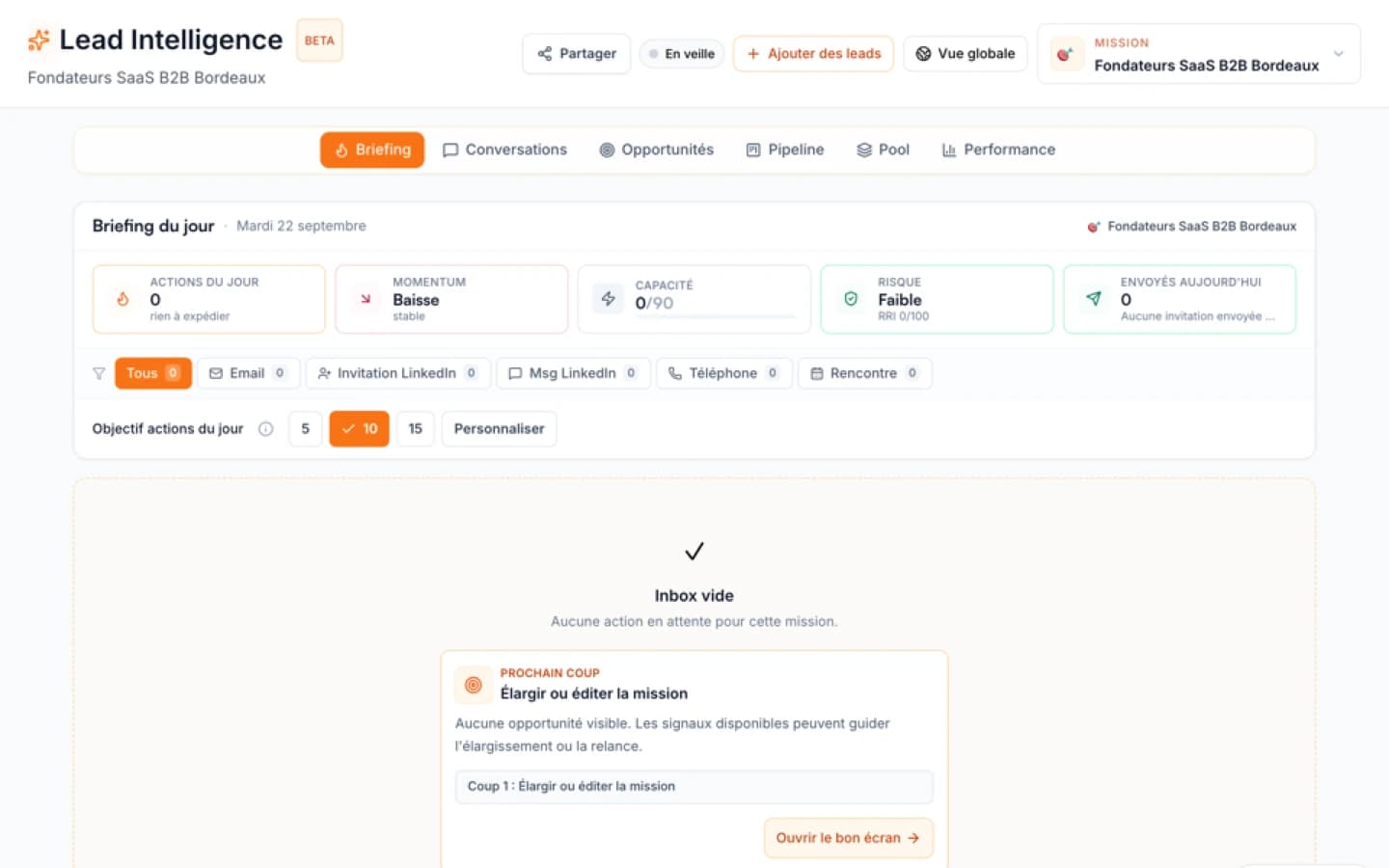
For a small team with no brand and no list, a realistic 30-day outbound pipeline relies on targeted activities and explicit quotas. The "How To Generate B2B Leads" guide sets out a week-by-week plan with daily email and call targets, and the response rates a team should expect, giving an early-stage founder a concrete baseline (source: thesmallbusinessexpo.com). Another outbound-focused guide details the steps to turn these activities into meetings (source: thesmallbusinessexpo.com). In this context, the temptation to adopt a general-purpose tool like Apollo is strong. Apollo reached $150 million in annual recurring revenue by optimizing for send volume (source), but its free plan already includes a limited credit allowance per user, a mechanism that quickly penalizes small teams as volume grows (source: factors.ai). Likewise, platforms like Clay impose row limits per table: 200 rows on the free plan, up to 50,000 on the Launch and Growth plans, and unlimited volume on Enterprise (source: clay.com/pricing). To work around these constraints, Ember offers a different approach with its Lead Intelligence capability. It finds and prioritizes contacts regardless of how many contacts the team starts with: the tool filters out the noise and surfaces opportunities worth acting on now. This means a founder can qualify B2B prospects without a dedicated sales team: the system identifies who to contact first based on potential, without having to manage a complex database by hand or buy thousands of credits. In practice, this directly answers early-stage founders' recurring questions: how do you qualify B2B leads without a sales team? By handing prioritization to an intelligent tool that requires no minimum threshold. Who to contact first? The contacts Lead Intelligence ranks as most promising, based on the signals available.
Findings
For an early-stage founder building a sales pipeline from scratch, executing outbound sales for startups requires transitioning from chaotic emailing to a structured, week-by-week 30-day plan that sets explicit activity quotas and conversion benchmarks (source: The Small Business Expo). When launching cold outreach without an established brand, the first critical decision is determining who to contact first as a founder. Instead of targeting massive, unverified lists, early-stage teams must focus on high-fit accounts that closely match their Ideal Customer Profile (ICP). This directly answers the question: how does a founder qualify B2B leads without a sales team? By adopting an ICP-based qualification approach and prioritizing high-fit accounts, even without a dedicated SDR. B2B prospecting then becomes a targeted process, where every contact is chosen to maximize the odds of a meeting, rather than a matter of raw email volume.
This approach also connects with How should a B2B sales team generate leads in 2026 without relying on a single channel: outbound, inbound, or partnerships?, which clarifies the next choice.
Limitations
While executing a structured 30-day plan helps founders move away from chaotic emailing, building an outbound sales pipeline from scratch comes with distinct operational limits. An early-stage founder trying to qualify B2B leads without a dedicated sales team has to work around the structural limitations of traditional prospecting tools.
The first limitation is the volume trap. Large database providers optimize for mass outreach. For example, Apollo reached $150 million in annual recurring revenue by building a system that makes high-volume outbound efficient (Apollo). Its free plan already runs on a credit system with a limited allowance per user, a mechanism that often penalizes small teams that need to focus on ICP precision rather than volume (Factors.ai).
Conclusions
When considering how a founder qualifies B2B leads without a sales team, the answer lies in automating lead scoring and focusing on high-intent signals rather than manual database filtering. For those wondering who an early-stage founder should contact first, the priority should always be accounts that match a tightly defined Ideal Customer Profile (ICP) and show immediate operational needs. Building a prospect list from scratch and executing outbound sales for a startup requires a structured, week-by-week 30-day plan that sets explicit activity quotas and conversion benchmarks, to avoid disorganized emailing, according to The Small Business Expo. Traditional B2B prospecting platforms focus heavily on volume-driven cold outreach. For instance, Apollo grew its database and sequence automation to reach $150 million in annual recurring revenue, according to Apollo's company history page.
In practice, Most Promising French Startups: A Practical Guide for Founders completes this framework with another angle on the same topic.
Recommendations
To build a realistic 30-day B2B outbound pipeline without a pre-existing brand or contact list, founders must shift from high-volume spamming to highly targeted prospecting. When considering how a founder qualifies B2B leads without a sales team, the answer lies in automating lead scoring and focusing on high-intent signals rather than manual database filtering. Instead of relying on a generic funnel, executing outbound sales for a startup requires a structured, week-by-week 30-day plan with explicit activity quotas and realistic conversion benchmarks, as outlined by The Small Business Expo. Building a prospect list from scratch should start with a narrow definition of your Ideal Customer Profile (ICP) and a systematic approach to lead qualification. When deciding who to contact first as a founder, the priority should always be accounts that match your ICP and show active readiness signals: recent hiring, technology shifts, or leadership changes. Traditional cold outreach often fails because teams focus on volume over relevance. For instance, Apollo is built for volume-driven outbound, where unit economics depend on sending more emails and booking more meetings per SDR, helping the company reach $150 million in annual recurring revenue (source).
When to use this analysis
This analysis is designed for early-stage founders who need to move from chaotic emailing to a structured, week-by-week 30-day plan with explicit activity quotas and conversion benchmarks, as outlined by The Small Business Expo. When launching outbound sales for a startup, founders often struggle to build a prospect list from scratch without a recognized brand or a dedicated SDR team. If you are wondering who an early-stage founder should contact first, the answer is not to buy a massive database and blast generic cold outreach. Instead, target high-intent accounts that match your Ideal Customer Profile (ICP), to avoid wasting resources on metered credit pricing. How does a founder qualify B2B leads without a sales team? The key is prioritizing contacts based on strong intent signals, such as a recent funding round or a leadership change, rather than relying on volume. To decide who to contact first, target the decision-makers directly tied to your solution, such as a VP of Sales or a RevOps lead, matching the typical Apollo buyer profile: often a sales manager or RevOps lead at a company running structured outbound (source). When building a prospect list from scratch, focus on quality over quantity: use tools like Lead Intelligence, which finds and prioritizes contacts on its own, regardless of how many contacts you start with, with no minimum threshold.
Before deciding, What does a defensible B2B lead qualification framework look like in 2026 for a team that has no marketing function and no scoring tool? helps connect this method with adjacent priorities.
Sources and methodology
To run effective outbound sales as a startup, building a prospect list from scratch and deploying a 30-day plan requires a systematic process, not chaotic emailing. Lead qualification must happen before any message is sent, as detailed in the B2B prospecting guides by The Small Business Expo. For a structured week-by-week approach, founders can draw on the outbound lead generation frameworks presented by The Small Business Expo, which explain how to move from cold outreach to an active sales pipeline. This way, an early-stage founder can qualify B2B leads without a sales team by using ICP criteria and intent-signal-based lead scoring, prioritizing decision-makers who match their ideal persona, such as a VP of Sales or a RevOps lead, even before hiring an SDR or adopting a CRM.
Sources
- Instead of a generic 'how to generate B2B leads' funnel, this article commits to a week-by-week 30-day plan with explicit activity quotas (emails/day, calls/day, replies/week) and the conversion benchmarks a small team should expect. Anchor
- Step-by-Step Guide To Outbound Lead Generation
- AI-Powered B2B Outbound: The Complete Guide (2026)
FAQ
Lead Intelligence
Move from list to priority
Connect context, signals and human relationships to the next action.