
Definition
Turning a competitor's funding announcement into a qualified sales pipeline is the process of using a rival's capital event as a strategic trigger to identify and engage vulnerable accounts. When a competitor secures funding, they are under intense pressure to get to market fast, generate high sales volumes, and establish a clear return on investment, as discussed by MarketLauncher. This sudden rush to scale often causes shifts in their product roadmap, customer support quality, or pricing structures, leaving their existing customer base open to alternative solutions. For sales teams, growing pipeline opportunities in this context means finding new ways to connect with these newly receptive buyers and keeping deals moving forward until they close, according to LinkedIn.
To execute this strategy successfully, sales teams must align their messaging and ensure that everyone uses consistent language and promises so prospects stay engaged throughout every stage of the sales cycle, as outlined on LinkedIn. This approach also involves tapping into existing accounts and regularly revisiting past customers, lost deals, and Customer Relationship Management (CRM) data to identify who previously chose the competitor.
Rather than chasing a high volume of low-intent leads, the focus must remain on qualification. A high volume of sales meetings does not equal closed deals, which is why sales teams require precise market data to identify prospects with a genuine potential to close, as noted by MarketLauncher. By monitoring these funding events, sales professionals can target the exact accounts experiencing the friction of a competitor's rapid transition, transforming a rival's milestone into their own pipeline expansion.
To place this decision in context, the Knowledge guides for sales brings together deeper guidance on the same field.
Prerequisites
Before a sales team can successfully intercept a competitor's market expansion post-funding, several critical prerequisites must be established.
First, the sales team requires access to rock-solid market data. When a competitor secures capital, they are under immediate pressure to get to market fast and establish a clear return on investment (ROI). Chasing a high volume of sales meetings does not guarantee closed deals, meaning teams must focus on prospects with actual potential to close to achieve true market penetration, as discussed by Lara S. Triozzi in her guide on building a qualified sales pipeline for private equity funded firms. Without this data foundation, sales teams risk wasting resources on low-intent accounts.
Second, sales teams must have a unified messaging framework and deep visibility into historical account data. To grow pipeline opportunities effectively, reps need to align their messaging to ensure consistent promises and language while systematically revisiting past customers, lost deals, and Customer Relationship Management (CRM) data, as outlined in LinkedIn's guide on growing pipeline opportunities. This historical context prevents reps from reaching out blindly and helps them target accounts that may be reconsidering their options in light of the competitor's new positioning.
Finally, teams need a structured process for qualifying leads rather than simply increasing outreach volume. Filling the sales pipeline with qualified opportunities requires moving past generic lists to focus on high-value targets, a strategy supported by Leanlabs' tactical pipeline recommendations.
By combining precise market data, aligned sales messaging, and structured qualification, sales teams can turn a competitor's funding event from a market threat into a highly predictable pipeline driver.
To explore this point further, How to set up sales compensation and commission accruals so finance and sales stop arguing at quarter-end details a step directly related to this decision.
Steps
To systematically convert a competitor's funding milestone into your own qualified sales pipeline, sales teams must execute a coordinated sequence that exploits the competitor's transitional vulnerabilities.
Identify the vulnerable account segments. When a competitor secures a major funding round, they are immediately pressured by their investors to scale operations and penetrate the market rapidly. According to analysis on MarketLauncher, companies backed by new capital must build market presence quickly, which often forces them to prioritize sales volume over relationship quality. This aggressive push creates an opening. Sales teams should target the competitor's existing accounts that may feel neglected during this rapid transition, as well as mid-market prospects who prefer a high-touch partnership over a venture-backed sales machine.
Detect the disruption signals. The next phase requires monitoring the market for concrete signs of friction. Look for sudden pricing restructures, key account management departures, or negative customer feedback resulting from rushed product updates. While highly technical revenue operations teams might choose to build custom data pipelines and orchestrate multi-step enrichment workflows using platforms like Clay, as discussed on Derrick App, busy sales teams often need a more direct path to action. Utilizing Lead Intelligence allows sales teams to bypass complex setup by researching accounts from the mission’s target profile and signals, then explaining which opportunities merit review.
Revisit historical context and lost deals. A competitor's funding announcement is the perfect trigger to reopen conversations with prospects who previously chose that competitor. Sales teams should systematically audit their Customer Relationship Management (CRM) data to identify past opportunities lost to the rival. As highlighted in sales pipeline strategies on LinkedIn, tapping into existing accounts and revisiting lost deals is a highly effective way to grow pipeline opportunities. Reach out to these accounts with a supportive, non-aggressive posture, inquiring how their implementation is progressing under the competitor's new corporate structure.
Align your messaging to the transition. Your outreach must contrast sharply with the competitor's aggressive, volume-driven expansion. While they are pushing generic, standardized packages to meet their new venture targets, your messaging should emphasize stability, tailored solutions, and dedicated support. Professional insights on LinkedIn emphasize that aligning your messaging across the entire sales team ensures that prospects stay engaged throughout every stage of the pipeline. By positioning your offering as the reliable, customer-centric alternative, you capture the buyers who are alienated by the competitor's sudden shift in focus.
Execute context-driven prioritization. Rather than launching a broad, untargeted campaign that contributes to market noise, focus your energy on the opportunities that are most receptive right now. This is where Lead Intelligence from Ember changes the dynamic for sales teams. By analyzing the available context, Lead Intelligence helps sales teams prioritize conversations that deserve attention immediately, offering clear guidance on who to contact, why the timing is right, and which angle to use. This ensures that your team spends its time only on high-value conversations, turning a competitor's corporate transition into a predictable source of qualified pipeline.
Worked example
Consider a B2B logistics software company whose competitor announces a funding round. The sales team records that event, but does not assume the rival's customers are unhappy. It looks for public changes that may affect buyers, such as a published pricing revision or a relevant hiring plan, and checks whether the affected accounts match its own offer. A Lead Intelligence mission can use the target profile and those signals to research accounts and propose a priority with an explanation. The team reviews the sources and chooses a contact angle based on the observed change. If it finds no relevant change, it does not claim one in outreach.
This approach also connects with Funding pathway selection for early-stage founders: how to choose.
Common mistakes
When attempting to capitalize on a competitor's funding milestone, sales teams frequently stumble into predictable traps that dilute their efforts and waste valuable resources.
The most prevalent error is chasing raw meeting volume over pipeline quality. In the rush to react to a competitor's market expansion, sales organizations often prioritize booking as many conversations as possible. However, as noted in strategic guidance from Market Launcher, a high volume of sales meetings does not equal closed deals. The true measure of success is how many of those prospects in a company's pipeline actually have the potential to close, ensuring that the team builds a highly qualified sales pipeline rather than a list of empty appointments.
Another common mistake is executing outreach with fragmented, inconsistent messaging. When sales representatives act in isolation without a unified narrative, they deliver conflicting value propositions to the market. Expert analysis on LinkedIn emphasizes that sales teams must align their messaging and ensure everyone uses consistent language and promises so prospects stay engaged throughout every stage of the sales cycle. Without this alignment, prospects quickly lose trust and disengage.
Additionally, sales teams often suffer from tunnel vision, searching exclusively for new, cold leads while ignoring the valuable historical data already in their possession. According to best practices shared on LinkedIn, teams must regularly revisit past customers, lost deals, and Customer Relationship Management (CRM) data. These existing records often contain accounts that previously evaluated the competitor and are now prime candidates for a timely, targeted intervention.
To bypass these inefficiencies and focus on high-potential opportunities, sales teams require a structured approach to prioritization. Instead of manually parsing noisy market signals, leveraging Lead Intelligence allows teams to identify which conversations deserve immediate attention. This systematic focus helps sales professionals avoid the trap of generic outreach and instead deliver highly contextualized, timely messages to the right accounts.
Tools
teams often default to generic, high-volume outreach rather than targeted, high-conviction engagement. To avoid this pitfall, organizations must equip their representatives with a specialized toolkit designed to turn raw market signals into structured, actionable opportunities.
First, sales teams require broad market data to map out the competitive landscape and identify newly funded entities. Large-scale data intelligence platforms are commonly used to build these initial lists. For instance, Apollo provides the extensive database operations necessary to locate target accounts. However, raw contact information is only the starting point. Verify a relevant change and a reason to contact each account before outreach.
In practice, Which B2B Business Models Are Fundable in 2026? And Which Should You Skip? completes this framework with another angle on the same topic.
When to use this method
This strategic play is not a daily routine. It is a highly targeted campaign that sales teams should deploy under specific market conditions to maximize its impact.
First, use this method when a direct competitor announces a major institutional or Private Equity (PE) funding round. Funded companies face immediate pressure to scale rapidly and capture market share. As highlighted by Market Launcher, these funded firms must build a qualified sales pipeline quickly to satisfy investor expectations. In their haste to move upmarket or chase larger enterprise deals, they often alienate or ignore their mid-market or smaller accounts. This transition can create an opening: some of their existing customers may feel less well served, though this is not certain, and may be more open to alternatives.
Second, deploy this approach when your sales pipeline requires high-quality, high-conviction opportunities rather than raw lead volume. According to LinkedIn Top Content, growing pipeline opportunities effectively relies on finding new ways to connect with potential buyers and keeping deals moving forward. This method is ideal when you want to systematically revisit lost deals, past conversations, and dormant accounts in your Customer Relationship Management (CRM) system. Instead of cold outreach, the competitor's funding announcement serves as the perfect external trigger to re-engage these accounts with a fresh, highly relevant angle.
Third, this method is highly effective when you observe signs of competitor instability, such as sudden pricing changes, product feature deprecations, or sales team restructuring. When a competitor shifts their focus to satisfy new board mandates, their product roadmap often changes overnight. Customers who rely on features that are no longer prioritized will actively seek alternatives.
To ensure your sales team can execute this strategy without getting bogged down in manual tracking, Lead Intelligence helps identify and prioritize these accounts from the context and signals researched for the mission. By analyzing market signals and prioritizing opportunities from the available context, sales teams can focus their energy on the conversations that are most likely to convert, turning a competitor's milestone into their own pipeline growth.
Before deciding, What does a capital-efficient seed round look like in practice, and how small can the round actually be? A practical guide helps connect this method with adjacent priorities.
When not to use it
While targeting a competitor's funding announcement is a powerful play, it is not a universal solution for every sales organization.
First, do not deploy this strategy if your business operates in a highly transactional, low-cost market where personalization has diminishing returns. For high-volume, low-ticket sales, traditional prospecting databases and automated email sequences are often good enough. In those scenarios, the deep contextual research required to peel away a competitor's customer is rarely justified by the average contract value.
Second, avoid this play if your sales team is currently restricted by rigid, credit-based prospecting tools. Chasing speculative funding signals can quickly become a financial drain when every contact export, email verification, and record enrichment consumes a metered credit. As industry analyses on Coldreach.ai summarize it, the entry price is low, but costs climb with seats and credits. If your team is forced to treat every search as a metered decision, the trial and error of mapping a competitor's newly funded territory may result in prohibitive overhead.
Finally, this method is ineffective if the competitor's funding announcement does not signal an immediate shift in their product or customer success focus. If the capital is allocated to long-term research or debt restructuring rather than aggressive market penetration, their existing customers will not experience the immediate service disruption or price hikes that typically make them open to switching.
For sales teams that do have the right high-value target profile, executing this strategy requires a shift away from volume-based noise. Instead of burning resources on unverified lists, platforms like Lead Intelligence help sales teams identify exactly who to contact and why now, ensuring that high-conviction signals are met with precise, context-driven outreach rather than wasted effort.
Action plan
To transform a competitor's recent funding milestone into a highly qualified sales pipeline, sales teams must execute a structured, precision-targeted strategy. This process moves away from generic, high-volume outreach and focuses instead on identifying accounts where the competitor's transition creates immediate friction.
First, sales teams must map the competitor's existing customer base and identify accounts that are likely to experience disruption. When a competitor receives institutional or Private Equity (PE) funding, they face intense pressure to scale rapidly and establish a return on investment, which often forces them to alter their pricing models, shift account management resources, or change their product roadmap. According to insights on building qualified pipelines for PE-funded firms published by Lara S. Triozzi on MarketLauncher, a high volume of sales meetings does not equal closed deals. The critical metric is how many prospects in the pipeline actually possess the potential to close, meaning sales teams must prioritize high-quality, high-conviction targets over raw outreach volume.
Second, sales teams should systematically mine their own historical data. This involves revisiting past customers, previously lost deals, and historical Customer Relationship Management (CRM) records to identify prospects who previously chose the competitor or expressed hesitation during their evaluation. As highlighted in professional insights on pipeline management on LinkedIn, tapping into these existing accounts and aligning your messaging with consistent language ensures that prospects remain engaged throughout every stage of the sales cycle.
Third, the outreach must address the specific operational friction points that funding announcements typically introduce. For example, when competitors scale, they often transition to credit-based pricing models that turn every customer action into a metered decision, which can frustrate buyers who face compounding costs for basic tasks like exporting contacts or verifying records. This common pricing friction, noted in discussions about B2B sales tool alternatives on Coldreach, provides a powerful narrative angle for your sales team to position your solution as a more predictable, customer-aligned alternative.
To coordinate this offensive strategy, sales teams can leverage specialized tools within Ember. Using Lead Intelligence, sales teams can prioritize these competitive opportunities within their specific context, ensuring they focus their energy on the accounts most likely to convert. For organizations that need to align their broader strategic response, Fund Your Growth helps structure the business plan, choose a coherent funding strategy, and plan the next steps. This capability connects decisions to an action plan and items to validate, turning gaps in the file into prioritized next actions. Throughout this process, Second Brain is available to help sales teams reason from the context in their workspace, turning available information into clearer explanations and immediate next actions.
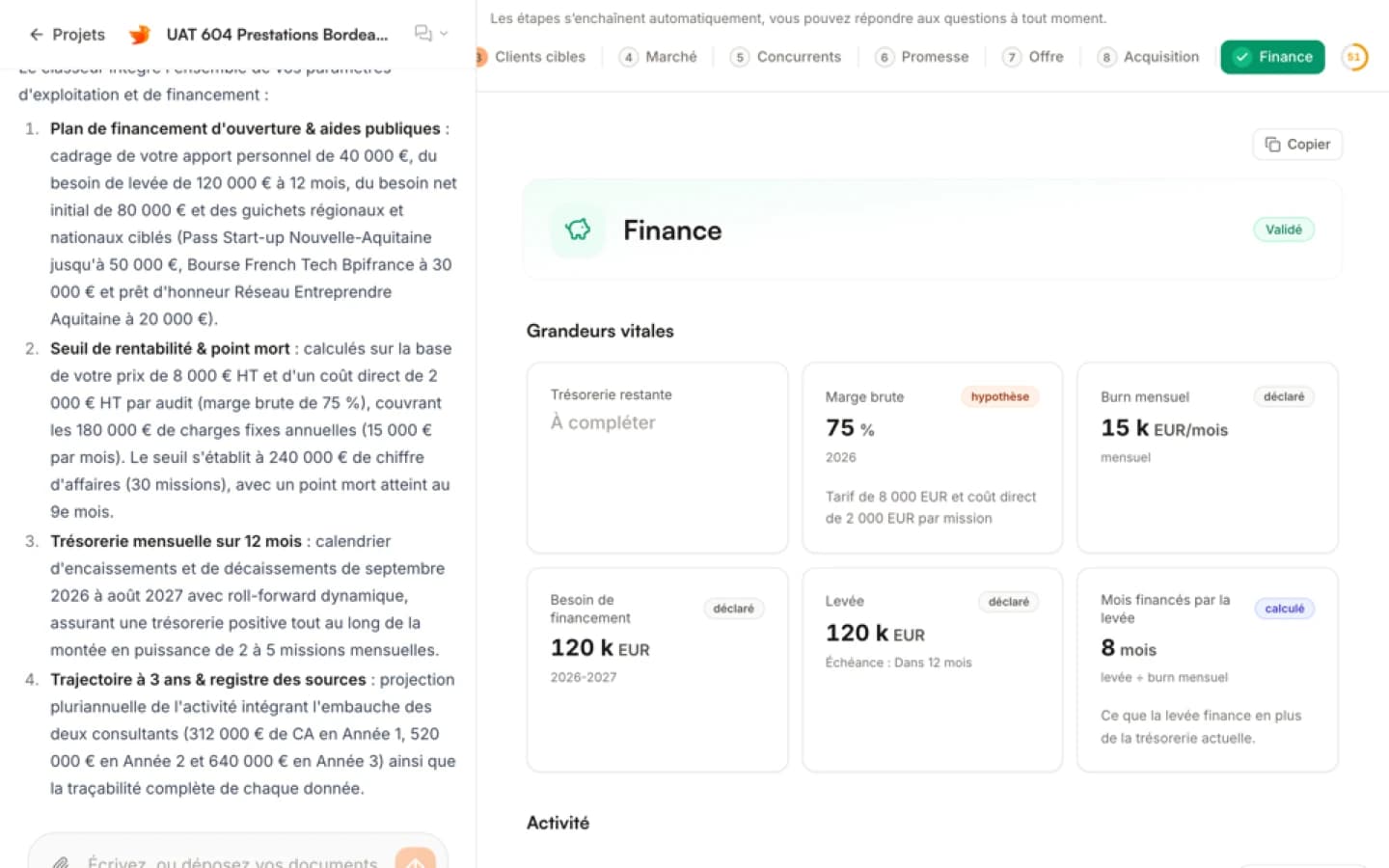
To move from analysis to action, Fund Your Growth presents the corresponding Ember workflow.
Sources and methodology
This guide draws on Market Launcher's discussion of market penetration, LinkedIn's sales pipeline overview and LeanLabs' pipeline guide. A funding announcement alone does not show customer dissatisfaction; verify any claimed change before using it in a sales message.
Sources
FAQ
Mini audit
Test your Business Plan
Identify strengths, missing proof and the next priority.