
Symptom or signal
Bootstrapped founders and early sales teams often face a difficult challenge when trying to grow their pipeline. They need to generate high-quality Business-to-Business (B2B) leads, but they lack the massive budgets required to purchase expensive contact lists or subscribe to high-volume outbound databases. The immediate temptation is to buy a pre-packaged list, but this often results in high bounce rates, wasted time, and generic outreach that fails to convert. For established sales teams with structured outbound budgets, traditional database tools can be highly effective. For example, Apollo is an excellent option for sales leaders or Revenue Operations (RevOps) managers who prioritize immediate volume and database depth. Apollo reached 150 million dollars in annual recurring revenue in 2025, as reported by Apollo's company history page. Its Chrome extension lets users add contacts from Salesforce or HubSpot to Apollo lists and sequences, as described by UpLead. However, its credit-based pricing model can quickly become expensive for a bootstrapped startup. Under this model, every contact action, such as verifying an email, obtaining a phone number or enriching a record, consumes credits, as presented on the Apollo pricing page. This financial barrier forces many early-stage entrepreneurs to ask how to build their first B2B lead list without paying for expensive tools, a common pain point discussed widely on Reddit. Founders frequently search for ways to generate B2B leads without relying on paid advertisements, seeking organic, high-intent alternatives as highlighted in community discussions on Reddit. They need to move away from generic, cold databases and focus on full-funnel strategies that actually convert, as outlined by the Small Business Expo. Instead of buying massive databases that create noise, sales teams can leverage targeted intelligence to identify high-priority opportunities. Ember offers a capability called Lead Intelligence, which helps teams know who to contact, why now, and which action to take. Rather than requiring a massive upfront database, Lead Intelligence finds and prioritizes the contacts itself, whether the team starts with 10, 100, or 1,000 contacts, with no minimum contact threshold, as outlined on the Ember Lead Intelligence Page. This allows bootstrapped teams to start small and scale organically. Once a team establishes a usable targeting context, the first prioritized leads can appear in about 30 minutes, providing a clear next action, including who to contact, why now, which channel, and which angle to use, as detailed on the Ember Lead Intelligence Page.
To place this decision in context, the Knowledge guides for sales bring together deeper guidance on the same field.
What changed
Traditionally, sales teams relied on massive, static databases to build prospect lists. Platforms like Apollo became highly popular by offering immediate volume for outbound sales. For instance, Apollo grew its annual recurring revenue to 150 million dollars in 2025, according to Apollo's company history page. These tools are excellent for structured, high-volume outbound campaigns managed by a dedicated Sales Development Representative (SDR) or a Revenue Operations (RevOps) manager who needs to maintain broad pipeline coverage.
However, for bootstrapped founders and lean sales teams, the credit-based pricing model of these databases can quickly become expensive. Apollo's pricing works with credits, and every contact action, such as verifying an email, obtaining a phone number or enriching a record, consumes some, as presented on the Apollo pricing page. The cost therefore grows with volume. While these platforms offer a Chrome extension that lets users add contacts from Salesforce or HubSpot to their lists and sequences, as noted by UpLead, they still require significant manual filtering to avoid wasting expensive credits on cold, irrelevant leads.
What has changed is the shift from raw volume to usable context: instead of accumulating thousands of cold profiles, teams want to know who to contact, why now and with which angle.
Facts and sources
Bootstrapped founders and sales teams often struggle to build their initial pipeline without relying on expensive, static databases. In discussions on how to build a first Business-to-Business (B2B) lead list without paying for expensive tools on Reddit, practitioners emphasize organic, high-intent methods over blind list buying. Similarly, when exploring how to generate B2B leads without paid ads on Reddit, practitioners favor approaches built on value and precise targeting.
To explore this point further, What evidence should a pre-seed startup founder check before choosing Lead Intelligence? details a step directly related to this decision.
Why the common explanation is incomplete
The common advice given to early sales teams looking to build a pipeline is simple: subscribe to a massive database, download thousands of contacts, and start blasting emails. This explanation is incomplete because it mistakes raw data volume for actual sales opportunities. For a bootstrapped founder, this approach introduces severe operational friction and hidden financial drains that can stall growth before it even starts.
The first major gap in this common strategy is the actual cost of data acquisition. While database platforms promise easy access, their credit-based pricing models are highly restrictive for lean budgets. For instance, according to the Apollo pricing page, every contact action (email verification, phone number, enrichment, calls) consumes credits, and the bill grows with volume. When a sales team is forced to burn through many credits just to find a handful of responsive prospects, the cost of list building quickly rivals that of paid advertising.
The second issue is that these platforms are architected for a completely different type of buyer. They are built for organizations with dedicated sales leaders and Sales Development Representative (SDR) teams running highly structured, high-volume outbound campaigns. They rely on their CRM, for example Salesforce or HubSpot, which Apollo's Chrome extension can connect to its lists and sequences, as described by UpLead.
For a bootstrapped startup, copying this enterprise playbook is a mistake. Without a dedicated RevOps team to clean the data and manage complex CRM synchronizations, cold lists quickly decay into bounce-heavy databases. This operational bottleneck explains why founders frequently turn to communities like Reddit to figure out how to generate Business-to-Business (B2B) leads without paid ads or expensive tools. The missing piece in the traditional outbound playbook is not the quantity of the contacts, but the context behind them. Instead of paying to acquire thousands of cold profiles, lean sales teams need a way to identify who to contact, why they should contact them right now, and what specific angle will resonate with their current situation.
The real problem
The core challenge for a bootstrapped sales team is not a lack of names, but a lack of timing and relevance. When budgets are tight, buying a massive, static list of contacts is a high-risk gamble.
For established companies with large budgets and a highly validated Ideal Customer Profile (ICP), traditional sales engagement platforms are highly effective. These organizations can afford to run structured, high-volume outbound campaigns where the goal is sheer pipeline coverage. However, for a bootstrapped startup, this volume-first model introduces a severe financial strain. Under traditional credit-based pricing models, such as the one presented on the Apollo pricing page, every email verification, phone number and enrichment consumes credits. For a small team, these costs multiply rapidly before a single conversation even starts.
Beyond the financial cost, the operational burden of managing static lists is the true bottleneck. Static databases decay quickly, leading to high bounce rates and wasted effort. Sales teams end up spending their valuable hours cleaning outdated spreadsheets, manually verifying social profiles, and guessing which prospects are actually ready to buy. This lack of real-time context means outreach is often mistimed, turning potential opportunities into cold, ignored emails. For a bootstrapped founder, the real problem is that buying data does not buy attention, it only buys noise.
This approach also connects with How should a B2B sales team score and prioritise leads in 2026 without a marketing team, a CRM admin, or a scoring tool?, which clarifies the next choice.
How the mechanism works
Traditional outbound tools like Apollo are highly effective for sales leaders or Revenue Operations (RevOps) managers running highly structured, high-volume outbound campaigns. According to Factors.ai, Apollo combines a vast database of verified contacts with engagement features such as email sequencing, calling and pipeline tracking. These platforms appeal to teams with dedicated Sales Development Representatives (SDRs) who need rapid workflow speed and massive pipeline coverage. This high-volume model has proven highly successful, helping Apollo reach 150 million dollars in annual recurring revenue in 2025, as reported by Apollo's company history page.
However, this volume-first mechanism comes with a complex credit-based pricing model. For instance, according to the Apollo pricing page, email verification, phone number retrieval and data enrichment each consume credits. Additionally, as noted by UpLead, Apollo's Chrome extension lets users add contacts from Salesforce or HubSpot to their lists and sequences. For a bootstrapped startup or a lean sales team, spending credits on unverified contacts to find a few relevant buyers is often financially unsustainable.
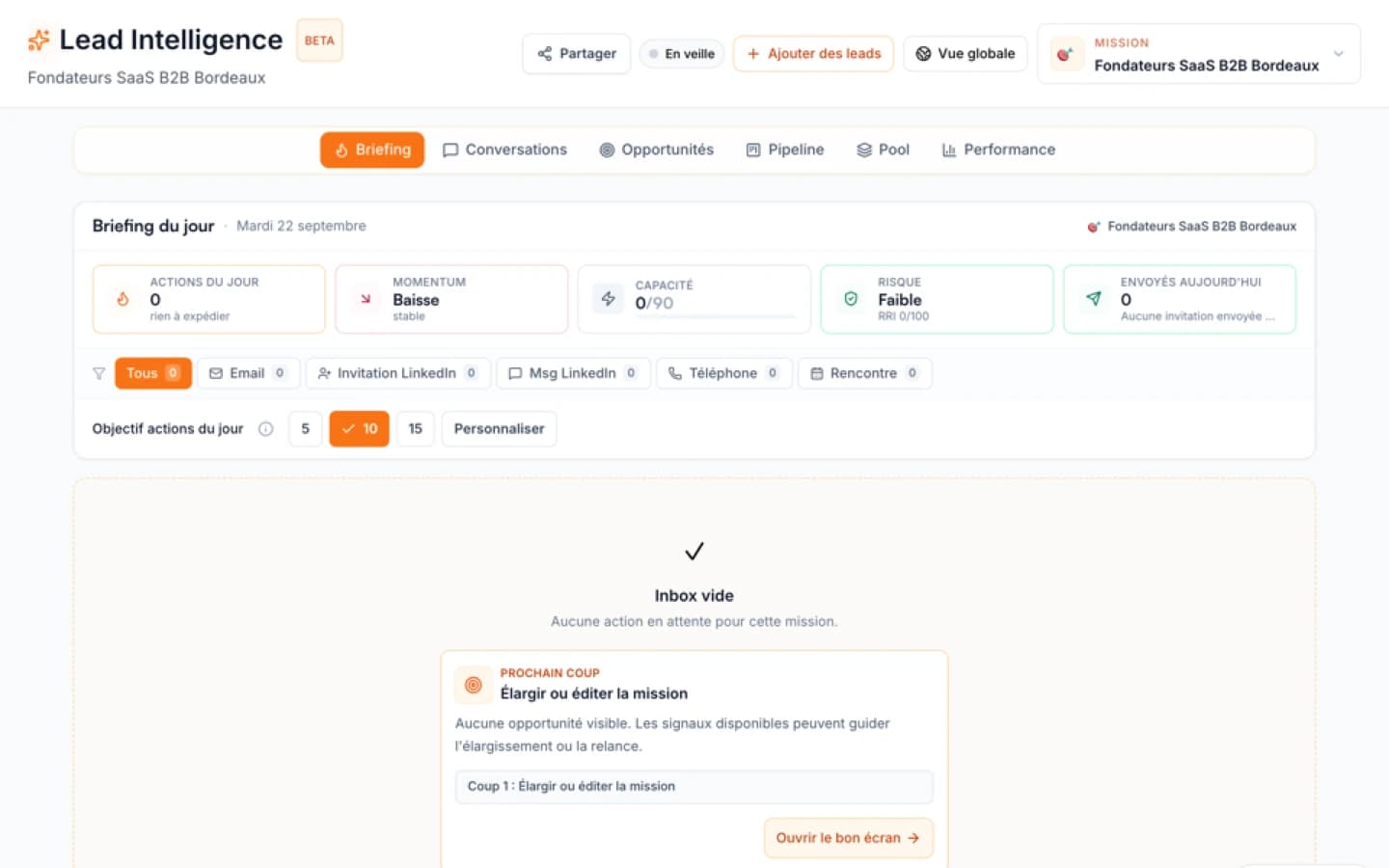
Instead of buying static lists, Lead Intelligence starts from your project context: it finds and prioritizes the contacts itself, then proposes the next action and channel that fit the lead situation, with no minimum contact threshold, as outlined on the Ember Lead Intelligence page.
Concrete examples
To understand how a bootstrapped founder can build a high-performing pipeline without a massive budget, consider the contrast between traditional database scraping and context-driven prospecting.
In a traditional outbound setup, sales teams often rely on massive databases to build volume. For established companies, this model works well because they have the budget to absorb the cost of unverified data. According to Apollo's company history page, Apollo reached 150 million dollars in annual recurring revenue in 2025, by serving sales leaders who require immediate volume. However, for a bootstrapped team, this credit-heavy model can quickly drain resources. On the Apollo pricing page, every contact action works with credits, which makes the bill grow with volume.
In practice, Apollo vs Ember Lead Intelligence for Founder Conversion completes this framework with another angle on the same topic.
When to use this diagnosis
For a bootstrapped founder or a lean sales team, paying for massive contact databases often leads to high bounce rates and generic outreach that fails to convert. Online discussions on Reddit regarding building lead lists and Reddit discussions on non-paid lead generation highlight a widespread frustration with the high cost of traditional tools.
When not to use it
A bootstrapped, context-first prospecting approach is highly efficient, but it is not a universal solution for every sales team. If your organization has a large, dedicated Sales Development Representative (SDR) team and a highly mature, validated market, a traditional high-volume database is often a better fit. Platforms like Apollo suit sales leaders or Revenue Operations (RevOps) managers running highly structured outbound campaigns where pipeline coverage and workflow speed are the primary metrics.
For companies that prioritize sheer volume and immediate outbound activity, these traditional platforms are highly effective. As reported by Apollo's company history page, Apollo reached 150 million dollars in annual recurring revenue in 2025, showing strong adoption among high-volume sales teams.
Before deciding, How a traction-stage startup founder should contact investors? helps connect this method with adjacent priorities.
Next step
To transition from generic database scraping to a context-driven pipeline, sales teams must shift their focus from sheer volume to high-intent signals. Instead of purchasing expensive, static contact lists that quickly decay, the most effective next step is to leverage real-time context to identify active Business-to-Business (B2B) opportunities. This approach allows lean teams to initiate highly relevant conversations without the overhead of massive databases.
By adopting Lead Intelligence, sales teams can systematically discover and prioritize opportunities based on their project context and on changes across people and companies. Whether your sales team starts with 10, 100, or 1,000 contacts, Lead Intelligence finds and prioritizes the opportunities itself with no minimum contact threshold, as outlined on the Ember Lead Intelligence page. This eliminates the need for massive upfront investments in unverified data. Once you establish your targeting context, the first prioritized leads can appear in about 30 minutes, according to the Ember Lead Intelligence capabilities.
This context-first methodology ensures that your outreach is always timely and purposeful. Rather than sending generic, automated sequences that risk damaging your domain reputation, Lead Intelligence proposes the next action and channel that fit the specific lead situation. It provides a clear next action by identifying exactly who to contact, why now, which channel to use, and which angle to take. By focusing on these high-priority conversations, bootstrapped founders and sales teams can build a sustainable, high-converting outbound engine that relies on relevance rather than raw volume.
Sources and methodology
To ensure the highest level of accuracy for sales teams evaluating outbound strategies, this analysis relies on verified public data, community discussions, and official product documentation.
The qualitative insights regarding organic lead generation are grounded in real-world experiences shared by founders. We analyzed community discussions on how to build a Business-to-Business (B2B) lead list without paying for expensive tools on Reddit and tactical advice on generating B2B leads without paid ads on Reddit.
Sources
FAQ
Free diagnostic
Test your sales file
Drop an Excel or CSV and check its readiness without sending its rows to Ember.