
Definition
Modern Business-to-Business (B2B) lead qualification in 2026 requires a fundamental shift because buying committees are larger and prospects complete most of their evaluation before ever speaking to a Sales Development Representative (SDR): according to monday.com, modern B2B buyers complete 67% of their purchase journey before contacting sales representatives. Traditional lead scoring models that rely solely on form fills or gated content downloads fail to capture the anonymous research signals of modern buyers. According to industry insights on B2B sales lead generation strategies for 2026 published by monday.com, revenue teams must adapt to self-educated buyers by focusing on real intent signals rather than superficial activity. This means qualification is no longer about checking boxes on a static list. It is about understanding the context of the entire account, mapping the multi-stakeholder committee, and identifying exactly when a company is ready to buy. Understanding how to qualify b2b leads early prevents pipeline bloat and helps ensure that your Customer Relationship Management (CRM) system is populated with high-quality opportunities rather than unverified noise. For early-stage companies, this shift changes the entire approach to outbound sales for startups. When resources are tight, a common question arises: how does a founder qualify B2B leads without a sales team? Without a dedicated SDR or Business Development Representative team, founders must rely on intelligent prioritization rather than raw volume. Instead of building a prospect list from scratch using manual databases that charge per credit, founders must focus on relevance. When determining who to contact first as a founder, the answer is generally the accounts showing active, verifiable signals that align with your core offering, rather than a generic list of cold contacts. Knowing who to contact first as a founder allows you to build momentum quickly without exhausting your limited resources on ineffective cold outreach. To build a healthy sales pipeline without wasting time, teams must look beyond legacy databases. For instance, while high-volume platforms like Apollo have grown significantly, reaching 150 million dollars in annual recurring revenue as reported by Apollo's company history page, their credit-based pricing models can penalize teams by turning every enrichment and export into a metered cost. For startups and lean sales teams, a more efficient path is to connect their core strategy directly to their b2b prospecting. By using Ember and its Lead Intelligence capability, teams can reuse their Ideal Customer Profile (ICP), business plan, and offer strategy to find and prioritize contacts. With usable targeting context, the first prioritized leads can appear in about 30 minutes, allowing founders and sales teams to focus their energy only on the conversations that deserve attention now.
To place this decision in context, the Knowledge guides for sales brings together deeper guidance on the same field.
Prerequisites
Before a Business-to-Business (B2B) sales team can execute modern lead qualification, several foundational elements must be established. The shift in how modern buyers evaluate software means that traditional lead scoring models, which rely purely on superficial form fills, are no longer sufficient. To build a healthy sales pipeline, teams must prepare their data, align their stakeholders, and establish clear criteria before launching any cold outreach or b2b prospecting campaigns. First, the team must define a dynamic Ideal Customer Profile (ICP). A static list of target industries and company sizes is no longer enough when buying committees are larger and most research happens anonymously. Sales teams need to establish how to detect real intent from anonymous research signals and how to map a multi-stakeholder committee without relying on a large Business Development Representative (BDR) team, which is a key strategy for driving results in 2026, as noted by monday.com. This requires a clear understanding of the roles within the target organization. For example, in structured outbound sales for startups, the buying committee often includes a VP of Sales who cares about pipeline coverage, a sales development representative (SDR) team lead who cares about workflow speed, and a finance or operations contact who scrutinizes software costs. Second, teams must address the infrastructure of their sales pipeline. Many teams fall into the trap of volume-driven outbound sales where success is measured by the sheer quantity of messages sent. Platforms like Apollo have scaled aggressively by optimizing for this end of the funnel, reaching 150 million dollars in annual recurring revenue (ARR) by making outbound activity highly efficient, according to Apollo's company history page. However, the tradeoff is that credit-based pricing models turn every action into a metered decision, where exporting contacts, enriching records, and verifying emails each consume credits. Apollo's pricing page states that export credits are consumed whenever a contact is exported outside Apollo. When scaling outbound sales for startups, this credit math does not just multiply linearly; instead, wasted exports and bounced emails compound the cost. Therefore, a prerequisite for modern lead qualification is establishing a system that prioritizes lead quality and context over raw volume. This infrastructure choice directly impacts early-stage companies. When considering how does a founder qualify B2B leads without a sales team, the answer lies in leveraging contextual intelligence rather than manual labor. Instead of building a prospect list from scratch with thousands of unverified contacts, founders can use intelligent systems to analyze existing context. If you are wondering who should an early-stage founder contact first, the priority should always be the prospects who exhibit the strongest situational alignment with your core offer. To support this, tools like Ember Lead Intelligence allow teams to bypass the traditional manual grind. By reusing the Ember Fund Your Growth, ICP, offer, and strategy, founders and sales teams can prepare a targeted sales mission.
Steps
To qualify Business-to-Business (B2B) leads effectively when buying committees are larger and research happens silently, sales teams must execute a structured, multi-step process.
First, transition from static firmographics to intent-driven account tracking. Traditional lead qualification often begins with building a prospect list from scratch based on broad categories like company size or industry. In the modern landscape, however, how to qualify B2B leads early depends on capturing anonymous research signals before a prospect ever speaks to a Sales Development Representative (SDR). Sales teams must monitor indicators such as hiring patterns, technology installations, and peer-to-peer discussions. By shifting the focus of B2B prospecting to active accounts, teams can prevent their sales pipeline from becoming clogged with cold accounts that have no immediate buying intent.
Second, map the multi-stakeholder buying committee without relying on a massive Business Development Representative (BDR) team. When an early-stage founder asks how does a founder qualify B2B leads without a sales team, the answer lies in systematic account mapping. Because modern purchasing decisions involve multiple stakeholders, qualifying a single lead is no longer sufficient. Founders and lean commercial teams must identify the distinct roles within a target account, including the end-user, the technical evaluator, and the financial decision-maker. If you are wondering who should an early-stage founder contact first, start with the operational champion who experiences the daily friction your product solves, then use their feedback to engage the economic buyer.
Third, replace legacy lead scoring with contextual opportunity analysis. Traditional lead scoring models in a Customer Relationship Management (CRM) system often assign arbitrary points to isolated actions, such as downloading an ebook. This approach fails when buyers do most of their research anonymously. Instead, modern outbound sales for startups requires analyzing the depth and velocity of account-level engagement. Rather than measuring raw activity volume, qualification must focus on the relevance of the interaction. For example, while legacy platforms like Apollo cover a wide scope of outbound prospecting, modern teams require tools that prioritize high-intent conversations. Apollo reached $150 million in annual recurring revenue by optimizing for outbound efficiency, as documented by Apollo's company history page, but scaling teams often face compounding costs from credit-based pricing models that charge for every enrichment and export.
Fourth, align your cold outreach with the validated context of the target account. Once an account is qualified, the initial engagement must reflect their specific stage in the buying journey. Instead of generic templates, outreach should address the exact pain points and structural gaps identified during the qualification phase. This is where agentic workflows transform the process. By utilizing Ember and its Lead Intelligence capability, teams can align their sales missions with their core strategy. The system reuses the validated Business Plan, Ideal Customer Profile (ICP), and offer to prepare the outreach context. With usable targeting context, the first prioritized leads can appear in about 30 minutes. This allows lean teams to focus their energy on high-value conversations rather than manual tasks.
To explore this point further, Clay vs Ember: when each one fits details a step directly related to this decision.
Worked example
To understand how this works in practice, let us look at a concrete scenario for a startup building a prospect list from scratch. When considering how to qualify B2B leads early, early stage founders often ask two critical questions: How does a founder qualify B2B leads without a sales team? And who should an early stage founder contact first?
To answer how a founder qualifies Business-to-Business (B2B) leads without a sales team, the strategy must shift from high volume outbound sales for startups to context driven lead qualification. Instead of trying to build a massive, unverified list, a founder should focus on high intent accounts that match their Ideal Customer Profile (ICP).
Traditional B2B prospecting platforms like Apollo have scaled significantly, reaching 150 million dollars in annual recurring revenue by making outbound activity highly efficient, according to data from Apollo's company history page. However, the tradeoff is that credit based pricing turns every action into a metered decision where exporting, enriching, and verifying contacts constantly consumes credits. This model often forces teams into a volume driven approach to justify the compounding costs of wasted exports and bounced emails.
Common mistakes
Many Business-to-Business (B2B) sales teams fail to adapt their lead qualification to the modern reality of self-educated buyers. The first major mistake is relying on volume-driven outbound strategies that prioritize quantity over context. When teams treat lead qualification as a numbers game, they often rely on massive databases that charge based on credits. This credit-based pricing turns every action into a metered decision where exporting contacts, enriching records, and verifying emails each consume credits. As a sales team scales, these costs compound due to wasted exports and bounced emails. While platforms like Apollo have successfully scaled to 150 million dollars in annual recurring revenue by making high-volume outbound activity highly efficient, as reported by Apollo's company history page, this model incentivizes teams to send more messages rather than identify genuine readiness. The second mistake is ignoring the size and complexity of the modern buying committee. Sales representatives often attempt to qualify a lead by speaking to a single contact, ignoring the fact that purchasing decisions are now highly distributed. A typical buying committee for a sales tool, for example, often includes a Vice President (VP) of Sales who focuses on pipeline coverage, a Sales Development Representative (SDR) team lead who prioritizes workflow speed, and a finance or operations manager who scrutinizes pricing. Failing to map these stakeholders early leads to stalled deals because the sales team has only qualified one person instead of the entire committee. The third mistake is relying on static firmographics and outdated lead scoring models instead of real-time intent. In 2026, buyers complete most of their research silently before ever speaking to a representative. Qualifying leads based solely on company size or job title misses the critical window of active evaluation. Modern qualification requires detecting real intent from anonymous research signals and mapping multi-stakeholder committees, as outlined in B2B sales lead generation strategies published by monday.com. This challenge is especially acute for early-stage startups where resources are limited. Founders often ask: How does a founder qualify B2B leads without a sales team?
This approach also connects with What does a defensible B2B lead generation process look like in 2026 for a team that cannot rely on a single channel?, which clarifies the next choice.
Tools
To qualify B2B leads in 2026, with buying committees widening and most research happening before the first call, sales teams must rethink their tools. A platform like Apollo, which offers among other things a B2B contact database, sequences, a phone dialer and a Chrome extension, reached 150 million dollars in annual recurring revenue according to Apollo's company history page. However, its credit-based pricing turns every action into a metered decision: exporting contacts, enriching records and verifying emails consume credits, and Apollo's pricing page states that export credits are consumed whenever a contact is exported outside Apollo. As a team grows, wasted exports, bounced emails and re-enrichments push costs up. In practice, the founder should first identify their ICP (ideal customer profile) and contact the most accessible decision-maker, often the VP of Sales or the RevOps lead, while mapping the other members of the buying committee, such as an SDR lead and a finance lead, who weigh in on the decision. The goal is to build a prospect list from scratch using intent signals, and to feed that data into a CRM (Salesforce or HubSpot) for lead scoring.
When to use this method
This modern lead qualification method is designed for Business-to-Business (B2B) sales teams facing a fundamental shift in buyer behavior, where most of the purchase journey occurs anonymously before any direct contact. Traditional cold outreach and volume-heavy outbound sales for startups are losing effectiveness because modern buying committees are larger and more risk-averse. Adopting these modern B2B prospecting strategies is essential for navigating the complex sales landscape of 2026, where buyers expect highly personalized interactions and have already completed most of their research before speaking to a representative. This approach is highly effective when a sales pipeline suffers from low conversion rates despite high activity levels, indicating that the team is targeting accounts without real buying intent.
For early-stage companies, this method directly addresses the challenge of how to qualify B2B leads early when resources are limited. Founders often struggle with the operational question of how does a founder qualify B2B leads without a sales team? The answer lies in replacing manual prospecting with automated signal tracking and contextual lead scoring. By monitoring indicators such as hiring plans, technology installations, and public growth signals, a founder can identify high-fit accounts that match their Ideal Customer Profile (ICP) without needing a dedicated Sales Development Representative (SDR) team to run manual cold outreach.
When building a prospect list from scratch, knowing who to contact first as a founder is critical to avoiding wasted effort. Instead of targeting the highest-ranking executive who is likely guarded by gatekeepers, this method points first to the operational champion who feels the friction day to day, then uses their feedback to reach the decision-maker.
In practice, Apollo vs Ember Lead Intelligence for Founder Conversion completes this framework with another angle on the same topic.
When not to use it
For an early-stage founder wondering who to contact first or how to qualify Business-to-Business (B2B) leads without a sales team, starting with a massive, unsegmented list is rarely the answer. However, there are specific scenarios where a highly targeted, signal-based qualification methodology is not the right fit.
First, if your sales organization is built entirely around high-volume, broad-market cold outreach, traditional database tools are a better choice. When your primary goal is to maximize the sheer quantity of outbound activities across phone, email, and social media, a broad database with built-in dialers is genuinely useful. For example, Apollo reached 150 million dollars in annual recurring revenue by building a product that makes high-volume outbound activity efficient, as reported by Apollo's company history page. If your revenue model relies on sending thousands of automated messages daily to secure a small percentage of meetings, a volume-driven platform is the correct tool for your Sales Development Representative (SDR) team.
Second, this signal-based approach is not suitable if your team is not prepared for the pricing structure of traditional data providers. Credit-based pricing models turn every single action, such as exporting contacts, enriching records, or verifying emails, into a metered decision. These costs can compound quickly due to wasted exports or bounced emails. If you do not have the budget or the operational oversight to manage metered credit consumption, a highly automated outbound engine may create unnecessary financial overhead.
Finally, signal-driven qualification is ineffective if you have not yet defined your Ideal Customer Profile (ICP) or core strategy. Tracking intent signals and executive movements requires a clear baseline of who you are trying to reach. Without this strategic foundation, attempting to monitor buyer behavior will only generate noise.
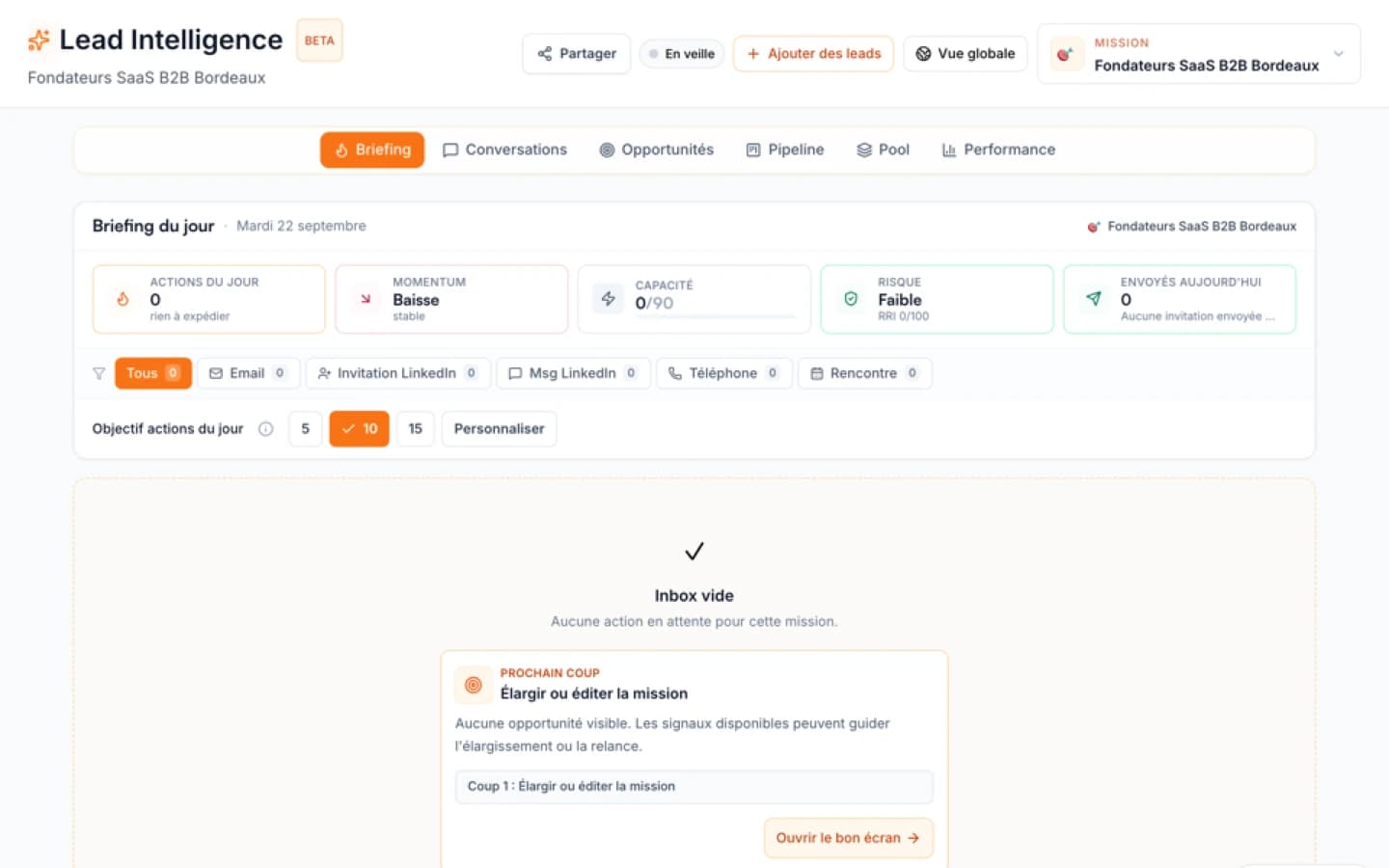
For teams that want to move away from the high costs of uncoordinated volume and instead focus on high-intent opportunities, Ember offers a different path. Ember Lead Intelligence is designed to reuse your existing business plan, ICP, and strategy to prepare a targeted sales mission, finding and prioritizing contacts with no minimum contact threshold. Lead Intelligence finds and prioritizes the contacts itself whether the team starts with 10, 100, or 1,000 contacts. Furthermore, with usable targeting context, the first prioritized leads can appear in about 30 minutes. This allows founders and sales teams to bypass the noise of generic databases and focus their energy on the conversations that are actually ready to convert.
Action plan
To navigate Business-to-Business (B2B) prospecting in 2026, as outlined by Monday.com, sales teams must adapt to self-educated buyers who perform anonymous research before ever speaking to a representative. This shift requires a structured action plan that moves away from legacy cold outreach and focuses on high-intent lead qualification. First, transition from volume-driven outbound sales to signal-based targeting. While legacy platforms are built for high-volume outbound, which helped Apollo reach $150 million in annual recurring revenue according to Apollo's company history page, this approach carries significant trade-offs. Credit-based pricing models turn every action into a metered decision where wasted exports and bounced emails compound costs as teams scale. Instead of scraping massive lists, build a highly targeted prospect list from scratch by identifying accounts that exhibit active research signals. Second, address the challenge of larger buying committees. When considering how a founder qualifies B2B leads without a sales team, the key is to map the multi-stakeholder committee early. A typical buying committee often includes distinct personas, such as a sales leader focused on pipeline coverage, an operational lead focused on workflow speed, and a finance contact scrutinizing costs. Rather than relying on a dedicated Sales Development Representative (SDR) team to run manual discovery, founders can identify these stakeholders and their unique pain points before initiating contact. Third, determine who should an early-stage founder contact first. Instead of reaching out blindly to the highest-ranking executive, target the internal champion who is actively feeling the operational pain, alongside the economic decision-maker who owns the budget. This dual-track approach aims to make your message resonate with both the daily user and the financial buyer. Fourth, update your lead scoring and Customer Relationship Management (CRM) workflows. Traditional lead scoring relies heavily on form fills and gated content downloads. A modern qualification checklist, however, must incorporate anonymous research signals and intent data to prioritize accounts that are already evaluating solutions in your category. This prevents your sales pipeline from becoming clogged with low-intent contacts. For teams and founders looking to execute this strategy without the overhead of complex operations, Ember provides a direct path. Through Lead Intelligence, the platform reuses your validated Ideal Customer Profile (ICP), business plan, offer, and strategy to prepare a targeted sales mission. Instead of waiting days for manual list building, the first prioritized leads can appear in about 30 minutes once a usable targeting context is established. This allows you to focus your energy on the conversations that actually deserve attention today, backed by a strategy ready to be defended.
Before deciding, What Does a Realistic Weekly Outbound Workload Look Like for a B2B Rep in 2026? helps connect this method with adjacent priorities.
Sources and methodology
Our analysis draws on the B2B lead generation strategies published by monday.com, on data from Apollo and on the presentation of Apollo and its pricing page. The Lead Intelligence capabilities described come from the product itself.
This methodology combines qualitative insights and quantitative benchmarks to help sales teams navigate ever larger buying committees. It lets a founder without a sales team qualify B2B leads by spotting intent signals from the first research, and decide whom to contact first: generally the business decision-maker most sensitive to results rather than to sheer activity volume.
Sources
FAQ
Free diagnostic
Test your sales file
Drop an Excel or CSV and check its readiness without sending its rows to Ember.