
Definition
Buying-group evidence is an account-prioritisation mechanism for teams facing several participants in one purchase. It replaces contact count with four evidence layers: current problem, credible access, relevant role coverage and a path toward shared internal value.
The account, not the person, is the decision unit. Each contact carries an observed role, a hypothesis or an unknown. The team records contradictions instead of overwriting them. Priority rises when one bounded action can resolve an important uncertainty, not when a database contains more names.
The four-layer buying-group evidence map is an editorial prioritisation method, not a universal purchasing model or a measured performance benchmark.
Why this category exists
Large buying teams create a coordination problem for the buyer and an interpretation problem for the seller. Gartner reported from a 2024 survey of 632 B2B buyers that buying teams in its study ranged from five to sixteen people across as many as four functions source.
That result describes Gartner's sample, not every B2B purchase. Its useful implication is that headcount alone cannot represent readiness. Several people may disagree about the problem, risk, value or implementation. One senior contact may have status but no role in the specific decision.
The category exists to make uncertainty visible. A small team cannot research and contact every possible participant. It needs to know which account question matters next and which person can help resolve it.
How it works
Start with problem evidence. Record a dated event, operational condition or buyer statement that makes the issue current. Separate the observed fact from the seller's interpretation and write what would disprove the hypothesis.
Next, record access evidence. Identify someone able to clarify the problem or route the team. A direct relationship, accepted conversation or credible introduction can create access. A profile in a database only proves discoverability.
Then map role coverage. List functions that may use, approve, secure, finance, implement or block the change. Mark each role known, unknown or contradicted and attach its source. Salesforce documents a buyer relationship map that visualises contacts across company levels and highlights stakeholders, champions and risks source.
Finally, write the consensus path: shared business outcome, likely disagreement, evidence the group can circulate and next decision. Choose one action that closes the most consequential gap with acceptable effort.
Use the Defensible B2B Lead Qualification Framework for Small Sales to define account entry rules.
Difference from the classic approach
The classic approach scores people from title, seniority, activity and apparent intent, then adds the scores to the account. Buying-group evidence starts from an account problem and maps the decision roles around it.
This avoids three false shortcuts. More contacts do not prove more intent. A senior title does not prove authority over this decision. One engaged person does not prove internal agreement. These signals can guide research, but none replaces role and problem evidence.
The next action also changes. Classic outreach may launch parallel sequences to several names. The evidence mechanism assigns one account action, such as verifying the triggering event, asking how the decision is evaluated, requesting an introduction or supplying a proof that can be shared internally.
Concrete example
A small team sells security workflow software. Two accounts match the ideal profile. Account A contains nine contacts, including a senior executive, but no current problem or accepted route. Account B contains three known people, a dated audit change, an engaged operations lead and an unknown security approver.
The classic contact score may rank Account A first. The evidence mechanism ranks Account B as map one gap. Its next action is to ask the operations lead how security approval works and whether an introduction is appropriate.
Account A remains research only until the team verifies timing or access. Nobody messages all nine contacts. The decision preserves scarce capacity and reduces the chance of contradictory promises inside one account.
Limits
Public sources rarely reveal informal influence, internal opposition or authority over one purchase. Role maps remain hypotheses until the buyer confirms them. A complete-looking chart can therefore create false confidence.
The Gartner figures describe a stated survey sample and should not become a minimum committee size. A small transaction may involve fewer people, while a regulated change may involve more. The method sets no universal role list.
The mechanism also does not create lawful contact rights, a compelling offer or buyer consensus. The team must review the source, permitted channel, objections and confidentiality before acting.
When to use it
Use this mechanism when enterprise accounts contain several functions, a current supporter cannot explain the whole decision, the sales team repeatedly contacts the wrong senior person, or opportunities stall after an initially positive conversation.
It is especially valuable when research capacity is limited. The map turns a broad account into one explicit evidence gap and makes the next research or conversation comparable across the pipeline.
Use the mechanism before multi-threading, before increasing outreach volume and before interpreting several anonymous signals as a buying group.
When not to use it
Do not use a buying-group map for a simple transactional decision that genuinely has one known owner and low implementation risk. The extra mapping would add administration without changing the next action.
Do not use it when no current account problem or suitable contact route is supported. Park the account rather than inventing roles. It is also inappropriate when the team cannot preserve source dates, permissions and contradictions. A polished map without provenance is not defensible evidence.
How Ember can support the review
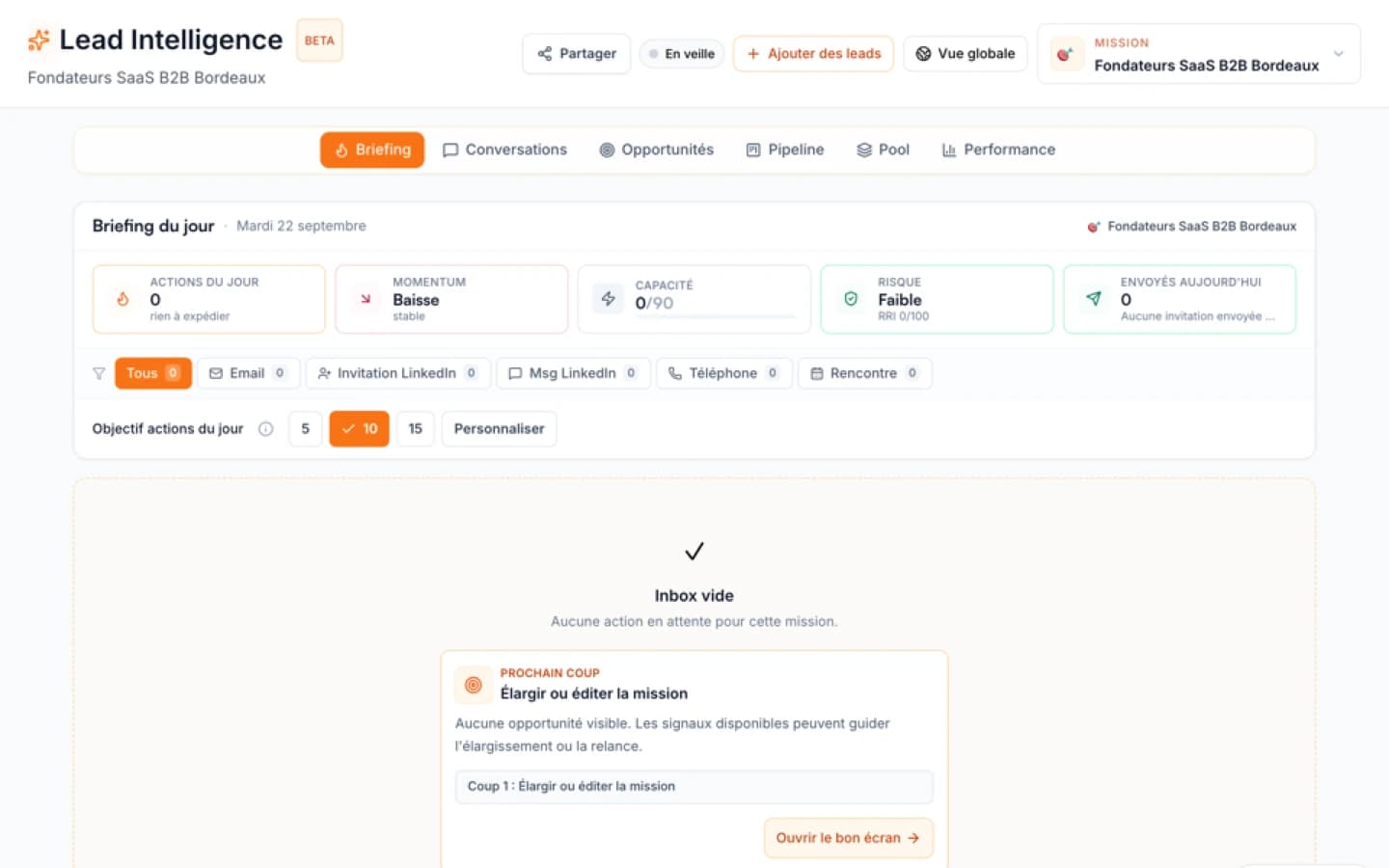
Lead Intelligence prioritises opportunities from the available context source. It can support account review while the user preserves the problem, access, role and consensus evidence behind the decision.
A human owner must confirm buyer roles, inspect sources, resolve contradictions and decide whether the proposed next action is appropriate. Public data alone does not establish consensus or purchase intent.
Lead Intelligence can inform the next account review. Your team still maintains the buying-group map and checks whether the people involved agree on the need and the next step; the tool does not establish that agreement automatically.
Sources and methodology
The market perimeter uses the Gartner buyer-team survey release. Relationship mapping uses official Salesforce documentation. The exact product capability is cited in the relationship section above.
The four review layers are a practical method for the team to test. Gartner’s surveyed buyers, Salesforce’s relationship mapping guidance and Ember’s product description have different scopes; none establishes that this exact method increases conversion.
Sources
FAQ
Free diagnostic
Test your sales file
Drop an Excel or CSV and check its readiness without sending its rows to Ember.