
Your ideal customer profile may say "SaaS vendors with 50 to 200 people". In the United States, two data vendors will not mean the same thing by "SaaS", and your CRM will not be able to match their lists. The classic remedy is called NAICS. This article explains what the code brings to an ICP, how to estimate the size of a market with the Census Bureau's public statistics before buying a list, and where the code stops being useful.
Starting point: according to Salesforce, an ideal customer profile is "a detailed description of a buyer who's a perfect fit for your products or services". Salesforce distinguishes it from a buyer persona: the ICP defines the type of company that is a good fit, while the persona is a semi-fictional representation of an individual buyer.
What NAICS is
According to the Census Bureau, the North American Industry Classification System (NAICS) is "the standard used by Federal statistical agencies in classifying business establishments" for analyzing US business data. It was created to allow comparability across the three North American countries. Its principle is production-oriented: it groups establishments into industries according to similarity in the processes used to produce goods or services.
Two practical consequences for an ICP. First, the code describes what an establishment does, not what its marketing says it does. Second, two companies that present themselves differently but produce in the same way receive the same code, which makes lists comparable.
The code reads from left to right, from broadest to finest.
| Level | Number of digits | Our use in an ICP |
|---|---|---|
| Sector | 2 | Frame the broad domain, too wide to prospect on its own |
| Subsector | 3 | First sort when your offer targets a whole domain |
| Industry Group | 4 | Good starting point to test a segment |
| NAICS Industry | 5 | Narrow down once a segment responds |
| National Industry | 6 | Finest level |
The "Our use" column is our recommendation, not a Census Bureau rule. It rests on a trade-off: the finer the code, the more precise your target, but the smaller your pool of accounts.
A reading trap: the Census Bureau specifies that three sectors are designated by a range of two-digit codes rather than a single one: Manufacturing (31 to 33), Retail Trade (44 to 45) and Transportation and Warehousing (48 to 49). If your target is "manufacturing", do not look for a lone code 31, you would miss two thirds of it.
Count the market before buying a list
Once your codes are chosen, you can estimate the size of each segment without paying. The Census Bureau's County Business Patterns program publishes every year, by NAICS industry and establishment size class, the number of establishments, employment during the week of March 12, first-quarter payroll and annual payroll. Geographic levels run from the country to the state, the county, metropolitan areas, ZIP codes and congressional districts.
Example: a maintenance software vendor for factories hesitates between two four-digit industry groups. By comparing the number of establishments with 50 to 249 employees in the states where it has sales reps, it sees which one offers the larger pool before ordering a list.
Three limits to keep in mind, all from the program's page:
- The unit is the establishment, not the company. A group with ten sites counts ten times. Read the documentation before converting establishments into accounts.
- Only establishments with paid employees are counted, and some sectors are excluded: crop and animal production (NAICS 111 and 112), rail transportation (482), the postal service (491), private households (814) and public administration (92) among others, as well as most establishments reporting government employees.
- The program is in transition. Its page, revised on June 18, 2026, says its information is no longer current: the Census Bureau is evaluating alternative approaches to comply with a Department of Commerce order prohibiting the use of noise infusion. Check the vintage and guidance available before building a sizing on it.
The code also changes what "small business" means
In its federal contracting guide, the Small Business Administration states that it assigns a size standard to each NAICS code to define which businesses qualify as small for a contract. Most manufacturing companies with 500 employees or fewer, and most non-manufacturing businesses with average annual receipts under $7.5 million, qualify as small businesses, with exceptions by industry.
For your ICP, this means an "SMB" criterion does not translate the same way from one code to another. If you sell to "small businesses" in the SBA sense, the threshold depends on the code: do not set the same headcount for all your segments.
Where the code is not enough
NAICS is a good anchor for firmographics, not for buying intent. Salesforce points out that an ICP combines behavioral, firmographic and environmental characteristics, such as industry trends, geographic location, economic conditions and regulatory factors. Two companies with the same code can have opposite needs.
A four-step method, which is our recommendation:
- Start from your best customers, not from a code. Note what they actually do, then find the matching code in the classification.
- Test at four digits. Run a first round of outreach at that level, then narrow to five or six digits if a segment responds.
- Size the pool with County Business Patterns before buying a list.
- Add signals specific to your offer: hiring, regulatory change, adoption of a complementary tool.
Where Ember fits
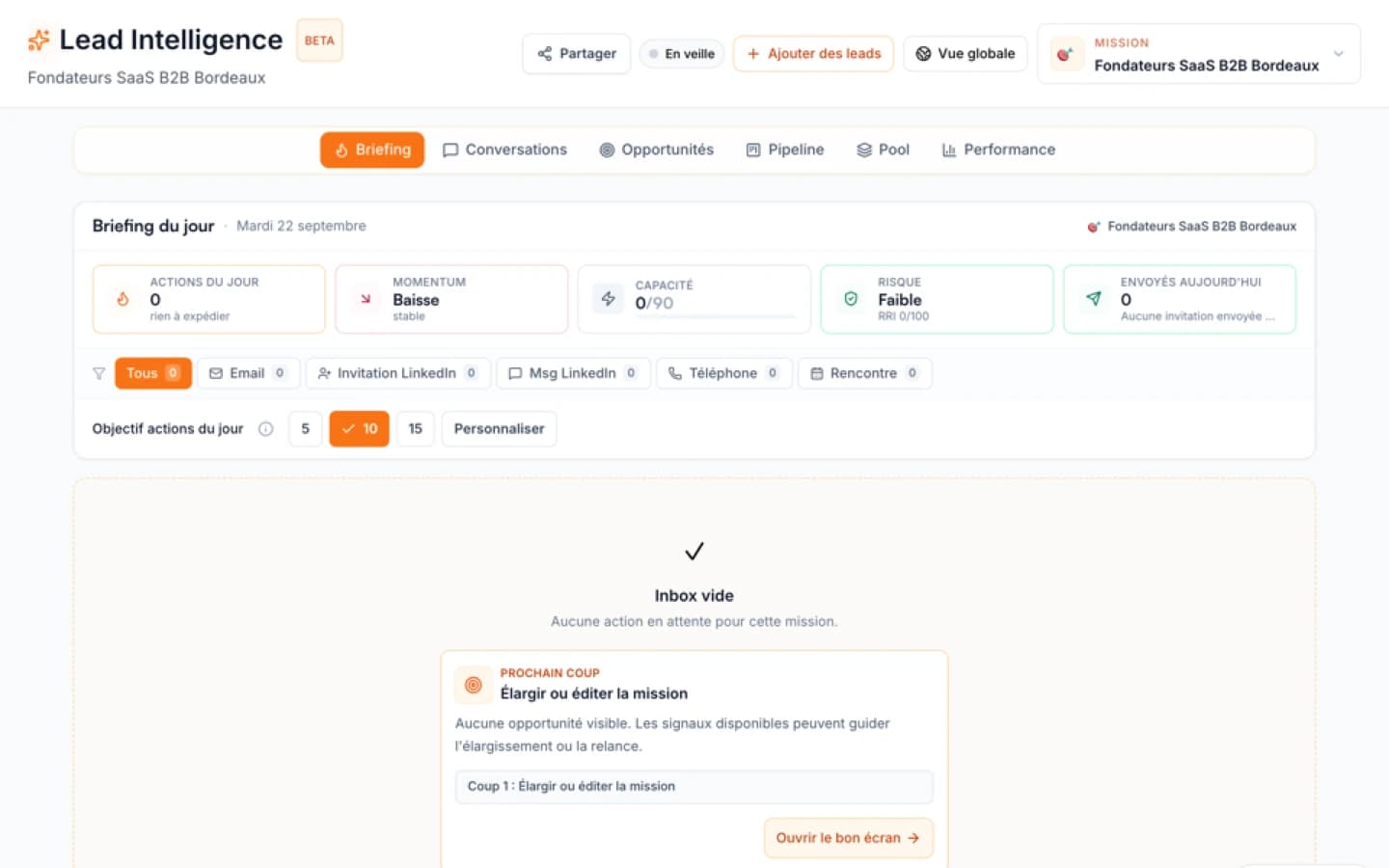
A Lead Intelligence mission is described with your offer and your ICP. Writing that ICP with precise NAICS codes gives you sharper criteria to enter. Lead Intelligence has no dedicated NAICS field: the precision comes from your description. To discover it, visit Lead Intelligence.
Further reading
- How does a small B2B sales team define an ideal customer profile in 2026? starts from your past sales to define the ICP. This one adds the common language of codes and the sizing of the US pool.
- How to define a B2B ICP when you have no historical closed deals covers the no-data case. This one assumes you already have customers to describe.
Sources
FAQ
Free diagnostic
Test your sales file
Drop an Excel or CSV and check its readiness without sending its rows to Ember.