
Definition
An Ideal Customer Profile (ICP) is a structured description of the target organizations that derive the most significant value from your solution and deliver the highest long-term value to your business. While established sales teams define this profile by analyzing historical Customer Relationship Management (CRM) data, teams launching new products must build their ICP from scratch without any closed-won deals to reference. In a cold-start scenario, an ICP is not a static list of industries and company sizes. It is an active, testable hypothesis about who has the most urgent, budget-backed pain today.
For sales teams and founders engaging in outbound sales for startups, defining this profile early prevents the common trap of chasing the wrong leads. According to practitioner insights shared on LinkedIn, defining an ICP incorrectly quickly leads to wasted sales cycles and team fatigue. Instead of relying on broad firmographics, a cold-start ICP focuses on situational triggers and observable pain points. This approach shifts the focus of Business-to-Business (B2B) prospecting from high-volume cold outreach to highly targeted, context-driven conversations.
If you are wondering who should an early-stage founder contact first, the answer lies in identifying early adopters who are already spending money or manual effort to solve the specific problem you address. Rather than targeting massive enterprises with complex procurement cycles, founders should target smaller, agile teams where the decision-maker is highly accessible and actively seeking a solution.
To understand how does a founder qualify B2B leads without a sales team, one must look at automated lead qualification and signal monitoring. Instead of hiring a full team of Sales Development Representatives (SDRs) to manually dial prospects, founders can qualify B2B leads early by tracking external indicators, such as active job postings, technology stack changes, or leadership transitions. This allows lean teams to build a highly qualified sales pipeline without the overhead of a traditional sales department. While legacy platforms often treat prospecting as a volume game where credit-based pricing meters every single action, modern approaches focus on opportunity readiness and contextual relevance to ensure that every outbound effort counts.
To place this decision in context, the Knowledge guides for sales brings together deeper guidance on the same field.
Prerequisites
Before you can map out an Ideal Customer Profile (ICP) without historical closed deals, your sales team must establish specific foundational inputs. Without historical Customer Relationship Management (CRM) data to analyze, the temptation is to target everyone. However, as noted in industry discussions, defining your target profile incorrectly causes immediate friction, leaving sales teams suffering from inefficient outreach and wasted energy, as discussed in this practitioner analysis on LinkedIn. To avoid this trap, you must gather three critical prerequisites before launching any outbound sales for startups.
First, you need a clear, documented hypothesis of the core business pain your solution solves. An ICP is not just a list of industries and company sizes. According to the Salesforce ICP Guide, a proper profile helps prioritize prospects who are the most likely to convert, stay loyal, and generate long-term revenue. When you have no historical data, this prioritization must start with a qualitative map of who feels the pain most acutely today.
Second, you must identify where your target buyers leave digital footprints. If you are wondering who should an early-stage founder contact first, the answer is always the buyers who are actively showing signals of change, such as hiring, technology shifts, or funding. Instead of relying on a Sales Development Representative (SDR) to manually scrape websites, you need to establish which public data sources, such as LinkedIn or job boards, will feed your lead qualification process.
Third, you must decide on your operational model and budget constraints. Building a modern outbound infrastructure from scratch can be resource-intensive. For instance, Clay’s Launch plan includes a stated allowance of actions and data credits; check the current Clay pricing page for the applicable price and billing period. For larger operations, Clay also offers a Growth plan with a larger allowance of actions and data credits, described on its pricing page.
Understanding these costs and data requirements is essential when figuring out how does a founder qualify Business-to-Business (B2B) leads without a sales team. Rather than committing to heavy manual workflows or complex credit-based tools early on, founders must first secure these prerequisites: a sharp pain hypothesis, a mapped signal path, and a clear view of their initial tooling budget. This preparation ensures that your early sales pipeline is built on real strategic assumptions rather than random guessing.
Steps
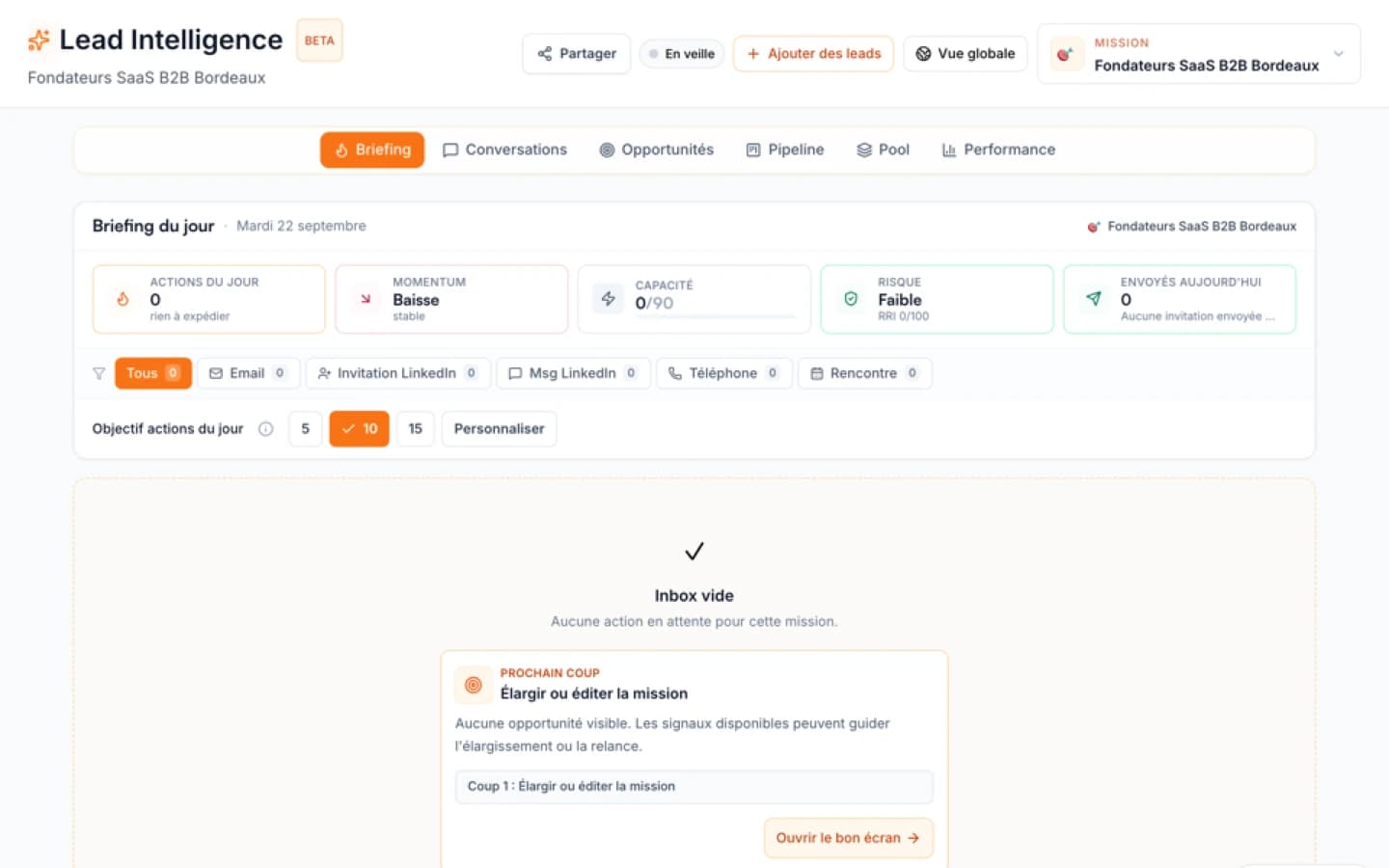
To define an Ideal Customer Profile (ICP) without historical closed deals, sales teams must shift from analyzing past data to validating active market signals. This structured approach allows early-stage companies to execute effective outbound sales for startups and build a healthy sales pipeline from scratch. First, formulate hypotheses based on acute pain rather than broad demographics. When starting out, a common question is: who should an early-stage founder contact first? The answer lies in identifying organizations facing immediate operational bottlenecks that your solution resolves. As documented by Salesforce, a well-defined ICP helps prioritize prospects who are the most likely to convert, stay loyal, and generate long-term revenue. Conversely, targeting too broadly leads to wasted effort. Industry practitioner Nick Hart emphasizes on LinkedIn that defining your target profile incorrectly causes your sales team to suffer, resulting in high rejection rates and stalled pipelines. Second, identify external proxies and signals that indicate this pain. Since you lack historical Customer Relationship Management (CRM) data, you must rely on observable business changes. These triggers might include specific hiring patterns, technology stack changes, or recent leadership transitions. Third, build a highly targeted micro-list for validation. For teams that already know their target market cold, traditional volume-oriented platforms like Apollo are highly effective for exporting and sequencing outreach. However, as highlighted by Factors.ai and Coldreach.ai, credit-based pricing models turn every action into a metered decision, compounding costs through wasted exports and bounced emails when scaling from one seat to five. For teams with heavy technical resources, Clay offers excellent breadth for custom enrichment logic, with its Launch plan starting at 167 USD per month on a monthly basis, or from 54 USD per month when billed annually, as detailed on the Clay Pricing Page. Yet, when you are building a prospect list from scratch to validate an early hypothesis, you do not need complex database orchestration or massive credit commitments. Fourth, execute low-volume, high-relevance outreach to qualify leads early. This answers a critical operational question: how does a founder qualify B2B leads without a sales team? By acting as their own Sales Development Representative (SDR) and running highly focused campaigns of ten to fifty accounts. The goal of this phase is not immediate scale, but rather conversational feedback that proves or disproves your ICP assumptions. Finally, transition your validated hypotheses into an automated, context-driven workflow. Ember supports this transition through Lead Intelligence, which helps founders and sales teams prioritize opportunities with their specific business context. Lead Intelligence finds accounts based on your mission ICP and signals, then verifies useful sources. Rather than forcing you to manage complex enrichment rules, Lead Intelligence prioritises opportunities from the available context, making the priority explainable from context, signals, and opportunity readiness. If you already have a preliminary list of targets, Lead Intelligence prepares and imports up to 3,500 valid contacts from Excel or CSV files into your pool, scoring the file readiness locally before import, and allowing you to enrich up to 200 contacts in a single wave while showing progress This ensures your outbound sales are grounded in real-world context, helping you scale your lead qualification without the overhead of traditional, volume-heavy databases.
To explore this point further, What B2B Sales Teams Should Measure Weekly Without a Funnel? details a step directly related to this decision.
Worked example
To understand how this works in practice, let us look at a hypothetical scenario of an early-stage software company launching a new security compliance tool. With zero historical closed deals in their Customer Relationship Management (CRM) system, the team cannot rely on historical data to build their Ideal Customer Profile (ICP). This situation raises a common question: How does a founder qualify B2B leads without a sales team? Instead of hiring a full team of Sales Development Representatives (SDRs) to run high-volume cold outreach, the founder must focus on highly targeted lead qualification based on active market signals. This leads to another critical decision: Who should an early-stage founder contact first? Rather than targeting a broad, static list of companies, the founder should contact organizations experiencing specific trigger events, such as hiring a new security director or migrating their technical infrastructure, which signal immediate opportunity readiness. For teams that already know their ICP cold, a classic B2B sales engagement platform like Apollo is highly effective. Apollo allows you to define your ideal customer profile, build lists from a large contact database, apply filters, and sequence outreach. However, this volume-oriented model means credit-based pricing turns every action into a metered decision. Wasted exports and re-enrichment can compound costs when a sales team scales from one seat to five, a common friction point cited by buyers looking for alternatives on Factors.ai and Coldreach. Similarly, if the team decides to build a highly customized list from scratch using data enrichment platforms, they might look at Clay. According to the Clay pricing page, the Launch plan starts at 15,000 actions and 3,000 data credits per month for 167 dollars monthly, or from 54 dollars per month billed annually, while the Growth plan starts at 40,000 actions and 6,000 data credits per month for 446 dollars monthly, or from 185 dollars per month billed annually. These tools are powerful for data-heavy workflows but require the team to manually construct the logic of who to target. To bypass manual list-building and credit-metered anxiety, the team can use Lead Intelligence from Ember. This capability helps founders and sales teams prioritize opportunities with their context. It finds accounts from the mission ICP and signals, then verifies useful sources, making the priority explainable from context, signals, and opportunity readiness. The team can search and import profiles through LinkedIn or Sales Navigator from a connected account. Alternatively, they can prepare and import up to 3,500 valid contacts from Excel or Comma-Separated Values (CSV) files into the pool. Before the import, a local score measures the readiness of the complete file. After cost confirmation, one wave can enrich up to 200 contacts and shows progress. This ensures that outbound sales for startups remain focused on high-intent conversations rather than raw volume.
Common mistakes
When building a Business-to-Business (B2B) sales pipeline from scratch, early-stage sales teams often fall into predictable traps that drain resources and stall momentum. Without historical Customer Relationship Management (CRM) data to guide decisions, these errors can quietly derail an entire outbound strategy.
The first common mistake is treating basic company demographics as a complete Ideal Customer Profile (ICP). Many teams assume that defining a target industry and company size is sufficient. However, as Salesforce points out in their guide on how to identify and win your best customers, a true ICP must prioritize prospects who are the most likely to convert, stay loyal, and generate long-term revenue. Relying on broad categories rather than specific operational pain points leads to a bloated pipeline filled with accounts that have no immediate reason to buy. This misalignment is why many sales teams suffer from low conversion rates, a critical issue discussed by sales practitioners on LinkedIn by Nick Hart, who notes that defining your target profile incorrectly directly damages sales team performance.
The second error is scaling outbound sales volume before validating actual market signals. When teams lack historical data, the temptation is to run high-volume cold outreach campaigns. They often turn to classic B2B sales engagement platforms like Apollo, which operates on a volume-oriented model where more credits allow teams to export and enrich larger lists. However, credit-based pricing turns every action into a metered decision. When a sales team scales without a validated target, wasted exports, bounced emails, and constant re-enrichment compound the costs, a common frustration for buyers seeking alternatives as highlighted on Factors.ai and Coldreach.ai. Similarly, a larger Clay workflow can waste time and credits if the target list is built on unverified assumptions; compare the current plan terms with the volume you actually need.
This volume-first approach also complicates the core question of how does a founder qualify B2B leads without a sales team? Without a dedicated team of Sales Development Representatives (SDRs) to manually filter through thousands of contacts, founders must rely on context and intent signals rather than raw volume. If you are trying to determine who should an early-stage founder contact first, the priority should always be companies experiencing specific trigger events, such as leadership changes or technology shifts, rather than a static list of prestigious logos.
To avoid these pitfalls, teams must transition from generic list-building to signal-based prioritization. Instead of consuming expensive credits on unverified databases, platforms like Ember and its Lead Intelligence capability allow teams to import up to 3,500 valid contacts from a local Excel or CSV file to measure list readiness before committing to enrichment, as explained on the Ember Lead Intelligence page. By focusing on opportunity readiness and making the priority explainable from real-world context, early-stage teams can build a highly targeted sales pipeline without the historical data typically required by legacy systems.
This approach also connects with SME CEO Warning Signals: When to Act on Sales Outreach Decay, which clarifies the next choice.
Tools
To build a prospect list from scratch without historical data, sales teams must choose their technology stack carefully. Traditional Business-to-Business (B2B) prospecting platforms often rely on static database filtering. For example, Apollo operates as a classic B2B sales engagement platform where users define their ideal customer profile, build lists from a large contact database, and sequence outreach. While this volume-oriented workflow works well for established teams with a proven Ideal Customer Profile (ICP), it presents significant challenges for early-stage outbound sales for startups.
The primary tradeoff of these traditional databases is their credit-based pricing model, which turns every action into a metered decision. Exporting contacts, enriching records, and verifying emails each consume credits, creating compounding costs that multiply when a sales team scales, as highlighted by Factors.ai and also noted by Coldreach. For an early-stage company still discovering its market, this model forces Sales Development Representatives (SDRs) to pay for trial-and-error, leading to budget drain on unverified leads.
When considering how does a founder qualify B2B leads without a sales team, the answer lies in shifting from high-volume database exports to context-driven lead qualification. Relying on a poorly defined ICP leads to wasted resources and sales team fatigue, as discussed on LinkedIn. Instead, an effective ICP should prioritize prospects who are the most likely to convert, stay loyal, and generate long-term revenue, as defined by Salesforce.
To achieve this without a dedicated sales team, founders can use Ember's Lead Intelligence. Instead of buying generic lists, Lead Intelligence finds accounts based on your specific mission ICP and active signals, then verifies useful sources, as explained on Ember. When deciding who should an early-stage founder contact first, the platform prioritises opportunities from the available context and makes the priority explainable from context, signals, and opportunity readiness, as detailed on Ember. This allows founders and early sales teams to focus their cold outreach on high-intent accounts without getting trapped in metered database subscriptions.
When to use this method
Defining an Ideal Customer Profile (ICP) without historical closed-won data is a specific challenge that requires a shift from retrospective analysis to active hypothesis testing. This method is designed for specific inflection points in a company's growth where traditional, backward-looking models cannot assist you.
First, this approach is essential when launching outbound sales for startups. When you are building a prospect list from scratch, your Customer Relationship Management (CRM) system is empty. Traditional lead scoring models fail in this environment because they require historical conversion patterns to predict future success. Instead of guessing, early-stage teams must prioritize prospects based on immediate, observable business changes. According to Salesforce, a well-defined ICP helps sales teams prioritize prospects who are the most likely to convert, stay loyal, and generate long-term revenue. When you have no historical data, this method allows you to establish that baseline.
Second, this method is built for the founder-led sales phase. Early-stage founders frequently face the question: how does a founder qualify Business-to-Business (B2B) leads without a sales team? When you do not have a dedicated team of Sales Development Representatives (SDRs) to manage high-volume cold outreach, efficiency is your only leverage. You cannot afford to burn through contacts with generic campaigns. This method answers who to contact first as a founder by focusing your limited time on high-probability targets who are actively experiencing the problem your product solves.
Third, this framework is necessary when entering a completely new market or launching a new product line. Even established companies with mature sales pipelines must adopt this approach when their existing CRM data does not align with their new direction. Relying on historical data from an unrelated product line will misguide your B2B prospecting efforts. As highlighted by sales practitioners on LinkedIn, defining your target profile incorrectly leads to immediate friction and poor conversion rates for your sales team.
In these scenarios, waiting for historical data to accumulate is not an option. Instead, using real-time context to guide your lead qualification allows you to build momentum immediately. This is where modern, context-driven tools become valuable. For instance, Ember and its Lead Intelligence capability help teams prioritize conversations based on active market signals and opportunity readiness, bypassing the need for years of historical CRM records.
In practice, How Does Lead Intelligence Work for Modern SME CEOs? completes this framework with another angle on the same topic.
When not to use it
Relying on a hypothesis-driven approach to define your Ideal Customer Profile (ICP) is a temporary necessity, not a permanent strategy. You should not use this speculative method if your Customer Relationship Management (CRM) platform already contains a robust history of closed-won deals. When historical data is available, ignoring it in favor of intuition can lead to major misalignment. According to practitioner feedback shared on LinkedIn, defining your ICP incorrectly causes immediate suffering for your sales team. In mature scenarios, your existing customer base provides the most reliable signals for lead qualification and structured lead scoring.
Traditional, database-driven prospecting platforms are also a better fit when your target market is highly standardized and your sales pipeline is already stable. For example, Apollo operates as a classic Business-to-Business (B2B) sales engagement platform that excels when teams already know their ICP cold. If your market is mature and your target personas are clearly defined, using a volume-oriented platform to filter large databases and sequence outreach is highly efficient. In these cases, you do not need to spend time validating fundamental assumptions. Instead, you can focus entirely on scaling your outbound sales for startups or established enterprises through high-volume cold outreach.
Additionally, the question of who should an early-stage founder contact first changes as the company grows. While a founder might initially learn how to qualify B2B leads early without a sales team by manually testing hypotheses, this hands-on approach becomes a bottleneck once you hire a dedicated Sales Development Representative (SDR) team. When you transition from founder-led selling to a structured sales team, your focus must shift from defining the ICP to optimizing the execution of your B2B prospecting. If you have already validated your target market, continuing to run manual, speculative discovery missions will only slow down your sales pipeline. At this stage, tools like Ember and its Lead Intelligence capability are designed to help you prioritize opportunities from your validated context, ensuring your team focuses on the accounts that are actually ready to convert.
Action plan
To build a functional outbound sales pipeline without historical closed deals, sales teams must execute a structured, hypothesis-driven action plan. This approach shifts the focus from retrospective analysis to active market testing.
First, define your initial Ideal Customer Profile (ICP) based on immediate pain points rather than broad demographic data. When considering who should an early-stage founder contact first, the answer lies in identifying prospects who are currently undergoing organizational transitions. Instead of targeting generic industry codes, look for companies experiencing specific triggers, such as leadership changes, new technology adoptions, or rapid department growth. This targeted approach prevents the common pitfall of defining the target market too broadly, which often leads to wasted outreach. According to insights on LinkedIn regarding common ICP mistakes, misaligning your target profile can quickly cause your sales team to suffer from low engagement and high opt-out rates.
Second, establish a systematic method to qualify Business-to-Business (B2B) leads early in the cycle. If you are wondering how does a founder qualify B2B leads without a sales team, the key is to leverage external intent signals and public data points before launching any cold outreach. Traditional prospecting platforms like Apollo are highly effective for teams that already know their ICP cold and want to scale volume. However, when you are building a prospect list from scratch, a purely volume-oriented model can become expensive. Credit-based pricing models mean that exporting, enriching, and verifying unverified contacts can quickly compound costs if your targeting is still speculative (Factors.ai). To qualify leads early without a dedicated Sales Development Representative (SDR) team, founders should look for verifiable indicators of opportunity readiness, such as active job postings for roles that would use your solution.
Third, run highly concentrated outreach campaigns to validate your assumptions. Rather than importing thousands of cold contacts into your Customer Relationship Management (CRM) system, focus on small batches of high-probability accounts. A structured framework, such as the one outlined in the Salesforce guide on identifying ideal customers, helps prioritize prospects who are most likely to convert and generate long-term value. By keeping your test batches small, you can personally review the responses, adjust your messaging, and refine your criteria without draining your budget or damaging your domain reputation.
Finally, automate the signal-monitoring process to sustain your outbound sales for startups. As your understanding of the market matures, manual tracking becomes a bottleneck. This is where modern intelligence tools bridge the gap. For instance, Ember Lead Intelligence reduces noise by focusing your attention on the opportunities that deserve action now. By analyzing context, signals, and opportunity readiness, it makes your prioritization explainable and provides a clear next action, outlining exactly who to contact, why now, and which channel to use. This continuous feedback loop ensures that your ICP evolves from a static set of assumptions into a dynamic, revenue-generating asset.
Before deciding, How to Score and Prioritise B2B Leads in 2026 with Ember? helps connect this method with adjacent priorities.
Sources and methodology
To provide sales teams with a reliable framework for defining an Ideal Customer Profile (ICP) without historical closed-won data, this analysis synthesizes insights from leading Customer Relationship Management (CRM) platforms and experienced sales practitioners. We address critical strategic questions, such as how an early-stage founder can qualify Business-to-Business (B2B) leads without a sales team, and who an early-stage founder should contact first when building a prospect list from scratch. Our methodology relies on a rigorous review of industry-standard documentation and real-world practitioner feedback. For instance, we examined the strategic guidelines from Salesforce on how to identify and win your best customers to understand how an ICP helps prioritize prospects who are most likely to convert. We also integrated practitioner insights, such as those shared by Nick Hart on LinkedIn regarding how incorrect ICP definitions negatively impact sales teams.
Sources
FAQ
Free diagnostic
Test your sales file
Drop an Excel or CSV and check its readiness without sending its rows to Ember.