
Symptom or signal
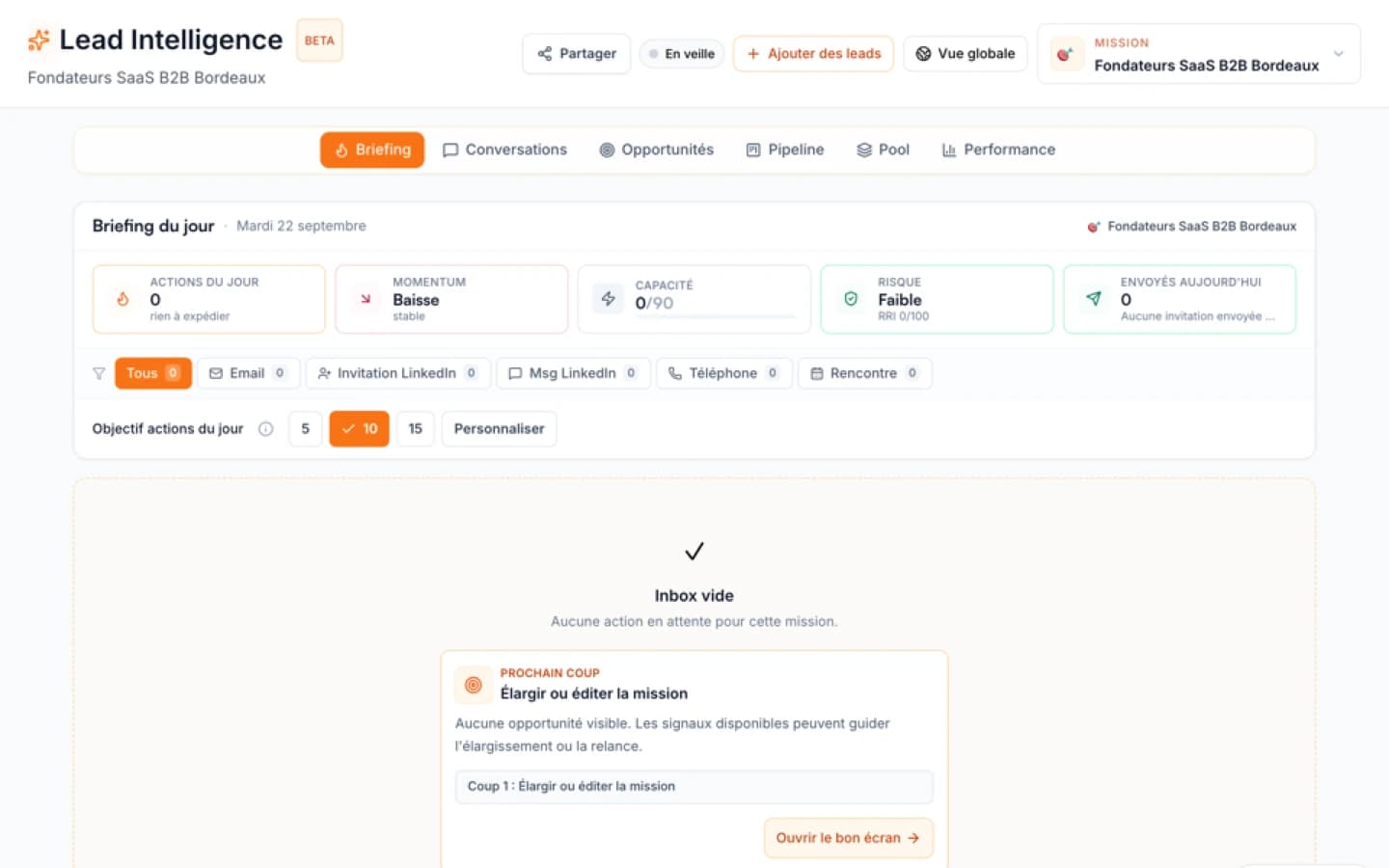
An SME can have a busy sales pipeline without knowing which conversations are worth pursuing. A long contact list does not explain who has a relevant need, why now, or what to say. Apollo can help teams find and reach many contacts, but the team still needs to check the reason for each approach. Lead Intelligence starts from a sales mission and researches contacts against its target profile and signals. It presents opportunities with an explained priority and a proposed next action, so the team can review the evidence before contacting anyone.
The Knowledge guides for sales provide further context.
What changed
Large contact databases make it easier to find names, but an SME still needs to decide which conversations matter. Apollo provides contact discovery and outreach tools; its pricing page describes the current plan conditions. Lead Intelligence offers a mission-based way to search for accounts matching the target profile and signals, verify useful sources, and present a priority the team can examine. The team still makes the outreach decision.
Facts and sources
The useful distinction is between obtaining contacts and deciding which contacts merit attention. Apollo describes its contact discovery and sales engagement tools. The Lead Intelligence page describes a mission that searches for accounts matching an ideal customer profile and relevant signals, checks useful sources, and proposes a next action. For a small sales team, the evidence attached to an opportunity matters more than the size of the exported list.
The Full-Cycle Sales Calendar: Serve Buyers and Refill Pipeline covers the next step.
Why the common explanation is incomplete
The common explanation for sales underperformance is often a perceived lack of data. Many business leaders assume that if their sales team simply had access to a larger database, they would naturally close more deals. This assumption has fueled the rapid growth of massive data providers. For example, Apollo describes itself as a sales platform for contact discovery and engagement (source).
However, this volume-first explanation is incomplete because it mistakes data access for sales readiness. Having millions of records does not tell a sales team who to contact, why now, and with what message. Even when platforms offer unlimited plans, those plans remain subject to a Fair Use Policy with strict credit limits (source). More importantly, raw volume without context simply creates noise, forcing lean teams to spend hours filtering out irrelevant leads.
An incomplete strategy relies on static lists that quickly go stale. Traditional databases can tell you that a company exists, but they cannot evaluate whether that company has a current, active need for your specific offer. They do not align the search with your unique business strategy or your Ideal Customer Profile (ICP).
This is where Lead Intelligence changes the approach. Instead of requiring massive databases to be useful, Lead Intelligence finds and prioritizes the contacts itself, with a small or larger starting list, with no minimum contact threshold. By analyzing signals researched for the mission and matching them against your specific business context, it proposes the next action and channel that fit the lead situation (source). This shifts the sales workflow from manual sorting to executing high-value conversations, providing a clear next action on who to contact, why now, which channel, and which angle to use.
The real problem
For a Chief Executive Officer (CEO) of a Small and Medium-sized Enterprise (SME), the real problem is not a shortage of names or email addresses. The market is flooded with raw contact data. The true bottleneck is the cognitive overload of sorting through this data to find the few opportunities that are actually ready for a conversation today.
When sales teams rely on traditional databases, they are forced to spend hours manually researching profiles, looking for buying signals, and guessing which angle will resonate. Large platforms like Apollo, which positions itself as a unified sales platform to simplify the sales stack (Apollo), provide vast quantities of data. However, even their unlimited email plans are subject to a strict Fair Use Policy with credit limits (Apollo Pricing). This volume-first approach encourages sales teams to blast generic messages to thousands of cold contacts, which damages the brand reputation of an SME and yields minimal results.
An SME leader needs three simple answers before any outreach begins: who to contact, why now, and which message or channel to use. Without these answers, outbound sales becomes an expensive guessing game.
This is where Lead Intelligence changes the paradigm. Instead of forcing sales teams to manually filter massive lists, it focuses on contextual prioritization. It helps teams know exactly who to contact, why now, and which action to take (Lead Intelligence). Because it prioritizes relevance over raw volume, the system works seamlessly whether a team starts with 10, 100, or 1,000 contacts, with no minimum contact threshold required to be effective. This allows SMEs to run highly targeted, high-conversion campaigns without wasting resources on unverified data.
This approach also connects with No Marketing Ops: Build a Four-State B2B Lead Queue, which clarifies the next choice.
How the mechanism works
To understand how Lead Intelligence transforms sales operations for a Small and Medium-sized Enterprise (SME), it is helpful to look at the underlying mechanism. Instead of forcing sales teams to sift through thousands of cold, unverified rows, the system operates through a structured, context-driven workflow. First, the process begins with contextual alignment. The team sets the Ideal Customer Profile (ICP), offer, and signals for its sales mission. Where connected, validated Fund Your Growth context can help prefill a fundraising mission. This ensures that the search parameters are not generic but are deeply rooted in the specific value proposition of the enterprise. Second, the system initiates market discovery and signal monitoring. It searches for accounts that match the mission ICP and active signals, and then verifies useful sources. It researches signals about people and companies for that mission and records useful sources. Third, prioritization evaluates the opportunities. Rather than relying on massive, arbitrary lists, the system classifies accounts into explained opportunities to watch, act on, or set aside. The system finds and prioritizes the contacts itself with a small or larger starting list, with no minimum contact threshold. This means a business leader does not need a massive database to begin seeing value. In fact, with usable targeting context, the mission can present prioritized leads once its research produces usable results. Finally, the mechanism delivers a clear, actionable recommendation for the sales team. For every prioritized opportunity, it proposes the next action, the most appropriate channel, and the precise angle that fits the lead situation. This directly answers the three critical questions for any sales representative: who to contact, why now, and with which message. This targeted approach replaces high-volume noise with high-relevance conversations.
Concrete examples
Consider a manufacturing SME that sells industrial packaging and wants to approach food distributors. The team defines its target profile and the signs that would make a conversation relevant. A Lead Intelligence mission searches for matching accounts and checks useful sources. If a distributor has publicly announced an expansion, the team verifies the announcement, identifies a relevant contact, and reviews the proposed angle before outreach. If the source does not support a need for packaging, the team does not claim one.
A professional services firm can use the same method for former prospects. It defines the relevant roles and changes to research, then reviews any resulting opportunities. A newly appointed technology director can be a reason to investigate; it is not proof that the company wants an audit.
When to use this diagnosis
Use a Lead Intelligence mission when the team has a target customer profile but needs help finding accounts and deciding which conversation to start. This is useful for a small sales team with a short list as well as one exploring a new market. Define the target role, offer and relevant signals, then review the sources and proposed next action for each delivered opportunity. If the evidence is weak, refine the mission before outreach.
The One Qualification Contract Across Every B2B Channel covers a related decision.
When not to use it
If a Small and Medium-sized Enterprise (SME) is executing a high-volume, broad-brush outbound strategy that relies on sheer scale rather than precise timing, Lead Intelligence is not the right tool. Traditional database providers are highly effective when the goal is simply to export thousands of raw contacts to feed a massive email sequence. For example, Apollo positions itself as a unified sales platform for modern sales and marketing teams focusing on pipeline, closing, and stack simplification (source). For companies that require this type of broad, all-in-one infrastructure, such established platforms are excellent. Furthermore, organizations looking for unlimited bulk emailing might prefer these traditional platforms, even though unlimited plans on Apollo remain subject to a Fair Use Policy with credit limits (source).
Another scenario where Lead Intelligence may not be necessary is when an enterprise already possesses a highly customized Customer Relationship Management (CRM) system supported by a dedicated sales operations team. If a company has already built proprietary scoring models and has the internal resources to manually clean, enrich, and monitor lead signals daily, they do not need an automated agentic system. Lead Intelligence is built to eliminate this manual overhead by automatically finding and prioritizing contacts with a small or larger starting list, with no minimum contact threshold. If an organization prefers to maintain manual control over every single data point and has the administrative budget to support it, traditional manual workflows remain a viable option.
Ultimately, Lead Intelligence is not designed for businesses that measure sales success solely by the volume of emails sent rather than the quality of the conversations started. The platform is specifically engineered to propose the next action and channel that fit the lead situation (source), helping founders and sales teams know who to contact, why now, and which action to take (source). If the strategic priority of the Chief Executive Officer (CEO) is to flood the market with generic messages rather than engaging in highly contextual, timely conversations, sticking to traditional bulk extraction tools is the more logical choice.
Next step
For a Chief Executive Officer (CEO) of a Small and Medium-sized Enterprise (SME), the immediate next step to accelerate sales is to shift the sales team away from manual list-building and toward high-intent conversations. Instead of acquiring massive databases that require complex filtering, leaders can initiate a targeted prospecting mission. With Ember, this process does not require a massive database setup or a minimum contact threshold. The Lead Intelligence capability finds and prioritizes the contacts itself, whether the sales team starts with 10, 100, or 1,000 contacts.
This approach solves the common bottleneck of traditional databases. For example, while Apollo.io offers contact discovery and engagement, its plan conditions affect how teams use credits. Even unlimited plans on these platforms remain subject to strict boundaries under their Apollo pricing fair use policies. Rather than burning through credits to build static lists, SME leaders can use Lead Intelligence to focus on immediate opportunities. The system analyzes the target profile and proposes the next action and channel that fit the lead situation, ensuring that sales representatives know exactly who to contact, why now, and which angle to use according to the Lead Intelligence product page.
To begin, the CEO can define a specific business segment, upload an existing list (up to 3,500 valid contacts from an Excel or CSV file), or let the system discover new accounts based on active market signals. By focusing on opportunity readiness rather than sheer volume, the sales team can stop chasing cold leads and start engaging in conversations that are primed for conversion.
Before deciding, Manual Lead Scoring With Overrides for Small B2B Teams helps connect this method with adjacent priorities.
Sources and methodology
This article uses the Apollo product description to describe contact discovery and the Lead Intelligence page to describe mission research and prioritization. Product capabilities are described from those pages; the examples are hypothetical and require source checks before a team sends outreach.
Sources
FAQ
Free diagnostic
Test your sales file
Drop an Excel or CSV and check its readiness without sending its rows to Ember.