
Context and ICP
For a startup Chief Executive Officer (CEO) or a Small and Medium-sized Enterprise (SME) leader, time is the most scarce resource. When managing early-stage growth, these leaders cannot afford to waste hours sorting through cold databases or generic contact lists. They need to know exactly who to talk to, why they should reach out right now, and what angle will resonate. This is where Lead Intelligence becomes a critical strategic asset rather than just another sales tool. Instead of forcing teams to build massive, noisy databases, Lead Intelligence focuses on high-leverage opportunities by understanding context and human relationships, detecting changes across people and companies to adjust priorities.
Whether a startup is launching its first outbound campaign or an SME is expanding into a new territory, the Ideal Customer Profile (ICP) must be translated into actionable conversations. Traditional prospecting tools can require a massive upfront volume to show any utility. In contrast, Lead Intelligence finds and prioritizes the contacts itself whether the team starts with 10, 100, or 1,000 contacts, with no minimum contact threshold. This flexibility allows founders to run highly targeted, high-conviction plays without needing a dedicated sales operations team.
Furthermore, speed to market is vital for emerging businesses. With usable targeting context, the first prioritized leads can appear in about 30 minutes. By monitoring signals about people and companies to keep context current, the system helps leaders act on up-to-date context. This continuous alignment helps SME leaders make priority explainable from context, signals, and opportunity readiness, turning raw market data into clear, defensible next steps.
To place this decision in context, the Knowledge guides for sales bring together deeper guidance on the same field.
Problem
For a Chief Executive Officer (CEO) of a growing startup or a Small and Medium-sized Enterprise (SME) leader, the primary obstacle to growth is not a lack of potential customers. The real bottleneck is the sheer volume of noise generated by traditional prospecting methods. When early-stage leaders attempt to scale their outbound sales, they typically face a frustrating trade-off between quality and quantity.
On one hand, established sales platforms like Apollo present themselves as an AI-powered go-to-market system, with access to 240 million contacts and 30 million companies, as shown on the Apollo homepage. On the other hand, data tools like Clay present themselves as infrastructure to get data, run agentic workflows and launch GTM plays (Clay), including a Sales Navigator data point for lead discovery, as detailed on the Clay Sales Navigator page. These tools are aimed at dedicated sales operations teams: they take time, technical expertise and configuration to filter out irrelevant data.
For a founder or SME leader who must balance product development, fundraising, and daily operations, managing these complex data pipelines is difficult. They cannot afford to spend hours cleaning databases or writing complex filtering rules. Instead, they need a way to quickly identify high-priority opportunities without being forced to meet a minimum contact threshold. Whether a startup has a highly targeted list of 10 key accounts, 100 warm leads, or 1,000 raw contacts, the leader needs a system that can automatically find and prioritize these contacts. Without a solution that understands context and human relationships, detects changes across people and companies to adjust priorities, and proposes the next action and channel that fit the lead situation, founders remain trapped in manual research, missing the critical timing that turns a cold account into an active commercial opportunity.
Three hidden costs weigh on volume-based prospecting: time spent sorting, reputation damaged by generic messages, and attention diverted from the accounts that really matter. They weigh more on a small team, where every lost hour shows immediately.
Prerequisites
Before a Chief Executive Officer (CEO) or a Small and Medium-sized Enterprise (SME) leader can effectively deploy automated lead discovery, they must establish a clear strategic foundation. Traditional outbound prospecting often requires a heavy upfront investment in data engineering and complex software configurations. For instance, comprehensive platforms like Apollo present themselves as an AI-powered go-to-market system, as detailed on the Apollo homepage. Similarly, data tools like Clay offer specialized features such as a LinkedIn Sales Navigator data point for lead discovery, as documented on the Clay Sales Navigator page. These established platforms are suitable options for dedicated sales operations teams with the technical resources to manage intricate workflows.
For a startup founder or SME leader without a dedicated sales operations department, the prerequisites are far simpler. The primary requirement is a clear understanding of the target market and a defined business offer. Instead of requiring massive databases or complex Application Programming Interface (API) setups, Lead Intelligence by Ember is designed to be highly accessible. Lead Intelligence finds and prioritizes the contacts itself whether the team starts with 10, 100, or 1,000 contacts, with no minimum contact threshold. By leveraging the existing strategic context of the business, founders can initiate targeted sales missions without the typical technical overhead, allowing them to focus directly on high-value conversations.
Before launching a mission, write on one page the target customer (sector, size, decision maker's role), the problem you solve for them and the most concrete proof you can cite: a customer, a trial, a result measured at your company. This page is the basis for the mission and for the first message.
To explore this point further, How Lead Intelligence Helps Account Executives Prioritize? details a step directly related to this decision.
Workflow
To translate strategic vision into actual sales conversations, a startup leader needs a repeatable, low-friction operational loop. The workflow begins by aligning the sales mission directly with the core business strategy. Instead of starting from a blank slate or a generic database, the system reuses the existing business plan, ideal customer profile (ICP), and offer context established within Ember. This helps keep every search query and filtering signal grounded in the company's actual value proposition.
From this strategic foundation, the leader can initiate lead discovery. Whether a startup begins with 10, 100, or 1,000 contacts, Lead Intelligence finds and prioritizes the targets itself without requiring any minimum contact threshold. This flexibility allows early-stage leaders to bypass the complex data engineering pipelines often associated with legacy outbound platforms.
Once the contacts are identified, the platform analyzes them against market signals and company changes. It classifies accounts into clearly explained opportunities, labeling them as accounts to watch, act on, or set aside. This contextual prioritization filters out the noise, allowing the business leader to focus only on accounts that are ready for a conversation.
The final step of the workflow is execution. Rather than leaving the user with a list of scored names and no direction, the platform proposes the next action and the most appropriate channel that fit the specific situation of the lead. This turns raw market data into a clear, defensible daily checklist for the founder or their sales team, which helps avoid losing opportunities to administrative overhead.
A simple rhythm helps keep the loop going: a short slot, twice a week, to review the opportunities to act on, send the first messages and note the replies. The leader does not need to do everything personally: they can delegate the sending and keep control of the key accounts.
Expected result
When a Chief Executive Officer (CEO) or a Small and Medium-sized Enterprise (SME) leader deploys Lead Intelligence, the most significant expected result is the reduction of business development noise. Instead of drowning in cold, unverified databases that require hours of manual filtering, leaders receive a highly curated stream of opportunities that are ready for direct engagement. The system understands the broader business context and human relationships, detecting subtle changes across target companies and individual professionals to adjust outreach priorities dynamically.
This context-driven approach fundamentally changes how early-stage companies approach outbound sales. Traditional platforms often focus on sheer volume. For example, Apollo presents itself as an AI-powered go-to-market system with 240 million contacts and 30 million companies; this type of platform suits teams that have the means to filter and track large lists. Similarly, data tools like Clay offer a LinkedIn Sales Navigator data point for lead discovery, but require technical configuration that busy founders do not always have time to master.
In contrast, the expected outcome here is an actionable, low-friction workflow. Whether a startup team starts with 10, 100, or 1,000 contacts, the system researches and prioritizes them itself with no minimum contact threshold. The final output is not just a list of names, but a clear recommendation proposing the next action and channel that fit the lead situation. This allows founders to transition seamlessly from high-level strategy to precise execution, turning raw market data into meaningful, useful business conversations.
To know whether the result is there, compare over four weeks the time spent preparing prospecting and the number of useful conversations obtained, before and after. If preparation time drops without useful conversations decreasing, the method is doing its job; otherwise, revisit the ideal customer profile before widening.
This approach also connects with How to qualify B2B leads without a marketing department?, which clarifies the next choice.
Example Ember mission
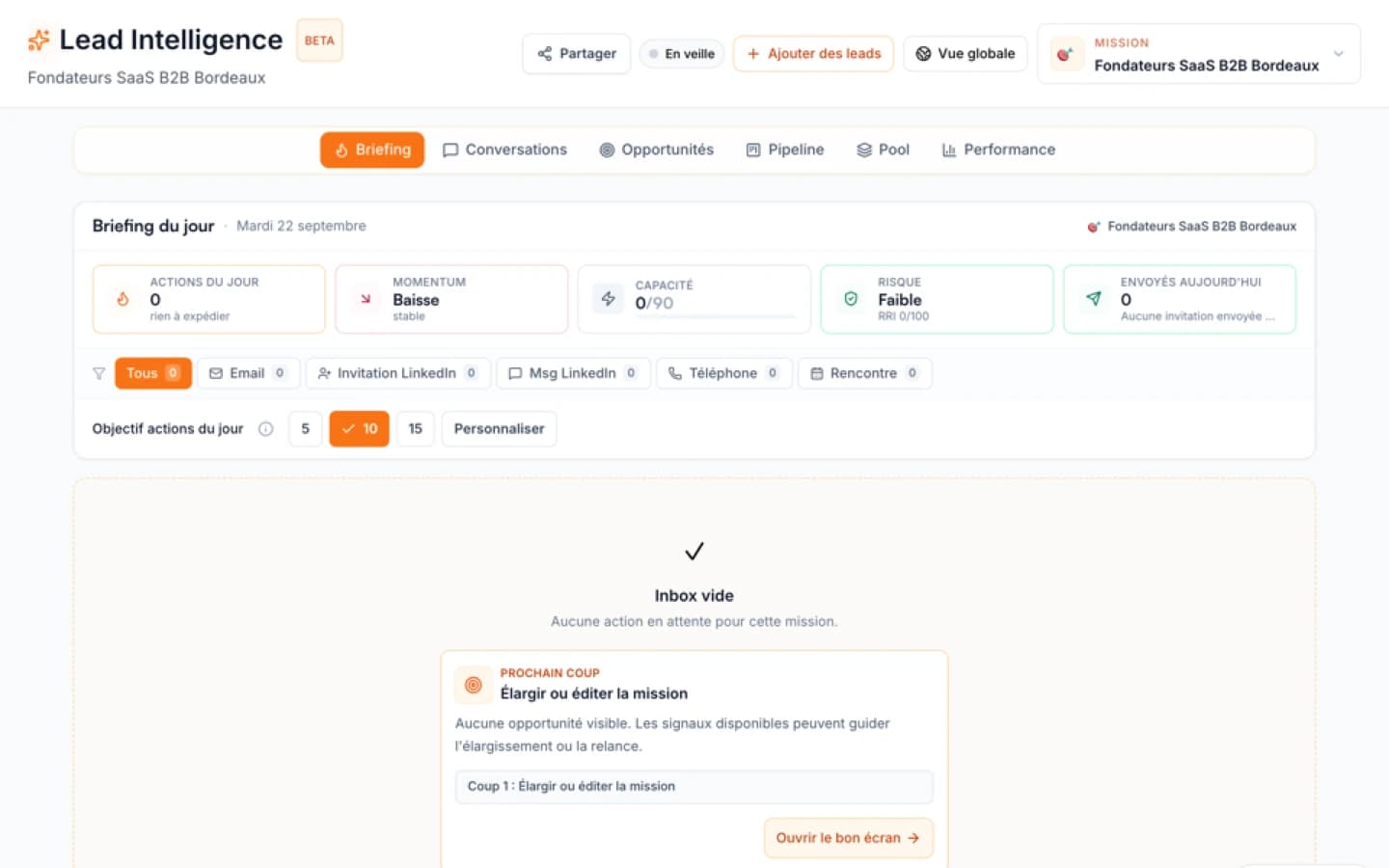
To illustrate how this works in practice, consider a Small and Medium-sized Enterprise (SME) leader launching a new business-to-business offering. Instead of manually scraping directories or building complex workflows in generic databases, the Chief Executive Officer (CEO) initiates a targeted sales mission directly within Ember. The mission begins by automatically reusing the existing business plan, Ideal Customer Profile (ICP), offer, and strategy already defined in the workspace. This ensures that the search is grounded in the actual business context rather than generic keywords. The leader can choose to upload their own list of contacts or let the system discover new accounts. The platform finds and prioritizes the contacts itself whether the team starts with 10, 100 or 1,000 contacts, with no minimum contact threshold. During the mission, Lead Intelligence finds accounts based on the defined ICP and signals, verifying useful sources to ensure data accuracy. It then classifies these accounts into opportunities to watch, act on, or set aside. For every high-priority opportunity, Ember proposes the next action and the most appropriate channel that fits the specific situation of the lead. Once the mission is complete, the workspace displays a clear proof of performance. The leader can immediately review the contacts analysed, the signals detected, and the priority actions actually recorded by Ember, making the initial value of the sales effort fully visible and actionable.
Limits and non-fit
While Lead Intelligence provides rapid strategic alignment, it is not the right fit for every sales organization. For mature startups with dedicated sales operations teams that require highly customized, multi-step data-stacking workflows, specialized platforms are often more appropriate. For example, Clay presents itself as infrastructure to get data and offers a Sales Navigator data point, useful for complex lead discovery and custom data engineering. Similarly, teams looking for an all-in-one sales execution suite might consider Apollo, which integrates with Salesforce, HubSpot, Outreach or SalesLoft (Apollo pricing). If your primary need is a heavy, engineering-first data pipeline, these incumbent tools are relevant choices.
Additionally, Lead Intelligence is not built for automated, mass-volume transactional spam. Ember does not automatically synchronize with every external Customer Relationship Management (CRM) system. For founders who require deep, bi-directional CRM synchronization out of the box, a traditional sales engagement platform is a better fit. Furthermore, the security model of Ember introduces specific functional boundaries. For instance, the provider Application Programming Interface (API) diagnostic operates under a read-only model where the API connection is never silently transferred and must be manually re-entered in the Ember account after signing in.
Finally, while Lead Intelligence is highly flexible and can prioritize contacts whether a team starts with 10, 100, or 1,000 contacts with no minimum contact threshold, it relies entirely on having a clear business context. If a startup has not yet defined its basic ideal customer profile or has no qualitative strategy to feed into the system, the agentic reasoning cannot perform at its best. Lead Intelligence is designed to turn existing strategic context into action, not to invent a business model from scratch.
When in doubt, run a bounded trial: one mission, one segment, four weeks, one owner. At the end of the trial, decide whether to continue, correct the ideal customer profile or stop, based on the conversations obtained and not on a general impression.
In practice, How Small Sales Teams Qualify Inbound Leads Without a CRM? completes this framework with another angle on the same topic.
When to use it
For a Chief Executive Officer (CEO) of a startup or a Small and Medium-sized Enterprise (SME) leader, time is the most constrained resource. Deploying Lead Intelligence is particularly critical in three specific business scenarios where traditional prospecting databases fail to deliver immediate value. First, use Lead Intelligence when launching a new product or entering an unfamiliar market segment. In this phase, you do not need thousands of generic contacts. Instead, you need to identify the exact decision-makers who are experiencing the specific pain points your new offer addresses. Because the system understands context and human relationships, it detects changes across people and companies to adjust priorities dynamically. This helps direct your initial outreach to organizations showing genuine readiness signals. Second, use it when you have a highly targeted list but lack the internal sales operations resources to enrich and prioritize it manually. Unlike legacy platforms that require massive databases to function effectively, Lead Intelligence finds and prioritizes the contacts itself whether the team starts with 10, 100 or 1,000 contacts, with no minimum contact threshold. This makes it particularly useful for niche business-to-business campaigns where quality completely overrides quantity. Third, use it when your leadership team needs to step in to close key accounts but lacks the time to research the perfect angle. Lead Intelligence analyzes the surrounding context of each prospect and proposes the next action and channel that fit the lead situation. This allows busy executives to transition from cold, generic outreach to highly personalized, context-driven conversations that respect the prospect's current situation.
Three signals show it is time to get started: your reps spend more time preparing lists than talking to prospects, your follow-ups go to accounts that never reply, or you cannot explain why you contact one account rather than another.
Next step
To move from strategic planning to active business development, the most practical next step is to run a targeted sales mission. The system finds and prioritizes the contacts itself whether the team starts with 10, 100 or 1,000 contacts, with no minimum contact threshold. This allows a Small and Medium-sized Enterprise (SME) leader to test a new market angle without buying a database or running complex data-cleaning workflows.
By initiating a mission, the system analyzes the specific business context of the startup, identifies relevant accounts, and proposes the next action and channel that fit the lead situation. This helps ensure that outreach is driven by detected signals rather than static, outdated spreadsheets. For founders and sales teams ready to convert strategic intent into active conversations, the immediate action is to define the Ideal Customer Profile (ICP) within the workspace and let Lead Intelligence surface the highest-priority opportunities. This shifts the daily focus from administrative prospecting to meaningful, high-value executive discussions.
To finish, keep one simple rule: contact no one without being able to say, in one sentence, why now and with which angle. If that sentence is missing, the account waits or leaves the list.
Before deciding, Qualify B2B prospects without a CRM helps connect this method with adjacent priorities.
Sources
This article relies on the definition of lead intelligence given by ActiveProspect, on the official pages of Apollo and Clay, consulted on 28 September 2026, and on the description of Ember's features by its publisher. Lead Intelligence finds and prioritizes contacts itself whether the team starts with 10, 100 or 1,000 contacts, with no minimum contact threshold, from the mission's Ideal Customer Profile (ICP) and signals, and proposes the next action and channel that fit the lead situation. This article is published by Ember, the publisher of Lead Intelligence.
Sources
FAQ
Free diagnostic
Test your sales file
Drop an Excel or CSV and check its readiness without sending its rows to Ember.