
Context and ICP
For a leader of a Small and Medium-sized Enterprise (SME), commercial efficiency is not about chasing infinite volume. It is about focusing limited sales resources on the accounts most likely to convert. Large-scale outbound platforms like Apollo, which presents itself as "the AI GTM system for Go-to-Market teams", are useful for teams looking to build massive pipelines, but they can introduce noise for smaller, highly focused teams. Ember, the publisher of this article, is an interested party: the comparisons below describe each approach without claiming neutrality. SME leaders do not have the time to filter through thousands of cold records. They need to know exactly who to contact, why now, and which angle to use.
This is where Lead Intelligence changes the approach. Instead of requiring a massive database setup, the system adapts to the existing scale of the business. According to the Ember Lead Intelligence page, Lead Intelligence finds and prioritizes contacts itself whether the team starts with 10, 100, or 1,000 contacts, meaning there is no minimum contact threshold to get started. By understanding the business context and human relationships, it detects changes across people and companies to adjust priorities. This contextual prioritization helps the sales team focus on opportunities that are ready for action. With a usable Ideal Customer Profile (ICP) and targeting context, the first prioritized leads can appear in about 30 minutes as documented on the Ember Lead Intelligence page, allowing SME leaders to quickly identify and act on high-value conversations.
To place this decision in context, the Knowledge guides for sales bring together deeper guidance on the same field.
Problem
Small and Medium-sized Enterprise (SME) leaders face a fundamental resource constraint. Unlike large corporations with dedicated sales operations departments, smaller companies cannot afford to waste valuable hours on low-intent outreach or manual database cleaning. The primary challenge is not a lack of data, but an excess of noise. When sales teams rely on generic lists, they end up chasing cold prospects who have no immediate need for their services. This volume-first approach drains team morale and dilutes the brand's value proposition in the market.
Traditional sales platforms, such as Apollo, which offers to unify data into a clear view, still require sorting effort to filter out irrelevant leads when the team does not already know precisely whom to target. Sales teams often struggle to prioritize their outreach regardless of whether they start with 10, 100, or 1,000 contacts: according to the Ember Lead Intelligence product page, Lead Intelligence finds and prioritizes contacts itself, with no minimum threshold. Without deep context, sales representatives cannot identify which accounts are actually ready to engage. They miss critical timing signals, such as organizational changes or shifting business priorities, leading to missed opportunities and wasted sales cycles. For an SME leader, the real bottleneck is translating raw contact data into actionable, timely conversations.
Prerequisites
Before deploying an automated sales intelligence workflow, a Small and Medium-sized Enterprise (SME) leader must establish a clear strategic foundation. The primary prerequisite for using Lead Intelligence is not a massive, pre-cleaned database. In fact, according to the Ember Lead Intelligence product page, the platform finds and prioritizes the contacts itself whether the team starts with 10, 100, or 1,000 contacts, meaning there is no minimum contact threshold required to launch a mission.
Instead, the true prerequisite is strategic alignment. Lead Intelligence operates by reusing the Business Plan, Ideal Customer Profile (ICP), offer, and strategy to prepare a sales mission. If you have already used the Fund Your Growth capability to build a Business Plan to fund and develop the project, this existing context serves as the direct input for your commercial targeting.
Additionally, the system requires an understanding of your business goals rather than complex technical integrations. Because the platform understands context and human relationships, and subsequently detects changes across people and companies to adjust priorities, the only preparation needed is defining who you want to target and what value you offer. Once these strategic parameters are set in your workspace, the system monitors signals about people and companies to keep this context current, proposing the next action and channel that fit the lead situation without requiring manual database management.
To explore this point further, Lead Intelligence Use Cases for Scale-Up CEOs: A Decision Guide details a step directly related to this decision.
Workflow
The operational workflow of Lead Intelligence is designed to reduce manual data preparation and keep your sales team focused on active opportunities. This process translates your high-level business strategy into daily, prioritized sales actions through four distinct stages. The workflow begins with strategic alignment. Instead of requiring you to rebuild your targeting criteria from scratch, the system directly reuses the business plan, Ideal Customer Profile (ICP), offer, and strategy already established within Ember to prepare the sales mission. This direct connection helps keep your outbound efforts aligned with your broader business goals without manual configuration. Once the strategic context is established, the workflow moves to target discovery and contact identification. As detailed on the Ember Lead Intelligence product page, the platform finds and prioritizes the contacts itself whether the team starts with 10, 100 or 1,000 contacts, meaning there is no minimum contact threshold to begin. This flexibility allows Small and Medium-sized Enterprise (SME) leaders to launch highly targeted micro-campaigns or broader market discovery missions with equal ease. After identifying the initial accounts, the system applies contextual prioritization. Rather than relying on static lists that quickly become outdated, the platform understands context and human relationships, then detects changes across people and companies to adjust priorities. By monitoring these signals, the workflow separates passive accounts from high-readiness opportunities. The final stage of the workflow is actionable execution. For every prioritized opportunity, the platform proposes the next action and channel that fit the lead situation. This gives your sales representatives a clear starting point, specifying who to contact, why the timing is right, and which channel is most likely to yield a response, to make the best use of your limited sales resources.
Expected result
For a Small and Medium-sized Enterprise (SME) leader, the expected result of deploying Lead Intelligence is a focused, signal-driven sales pipeline that reduces the burden of manual database administration. Instead of forcing sales representatives to spend hours cleaning outdated lists or guessing which prospects are ready to buy, the system proposes a clear, prioritized action plan. According to the Ember Lead Intelligence product page, the platform finds and prioritizes the contacts itself whether the team starts with 10, 100 or 1,000 contacts, with no minimum contact threshold. This means that even smaller niche campaigns can benefit from prioritization. The system understands context and human relationships, detecting changes across people and companies to adjust priorities. It monitors signals about people and companies to keep this context current, which helps sales representatives avoid wasting time on stale opportunities. Another key outcome is the reduction of guesswork during outreach. As documented on the Ember Lead Intelligence product page, the platform proposes the next action and channel that fit the lead situation, which helps make every touchpoint relevant and timely. By reusing the strategic foundation established during the business planning phase, the sales team can execute missions aligned with the company's broader commercial goals. This result remains to be observed mission by mission: no commercial gain is promised.
Example Ember mission
To understand how this works in practice, consider a Small and Medium-sized Enterprise (SME) leader aiming to expand into a new regional market. Instead of purchasing static lists or manually searching social networks, the leader initiates a targeted sales mission.
The process begins with strategic alignment. The system reuses the existing Ember Business Plan, Ideal Customer Profile (ICP), offer, and strategy to prepare the sales mission, so that the outreach remains consistent with the company's core positioning. From there, Lead Intelligence finds accounts based on the mission ICP and active signals, then verifies useful sources to check data accuracy.
According to the Ember Lead Intelligence product page, the platform finds and prioritizes the contacts itself whether the team starts with 10, 100, or 1,000 contacts, with no minimum contact threshold. This flexibility allows the SME leader to run highly targeted micro campaigns without worrying about database size limitations.
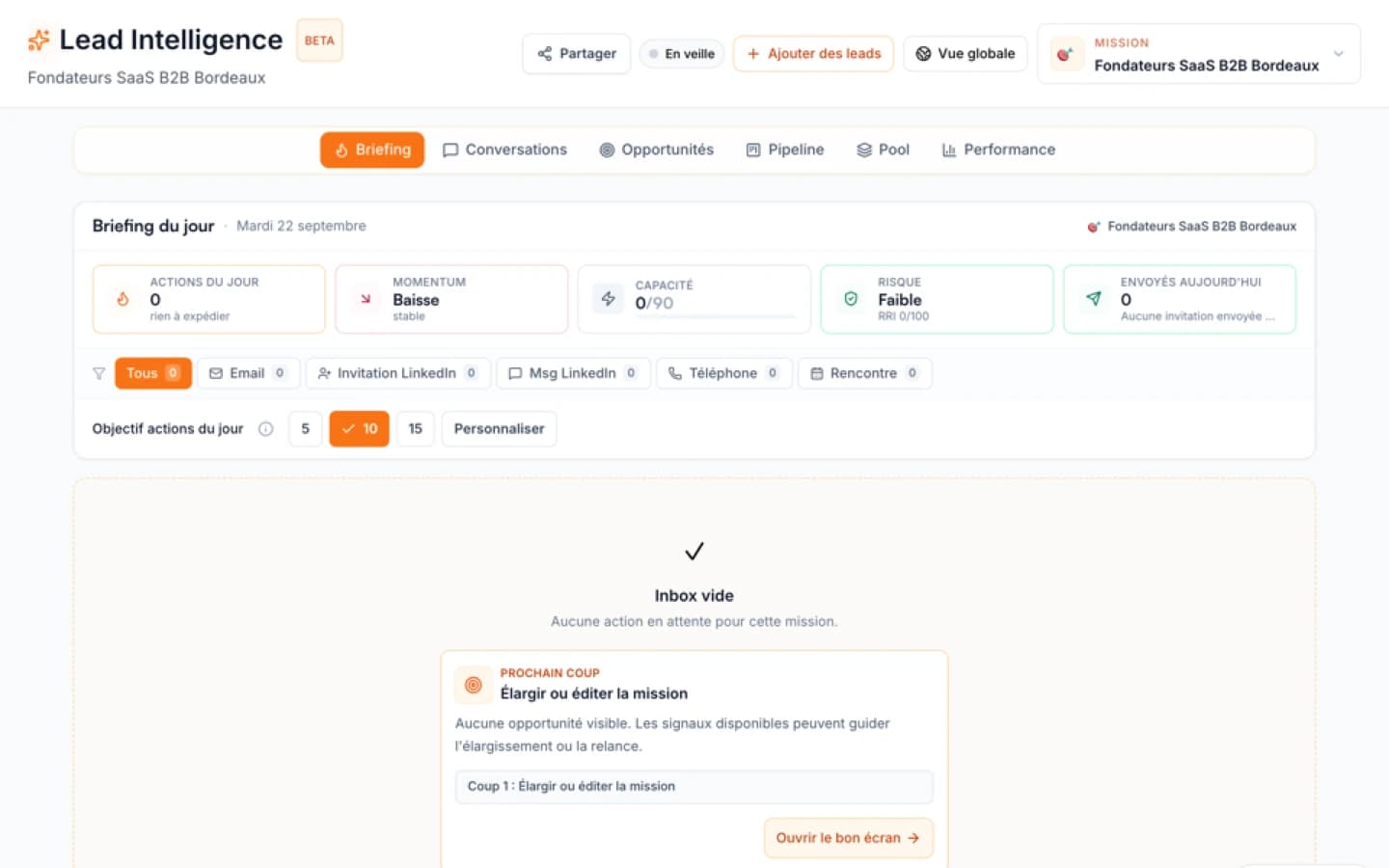
Once the accounts and contacts are identified, the system proposes the next action and channel that fit the lead situation, giving the sales team a clear, contextual starting point for outreach. After the mission is complete, the platform shows the contacts analysed, signals detected, and priority actions actually recorded by Ember. This immediate feedback loop makes the first value produced by the mission visible, allowing the business leader to measure progress based on real, persisted outcomes rather than generic estimates.
This approach also connects with How Lead Intelligence Helps Account Executives Prioritize?, which clarifies the next choice.
Limits and non-fit
Lead Intelligence is designed for relationship-driven Business-to-Business (B2B) sales where context, timing, and relevance dictate success. If your Small and Medium-sized Enterprise (SME) relies on high-volume, transactional, or automated consumer outreach, this agentic approach will not align with your operational model. For organizations that prioritize raw email volume over relationship signals, a platform like Apollo, which presents itself as "the AI GTM system for Go-to-Market teams", may fit better. Similarly, companies looking for deep, programmatic data enrichment pipelines might find a better fit in tools like Clay, which offers a Sales Navigator data point to discover potential leads and professional connections. Lead Intelligence, by contrast, is built to reduce noise and help teams focus on high-value conversations rather than managing complex data engineering workflows.
SME leaders must also consider technical boundaries before deploying Lead Intelligence. A common misconception is that modern artificial intelligence tools can automatically synchronize with any internal database. Ember does not automatically synchronize CRM systems. To protect sensitive business data, Ember requires that any Application Programming Interface (API) connection be entered manually by the user after signing in, ensuring that security credentials are never transferred silently across networks. If your sales team requires a fully automated, hands-off CRM synchronization that operates without manual token verification or human review, the current version of Lead Intelligence will not fit that workflow.
Finally, while Lead Intelligence is highly effective regardless of database size, it is not a magic solution for a missing commercial strategy. According to the Ember Lead Intelligence product page, the system finds and prioritizes contacts whether your team starts with 10, 100, or 1,000 contacts, meaning there is no minimum contact threshold. However, this volume independence means the tool relies heavily on the quality of your strategic inputs. If your SME has not yet defined its Ideal Customer Profile (ICP) or lacks a clear business plan, the agentic workflow cannot substitute for those foundational decisions. The system is designed to reuse the strategic context from your business plan and offer to prepare its missions. Without this strategic grounding, the prioritized actions and signal monitoring will lack the necessary direction to convert opportunities effectively.
When to use it
For a Small and Medium-sized Enterprise (SME) leader, the decision to deploy Lead Intelligence usually arises during specific strategic inflections rather than routine administrative cycles. The first critical scenario is the launch of a new Business-to-Business (B2B) offering or entry into a new market segment. Traditional lead generation often demands purchasing massive databases that require extensive manual filtering. If your team is testing a new value proposition, you do not need thousands of unverified records. Lead Intelligence is built to find and prioritize contacts itself whether your sales team starts with 10, 100 or 1,000 contacts, with no minimum contact threshold as detailed on the Ember Lead Intelligence page. This allows the Chief Executive Officer (CEO) to run highly targeted, low-volume validation campaigns without wasting resources on broad, generic lists. The second scenario involves maximizing the value of existing, dormant networks. Many SMEs possess historical lists of past clients, lost prospects, or old event attendees that sit unused in static spreadsheets. Lead Intelligence can set these assets back in motion by monitoring signals about people and companies to keep the context current. It understands context and human relationships, detecting changes across people and companies to adjust priorities. When a former prospect changes roles or a target company secures new resources, the system can detect this movement and propose the next action and channel that fit the lead situation, turning cold data into timely conversations. There are times when alternative platforms are better suited to your operational setup. If your SME already employs a large, specialized sales development team that requires an all-in-one platform for high-volume outbound campaigns, a platform like Apollo is better suited. Similarly, if your team includes technical sales operations specialists who want to build highly customized data enrichment pipelines using data points like the Sales Navigator data point offered by Clay, those platforms are excellent choices. However, if your goal as an SME leader is to keep your sales execution tightly aligned with your high-level business strategy, Lead Intelligence has an advantage: it directly reuses the strategic foundation you build within Ember, including your business plan, Ideal Customer Profile (ICP), and offer, to prepare and guide every sales mission. Your commercial outreach thus remains a direct extension of your corporate strategy.
Next step
For a Small and Medium-sized Enterprise (SME) leader, the path forward does not require a massive data-cleansing project or a heavy upfront investment in complex Customer Relationship Management (CRM) configurations. The transition to context-driven prospecting can begin with a single, well-defined sales mission.
According to the official product page for Lead Intelligence, the platform finds and prioritizes the contacts itself whether the team starts with 10, 100 or 1,000 contacts, with no minimum contact threshold. This means a business can test the system on a tight, highly specific segment of high-value targets before expanding outreach.
To take the next step, the leadership team needs to identify one critical business objective, such as securing meetings with key decision-makers in a newly launched service line. Once this focus is established, the system finds accounts from the mission's ICP and signals, monitors relevant signals, and proposes the next action and channel that fit the lead situation. This allows sales representatives to spend their time preparing for meaningful Business-to-Business (B2B) conversations rather than managing spreadsheets, turning raw market context into structured, actionable opportunities.
In practice, How to qualify B2B leads without a marketing department? completes this framework with another angle on the same topic.
Sources
This analysis relies on pages consulted on September 28, 2026. Apollo's positioning is drawn from its home page, and Clay's Sales Navigator data point from its integration page. The capabilities of Lead Intelligence are detailed on the official Ember Lead Intelligence Product Page, which highlights that the system operates without a minimum contact threshold, finding and prioritizing contacts whether a team starts with 10, 100 or 1,000 contacts. For context on executive workflows, we also refer to the strategic guide on Lead Intelligence Use Cases for Modern Startup CEOs. Ember, the publisher of this article, describes its capabilities based on how the product currently works; the comparisons with other tools remain general and are not meant to disparage anyone.
Sources
FAQ
Free diagnostic
Test your sales file
Drop an Excel or CSV and check its readiness without sending its rows to Ember.