
Symptom or signal
For a small Business-to-Business (B2B) sales team operating without the support of a marketing department, the lack of inbound leads quickly becomes a critical bottleneck. Jason Lemkin writes in a LinkedIn post that most sales reps who have only known inbound do not start doing outbound, even when they are behind on quota: this is a practitioner's opinion, not a study, but it illustrates how hard the move to self-sourced outbound prospecting can be. Without marketing to deliver pre-qualified opportunities, sales representatives must build their own lead generation programs from scratch. According to an analysis published by The Geisheker Group, most B2B SaaS lead generation programs fail because they optimize for lead volume instead of pipeline quality. To compensate for the absence of a marketing team, small sales groups often turn to massive, volume-centric databases. Apollo, for instance, presents itself as an AI-powered go-to-market system and highlights access to 240 million contacts and 30 million companies, as stated on its homepage. However, this volume-first approach introduces a hidden symptom of operational friction. These platforms often work with credits: at Apollo, the pricing page states that an export credit is consumed whenever a contact is exported outside Apollo, for example through a CSV export or a sync to a CRM. Every export therefore becomes a decision to measure. The ultimate signal of this struggle is a sales team that spends more time managing database credits, cleaning bad data, and writing generic email sequences than actually speaking with qualified prospects. Instead of chasing raw volume, small teams need a way to surface high-intent opportunities without a massive database or a dedicated marketing department. This is where a context-driven approach changes the dynamic. For example, Lead Intelligence from Ember allows a small team to bypass high-volume noise entirely. With a usable targeting context, the first prioritized leads can appear in about 30 minutes, and the system finds and prioritizes the contacts itself, whether the team starts with 10, 100 or 1,000 contacts, with no minimum contact threshold. A small team of representatives can therefore focus on the conversations that deserve attention now.
To place this decision in context, the Knowledge guides for founders brings together deeper guidance on the same field.
What changed
Historically, small sales teams without a marketing department faced a stark choice. They could either spend hours manually researching prospects or purchase expensive, static databases that quickly went out of date. This often led to failed lead generation programs, for lack of consistent, high quality data and of a structured qualification process. Today, the rise of modern data enrichment and sales execution platforms has changed the landscape. For teams with the resources to build custom workflows, platforms like Apollo integrate with Salesforce, HubSpot, Outreach or SalesLoft, as stated on the Apollo pricing page, and offer a free Chrome extension for prospecting where people already work (Apollo). Similarly, Clay presents itself as infrastructure to get data, run agentic workflows and launch GTM plays (Clay). It lets teams buy data from 200+ providers in one place and offers integrations with sequencing tools such as Salesloft or Instantly (Clay Integrations), as well as a Sales Navigator data point (Clay Sales Navigator). These platforms take time to learn and active management, and they come with limits: Clay's free plan, for example, is capped at 200 rows per table (Clay Pricing). For a small sales team, managing complex data pipelines can become a full time job in itself. The real shift for these lean teams is the transition from complex data engineering to contextual intelligence. Instead of building databases, sales reps can now rely on agentic systems that understand the business context directly. With Ember Lead Intelligence, there is no minimum contact threshold required to start, meaning the system can find and prioritize contacts whether the team starts with 10, 100 or 1,000 contacts. To get started, a small team therefore does not need to build a large contact database first. Once a usable targeting context is established, the first prioritized leads can appear in about 30 minutes, allowing reps to focus on active conversations rather than database administration.
Facts and sources
To build a reliable Sales Qualified Lead (SQL) generation framework without a dedicated marketing department, small sales teams must navigate a highly fragmented landscape of tools and methodologies. Many traditional lead generation programs fail because they optimize for lead volume instead of pipeline quality, as highlighted in the analysis of lead generation program failures at Software as a Service (SaaS) companies published by Geisheker Group, which also notes that marketing and sales do not share the same definition of a "qualified" lead. Jason Lemkin observes, in the same LinkedIn post, that most B2B sellers mainly want to work warm, qualified inbound leads rather than prospect cold. This preference makes the transition to self-sourced outbound prospecting culturally and operationally challenging for small teams.
To bridge this gap, small teams often turn to major sales intelligence platforms, but these tools introduce distinct structural tradeoffs. For example, Apollo presents itself as an AI-powered go-to-market system and highlights access to 240 million contacts and 30 million companies, as detailed on Apollo. Apollo offers a contact database, email sequences and a free Chrome extension to find emails and add prospects to a list or sequence from a target company's website, a CRM or Gmail, as stated on the Apollo Chrome extension page. For a small team, an approach built on large volumes requires close tracking of credit consumption. On the Apollo pricing page, an export credit is consumed whenever a contact is exported outside Apollo, for example through a CSV export or a sync to a CRM: every export becomes a metered decision.
Other platforms focus on data orchestration rather than simple databases. Clay, for instance, presents itself as infrastructure to get data, run agentic workflows and launch GTM plays, as shown on Clay. An infrastructure of this kind has to be built and maintained: a small sales team without dedicated operations support has to trade off the time spent configuring it against the time spent selling.
Instead of managing complex databases or paying for wasted credits, small sales teams require a system that automates the intelligence layer. This is where Ember Lead Intelligence changes the dynamic. Rather than forcing reps to manually filter thousands of cold records, Lead Intelligence finds and prioritizes the contacts itself whether the team starts with 10, 100, or 1,000 contacts, with no minimum contact threshold. By focusing on context and on the signals detected about people and companies rather than raw volume, the platform helps small teams choose their priorities. With usable targeting context, the first prioritized leads can appear in about 30 minutes. This context-driven prioritization helps a small team sort accounts into explained opportunities to watch, act on or set aside.
To explore this point further, How Small Sales Teams Qualify Inbound Leads Without a CRM? details a step directly related to this decision.
Why the common explanation is incomplete
The traditional advice given to small Business-to-Business (B2B) sales teams operating without a marketing department is simple: buy a larger database or build a complex data enrichment pipeline. However, this explanation is incomplete because it mistakes a lack of focus for a lack of raw data. For a small team of fewer than five representatives, attempting to manage massive lists of unverified prospects leads to operational paralysis. Many teams turn to high-volume platforms like Apollo, which presents itself as an AI-powered go-to-market system, according to Apollo. While this approach works for large organizations, the sheer scale can overwhelm a small team. While powerful, this infrastructure requires dedicated GTM engineers or Revenue Operations (RevOps) specialists to configure and maintain. A team of under five representatives rarely has the technical bandwidth to manage complex Application Programming Interface (API) integrations and data parsing rules while simultaneously trying to close deals. Ultimately, the common explanation fails because it assumes that more data equals better qualification. When sales representatives are forced to act as their own marketing department, they do not need millions of raw contacts; they need immediate, actionable context. Instead of managing complex databases, small teams need a system that can prioritize opportunities based on real-world signals. For example, Lead Intelligence by Ember finds and prioritizes contacts automatically, whether a team starts with 10, 100 or 1,000 contacts, with no minimum contact threshold. By focusing on context rather than sheer volume, the first prioritized leads can appear in about 30 minutes, allowing a small team to focus their limited time on conversations that deserve attention now.
The real problem
The core challenge for a small sales team operating without a marketing department is the transition from passive waiting to active qualification. When there is no marketing team to generate, nurture, and filter incoming prospects, the burden of identifying high-quality opportunities falls entirely on the sales representatives. This creates an operational bottleneck where reps spend far more time researching companies than having meaningful conversations.
Jason Lemkin describes, in a LinkedIn post, sales reps used to inbound leads who struggle to start doing outbound. This difficulty highlights the psychological and operational friction that occurs when a small team is forced to switch to cold outbound prospecting without any pre-qualification support. Without a marketing department to warm up the market, reps can end up buying generic contact lists, which exposes them to high bounce rates and low engagement. The Geisheker Group analysis of B2B SaaS lead generation failures describes sales teams that quietly stop working the leads marketing sends them when those leads are poorly qualified, wasting sales hours on unresponsive accounts.
To sort without heavy tooling, three questions are often enough: does the account have a visible need that your offer solves? Can the person you contact decide or steer the decision? Is there a reason to act now, such as a team change, a hire or company news? An account that answers yes to all three goes first; an account that answers no to the first can wait, whatever its size.
Ultimately, the real problem is not a lack of data, but a lack of focus. When a small team tries to qualify leads manually, they spend hours cross-referencing websites, social profiles, and news feeds to find a relevant hook. This manual research does not scale, and it quickly exhausts the team's capacity. To succeed, a small sales team needs a way to automatically surface context and identify which accounts are ready for a conversation, turning cold outreach into a highly targeted, relevant discussion.
This approach also connects with Qualify B2B prospects without a CRM, which clarifies the next choice.
How the mechanism works
To qualify leads effectively without a marketing department, a small sales team must shift from manual, volume-heavy scraping to an automated, context-driven evaluation process.
Traditional sales intelligence platforms are often built to support high-volume outbound campaigns. For example, Apollo is a sales intelligence and engagement platform built around a large B2B contact database, email sequences and prospecting workflows, as its homepage and pricing page show. This approach suits teams that have the resources to manage large databases and to track their credit consumption. Similarly, other platforms act as infrastructure for Go-To-Market (GTM) teams and GTM engineers to get data, run agentic workflows, and launch GTM plays, as shown on Clay.
However, when a sales team has fewer than five representatives and lacks a marketing department to pre-filter prospects, managing complex data enrichment pipelines or paying for wasted database exports can quickly drain both time and budget. Instead of building a complex data engineering stack, a small team needs a mechanism that evaluates opportunities based on active business context.
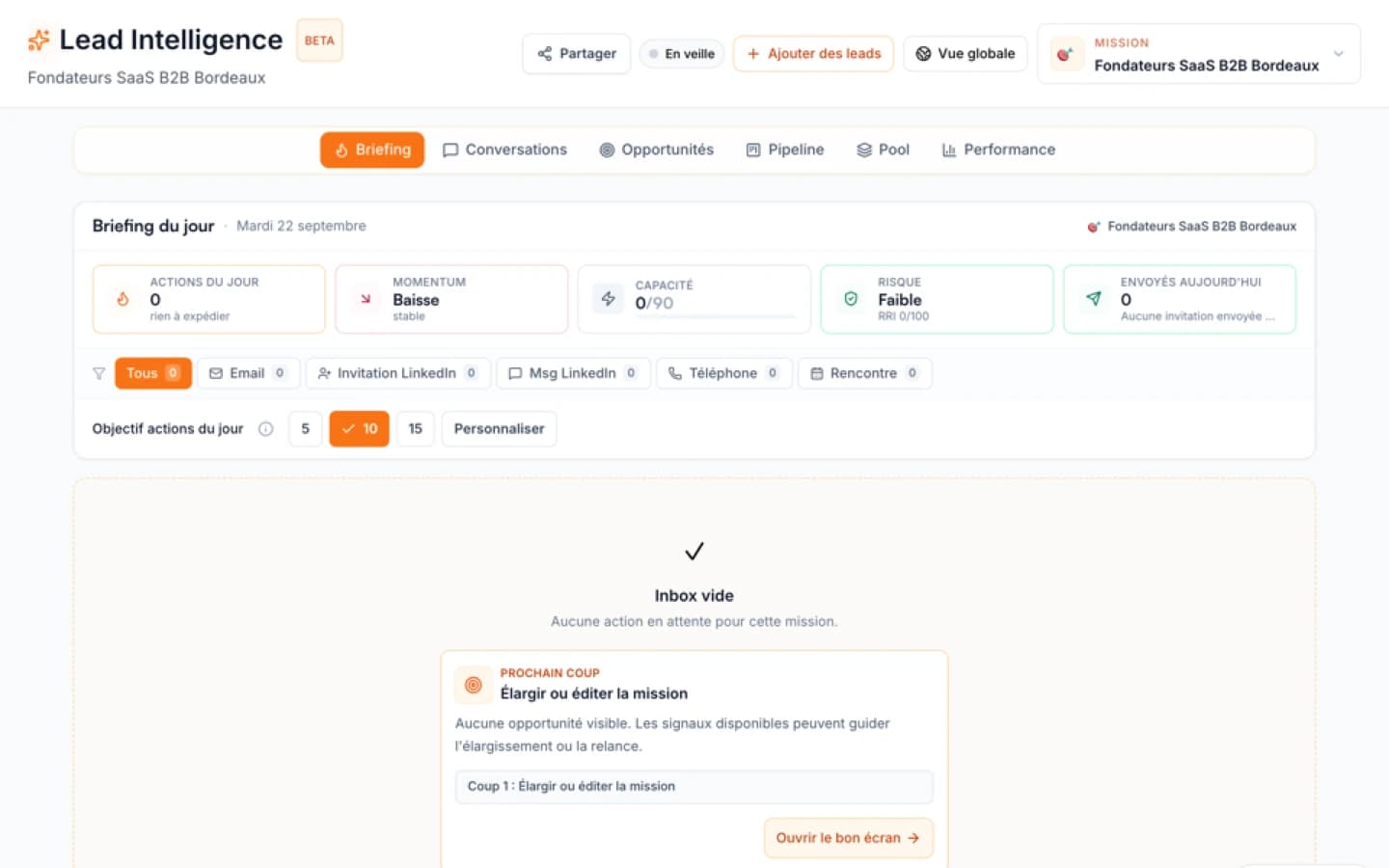
This is where Lead Intelligence changes the workflow. Instead of requiring a team to manually configure rules or clean raw databases, the system uses the existing business plan, target Ideal Customer Profile (ICP), and strategy to run autonomous sales missions. The mechanism works by finding accounts that match the specific ICP and active market signals, verifying useful sources, and then classifying these accounts into explained opportunities to watch, act on, or set aside.
Because the qualification is driven by context rather than database size, there is no need for a massive initial list. Lead Intelligence finds and prioritizes the contacts itself whether the team starts with 10, 100 or 1,000 contacts, with no minimum contact threshold. This allows a small team to launch highly targeted qualification efforts immediately. With usable targeting context, the first prioritized leads can appear in about 30 minutes.
Once the opportunities are classified, the system proposes a clear next action, the most appropriate channel, and the specific angle to use based on the lead's current situation. This mechanism helps a small sales team spend its limited hours on the conversations that deserve attention now, where a marketing department would otherwise filter prospects.
Concrete examples
To understand how these concepts apply in practice, consider a small Business-to-Business (B2B) sales team trying to build a predictable pipeline without any marketing support. In a typical scenario, a team might rely on traditional sales intelligence platforms to build prospect lists. For example, Apollo presents itself as an AI-powered go-to-market system with a database of 240 million contacts and 30 million companies, as stated on the Apollo homepage. However, for a small team, managing a massive database can quickly become a bottleneck. At Apollo, the pricing page states that an export credit is consumed whenever a contact is exported outside Apollo: exporting contacts consumes credits that the team has to track as it grows. When there is no marketing department to warm up or filter these prospects, sales representatives must handle the entire qualification process themselves. Without marketing-generated leads, reps often spend hours manually scraping websites or building complex workflows. Some teams attempt to solve this by using advanced data infrastructure. For instance, Clay presents itself as infrastructure to get data, run agentic workflows and launch GTM plays, as shown on the Clay homepage. While powerful, this infrastructure can require technical skills that a small sales team does not always have. Instead of building complex databases or wasting hours on manual qualification, a small team can use context-driven prioritization to focus only on high-value opportunities. With Ember's Lead Intelligence, the team does not need to manage massive contact databases or worry about minimum volume requirements. Lead Intelligence finds and prioritizes the contacts itself, whether the team starts with 10, 100 or 1,000 contacts, with no minimum contact threshold. This approach allows a small team of fewer than five representatives to act on the signals detected about people and companies. Once the team establishes a clear targeting context, the first prioritized leads can appear in about 30 minutes. By focusing only on the prospects that show immediate readiness, a small sales team can concentrate its time on the opportunities to handle now, without having to pre-filter its whole list itself.
When to use this diagnosis
This diagnosis is critical when a small Business-to-Business (B2B) sales team is forced to move from passive waiting to active prospecting. Without a dedicated marketing department to feed the pipeline, reps must source their own opportunities, which often leads to friction and inefficient outbound campaigns.
It also helps when the founder or the rep spends most of the week building lists rather than talking to prospects, or when no written rule says when a prospect deserves a call. In those situations, setting three simple criteria and applying them to a small number of accounts beats widening the list.
It is also highly relevant when a team begins to feel the strain of traditional databases: at Apollo, for example, every contact exported outside the platform consumes an export credit (Apollo pricing). This metered decision-making process slows down small teams and punishes experimentation.
Instead of getting stuck in this high-cost loop, sales teams should apply this qualification framework when they need to focus on high-intent opportunities without managing complex data pipelines. By utilizing Lead Intelligence, teams can bypass traditional volume-heavy scraping. The system finds and prioritizes the contacts itself whether the team starts with 10, 100, or 1,000 contacts, with no minimum contact threshold. This approach is particularly useful when speed is essential, as the first prioritized leads can appear in about 30 minutes once a usable targeting context is established.
In practice, How to Build a B2B Prospect List from Scratch for Founders? completes this framework with another angle on the same topic.
When not to use it
A context-driven, highly prioritized qualification process is not the right fit for every Business-to-Business (B2B) sales model. If your sales strategy relies entirely on high-volume outbound prospecting where success is a function of sheer scale, traditional database-first platforms are more appropriate. For instance, Apollo offers a database of 240 million contacts, email sequences and a free browser extension, as stated on its Apollo and Chrome extension pages. If your team intends to scale aggressively using a unified sales and marketing platform to simplify its software stack, Apollo, which integrates with Salesforce, HubSpot, Outreach or SalesLoft (Apollo pricing), is worth considering. Similarly, if your organization has the budget and technical resources to employ dedicated Go-To-Market (GTM) engineers or Revenue Operations (RevOps) specialists, you may prefer a highly customizable data infrastructure. In this scenario, Clay offers the necessary framework for technical teams to run agentic workflows and launch custom GTM plays, as outlined on Clay. These platforms fit when you have the internal expertise to manage complex data enrichment pipelines and accept credit-based pricing, where exporting and enriching records become metered actions (Apollo pricing, Clay pricing). If your team does not have these technical resources or does not want to manage the compounding costs of metered credits as you scale, a context-driven approach is better. Ember designed Lead Intelligence to bypass the noise of massive databases by finding and prioritizing contacts directly, whether a team starts with 10, 100 or 1,000 contacts, with no minimum contact threshold. With usable targeting context, the first prioritized leads can appear in about 30 minutes. However, if your goal is to build a massive, unprioritized database for broad email blasts, traditional volume-oriented platforms remain the more logical path. To be clear, this article is published by Ember, the publisher of Lead Intelligence; the descriptions of Apollo and Clay reproduce what those publishers state on their own official pages, without any performance comparison.
Finally, if you sell into a very narrow market where you already know every account by name, a simple shared spreadsheet may be enough: in that case, adding a tool brings little.
Next step
To build a sustainable pipeline without a marketing department, a small sales team must transition from manual spreadsheet tracking to an automated, context-driven workflow. Instead of building complex data pipelines using platforms like Clay, which serves as infrastructure for Go-To-Market (GTM) teams and GTM engineers (Clay), small teams need a system that works immediately without dedicated technical resources. Large databases like Apollo, which highlights 240 million contacts and 30 million companies (Apollo), have their place in high-volume outbound, but they require close tracking of credit usage.
For a lean team, one option is to rely on Lead Intelligence, Ember's product; Ember is also the publisher of this article. This capability allows you to bypass complex configurations and immediately focus on the opportunities that deserve action now. Lead Intelligence finds and prioritizes the contacts itself whether your team starts with 10, 100, or 1,000 contacts, with no minimum contact threshold. Once you establish a usable targeting context, the first prioritized leads can appear in about 30 minutes.
By focusing on immediate context rather than sheer database volume, your sales reps can spend their time holding meaningful conversations instead of cleaning messy spreadsheets. You can start by defining your Ideal Customer Profile (ICP) directly in Ember, allowing the system to surface the accounts that deserve attention now.
A simple method, with no imposed tool, comes down to five steps. First write down, in two lines, the customer you want to sign in the next three months and the two or three signs that show an account has a need now. Then list about twenty accounts that match that description, without aiming for completeness. For each one, note why this account, why now, and the first message you would send. Sort them into three piles: act on this week, watch, set aside. Finally, measure over two weeks how many useful conversations each pile produced, and adjust your criteria rather than increasing volume.
Three indicators are enough to steer: the number of accounts reviewed each week, the share of accounts sorted into "act on", and the number of real conversations obtained from that pile. If the first rises while the third does not move, your criteria are too broad; if the "act on" pile stays empty, they are too strict.
A short first message can follow the same structure as your sorting: one sentence on what you noticed about the account, one sentence on the problem you help solve, then an open question. Avoid attaching a presentation: the goal is to get a reply, not to explain everything.
Three mistakes come up often: launching a sequence before defining the target customer, mixing accounts of very different sizes or needs in one list, and judging a method on three days of results. Fixing one of these often changes results more than adding a tool.
Before deciding, How small sales teams build pipeline without a lead scoring? helps connect this method with adjacent priorities.
Sources and methodology
This analysis draws on the official pages of Apollo (homepage, pricing and Chrome extension) and Clay (homepage, pricing and integrations), consulted on 28 September 2026, on an analysis published by The Geisheker Group about the failure of B2B SaaS lead generation programs, and on a LinkedIn post by Jason Lemkin, which remains a practitioner's opinion. This article is published by Ember, the publisher of Lead Intelligence: the descriptions of Apollo and Clay are limited to what those publishers state themselves, and the figures quoted are those on their pages at the date of consultation, which may change. The capabilities described for Lead Intelligence are those of the product: with usable targeting context, the first prioritized leads can appear in about 30 minutes, and the system finds and prioritizes the contacts itself whether the team starts with 10, 100 or 1,000 contacts, with no minimum contact threshold.
Sources
FAQ
Free diagnostic
Test your sales file
Drop an Excel or CSV and check its readiness without sending its rows to Ember.