
Claim to verify
Can a small sales team tell a customer's story in a deck without inventing a single result, and still be convincing? The claim defended here is yes, on one condition: only tell what you can show, and state the rest plainly as a limit instead of dressing it up as a success.
The starting point is a dilemma almost every young team knows. You do not have ten case studies written by a marketing department. You have three customers, a handful of thank-you emails and a few memories of calls. The temptation is then to round up: an "about 30% gain" that was never measured, a quote reworded to sound better, an anonymized customer whose context you no longer remember well. The problem is not only ethical. A buyer who has already seen twenty decks recognizes numbers that are too neat, and a single detail they cannot cross-check is enough to make them doubt everything else.
Two practitioner posts, which we opened for this article, feed the discussion. Brent Adamson writes that the best part of selling is the stories: the moments where you learn something, the mistakes you will not repeat. He draws a very concrete use from them: rely on what happened with previous customers to warn the buyer about an obstacle before they run into it (Brent Adamson on LinkedIn). Maja Voje, for her part, describes an eight-step B2B sales deck, which she attributes to April Dunford's framework, where proof only arrives in sixth position, after the change in context, the existing alternatives and the picture of a world where the problem is solved (Maja Voje on LinkedIn).
These two texts are practitioners' points of view, not studies. They do not demonstrate that a story without numbers converts better. They support a more modest and more useful idea: a customer story first helps the buyer recognize their own situation, and the number is only one piece of evidence among others. The rest of the article turns this into a method, examples you can adapt and a list of limits.
Methodology
The method comes down to five steps, to be done in order. It needs few tools: a spreadsheet, the history of your exchanges with the customer and an hour of work per story.
Step one, gather the raw facts. For every customer you plan to cite, write down what you can retrieve: the start date, what they used before, the reason for the purchase, what happened during rollout, what they said in writing. A fact that only exists in your memory does not go on the list.
Step two, sort every statement into one of three categories. Observed: you saw or measured it yourself, for example "the rollout took three weeks" if your calendar proves it. Declared: the customer says so, to be cited as such ("according to their operations lead"). Estimated: it is an extrapolation, to be presented as a hypothesis, never as a result. This simple label prevents most drift, because it forces you to write where each sentence comes from.
Step three, get the customer's approval on the exact text. Send them the slide as it will be shown, not a summary of what you intend to say. If the customer changes a word, the word changes in the deck. If the customer declines, the story becomes anonymous and you say so: "customer in sector X, name not disclosed", with no detail precise enough to identify them or to invent.
Here is a simple wording for asking for that approval, to adapt to your own tone: "We would like to present your project to prospects. Here is the slide as it would appear. Could you tell us what you accept, what you want to change, and whether your name can appear?" It has the advantage of giving the customer three separate decisions: the content, the corrections and the identification. Many customers who refuse the name accept the content, and many refusals simply come from a text they had never seen.
Step four, build the story around the situation rather than the number. A simple outline works well: the starting situation, the event that forced the decision, what was put in place, what was hard, what the customer sees today. The hard part is the most valuable, because it is the one a competitor who invents cannot supply. It is also what the approach described by Brent Adamson emphasizes: warning the buyer about the obstacle before they meet it.
Step five, keep a record. For every proof slide, keep a folder with the origin of every number and the date of the customer's approval. Six months from now, when a prospect asks a precise question, you will be able to answer without improvising.
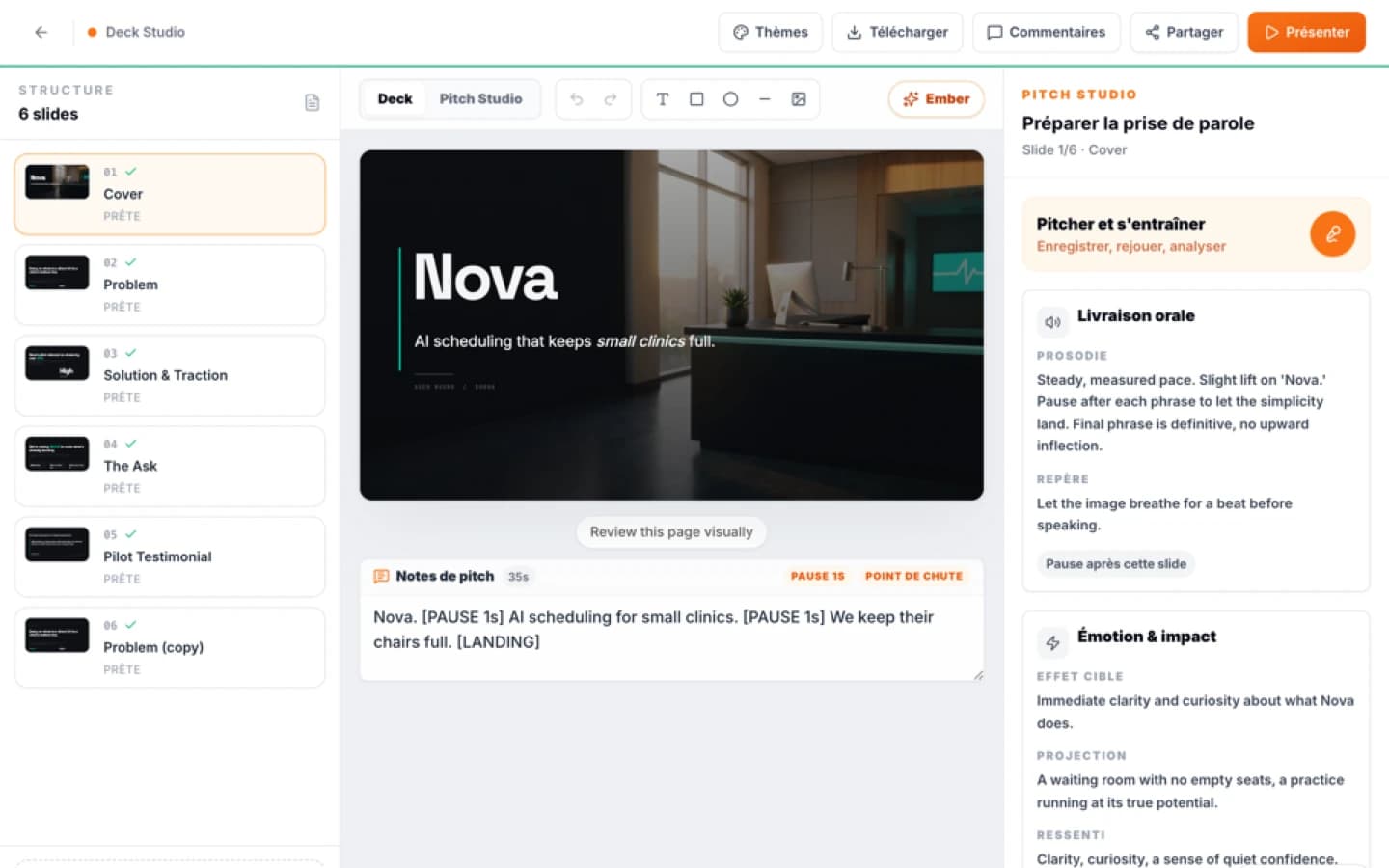
To prepare this work in a tool, let us first state our position: Ember publishes this site and offers Creation. The module suggests three templates with previews, asks the useful questions, then asks for your confirmation before creating the presentation. It does not replace the five steps above: the facts and the customers' approvals remain on your side. The details of how it works are on the Creation page.
To place this decision in context, the Knowledge guides for founders gather the in-depth analyses on the same topic.
Evidence
Not all evidence is equal, and an honest deck ranks it. From the strongest to the weakest, you can distinguish four levels.
The strongest level is a document the buyer can consult or the customer can confirm: an invoice, a usage report exported from your own system, an excerpt of an email sent by the customer and approved by them. Next come internal measurements you are able to redo: the time between signature and first use, the number of tickets opened during the first month. Then the customer's statements, cited with their name and role, or anonymized with their agreement. Finally, at the very bottom, your own interpretation, which is useful but must be presented as a reading, not as a fact.
In a small team, the sources are often closer than you think. The CRM keeps the dates. The mailbox keeps the exact words. Call recordings, when the customer agreed to be recorded, let you retrieve a precise sentence. The project tracker shows the real delays, which is valuable for the "what was hard" part. Get into the habit of copying these items into one folder per customer as soon as the project ends, while memory is fresh.
The eight-step framework described by Maja Voje places proof after the introduction of your company and of what sets you apart (Maja Voje on LinkedIn). That position matters: when the buyer sees the customer story, they already know which problem you address, and the proof does not have to explain everything. It can be limited to showing that the mechanism described earlier worked in a real case, with its reservations.
When proof is missing, two honest options remain. The first is not to show a customer story at all and to present your way of working instead, with an example clearly marked as illustrative. The second is to offer the prospect a short pilot, announcing in advance what you will measure together: the prospect then becomes the source of your first proof, and you know where it will come from.
One last point on presentation tools. An honest deck can be made in any of them. If you hesitate between a general-purpose tool and Creation, Gamma or Ember: when each one fits details the criteria, with the reminder that this guide is published by Ember. The choice of tool changes nothing about the underlying rule: a proof slide is only as solid as the folder behind it.
Demonstration and examples
Here is an illustrative example, about a fictional company, comparing three versions of the same slide. None of the numbers or names below describes a real situation.
Imagine a small team that sells scheduling software to maintenance workshops. It has one customer, a mid-sized workshop that finished its rollout last month. The first version of the slide, the one you are tempted to write, states: "Our customer cut lead times by 40% in the first month." Nobody measured those 40%; they come from a conversation at the coffee machine. An attentive buyer will ask "40% of what, measured how, over how long?", and the team will have no answer.
The second version, more cautious but still weak, says: "Our customer is very satisfied." Nobody can dispute it, and nobody remembers it either, because it tells nothing.
The third, honest version tells the situation. It says, for example: "The workshop scheduled its jobs on a shared spreadsheet. After a delay on an important order, its manager looked for a tool that would show scheduling conflicts before they happen. Rollout took three weeks, one of which was lost cleaning up the spreadsheet data. A month later, the manager wrote to us that the team opens the tool every morning. We do not yet have a before-and-after lead time measurement, and we plan to make one with them in month three." In this version, every sentence can be tied to a source (the project calendar, an email), the absence of a measurement is stated, and the buyer is warned about a real friction point: data cleanup. It is exactly the idea of anticipating the obstacle described by Brent Adamson.
Consider a quote as well. The customer wrote in an email: "The tool spared us two or three scheduling conflicts this week, that's already good." The temptation is to smooth it into "The tool eliminated scheduling conflicts." That is no longer the customer's sentence, and it claims far more. The honest version keeps the words as they are, with the context: "written a month after rollout, about one week of use". The quote looks more modest, and that is precisely what makes it credible: it sounds like a real person, not a press release.
This third text is longer, but it does not sound like a brochure. A prospect who also has a messy spreadsheet recognizes themselves in it, and the remark about the lost week gives them a reason to believe the rest.
If you are preparing a deck that follows the eight-step framework, this story belongs at the proof step. It does not replace the rest: it is the buyer's view of the world, then the gap with current alternatives, that make the story useful (Maja Voje on LinkedIn). Without that context, even a true story looks isolated.
What to expect, and what not to promise
This section could have displayed a statistic on the conversion lift of an honest story. We chose not to: none of the sources opened for this article provides such a measurement, and a number lifted from a third-party article without checking it would be exactly the mistake this guide warns against.
What you can reasonably expect is of a different kind, and you can verify it yourself. Your prospects ask more precise questions, because the story gives them material: they will ask how the data cleanup went rather than dispute a percentage. Your reps tell the same story the same way, which reduces the risk of gaps between two presentations. Finally, you know at any time where each sentence of the deck comes from, which makes legal reviews and answers to tenders noticeably faster.
What you should not promise, on the other hand, are effects you have not measured. Telling your management that an honest story "will double the signing rate" is no better founded than inflating a customer figure. If you want to know whether your new slide works, compare before and after on your own conversations: number of follow-up questions, time until the next meeting, rate of moving to the next stage. On a small volume, the comparison stays fragile, and you should tell your team so.
A very simple tracking example, for a team of three sales reps: after each presentation, each one notes whether the buyer asked a question about the story slide, which one, and whether the next meeting was booked within the week. After twenty presentations, you do not hold statistical proof, but you have real material to improve the text: the questions that keep coming back show what is missing, and the ones that never come show what is clear. This kind of tracking is worth more than an invented percentage, because it comes from your own conversations and you can show it.
To see how other teams approached a neighboring topic, Creation use cases for founders entering a new market extends this thinking to startup stories.
Limitations
The first limit is the raw material. If your sales team is separated from delivery and support, it does not know the real difficult points of a project, and the story falls back into the generic. The fix is organizational: a twenty-minute conversation with the person who led the rollout, before writing a line.
The second limit is consent and confidentiality. A customer may agree to testify verbally and refuse the written version, or accept a name but not a number. The deck must respect what the customer accepted, even when it weakens the story. A sales contract sometimes contains a confidentiality clause that forbids any mention: read it before citing.
The third limit is legal, and this guide does not replace a lawyer's advice. The French Consumer Code classifies as a misleading commercial practice one based on false allegations, notably about the results expected from using a good or service (Légifrance, article L121-2). This code first targets relations with consumers: its application to a sale between businesses depends on the situation and must be checked with counsel. In the United States, the Federal Trade Commission has published a guide to its rule on consumer reviews and testimonials, which targets in particular testimonials that are fake or that misrepresent a person's actual experience (FTC, rule questions and answers). That rule concerns consumer reviews and does not automatically apply to your sales in France. These two texts mostly show that the subject is regulated, which is one more reason to keep a proof folder.
A fourth limit is time. A story written a year ago may no longer be true: the customer may have changed team, supplier or usage. Date every story in your folder, and reread it with the customer before reusing it in a new deck. A slide that says "situation as of March" is more honest than a slide with no date.
Finally, a true story remains a single case. One satisfied customer does not prove the next one will be. Say so: "this case illustrates, it does not guarantee", and let the buyer draw their own conclusion.
Decision criteria
Before including a story in your deck, run it through six questions. Every negative answer is a signal to rework or remove it.
First question: does every sentence on the slide have a source you can show? Second: has the customer approved the exact text, and for what use? Third: are the numbers, if any, measured or declared, and is that written? Fourth: does the slide state a real difficulty or only successes? Fifth: would a prospect with the same problem recognize themselves in it? Sixth: can you answer a follow-up question without improvising?
Also note the relative weight criterion. A story slide that fills half the deck unbalances the presentation: the buyer comes looking for a solution to their problem, not an account of your success. A short story, well placed and well supported, weighs more than a long testimonial. If you hesitate between two stories, keep the one whose every sentence you can document best, even if the other looks more spectacular.
These criteria read alongside the eight-step framework: if the story serves none of the steps (change in context, alternatives, perfect world, differentiation, proof, objections), it is probably decorative. Conversely, a story that answers a frequent objection, for example the fear of a long rollout, has more value than an isolated number.
On the choice of tool, the criteria are simpler: does the tool let you keep control of the final text, does it ask you questions before producing, and does it ask for your confirmation before creating? That is what Creation does, but the essential remains your folder of facts. To decide which evidence to look at before committing, Which evidence should a founder seeking first customers verify before choosing Creation? offers a complementary list.
What remains unproven
Several things remain uncertain, and it is better to write them down than to hide them.
First, the link between an honest story and a better closing rate is demonstrated by none of the sources opened here. The two LinkedIn posts are opinions from experienced professionals, useful for the method, but they are not measurements. It is possible that buyers react more favorably to a spectacular figure, even an implausible one, in some very transactional markets. We do not claim it; we only say we have no proof either way.
Then, how far anonymization protects. A customer "in sector X, mid-sized, in such region" may be recognizable to its competitors. We have no sourced rule to set the right level of detail: the only safe practice is to ask the customer what seems identifiable.
Next, the ideal position of proof in the deck. The eight-step framework puts it in sixth position, but nothing indicates that this order is optimal for every sale. A team selling a simple product to a hurried buyer may benefit from shortening the sequence.
Finally, how French or American law applies to sales between businesses varies from case to case, and we have no source that settles it for your situation. If your sector is regulated, have the slides reviewed by a lawyer.
Before deciding, What does a narrative-led B2B pitch change in buyer behavior? helps connect this method to neighboring priorities.
What this article verified
This guide relies on four pages actually opened on 29/09/2026, and on nothing else for the facts cited.
Brent Adamson's LinkedIn post was read in full: it supports the idea that stories lived with customers help warn a buyer about an obstacle, and it provides no figures. Maja Voje's post was read in full: it describes an eight-step framework for a B2B sales deck and attributes it to April Dunford, and it does not provide any measurement either. Article L121-2 of the French Consumer Code was opened on Légifrance. The Federal Trade Commission's questions and answers page was opened on the agency's official site.
What we did not verify: the real effect of an honest story on sales, how the legal texts cited apply to your situation, and any data on competing tools. We therefore cite none. The examples in this article are illustrative and do not describe real customers.
Sources and updates
This guide is published by Ember, which also publishes Creation: read it with that in mind. The sources below were consulted on 29/09/2026.
For customer stories and warning about obstacles: the post by Brent Adamson on LinkedIn. For the structure of an eight-step B2B sales deck: the post by Maja Voje on LinkedIn. For the French legal framework on misleading practices: article L121-2 of the Consumer Code. For the American framework on testimonials: the FTC questions and answers.
For what Creation does, the source is Ember's product page. This page will be reread if one of the sources changes significantly.
Sources
FAQ
Creation
Work on substance and impact
Structure the reasoning, form and mental journey of your presentation.