
Claim to verify
When you are an early stage founder seeking your first Business-to-Business (B2B) clients, your pitch deck is not just a visual aid. It is the structural backbone of your sales argument. Before choosing a presentation tool to build this narrative, you must verify how it handles the transition from raw business ideas to a persuasive flow.
For many standard scenarios, traditional presentation software is entirely sufficient. If you already have a finalized narrative and simply need to polish your slides manually, Microsoft PowerPoint remains a highly capable industry standard. It even includes built-in features for private preparation, such as the ability to rehearse your slide show with Speaker Coach, as detailed in the Microsoft PowerPoint Speaker Coach documentation.
However, the primary challenge for early stage founders is rarely the visual design alone. It is the clarity of the message. According to practitioner feedback shared on LinkedIn by investor Ben Yoskovitz, founders frequently struggle with structural clarity, highlighting 8 issues that early-stage founders face when having their pitch decks reviewed. When your goal is securing those critical first customers, you cannot afford a generic template that fails to address your specific Ideal Customer Profile (ICP).
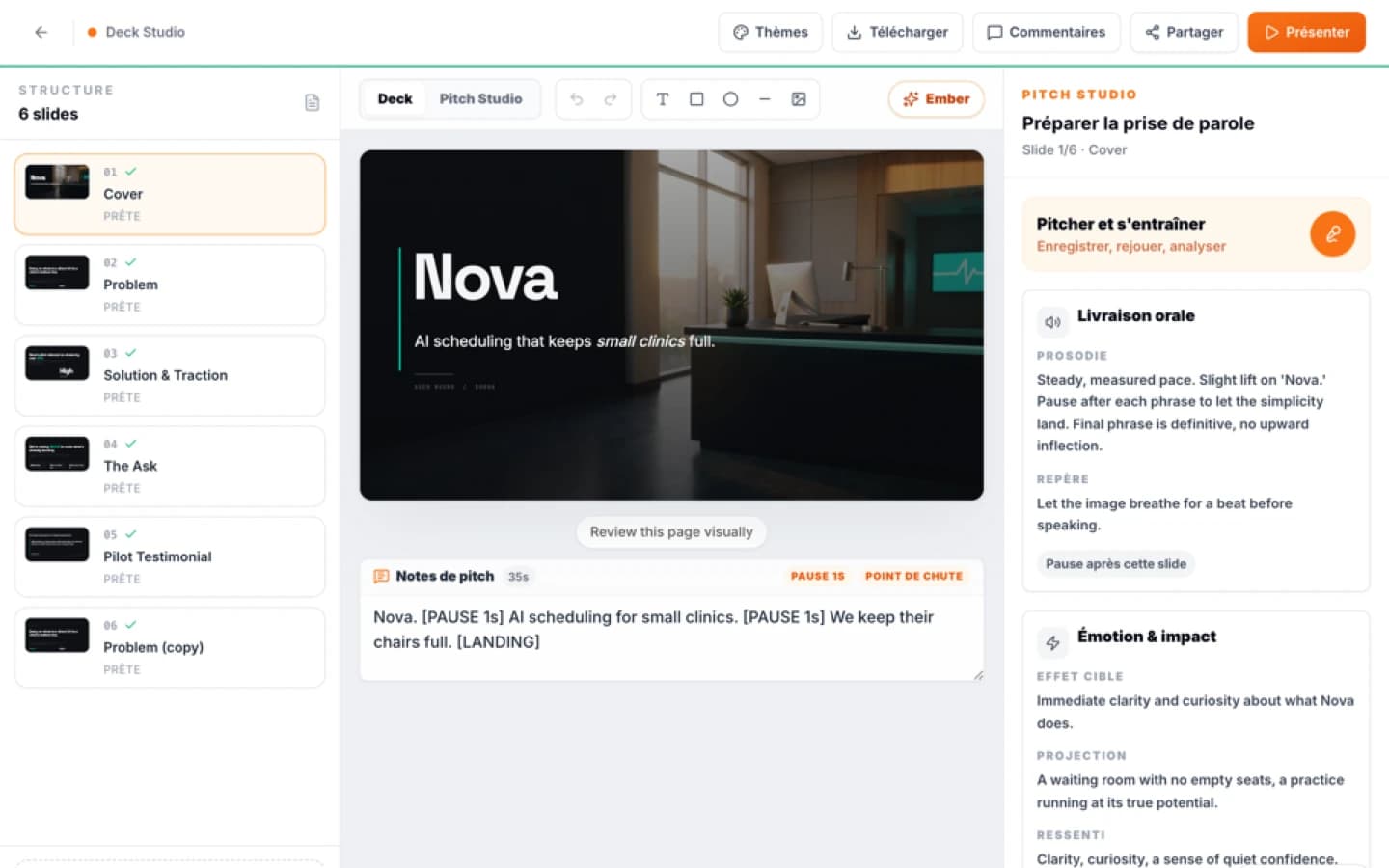
Before committing to Creation, you should verify that the tool prioritizes narrative substance over superficial layouts. A reliable Artificial Intelligence (AI) workflow must guide you through the framing of your message before generating slides. In Ember, this process begins with active guidance: the system suggests three templates with previews, asks useful questions, and asks for confirmation before creating, as shown on the Ember Creation page. This ensures you do not waste resources on a structure that does not fit your commercial goals.
Furthermore, you must ensure you retain complete creative control. A common limitation of automated tools is the inability to make granular adjustments once the slides are generated. You should verify that any presentation platform you choose allows you to edit the final output directly. Within Ember, users can edit the generated presentation in Creation and later record, replay, and rehearse the presentation with Speaking practice to refine their delivery, as detailed on the Ember Creation page.
Ultimately, your commercial presentation must align with your broader business strategy. If you are also in the process of structuring your company's financial roadmap, you may need to look beyond the pitch deck itself. For these strategic phases, Ember also offers Fund Your Growth, which helps founders build their Business Plan, choose a coherent funding strategy, and plan their next operational steps. Evaluating these capabilities beforehand ensures you select a toolset that truly supports your journey toward securing your first clients.
To place this decision in context, the Knowledge guides for marketing bring together deeper guidance on the same field.
Methodology
To evaluate whether a presentation platform can support your founder-led sales phase, you should apply a systematic verification methodology based on specific core pillars.
First, verify how the tool structures the initial creation process. A reliable platform should not jump straight to design without understanding your business context. For example, the onboarding workflow in Creation suggests three templates with previews, asks useful questions, and asks for confirmation before creating, as detailed on the Ember Pitch Deck page. This ensures that the narrative is grounded in your actual business goals before any slides are generated.
Second, evaluate the level of post-generation control. Many automated tools produce static layouts that are difficult to modify, which can ruin a deck when you need to make quick adjustments for a specific client. You must ensure the tool lets you edit the generated presentation directly. In Creation, users can edit the generated presentation within the editor, keeping you in complete control of both the substance and the form.
Third, assess how the tool helps you prepare for the actual delivery. Building the slides is only the first step, as your verbal delivery is what ultimately closes the deal. Incumbent tools are often sufficient for basic practice. For instance, Microsoft PowerPoint offers a private rehearsal feature with Speaker Coach to help presenters prepare before their live session, as documented on Microsoft Support. To provide a more integrated experience for founders, Creation lets users record, replay, and rehearse their presentation directly with Speaking practice, helping you refine your rhythm and impact.
Finally, align your tool selection with real-world founder experiences. According to practitioner feedback shared by Ben Yoskovitz on LinkedIn, early stage founders frequently struggle with structural and narrative issues when building their pitch decks, as discussed in his LinkedIn post. Your chosen platform should actively address these common structural weaknesses rather than just offering superficial visual polish.
Evidence
To build a presentation that actually wins clients, you must look beyond superficial design templates and verify how a platform handles the core narrative. According to practitioner feedback shared by Ben Yoskovitz on LinkedIn, early-stage founders frequently struggle with structural and narrative issues when their pitch decks are reviewed.
When evaluating alternative presentation tools, you should also verify their pricing mechanics and credit limitations to avoid unexpected interruptions. For instance, Gamma offers five plans: Free, Plus, Pro, Ultra, and Business, as detailed on the Gamma help center. Their free tier provides a one-time grant of 400 credits at signup with no refresh, whereas their paid plans refill credits monthly and allow a rollover of up to double the plan size, according to the Gamma credit documentation.
If your primary goal is simply to rehearse a manually created slide deck with automated feedback, traditional tools are often entirely sufficient. Microsoft PowerPoint remains an excellent choice for this specific scenario, offering a private rehearsal experience with Speaker Coach to help you prepare before your presentation, as documented by Microsoft Support.
However, if you need a platform that actively helps you structure your business reasoning, you should verify how the tool guides you through the creation phase. In Ember, the workflow for Creation is designed to prevent blank-page anxiety by suggesting three templates with previews, asking useful questions, and asking for confirmation before creating.
Once the initial draft is generated, a founder must retain full editability. You should verify whether the platform allows direct modifications or locks you into rigid layouts. Ember lets users edit the generated presentation directly in Creation and also lets users record, replay, and rehearse the presentation with Speaking practice to ensure the final delivery is seamless.
Finally, a sales deck does not exist in a vacuum. It must align with your broader business model and funding strategy. For founders who need to ensure their client-facing narrative matches their financial planning, Ember's Fund Your Growth capability connects assumptions, evidence, funding needs, and the action plan in one single context. You can explore the full list of benchmarks to verify before choosing a tool on Ember's Creation verification page or review the financial planning requirements on Ember's Fund Your Growth verification page.
To explore this point further, How Narrative-Led B2B Pitches Shift Buyer Behavior? details a step directly related to this decision.
Demonstration and examples
To see these principles in action, early stage founders can look at how different platforms handle the transition from a raw business idea to a structured pitch.
When verifying a tool, founders should first look at the onboarding and framing stage. A common pitfall in automated slide generation is receiving a generic presentation that does not fit the specific audience. A reliable platform must structure the narrative before designing slides. For example, as shown on the Ember Pitch Deck page, Creation suggests three templates with previews, asks useful questions to capture the project context, and asks for confirmation before creating. This step ensures that the underlying business logic is sound before any visual assets are created.
Second, founders must verify the flexibility of the editing environment. Traditional software like Microsoft PowerPoint remains an excellent choice for founders who prefer complete, manual control over every text box and shape from scratch. However, if you use an automated generator, you must verify that you are not locked into a static output. The platform should let users edit the generated presentation directly, which is a core capability of Creation. This ensures you can tweak the messaging as your customer conversations evolve.
Finally, the delivery of the pitch is just as important as the slides themselves. Before committing to a tool, founders should check if it supports the rehearsal phase. Microsoft PowerPoint offers a robust private rehearsal experience with its Speaker Coach, allowing founders to prepare privately before their presentation, as detailed on the Microsoft Support page. In comparison, to help founders practice their verbal delivery alongside their slides, Creation lets users record, replay, and rehearse the presentation directly with Speaking practice.
By evaluating these concrete examples, early stage founders can choose a presentation partner that supports both the strategic narrative and the practical execution of their first sales campaigns.
Observed results
Traditional presentation software remains highly effective for many standard business needs. For instance, Microsoft PowerPoint offers a robust environment for slide design and includes a private rehearsal feature with its Speaker Coach to help presenters prepare before their live presentation, as detailed on the Microsoft Support Page. For founders who already possess a fully structured, validated sales narrative and simply need to practice their delivery, such established tools are entirely sufficient.
However, early stage founders seeking their first clients often face challenges long before they stand up to present. The primary hurdle is not visual polish, but the underlying narrative structure. This difficulty is reflected in practitioner feedback shared by Ben Yoskovitz on LinkedIn, which highlights the common structural issues founders face when trying to build pitch decks that convince external audiences.
When evaluating alternative platforms, founders should verify whether the tool actively helps them resolve these structural gaps. In Ember, the creation workflow is designed to prevent generic, uninspired slides. The system suggests three templates with previews, asks useful questions to capture the unique context of the business, and asks for confirmation before creating, as outlined on the Ember Pitch Deck Page. This ensures that the presentation is grounded in real business substance rather than superficial design.
Once the initial draft is ready, the founder must retain absolute control over the messaging. The platform lets users edit the generated presentation directly in Creation, ensuring that any necessary adjustments can be made easily, as shown on the Ember Pitch Deck Page. Finally, to ensure the pitch is delivered with confidence, the platform lets users record, replay, and rehearse the presentation with Speaking practice, as documented on the Ember Pitch Deck Page. By verifying these capabilities, early stage founders can choose a solution that does not just generate slides, but actively prepares them to win their first customers.
This approach also connects with Creation Use Cases for Founders Seeking Product-Market Fit, which clarifies the next choice.
Limitations
While automated tools offer a powerful starting point, early stage founders must understand the inherent limitations of relying on artificial intelligence (AI) for presentation design. An AI tool cannot invent product-market fit or substitute for a lack of real-world customer validation. If a founder has not yet defined their core value proposition, the resulting slides will inevitably reflect those strategic gaps.
Within the Ember ecosystem, this limitation is addressed by connecting different business modules. For example, the Fund Your Growth capability is designed to make validation gaps and assumptions visible in one shared context, as detailed on the Ember Fund Your Growth page. However, the tool cannot resolve those gaps for you. The founder must still do the hard work of validating their business model.
Additionally, automated generation is not a hands-off process. When using Creation, the system suggests three templates with previews, asks clarifying questions, and asks for confirmation before creating, as explained on the Ember Creation page. This workflow requires active human input and strategic decision-making. While the platform lets users edit the generated presentation and rehearse their delivery with Speaking practice, the final responsibility of defending the deck and closing the client remains a human task.
For founders who prefer absolute manual control over every pixel from the start, traditional tools remain a strong alternative. For instance, Microsoft PowerPoint provides a highly mature environment for manual slide editing and includes a private rehearsal feature with its Speaker Coach, as documented on the Microsoft Support page. Founders must weigh the speed and contextual alignment of an agentic workflow against the granular, manual design control of legacy software.
Decision criteria
When early stage founders seek their first clients, the primary criteria for evaluating a presentation tool must shift from superficial design to narrative substance. A beautiful deck that fails to articulate a clear value proposition will not close deals. According to practitioner feedback shared by Ben Yoskovitz on LinkedIn, founders frequently struggle with structuring their core message. Therefore, a critical proof point to verify is whether the software helps the presentation build understanding and move a decision forward beyond visual polish, a core benefit detailed on the Ember Pitch Deck Page.
Another essential criterion is how the tool initiates the creation process. Founders should avoid platforms that demand immediate payment before demonstrating value or understanding the project context. A reliable workflow should suggest templates with previews, ask useful questions, and ask for confirmation before creating, ensuring the founder validates what they are getting before committing resources, as outlined in the capabilities on the Ember Pitch Deck Page.
Many automated tools generate static files that are difficult to modify, forcing founders to restart from scratch for minor adjustments. Before choosing a solution, founders must verify that the platform lets users edit the generated presentation directly within the workspace. This capability, highlighted on the Ember Pitch Deck Page, ensures that the presentation remains a living document that can adapt as customer conversations evolve.
Finally, the transition from slide creation to live delivery is where many founders struggle. Traditional presentation software remains highly effective for standard needs, and established tools like Microsoft PowerPoint offer robust environments that include private rehearsal features with Speaker Coach to help presenters prepare before live meetings, as detailed on the Microsoft Support Page. To match this level of preparation, founders evaluating modern alternatives should check if the platform lets users record, replay, and rehearse the presentation, a capability built directly into Speaking practice as described on the Ember Pitch Deck Page.
In practice, How to Build a B2B Sales Pitch from a Real Customer Story? completes this framework with another angle on the same topic.
What remains unproven
While automated tools can rapidly generate a structured narrative, several critical factors remain unproven until a founder actually presents to a live prospect. An Artificial Intelligence (AI) tool can structure a narrative path and generate slides, but it cannot guarantee real-world traction or validate product-market fit.
One major area of uncertainty for founders is the predictability of tool usage and pricing models. For instance, Gamma offers five plans: Free, Plus, Pro, Ultra, and Business, as detailed on the Gamma Subscription Help Page. Their Free plan gives a one-time grant of 400 credits at signup with no refresh, as explained on the Gamma Credits Help Page. For their paid tiers, credits refill monthly with a rollover of up to double the plan size, offering 1,000 monthly credits for Plus, 4,000 for Pro, and 20,000 for Ultra, according to the Gamma Subscription Help Page. This credit-based consumption can make it difficult for early-stage founders to budget their presentation costs when iterating frequently.
To address this unpredictability, Ember takes a different approach in Creation. The platform suggests three templates with previews, asks useful questions, and asks for confirmation before creating, as described on the Ember Pitch Deck Page. This lets founders confirm what they are launching before generating their slides.
Even with a well-framed creation flow, the ultimate test of any presentation is how well it performs in front of an audience. While Creation lets users record, replay, and rehearse the presentation with Speaking practice, as noted on the Ember Pitch Deck Page, the actual psychological impact on a potential client cannot be simulated. Founders must actively test their generated decks in real Business-to-Business (B2B) conversations to prove that the messaging converts interest into actual sales.
Before deciding, Gamma vs Creation: Read-Alone Deck or Live Angel Pitch? helps connect this method with adjacent priorities.
Sources and updates
This guide draws on the Ember Finance benchmarks, the Ember Creation benchmarks and a LinkedIn post by Ben Yoskovitz, consulted on September 28, 2026. Ember is the publisher of Creation. When comparing tools, founders can look at alternatives like Gamma, where users can generate layouts and text from prompts or uploaded material, or Microsoft PowerPoint, which provides a private rehearsal tool with its Speaker Coach feature. These benchmarks and public features help founders verify that their chosen platform supports both the narrative structure and the delivery practice required to win their first clients.
Sources
FAQ
Creation
Work on substance and impact
Structure the reasoning, form and mental journey of your presentation.