
Claim to verify
The claim of this guide is simple: in a B2B sales pitch, the strongest story is not a list of features but a structured account in which the customer is the hero. Two external sources support it. LinkedIn Top Content on storyboarding the sales narrative explains that a pitch should be organised like a story, with the customer as the protagonist facing a specific conflict and the solution acting as a guide. The Harvard Business Review article on the right story argues that a great sales pitch hinges on choosing and shaping the right story, and that most salespeople centre it on product benefits instead of customer obstacles.
To verify the claim in your own case, ask a first practical question: do you have a real customer story you can tell, with facts you can check and permission to use them? A pitch built on a real result is only as good as the evidence behind it. If the story is a composite or an assumption, the pitch must say so or should not use it.
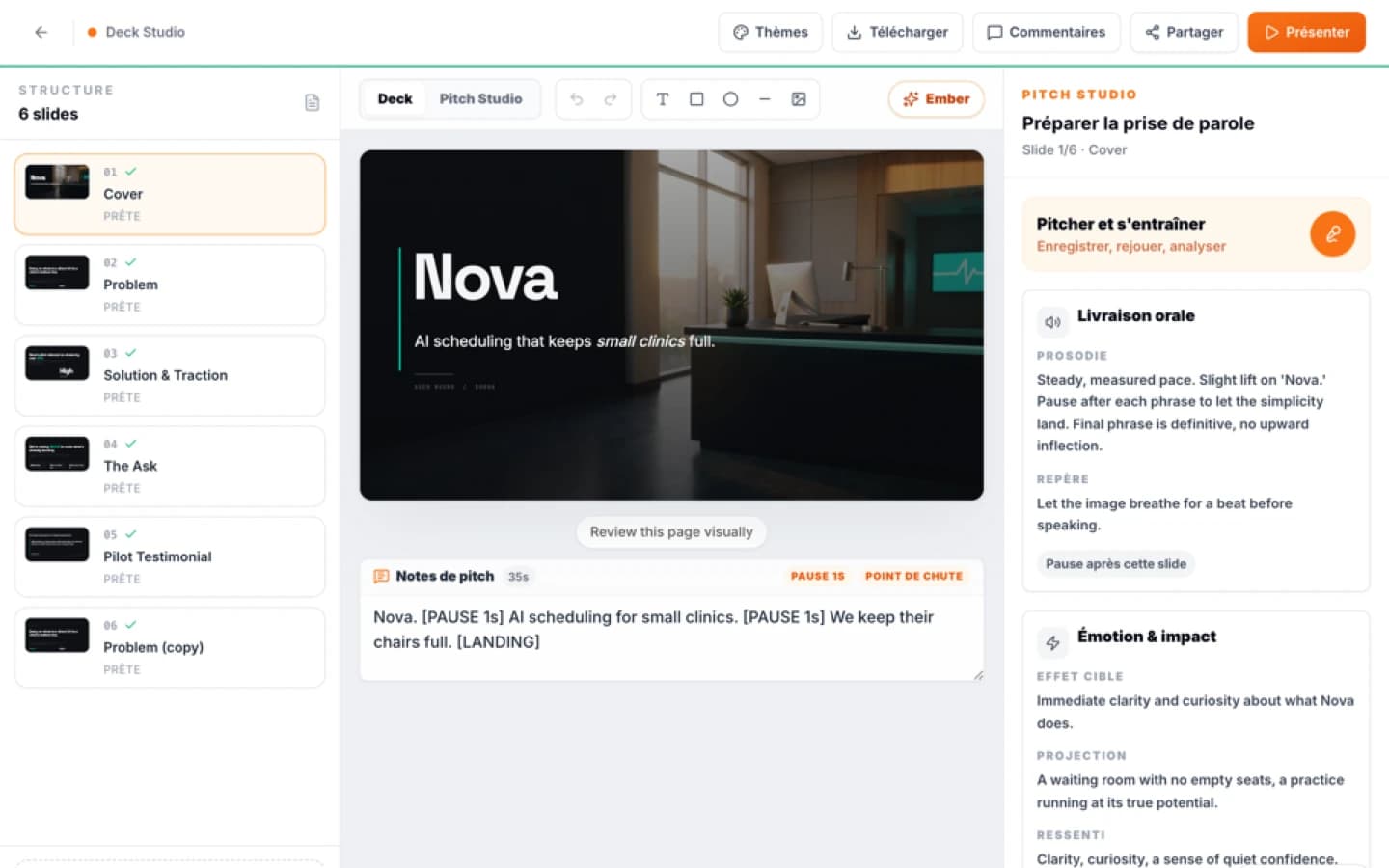
Sales intelligence tools are good at finding the right accounts, but they do not build the story for you. Once the contacts are found, persuasion rests on the pitch itself. Ember's Creation is designed to help the presentation build understanding and move a decision forward beyond visual polish: it analyses the substance and structures the narrative path before producing the slides.
The claim has practical consequences. If the customer is the hero, the first minutes of a pitch are about their situation, not about your company. Introductions of the vendor, the technology and the team come after the problem has been recognised by the buyer. Many pitches invert this order, and the buyer has to wait several slides before seeing anything that concerns them.
To verify the claim in practice, run a small test on your own material. Take your current deck and mark each slide as about the customer or about the vendor. If most slides are about the vendor, the deck is feature-led, whatever its design. This simple count costs nothing and shows how much rebuilding is needed.
The word real matters. A real customer story is one that happened, with a customer who exists, a problem that was observed and an outcome that can be described. A composite built from several cases, or a plausible story invented to illustrate a point, is not a real story, and using it as one would undermine the whole approach.
To place this decision in context, the Knowledge guides for sales bring together deeper guidance on the same field.
Methodology
Building a pitch around a real customer story takes a systematic approach, from raw case-study data to a structured, persuasive flow. Sales teams often list product features in chronological order. A better method centres on the customer's journey.
The HBR article proposes three steps. First, identify the obstacles: listen carefully to what prevents customers from buying. Its authors write that jargon will never be as effective as the emotional connection you create when you listen to and relate to someone else's pain point. Second, tap into emotions, because feelings influence what we believe to be true, so the pitch must appeal both rationally and emotionally. Third, tell a different story: reframe the narrative for this specific customer, showing how the product answers their concerns, not only the logical ones.
The LinkedIn source adds two frameworks. The hero, guide, conflict and transformation model places the customer as the hero, the seller as the guide who shows empathy and authority, the conflict as the specific challenge blocking success, and the transformation as the improved future state. The STAR method structures a customer example in four parts: situation, trouble, action and result, with specific details in the situation and, where they exist, concrete metrics and timelines in the result.
Before using any of this, check the facts of the customer story: what happened, who did what, and which figures come from the customer's own data. Get the customer's agreement to use the story and, if relevant, their name.
A practical way to collect the story is a short customer conversation. Ask what the situation was before, what they tried, what made them act, what changed, and what they would tell a peer in the same position. Record their words: a customer's own phrase is more convincing than a paraphrase, and it is easier to verify.
Then test the story on a colleague who does not know the case. If they can repeat the problem, the action and the result in their own words after one minute, the story is clear enough. If not, remove details until the core remains. A story library of several cases, each short enough to tell in about a minute, lets you choose the one that fits the conversation.
A short permission checklist helps. Does the customer agree to the use of the story? Do they agree to be named, or must the case be anonymised? Have they seen the figures you plan to quote? Is there a date after which the story should be reviewed? Write the answers down next to the story, so that a colleague using it later knows what is allowed.
Keep the story short enough to fit the format: a spoken version of about a minute, and a written version of a short paragraph. Both should state the same facts.
Finally, keep a copy of the customer's approval with the story, so that the permission can be shown if it is ever questioned.
Evidence
What supports the claim, and how strongly?
The HBR article gives a worked example. A food and beverage company failed to obtain premium shelf space by stressing its state-of-the-art production process. After identifying the retailer's concerns, a high price and low sales, the team found its real value proposition through a chance conversation with a waitress whose son had health issues and had benefited from the product. That human story, plus further customer testimonials showing that consumers saw the product as preventing future medical costs, persuaded the retailer to provide premium shelf placement, and sales increased.
The LinkedIn source states that decision-makers do not just buy products, they buy stories, and recommends personalising with specific names, roles and timelines, keeping the customer as the hero, and making challenges tangible.
These are practitioners' accounts and one detailed example. They show a plausible mechanism, but they are not controlled measurements, and none of the sources gives a figure that could be applied to your own pitch. This guide therefore claims no percentage improvement.
Traditional presentation tools remain a good choice for the layout of a story that is already clear. Their strength is design and collaboration, not the logic of the story. The evidence supports working on the story first, and only then on the slides.
It is also worth noting what the sources do not say. Neither claims that every story works, or that emotion should replace facts. HBR speaks of appealing both rationally and emotionally, and the LinkedIn source asks for concrete metrics and timelines in the result. The evidence supports combining a human story with verifiable facts, not choosing between them.
Demonstration and examples
To see the difference, compare two versions of the same pitch. This example is illustrative and does not describe a real customer.
Feature-led version: "Our platform includes automatic data cleaning, a built-in contact database and email sequencing tools."
Story-led version, using STAR: Situation: a regional logistics company with a small sales team. Trouble: the reps spent part of each week checking contact data by hand, so they had less time to talk to buyers. Action: the company automated the verification of its data and reorganised the team's week around live conversations. Result: what the customer measured and agrees to share, stated with its own figures and dates, or, if there is no measured figure, a plain description of what changed.
The second version does three things the first does not. It makes a specific problem visible, it shows the customer acting, and it lets the buyer recognise their own situation. It also forces the seller to have facts. If the result cannot be stated honestly, the pitch should describe the change without inventing a figure.
In Creation, the same logic applies to the deck. The workflow proposes three templates with a preview, asks the useful questions, such as who the audience is and which customer story anchors the pitch, and asks for confirmation before creating. The deck can then be exported to PDF or PowerPoint, and Speaking practice, reserved to decks, lets you record and replay the presentation and receive an analysis of rhythm, clarity, impact and structure.
A second illustration concerns the opening. A feature-led opening says: "We are a leading provider of sales automation." A story-led opening says: "A team like yours was spending its Monday mornings correcting contact lists." The second sentence lets the buyer think about their own Mondays. Whether the story then holds depends on the facts you can bring, which is why the verification step comes before the writing step.
Adapt the story to the moment of the conversation. In a first meeting, a short version focused on the problem and the transformation may be enough. In a later meeting with a decision-maker who has doubts, a longer version with more detail on the action and the result may help. Keep the facts identical and change only the length.
A third illustration: handling an objection with a story. When a buyer says the solution seems too complex to adopt, a short story about a customer who had the same worry, what they did in the first weeks and what they observed afterwards can be more useful than a list of onboarding features. The story only works if the facts are real and the customer's words are quoted accurately.
A possible outline for a story-led deck follows the hero and guide model. Slide one names the customer's situation. Slide two states the conflict in the customer's words. Slide three shows what was tried before and why it fell short. Slide four introduces the action taken, with the customer as the actor. Slide five shows what changed, with figures the customer agreed to share or a plain description. Slide six generalises: which buyers face the same conflict. Slide seven proposes the next step for this buyer. The vendor's own presentation, its technology and its team can sit in an appendix, available if asked.
The point of these examples is the reasoning, not the wording: replace the situation, the conflict and the result with facts from your own customers.
Observed results
No measured results are reported in this guide. None of the sources opened for this version provides statistics on how much a customer-story pitch improves win rates, response rates or deal size, and inventing such figures would mislead.
What you can observe yourself is more modest. After a pitch, note which parts of the story prospects repeat back, which questions they ask, and whether they mention their own situation. Note how many of your pitches rest on a customer story you can document, and how many still rely on a feature list. Keep track of which customer facts were verified with the customer.
If you use Creation, you can also see practical outputs: the deck exported in the format you need, and, for decks, the analysis of a recorded rehearsal. These describe the material you have produced, not its effect on buyers.
Treat any early impression as a hypothesis. A single good meeting does not prove that the story works, and a single poor one does not disprove it.
A reasonable way to track progress without inventing figures is to keep a simple log for each pitch: the story used, the facts verified, the questions asked by the prospect and the next step agreed. After several pitches, patterns appear in what prospects react to, and you can refine the story with real observations.
A small habit helps: after each pitch, write two lines within the hour, one on what the prospect reacted to and one on what you would change.
Limitations
Several limits apply.
Evidence. The two external sources are practitioner views and one worked example. They do not measure how often a story-led pitch wins deals.
Facts. A story is only as strong as its facts. Using a customer story without agreement, exaggerating a result or presenting a composite as real damages trust and may create legal or contractual problems, which are to be validated with the customer and, if needed, with a lawyer.
Fit. The narrative approach suits complex B2B sales where the decision involves several people and a real problem. For a simple, low-value purchase, a short factual pitch may do better.
Product. Creation offers eight formats, but only decks export to PDF and PowerPoint (the others export as PNG), and Speaking practice applies to decks only. Regeneration and editing rely on the model and may need several rounds. No duration or price is promised here.
Delivery. A good story told badly still fails. Rehearsal with someone who challenges you remains necessary.
One more limit is scale. A story library takes time to build and to keep current. A customer story that was accurate two years ago may no longer match the product or the customer's situation, so date each story and review it regularly.
Also consider confidentiality. Some customers cannot be named. In that case, describe the situation without identifying them, state clearly that the case is anonymised, and never add details that would make it seem more precise than it is.
Finally, do not over-personalise with details you cannot verify. A specific but wrong detail about a prospect's company does more damage than a general but accurate one.
Decision criteria
To decide how to build your pitch, ask these questions.
Do you have a real customer story, with verified facts and the customer's agreement? If not, the first task is to collect one, not to design slides.
Is the sale complex enough to justify a story? If several people decide and the problem is specific, yes.
Can you state the result honestly, with the customer's own figures and dates, or as a plain description of the change?
Do you already have a clear narrative and only need layout? Then a classic presentation tool is enough. If the structure is still unclear, a workflow that asks questions and structures the narrative before producing slides may save time.
To compare tools for your case, see the guides Gamma vs Creation: Read-Alone Deck or Live Angel Pitch? and Pitch vs Ember: which workspace fits your sales team, which explain when each option fits.
Add a fifth question: how will the story be used? A story for a live meeting can be short and visual, while one for a document sent by email must stand on its own and carry more detail. The same facts serve both, but the format differs, and Creation's editor lets you adapt a deck page by page or zone by zone.
If two options score the same, choose the one that lets you start soonest and correct fastest: a small pitch built around one solid story is better than a large deck waiting for a perfect one.
What remains unproven
Several points remain unproven.
It is not proven that a story-led pitch wins more deals than a feature-led one in your market. The sources describe a mechanism and give an example, not a measure.
It is not proven that a given structure, whether hero and guide or STAR, is better than another. They are frameworks that help organise a story.
It is not proven that using Creation improves buyer response. The tool structures a deck and offers rehearsal features; the effect on buyers depends on the story, the delivery and the audience.
The product behaviour described here is the documented behaviour of Creation and has not been tested by this guide on your account. Check on your own account what is available.
Finally, it is unproven that a story-led pitch works equally well in all cultures and sectors. Preferences for storytelling versus data vary, and a team should test with its own buyers rather than assume.
It is also unproven that recording and replaying a presentation improves the delivery of a story. Speaking practice offers the means to do it and an analysis of the take, and whether it helps depends on how you use it.
Sources and updates
This guide draws on two external sources opened and read for this version: the Harvard Business Review article by Gina Fong and Esther Choy, A Great Sales Pitch Hinges on the Right Story (May 2024), and the LinkedIn Top Content piece on storyboarding the sales narrative. The three-step framework, the beverage example and the hero and STAR frameworks come from them. The description of Creation comes from the documented behaviour of the product. The example pitch is an illustration, not a real customer case. Related guides: Creation use cases for early-stage founders in traction and Creation use cases for founders seeking first clients. Product conditions can change.
If a source cited here changes or becomes unavailable, the statements attributed to it should be reviewed. Keep the date on which each source was opened, and update the guide when the sources or the product change.
Sources
FAQ
Creation
Work on substance and impact
Structure the reasoning, form and mental journey of your presentation.