
Claim to verify
The claim examined here is that a B2B pitch built around a real customer result convinces better than a pitch built around a product feature list. Two public sales guides help frame it. Highspot's guide to sales pitch examples lists six core components of an effective pitch: a hook, the problem, the value proposition, the solution, social proof through case studies or testimonials, and a call to action. Salesforce's guide to pitch examples proposes four components: a personalised opening, questions that let the prospect state their needs, data-driven solutions supported by statistics, case studies and testimonials followed by confirmation questions, and clear next steps.
In both, the customer result belongs to the proof: it is what turns a claim into something a buyer can weigh. The claim to verify is therefore twofold. Do you have a result that is real and documented? And does your pitch place it where the buyer needs it, after the problem has been recognised and before the request for a next step?
Two cautions apply from the start. A result that cannot be sourced should not appear in the pitch, and a result from another customer should not be presented as a promise for this one. The pitch describes what happened elsewhere and lets the buyer judge how far it applies.
Why place the result at this point? Because a result cited before the problem is a claim without context, and a result cited after the next-step request comes too late to matter. The buyer needs to recognise their own situation first, then see evidence that someone in a similar position moved, and only then be asked to act.
A quick way to test your current pitch: find the sentence that carries the customer result and ask three questions about it. Is it true and documented? Is it close to this buyer's situation? Does it come after the problem? If any answer is no, revise before sending.
The same logic applies at each step of a sale. In a first email, the customer result is a single sentence. In a demo, it is a short story before the feature that produced it. In a proposal, it is a documented case with figures and a reference the buyer may contact, if the customer agrees.
If your answers show gaps, start with the result: a documented case is the raw material for everything else in the pitch.
To place this decision in context, the Knowledge guides for founders bring together deeper guidance on the same field.
Methodology
A workable method has five steps.
One, choose the result. Pick a customer outcome that is specific, recent and close to the buyer's situation: same role, similar size, comparable problem. A closer match makes the result easier to believe.
Two, verify it. Confirm the facts with the customer: what they did, what changed and which figures come from their own data. Get their agreement to use the story and decide whether to name them.
Three, frame it with the problem. Start from the buyer's pain point, not from your product. Salesforce recommends letting the prospect state their needs through questions rather than telling them what they are.
Four, choose the format. Highspot lists phone, email, elevator, presentation, website and follow-up pitches. The same result can appear in each, at different lengths: two sentences in an elevator pitch, a paragraph in an email, a slide in a deck, a recap in a follow-up message.
Five, close with a next step. Both guides end with a clear action: a meeting, a demo, a trial or a defined follow-up, with someone accountable.
In practice, keep a small bank of results, each with a short record: the customer's role and size, the problem, the action, the result, the sources of the figures, the agreement obtained and the date of the last check. When a new prospect arrives, you choose the closest result rather than writing from scratch, and you know immediately what you are allowed to say.
Adapt to the reader. A finance leader looks for cost and risk, an operations lead for workload and reliability, a founder for speed and control. The same result can be told from each angle, provided the facts stay the same. Research the account beforehand, as both guides advise, so that the angle you choose is grounded in something you can verify about them.
Finally, review your pitch against the components: is there a hook, is the problem named, is the value stated as an outcome, is the solution explained, is there proof and is there a call to action? A missing component is often the reason a pitch stalls.
A short rehearsal routine completes the method. Say the pitch aloud, time it, and cut anything the buyer does not need to decide the next step. Ask a colleague to interrupt with objections. Re-read the numbers against the customer's own data one last time before sending.
A template for your results bank can be short: customer type, problem, action, result, source of the figures, agreement obtained, date checked and formats in which it may be used. Keep it in one shared place, so that every seller uses the same verified version.
Evidence
What do the sources establish?
Highspot describes the components of an effective pitch and the six formats, and gives advice: research the target account thoroughly, adjust the message by role, industry and timing, frame the pitch around the prospect's needs, use short narratives anchored in customer reality, keep sales emails short, and rehearse regularly. It also advises anticipating objections about need, urgency, trust and budget, with empathetic, evidence-based answers.
Salesforce gives five example pitches (a personalised email, a LinkedIn voice message, a conference follow-up video, a post-demo summary email and a custom-solution pitch) and delivery tips: identify likely sceptics and prepare material for them, avoid jargon, address objections proactively, end with specific next steps and keep refining. It also notes that the best elevator pitch is very short, and that the best pitch is close to a conversation.
Both guides also quote survey statistics about buyer behaviour. This guide does not repeat them, because their underlying studies were not opened and they are second-hand.
The evidence therefore supports the structure and the discipline of a customer-result pitch. It does not measure how much a customer result improves conversion, and no figure is claimed here.
Note also a common theme: both guides push toward conversation. The best pitch, in Salesforce's words, is close to a conversation, and Highspot advises letting the prospect articulate needs. A customer result is therefore best used as an answer to something the buyer has said, more than as a speech delivered in advance.
A last remark on evidence: vendor blogs have an interest in the subject they cover, and this applies to the two guides used here, which both come from sales-software companies. Their advice is consistent with common practice, and it is still advice, not proof.
Demonstration and examples
Here is an illustrative example of turning a result into a short email pitch. It is a model, not a real customer case.
Subject: a question about your outbound week. Body: "Hello Sam, teams like yours, with a small sales group and a growing target list, often tell us the week goes on checking data instead of talking to buyers. A company in a similar position reorganised its week around conversations after automating that verification. I can share what they changed and what they measured, with their agreement. Would twenty minutes next week be useful?"
The structure follows the guides: a personalised opening, the problem named, a result described without an invented figure, and a clear next step. If the customer has agreed to share a measured figure, it can replace the general statement, with its date and source.
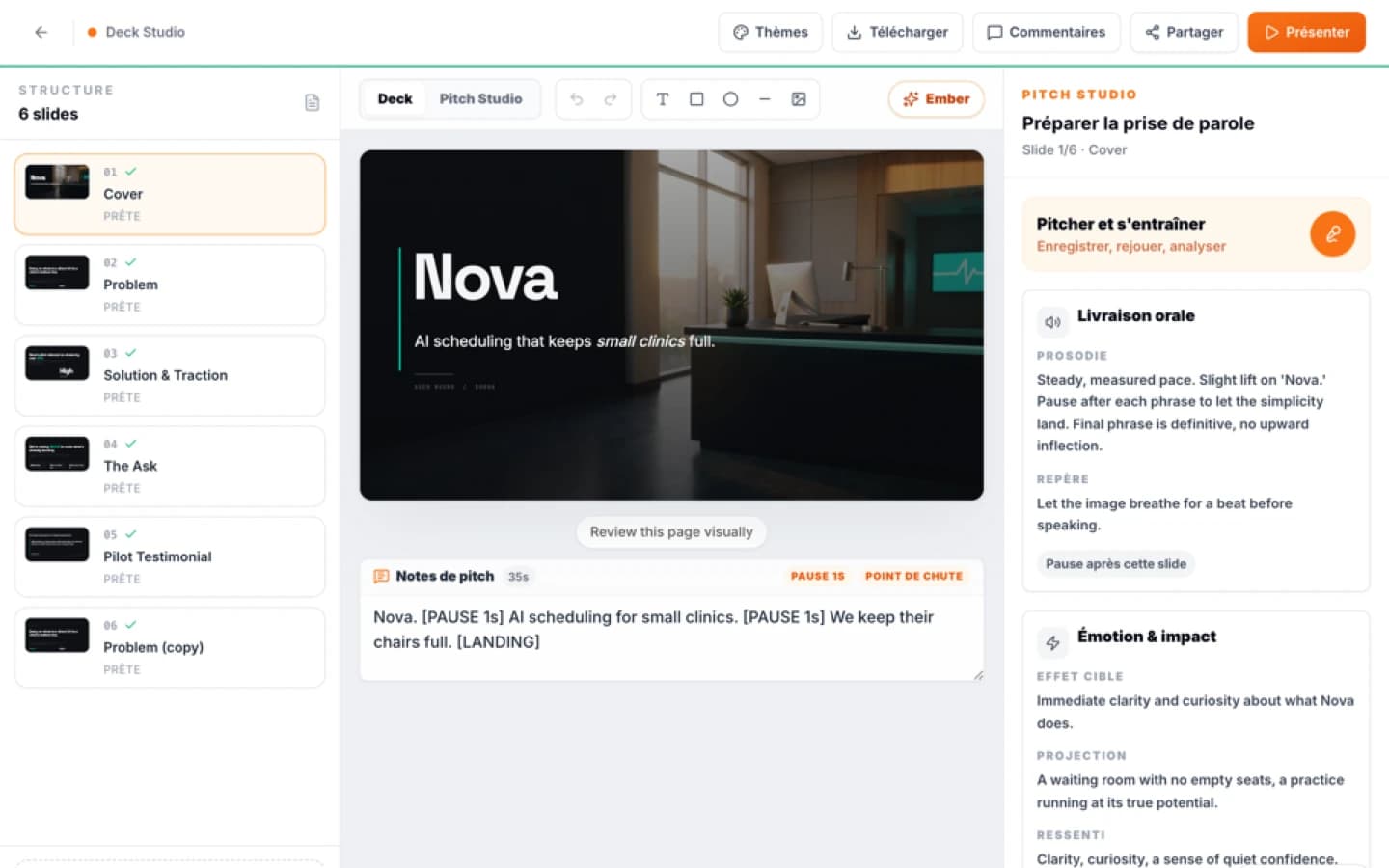
For a presentation, the same logic gives a deck in which the result sits after the problem and before the request. In Creation, the workflow proposes three templates with a preview, asks the useful questions, such as audience and result to feature, and asks for confirmation before creating. The deck exports to PDF or PowerPoint, and Speaking practice, reserved to decks, lets you record and replay the presentation and get an analysis of rhythm, clarity, impact and structure.
A second format is the phone pitch. The opening is a hook tied to the prospect's situation, the second sentence names the problem, the third offers one short example of a customer who faced the same, and the call ends with a proposal for a meeting. The whole exchange stays short, and the example is one sentence, not a story.
A third format is the post-demo recap. It starts with the next steps, then restates the pain points the prospect acknowledged, then adds the customer result as the reason the next steps make sense. Because the prospect has already seen the product, the result is used to reduce doubt rather than to open the subject.
For an elevator pitch, Salesforce suggests two sentences at most, and Highspot a thirty to sixty second summary. In that space, a customer result can occupy one clause at most. Choose it for its closeness to the listener and leave the details for the conversation that follows.
Objections deserve their own rehearsal. Highspot suggests anticipating questions about need, urgency, trust and budget, and answering with empathy and evidence. A customer result is most useful on trust: the buyer wonders whether it works for someone like them. Prepare a one-sentence answer for each of the four objections, and note which result supports it. Where no result supports an answer, say so during preparation and decide how to respond honestly.
Salesforce adds a useful habit: identify the likely sceptics in the buying team and prepare material for them. A sceptic is often the person who will carry the internal argument after the meeting, so give them something they can forward, such as a one-page summary of the customer result with its sources.
Two more formats complete the range. The website pitch turns a visitor into a request for a demo or a purchase: a customer result near the form can help, if it is short, dated and attributed. The follow-up pitch keeps momentum after a first contact and works best when it refers to something specific the prospect said, adding the customer result only if it answers a concern they raised.
Observed results
No measured results are reported. The sources opened for this version give advice and examples but no data on how much a customer-result pitch increases replies, meetings or wins. This guide does not invent any.
What you can observe with your own pitches is modest and useful. Count how many of your pitches include a customer result you can document. Note the replies and questions each version receives, and which sentence prospects quote back. Compare a feature-led version and a result-led version on the same type of prospect, over enough messages to see a pattern, without drawing conclusions from a handful.
Keep a record for each pitch: the result used, the facts verified with the customer, the format, the reaction and the next step. After several weeks, this record is your own evidence, better suited to your market than any external figure.
Beware of small numbers. With a handful of pitches, a difference may be due to chance, to the quality of the list or to timing. Keep collecting before changing your approach on the basis of a single week.
Qualitative observations matter as much as counts. Note the words prospects use to describe their own problem, and reuse them in your next pitch. A pitch that speaks in the buyer's language tends to be easier to follow, and the log gives you the vocabulary.
Limitations
Several limits apply.
Evidence. The guides are practitioner advice from software vendors, and they present examples rather than studies. They do not prove that a customer result outperforms other approaches.
Transferability. A result obtained by one customer may not apply to another. The pitch must describe it as what happened elsewhere, and never as a promise.
Confidentiality and consent. Using a customer's result requires their agreement. Naming them, quoting figures or using their logo may have legal or contractual implications, to be validated with the customer and, if needed, with a lawyer.
Fit. In a simple, low-value sale, a short factual message may be enough. The result-led approach pays most in complex B2B sales with several decision-makers.
Product. In Creation, PDF and PowerPoint exports are reserved to decks, other formats export as PNG, and Speaking practice applies to decks only. No price or duration is promised here.
Time is another limit. Building a bank of documented results takes effort: conversations with customers, verification and approval. The effort pays back over many pitches, but it should be planned rather than treated as a one-off task.
Finally, a result-led pitch can backfire when the result is much stronger than what the prospect can expect. If the gap is obvious, the buyer may doubt the whole pitch. Choose results that are credible for the listener, even if they are less spectacular.
One more caution concerns automation. Sending large volumes of similar messages with the same customer result can look like a template and lose the personalisation both guides recommend. Keep volume at a level where each message can be checked by a person.
Take care with comparisons as well. Presenting a customer result next to a competitor's product without a source for the comparison invites challenge. Describe your own customer's experience, and leave the comparison to the buyer.
Decision criteria
To decide how to build your pitch, ask five questions.
Do you have a customer result that is real, recent and close to your buyer's situation? If not, the first task is to obtain one, not to write a pitch.
Do you have the customer's agreement, and do you know whether to name them?
Can you state the result honestly, with a measured figure the customer accepts, or as a plain description of the change?
Which format matches the moment: an email for a first contact, a deck for a meeting, a recap for a follow-up?
Do you already have a clear narrative that only needs layout, or does the structure still need work? To compare tools, the guides Gamma vs Creation: Read-Alone Deck or Live Angel Pitch? and Gamma vs Creation: Read-Alone Deck or Live Angel Pitch? explain when each option fits.
Add a sixth question: who will tell the story? A result told by the customer, in a short quote or a call with the prospect, carries more weight than one told by the seller. If the customer is willing to speak to prospects, plan for it, and prepare them with the context of the call.
Then choose the smallest next step: for example, verify one result this week, or rewrite one email with it.
Suppose your answers are yes, yes, yes, email, and layout only. Then a simple presentation tool is enough. Suppose they are yes, no, no, deck, and structure needed. Then the priority is to secure the customer's agreement and the facts first, and to use a workflow that structures the narrative afterward.
What remains unproven
Several points remain unproven.
It is not proven that a customer-result pitch converts better than a feature-led one in your market. The guides recommend it, and they do not measure it.
It is not proven that a given structure, four or six components, works better than another. They are checklists that help avoid omissions.
It is not proven that rehearsing with Speaking practice improves the delivery of a pitch. The feature lets you record, replay and receive an analysis, and the benefit depends on use.
The description of Creation reflects its documented behaviour and has not been tested by this guide on your account. Check what is available on yours.
Nor is it proven that a customer quote adds more than a plain description of the result. Some buyers prefer figures, others prefer stories. Testing both with your own audience is the only way to know.
Finally, it is unproven that the effect of a customer result lasts. A result that persuaded buyers a year ago may look dated today, so keep the date of each result visible in your bank and refresh it regularly.
Finally, it is unproven that the advice of software vendors applies equally to small teams and founder-led sales. Adapt it to your own scale and test it.
Sources and updates
This guide draws on two public sales guides opened and read for this version: Highspot's sales pitch examples and Salesforce's pitch examples. The pitch formats, components, tips and examples come from them; the survey statistics they quote were deliberately left out. The description of Creation comes from the documented behaviour of the product. The example email is an illustration, not a real customer case. Related reading: What a narrative-led B2B sales pitch looks like and Gamma vs Lead Intelligence: best alternative for founders. Product conditions can change.
Sources
FAQ
Creation
Work on substance and impact
Structure the reasoning, form and mental journey of your presentation.