
Context and ICP
For early-stage founders, the journey toward Product-Market Fit (PMF) is rarely a straight line. As noted in a discussion on LinkedIn by Grant Lee, while almost every founder obsesses over PMF, the real challenge lies in aligning the market, product, and channel before scaling. In the early days of Business-to-Business (B2B) founder-led sales, you are not just looking for buyers, you are looking for partners who can validate your core assumptions. This phase requires deep qualitative feedback rather than massive, untargeted outbound volume. According to the Bessemer Venture Partners playbook, mastering this fit requires recognizing unmistakable signals of market pull rather than forcing a generic offering onto an unreceptive audience.
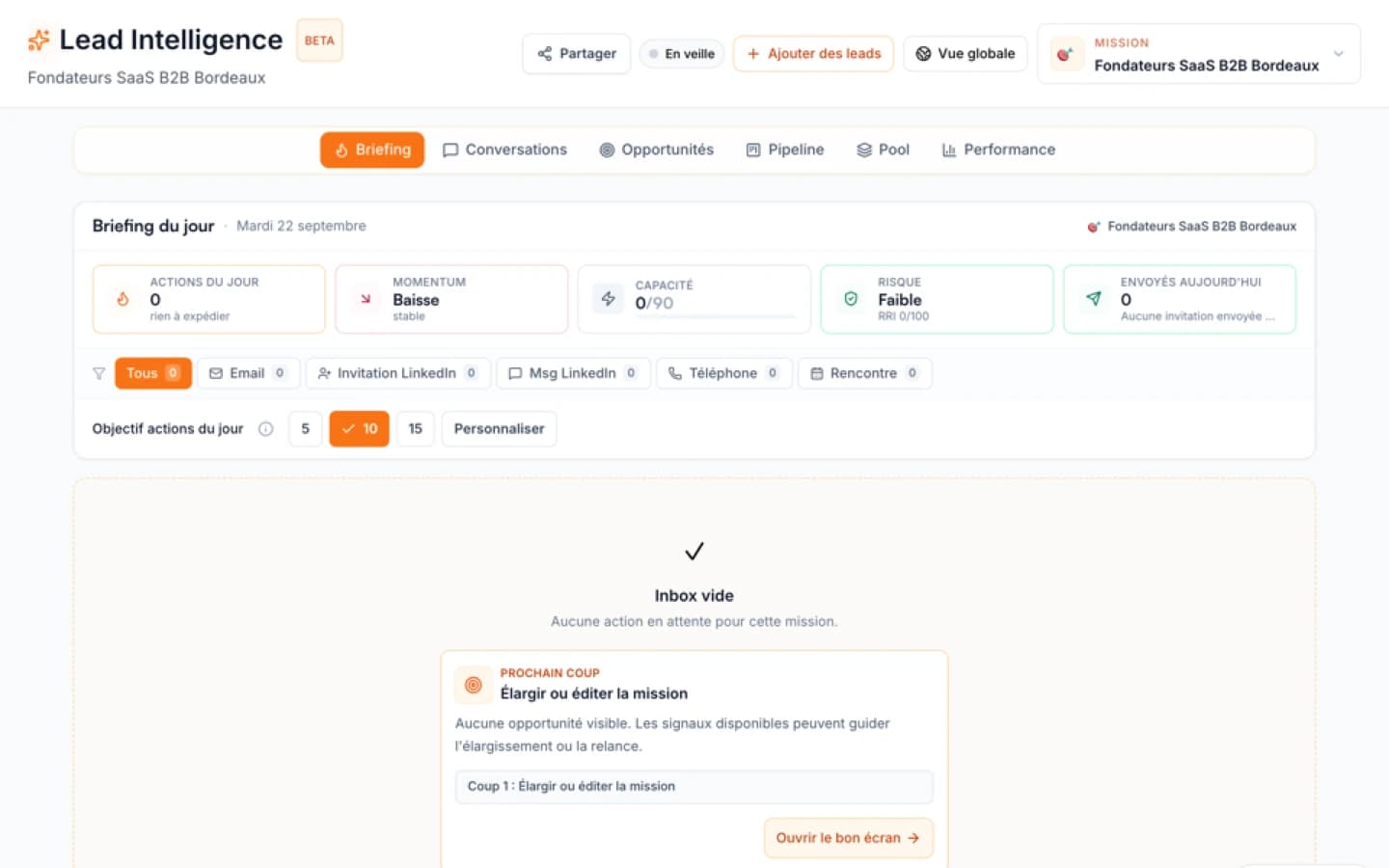
This is where Lead Intelligence becomes a critical asset for an early-stage founder. Instead of requiring a massive database or a complex sales operations setup, it allows founders to start small and iterate quickly. The system finds and prioritizes the contacts itself whether the team starts with 10, 100 or 1,000 contacts, with no minimum contact threshold. This flexibility is essential when testing a highly specific Ideal Customer Profile (ICP). If your initial hypothesis is wrong, you can pivot your targeting immediately without having wasted resources on buying thousands of irrelevant leads.
During the market discovery phase, understanding the human element of sales is just as important as the data itself. Lead Intelligence understands context and human relationships, then detects changes across people and companies to adjust priorities. It monitors signals about people and companies to keep context current, ensuring that founders reach out to prospects when they are most receptive.By focusing on high-intent signals rather than raw volume, early-stage founders can protect their time, gather high-quality feedback, and accelerate their path to PMF. Founders can find a detailed breakdown of these early-stage sales workflows in the What are the use cases of Lead Intelligence for a B2B Founder in the founder-led sales phase?: a practical guide?.
To place this decision in context, the Knowledge guides for founders brings together deeper guidance on the same field.
Problem
In the early stages of building a Business-to-Business (B2B) startup, the search for Product-Market Fit (PMF) is often stalled by a fundamental execution problem. Founders must engage in founder-led sales to test their value proposition, yet they frequently find themselves trapped in manual administrative work instead of having high-value conversations. Traditional sales intelligence tools are designed for mature sales teams with established pipelines and large databases. These legacy platforms often require massive lists to generate any meaningful patterns, leaving early-stage founders struggling to find a starting point.
This creates a severe bottleneck. When trying to validate an Ideal Customer Profile (ICP), a founder does not need thousands of cold, unverified leads that dilute focus and generate noise. Instead, they need to identify a highly targeted group of early adopters who feel the pain point acutely today. According to the Bessemer Venture Partners playbook on mastering product-market fit, achieving PMF requires recognizing unmistakable signals of market demand rather than simply pushing volume. However, tracking these signals manually across social networks, news sources, and company websites is incredibly time-consuming.
Without a structured way to prioritize outreach, founders either freeze from analysis paralysis or blast generic messages that damage their brand reputation. They lack the real-time context to know who to contact, why they should reach out right now, and what specific angle will resonate. This is where the lack of specialized tooling hurts early-stage ventures. Founders need a system that can operate effectively at any scale, whether they are starting with a small list of 10, 100, or 1,000 contacts, without being restricted by a minimum contact threshold. The core problem is not a lack of potential buyers, but the inability to filter out the noise and surface the few conversations that will actually move the product closer to market validation.
Prerequisites
To leverage Lead Intelligence effectively in the search for Product-Market Fit (PMF), founders must first establish a baseline strategic direction. Lead Intelligence does not operate in a vacuum. Instead, it reuses the Fund Your Growth plan, Ideal Customer Profile (ICP), offer, and overall strategy to prepare a targeted sales mission. This means that having a structured business plan, which founders can build to fund and develop their project, serves as the essential starting point. This strategic foundation provides the necessary context that the system uses to align prospecting activities with the core value proposition.
Another key prerequisite is defining the initial scope of the market test, though this does not require a massive, pre-existing database. The system finds and prioritizes the contacts itself whether the team starts with 10, 100, or 1,000 contacts, with no minimum contact threshold. This flexibility is crucial for early-stage Business-to-Business (B2B) founders who may only have a handful of high-quality hypotheses rather than a mature list of leads.
Once these strategic inputs and initial parameters are set, the system understands context and human relationships, then detects changes across people and companies to adjust priorities. It monitors signals about people and companies to keep this context current, and subsequently proposes the next action and channel that fit the lead situation. This ensures that the founder-led sales process remains highly relevant and responsive to real-time market feedback, which is the ultimate requirement for validating PMF.
To explore this point further, How do solo B2B founders actually get their first 10 customers without an existing list? details a step directly related to this decision.
Workflow
The operational workflow of Lead Intelligence is designed to turn raw strategic assumptions into active market conversations without the administrative drag that usually stalls early-stage startups. The process begins by establishing a clear mission context. Rather than starting from scratch or using generic templates, Lead Intelligence reuses the Fund Your Growth plan, Ideal Customer Profile (ICP), offer, and strategy to prepare a highly targeted sales mission. This ensures that every prospecting effort remains aligned with the core hypotheses the founder needs to validate. Once the mission parameters are set, the workflow moves into volume-independent discovery. Founders do not need to purchase or clean massive databases before they can begin. Lead Intelligence finds and prioritizes the contacts itself whether the team starts with 10, 100 or 1,000 contacts, with no minimum contact threshold. This flexibility is crucial for early-stage validation, where a founder might only want to test a highly specific niche with a handful of high-value accounts before expanding their reach. After identifying the initial target set, the system shifts to continuous optimization and signal tracking. Lead Intelligence understands context and human relationships, then detects changes across people and companies to adjust priorities. By monitoring signals about people and companies to keep context current, the platform ensures that founders are not reaching out blindly. Instead, it proposes the next action and channel that fit the lead situation, allowing the founder to focus entirely on the qualitative feedback of the conversation. This tight, data-driven execution loop directly supports the rapid iteration cycle required to find Product-Market Fit (PMF), helping founders navigate the complex journey described in the Bessemer Venture Partners playbook.
Expected result
The ultimate expected result of deploying Lead Intelligence in the early stages is the systematic acceleration of the search for Product-Market Fit (PMF). By transforming how founders interact with the market, the tool replaces manual, administrative prospecting with high-impact, context-rich conversations. According to the strategic insights on Business-to-Business (B2B) founder-led sales outlined in the What are the use cases of Lead Intelligence for a B2B Founder in the founder-led sales phase?: a practical guide?, the primary outcome is a highly efficient feedback loop that validates or invalidates core business assumptions in real time.
On an operational level, founders are no longer restricted by the data volume limitations that typically plague early-stage startups. Traditional sales tools often require massive contact lists to yield any meaningful results, but Lead Intelligence finds and prioritizes the contacts itself whether the team starts with 10, 100, or 1,000 contacts, with no minimum contact threshold. This flexibility allows founders to run highly targeted, small-scale experiments without wasting resources on broad, unverified databases.
Furthermore, the system continuously monitors signals about people and companies to keep the workspace context current. It understands context and human relationships, detecting changes across target accounts to adjust priorities dynamically. Instead of sending generic cold outreach, the founder receives a proposed next action and channel that fit the specific lead situation. This level of precision is critical when navigating the early stages of a startup, aligning with the core principles of achieving PMF highlighted by Bessemer Venture Partners. Ultimately, the expected result is a clear, repeatable path to market validation, allowing founders to focus their energy on building relationships and refining their product rather than managing spreadsheets.
This approach also connects with What does a realistic 30-day B2B outbound pipeline look like for a small team with no brand and no list: and which activities actually produce meetings?, which clarifies the next choice.
Example Ember mission
To illustrate how this works in practice, consider an early-stage founder who is navigating founder-led sales to find Product-Market Fit (PMF). The founder starts by defining their initial strategy. Lead Intelligence directly reuses the Fund Your Growth plan, Ideal Customer Profile (ICP), offer, and strategy to prepare the sales mission, ensuring that the outreach is grounded in the core business logic.
The mission begins without the need for a massive database. Lead Intelligence finds and prioritizes the contacts itself whether the team starts with 10, 100, or 1,000 contacts, with no minimum contact threshold. This allows the founder to test hypotheses on a small set of accounts before widening the mission.
Limits and non-fit
While Lead Intelligence is a powerful asset for early-stage founders navigating the search for Product-Market Fit (PMF), it is not a universal solution for every sales scenario. Understanding its limitations and non-fit areas is essential for making an informed strategic decision.
First, Lead Intelligence is not designed for raw, unsegmented volume or bulk email spamming. If your primary objective is to acquire massive lists of thousands of contacts to blast with generic, automated sequences, traditional database providers are often good enough. For instance, platforms like Apollo.io are highly effective when a startup simply needs a broad directory for high-volume outbound campaigns. In contrast, Lead Intelligence is built for high-signal, context-driven prioritization. It works exceptionally well whether you start with 10, 100 or 1,000 contacts, as there is no minimum contact threshold required to begin a mission.
Second, the tool cannot substitute for a lack of foundational strategy or Founder-Market Fit. As noted in professional discussions on LinkedIn, the greatest risk for any startup is chasing a problem that the founders do not actually care about solving. Lead Intelligence relies on reusing the Fund Your Growth plan, Ideal Customer Profile (ICP), offer, and strategy to prepare a sales mission. If these strategic pillars are completely undefined or if the founder has not committed to a clear direction, the system cannot invent a viable business model or force market interest where no genuine value proposition exists.
Third, there are clear technical boundaries regarding integration. For mature Business-to-Business (B2B) sales teams that require complex, automated, and bi-directional synchronization across their entire Customer Relationship Management (CRM) suite, the current version of Lead Intelligence will not fit. The tool does not automatically synchronize with every CRM, and its initial setup is designed to prioritize secure, local data handling over silent, automated integrations. For founders who need heavy, pre-existing CRM automation workflows, traditional enterprise sales tools remain the industry standard.
Finally, Lead Intelligence is built to support the strategic search for Product-Market Fit (PMF) by prioritizing conversations that deserve attention now, but it does not guarantee sales or funding. It provides the signals, context, and next actions, but the founder must still get on the call, listen to the feedback, and execute the hard work of iterating the product based on real-world market responses.
In practice, Which reference data helps a pre-seed startup founder decide who to contact, why now, and with what message? completes this framework with another angle on the same topic.
When to use it
For early-stage founders navigating the challenging pre-revenue phase, identifying the right moments to deploy Lead Intelligence can prevent wasted runway and accelerate the discovery of Product-Market Fit (PMF). There are several specific scenarios where this capability becomes essential for a lean team.
First, use Lead Intelligence when validating a new Ideal Customer Profile (ICP) through highly targeted micro-campaigns. Traditional sales tools often require massive databases to function effectively, which forces founders to buy broad, noisy lists. In contrast, Lead Intelligence finds and prioritizes the contacts itself whether the team starts with 10, 100 or 1,000 contacts, with no minimum contact threshold. This allows founders to test highly specific hypotheses, such as reaching out to a handful of specialized engineering leaders, without needing a massive database to get started.
Second, deploy this capability when transitioning directly from strategic planning to active market validation. A common pitfall for early-stage companies is letting a business plan sit idle. Because Lead Intelligence reuses the Ember Fund Your Growth, ICP, offer, and strategy to prepare a sales mission, it acts as a direct bridge between strategy and execution. It allows founders who have used Ember to build a Business Plan to fund and develop the project to immediately translate those strategic assumptions into real-world outreach.
Third, use it when your outreach strategy relies on timing and context rather than sheer volume. Early-stage founders cannot afford to burn their limited addressable market with generic spam. Lead Intelligence monitors signals about people and companies to keep context current. It understands context and human relationships, then detects changes across people and companies to adjust priorities. When a target company undergoes a relevant shift, the system proposes the next action and channel that fit the lead situation. This ensures that founder-led sales conversations are always grounded in real-time relevance.
As founders obsess over achieving Product-Market Fit (PMF), as highlighted by practitioner Grant Lee on LinkedIn, the ability to have high-quality, timely conversations becomes the ultimate competitive advantage. By focusing effort only on high-priority opportunities, founders can execute the rigorous market-testing playbooks recommended by leading venture firms like Bessemer Venture Partners without drowning in administrative overhead.
Next step
To transition from theoretical strategy to real-world validation, early-stage founders must stop over-analyzing their market from a distance and start engaging directly with prospects. According to insights on how every founder obsesses over Product-Market Fit (PMF) shared by Grant Lee on LinkedIn, the real risk lies in chasing a problem without validating the market-product fit first. Instead of waiting for a perfect database, founders can initiate their first discovery mission immediately.
Whether you start with 10, 100, or 1,000 contacts, Lead Intelligence finds and prioritizes the contacts itself with no minimum contact threshold. This allows you to test your assumptions in real time. The platform then proposes the next action and channel that fit the lead situation, ensuring that your outreach is highly contextual and relevant. By integrating these insights directly with your broader business strategy, you can refine your positioning, build a solid business plan, and prepare a clear path to fund and develop your project. Ember, acting as an AI team for entrepreneurship, helps you understand this changing context, choose your next priority, and take action to secure your first design partners.
Before deciding, Which signals should alert a traction-stage startup founder? helps connect this method with adjacent priorities.
Sources
To build a reliable framework for early stage founders navigating the search for product-market fit (PMF), this analysis synthesizes real-world methodologies, platform capabilities, and market data. We draw on the strategic playbook for mastering PMF published by Bessemer Venture Partners (BVP) on BVP Atlas, which outlines the critical signals of market validation. This is paired with practical insights on founder-led sales and the essential alignment of founder-market fit discussed by Grant Lee on LinkedIn. For operational execution, the system finds and prioritizes contacts itself, whether a founder starts with 10, 100 or 1,000 contacts, with no minimum threshold. Additionally, we reference the practical use cases of Lead Intelligence during founder-led sales outlined in the What are the use cases of Lead Intelligence for a B2B Founder in the founder-led sales phase?: a practical guide?.
Sources
FAQ
Free diagnostic
Test your sales file
Drop an Excel or CSV and check its readiness without sending its rows to Ember.