
Outbound sales for B2B products priced below $10,000 in Annual Contract Value (ACV) can be economically viable, but only when teams abandon the labor-heavy enterprise playbook. Deploying dedicated Sales Development Representatives (SDRs) to run high-touch, unsegmented sequences against broad contact lists puts unit economics under heavy strain at low contract values. Viability at this tier requires compressed sales cycles, lean tooling, and timing driven by explicit buying signals rather than sheer contact volume.
The Unit Economics Dilemma of Low-ACV Outbound
Outbound profitability is governed by the relationship between fully loaded Customer Acquisition Cost (CAC) and Customer Lifetime Value (LTV). When contract values are below $10,000, margin for error disappears quickly.
Many sales organizations calculate CAC using only direct advertising or software licenses. As SaaS Hero's 2026 LTV:CAC benchmarks point out, a CAC that leaves out sales rep compensation and commissions understates the real cost of acquisition for sales-led motions. The fully loaded figure, which includes salaries, tools and overhead, is the one to compare with lifetime value.
Lifetime value sets a ceiling on what a sales team can spend to close an account. The lower the contract value, the sooner acquisition costs must be recovered, which is why payback time is the metric to watch. Aleph's 2026 CAC payback benchmarks, based on the Aleph and Benchmarkit report on full-year 2025 data from 198 companies reporting this metric, give the following medians.
| Segment | CAC payback (Aleph and Benchmarkit) |
|---|---|
| Sub-$5k ACV | 11 months |
| $50k-$100k ACV (enterprise) | 22 months |
| All companies in the dataset (median) | 16 months |
| Top quartile | 6 months or less |
| Bottom quartile | 24 months or more |
The table shows why low-ACV motions must recover costs quickly. These figures come from one cohort of companies and one year: they are a reference point, not a target that applies to your business.
If an outbound motion for a $4,000 product takes a long time to recover its fully loaded acquisition expenses, it traps operating capital and leaves the business exposed to customer churn.
Why Conventional SDR Models Fail Below $10k ACV
The traditional outbound model relies on structural specialization: SDRs book meetings, Account Executives (AEs) run demos, and Customer Success managers handle onboarding. This structure functions well for large contracts where a single closed deal covers months of overhead. At low contract values, the model breaks under three pressures.
First, human labor overhead per opportunity is too high. A dedicated SDR earning market compensation who books a limited number of qualified meetings each month creates a substantial cost per meeting before an AE ever opens a slide deck. When close rates on cold outbound stay low, the acquisition cost from sales rep time alone approaches or exceeds the first-year contract value.
Second, extended qualification cycles introduce deal drag. When reps treat a small sale like an enterprise purchase by scheduling separate discovery calls, technical validations, and proposal reviews, the calendar time stretches over months. Sales cycles of that length are damaging to low-ACV unit economics.
Third, contact list exhaustion damages domain reputation and response rates. Cold scraping thousands of names to find a few buyers yields diminishing returns. Before allocating budget to cold outbound lists, teams often find more immediate return by evaluating pipeline they already touch. Many revenue leaders choose to audit stalled B2B proposals to revive sales pipeline before investing in net-new cold campaigns.
Where pure outbound is economically unviable, inbound marketing, product-led trials, and content-driven discovery are often better choices. At very low annual prices, human-led outbound should generally be set aside in favor of self-serve conversion loops.
The Three Operational Rules for Viable Low-ACV Outbound
Outbound can function below the $10k ACV mark, provided teams operate under three strict operational disciplines.
1. Replace List Volume with Buying Signals
Cold outreach fails at low price points when reps contact accounts based solely on static firmographics such as company size and industry. Reaching out without a verifiable trigger means reps must generate interest from scratch, extending the cycle.
In his essay Do Things That Don't Scale, Paul Graham wrote: "The most common unscalable thing founders have to do at the start is to recruit users manually." For modern sales teams, doing the unscalable work means identifying accounts experiencing an immediate operational change: a leadership hire, a tech stack migration, or an urgent regulatory filing. Knowing who needs a solution right now cuts prospecting effort. Teams establishing their early outbound parameters can review how to build an ICP with fewer than ten customers to ground their outreach in observed operational realities rather than broad hypotheses.
2. Collapse the Evaluation into One or Two Touches
Low-value deals must close rapidly. The sales process cannot accommodate multiple stakeholders, procurement committees, or extensive bespoke proposals.
A viable low-ACV outbound motion uses a combined discovery and demo call. The rep qualifies the prospect early in the call, demonstrates the specific solution to the identified trigger event, and presents standardized pricing on the spot. If the evaluation requires security questionnaires, legal redlines, or custom vendor onboarding, the contract price must either be adjusted upward or the deal declined.
3. Maintain a Lightweight Tech and Labor Stack
High software licensing fees inflate fully loaded CAC. When small teams layer multiple single-point solutions for data scraping, email sequencing, lead enrichment, and verification, the fixed cost per rep balloons before a single conversation occurs.
Lean sales organizations avoid bloated setups by focusing strictly on actionable trigger events. Understanding how to prioritize B2B leads without a marketing team allows individual reps to rank opportunities based on verified public events rather than arbitrary demographic scoring models.
Signal-Driven Workflows: Database Volume Versus Context
For years, outbound teams addressed low deal values by attempting to out-scale the math. They purchased large databases containing millions of email addresses, loaded them into automated sequences, and accepted fractional response rates.
Broad list blasting runs into deliverability constraints and buyer fatigue. High-volume databases provide contact information, but they do not provide context or timing. When sales teams evaluate standard providers, understanding Apollo vs Ember Lead Intelligence for Founder Conversion clarifies the trade-off between purchasing raw database volume and generating contextual qualification based on timing signals.
Operating outbound efficiently at lower price points requires identifying who to contact, why reach out now, through which channel, and with what specific angle. Rather than maintaining massive inactive contact pools, high-velocity teams work in focused batches centered on verified events. This approach enables a single account executive or founder-led sales team to run outbound in structured intervals without hiring an army of SDRs to sift through cold directories.
Evaluating Your Outbound Viability Threshold
Before launching or scaling an outbound sales effort for a product priced below $10,000 ACV, test your motion against these questions, using your own numbers:
- Fully loaded CAC: Calculate your total sales expenditures, including base salaries, expected commissions, software subscriptions, and onboarding costs. Compare that total with the first-year contract value before scaling.
- Payback: Estimate how many months it takes to recover acquisition costs, and compare it with the Aleph medians above. Shorter payback keeps cash available for ongoing operations.
- Sales cycle length: Measure the time from first outreach to signature. Deals that linger require disproportionate rep follow-up that drains margin.
- Trigger clarity: Check that reps reach out based on observable public changes rather than cold company directories. Outreach anchored in timing is easier to explain and to review than outreach anchored in volume.
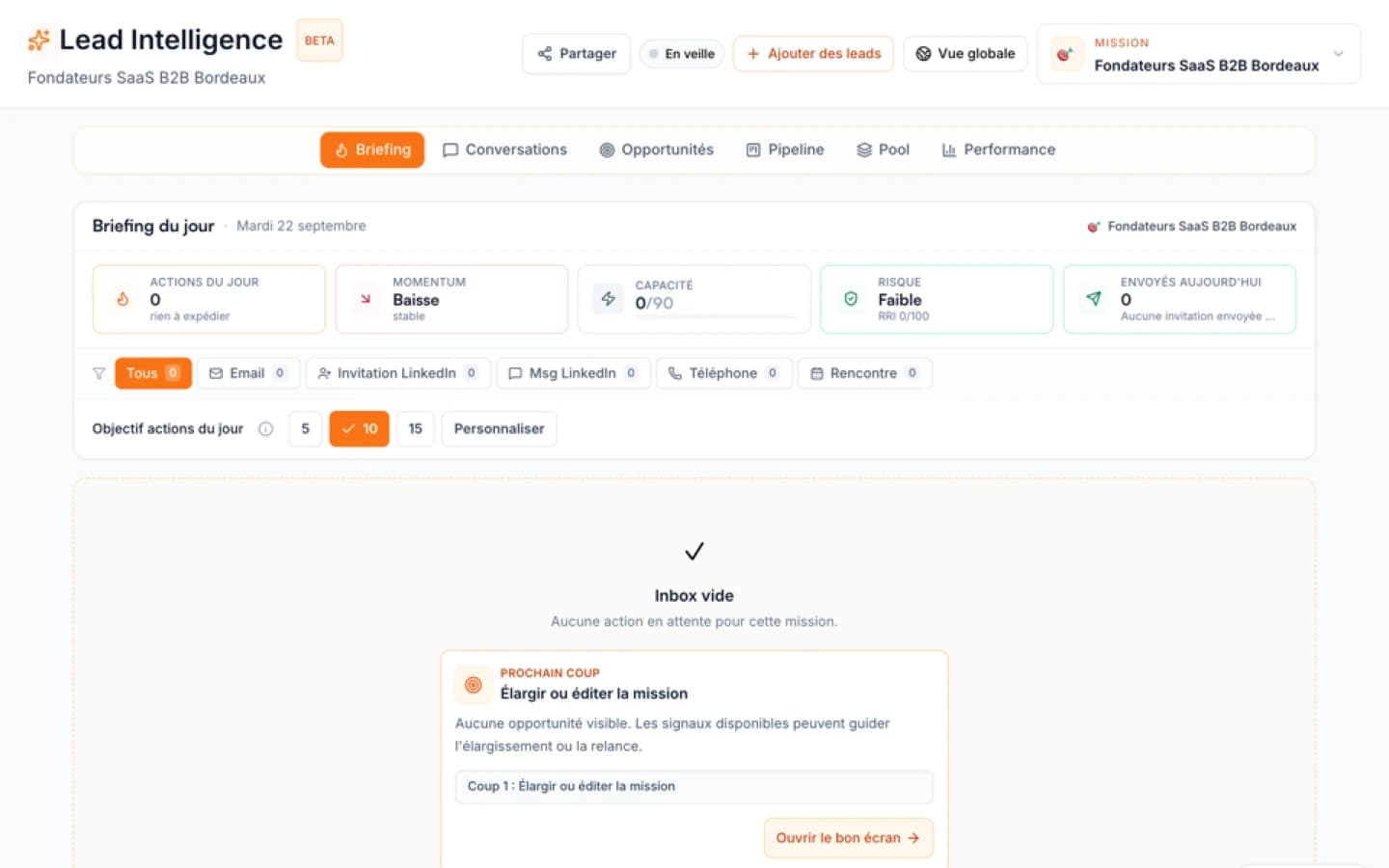
For teams looking to operationalize signal-based acquisition without expanding headcount, Ember Lead Intelligence turns a sales mission into contacts, signals and next actions: it searches for accounts matching your ideal customer, checks sources and ranks opportunities. It works whether you start from 10, 100 or 1,000 contacts, enriches them in waves of at most 200, and leaves the sending of messages to you. No tool guarantees results on compact deal sizes: the decision to contact stays with the team.
Sources
FAQ
Free diagnostic
Test your sales file
Drop an Excel or CSV and check its readiness without sending its rows to Ember.