
Claim to verify
Bootstrapped founders often possess incredible customer success stories, yet they frequently struggle to translate those raw case studies into a structured pitch narrative that closes deals. This narrative misalignment can prevent otherwise viable businesses from securing customers or raising capital. Many founders feel their pitch is simply not delivering the results they want because it lacks a resonant storyline, as noted in community discussions on the Facebook Founders Space Group.
The cost of a weak narrative is high. Toby Egbuna shared on LinkedIn that he bombed his first 15 Venture Capital (VC) pitches because of how he presented to investors, highlighting the critical need to craft tailored versions of a pitch deck. According to the Founder Institute, having a compelling pitch narrative in 2026 is a fundamental requirement for every startup founder, and modern Artificial Intelligence (AI) tools can help build one.
It is easy to mistake outbound activity for narrative clarity. For example, high-volume Business-to-Business (B2B) sales engagement platforms like Apollo help teams scale outreach. However, sending thousands of messages is useless if the underlying story does not resonate with the Ideal Customer Profile (ICP).
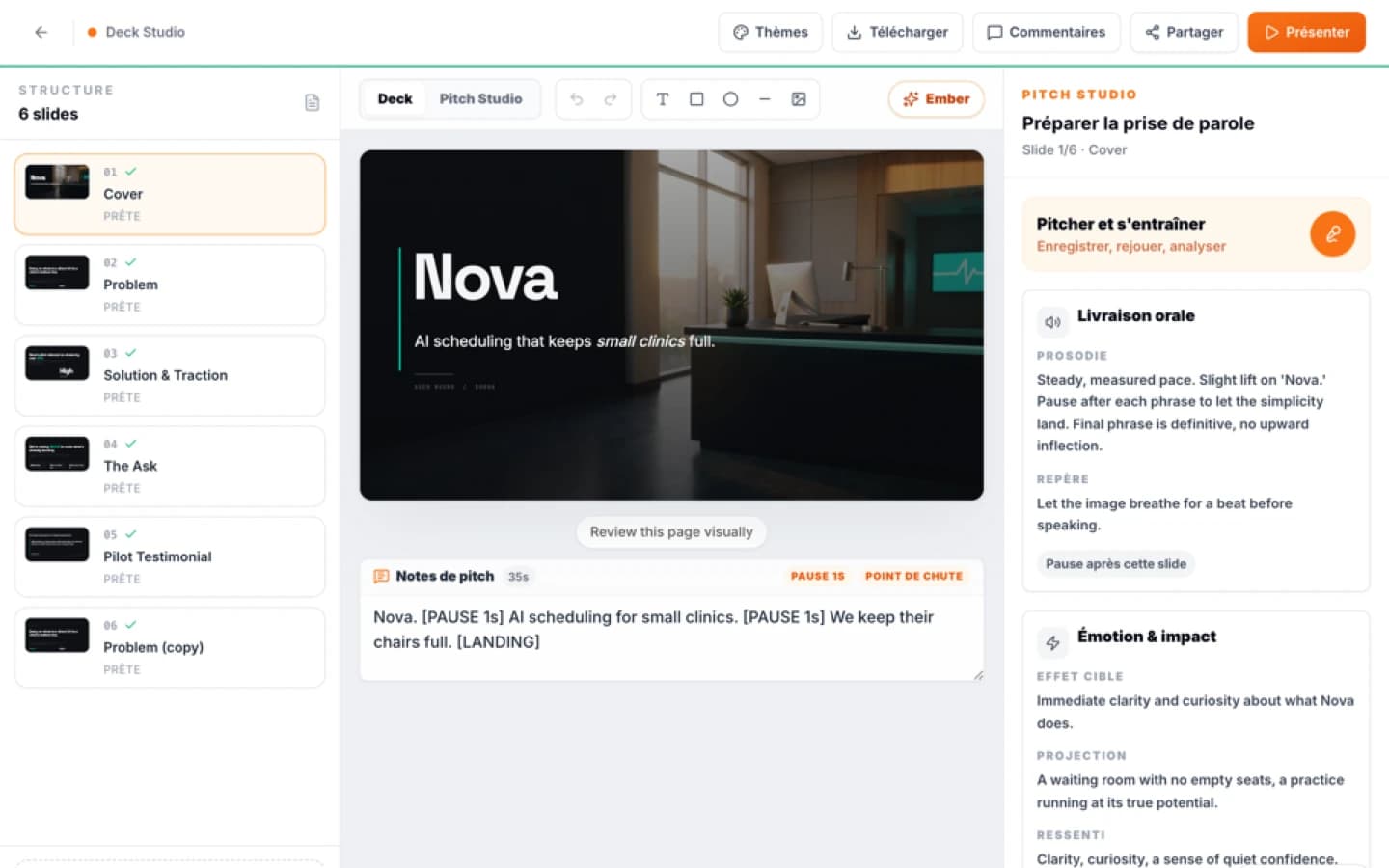
To bridge this gap, founders can use Ember to turn raw customer proof into a structured narrative. Specifically, Creation capability analyses the substance and structures the narrative path before producing slides, as detailed on Ember. It suggests three templates with previews and asks useful questions. Additionally, the Second Brain capability helps turn available context into clearer explanations and next actions, allowing founders to refine their customer stories into highly persuasive business arguments.
To place this decision in context, the Knowledge guides for marketing brings together deeper guidance on the same field.
Methodology
To turn a raw customer success story into a compelling pitch, founders must move away from chronological reporting. A standard case study explains what happened, but a pitch narrative explains why it matters to the next buyer or investor. This transition requires a structured methodology that isolates the catalyst, the friction, the resolution, and the broader market implication.
When founders focus solely on product features instead of the customer's strategic journey, they risk losing their audience early in the conversation. This narrative misalignment is a common hurdle even for experienced builders. To avoid this, the methodology must prioritize the customer's struggle as the central conflict, positioning your product as the unique mechanism that resolved it.
A successful pitch narrative follows a clear sequence. First, establish the status quo and the market shift that makes change inevitable. Second, introduce the customer's specific friction point, illustrating the cost of inaction. Third, present the intervention, detailing how your solution resolved the problem. Finally, project the future state, showing how this success can be replicated across the market. This structured approach ensures that the pitch remains focused on business value rather than technical specifications.
Developing this narrative path requires deep analysis before any visual design begins. Founders often make the mistake of opening presentation software too early, which leads to generic slides that lack substance. Instead, the focus must remain on the underlying logic of the story. This is why modern tools like Ember's Creation are designed to analyze the substance and structure the narrative path before producing slides. By grounding the presentation in the actual context of your business, you ensure that the final pitch is built to drive decisions rather than just look visually polished.
Evidence
Building a compelling pitch narrative is a critical milestone for any early stage founder looking to scale. According to insights from the Founder Institute, establishing a clear pitch narrative in 2026 is essential for connecting with audiences and leveraging modern tools effectively (Founder Institute). Without this narrative foundation, founders risk failing to engage their audience.
Many traditional tools focus primarily on visual layouts rather than the underlying strategic narrative. Google Slides, for example, provides templates designed to help users start their presentations faster (Google Workspace Blog). Other platforms, such as Gamma, introduce flexible cards that auto adjust to content (Gamma Help Center) and offer 400 credits at signup with no refresh (Gamma Help Center). Similarly, collaborative presentation workspaces like Pitch.com, which claims a user base of over 4 million teams (Pitch), offer a free tier at no cost for up to 5 members with 100 non renewable Artificial Intelligence (AI) credits (Pitch Pricing).
While these tools are excellent for formatting slides and collaborating on design, they do not automatically extract the strategic value of a customer story. To turn raw customer milestones into a persuasive narrative, founders must synthesize their actual business context. Instead of starting from blank slides or generic templates, utilizing Ember and its Second Brain capability allows founders to turn available context into clearer explanations and next actions. This ensures that real customer proof points are woven directly into a structured, high impact pitch narrative.
To explore this point further, Gamma vs Lead Intelligence: Which Tool Defines Your ICP Best details a step directly related to this decision.
Demonstration and examples
To understand how this transition works in practice, consider the common pitfalls early stage founders face when presenting to investors or prospective clients. Instead of presenting a chronological timeline of how a product was built, a successful pitch narrative must isolate the catalyst, the decision, and the ultimate business outcome.
Consider a hypothetical scenario of a bootstrapped founder who has built a specialized inventory management system.
A standard, chronological case study might read: "We signed a local retail chain with multiple stores. They imported their inventory data into our system, set up automated alerts, and reduced their manual stock-checking time significantly." While this is a positive result, it reads like a passive history lesson. It fails to explain why this solution is urgent or how it scales to other businesses.
To turn this into a high-impact pitch narrative, the founder must restructure the story to highlight the strategic stakes: "Mid-sized retail chains lose critical margin to overstocking and manual inventory tracking. When our customer expanded their locations, their manual processes broke down, leading to lost sales during their busiest season. By deploying our automated inventory system, they eliminated stockouts entirely and cut manual tracking time significantly during their first month. We enable growing retailers to scale their physical footprint without multiplying their administrative overhead."
This restructured narrative immediately shifts the focus from a specific customer's timeline to a repeatable market pain. It establishes a clear catalyst (expanding locations), a tension (manual processes breaking down during peak season), and a scalable resolution (growing without multiplying overhead).
For companies that have already locked in this narrative and possess a highly defined Ideal Customer Profile (ICP), high-volume sales engagement platforms are incredibly valuable. For instance, Apollo helps teams scale their outbound volume. Similarly, for organizations with the technical bandwidth to design custom data workflows, Clay offers an exceptional environment for orchestrating complex data enrichment steps Derrick App.
However, if you are a bootstrapped founder still refining your core message, launching high-volume campaigns before your narrative is proven often leads to wasted budget and mixed signals. The priority must be structuring your real-world success stories into a cohesive, persuasive argument first.
This is where specialized tools can assist. Rather than staring at a blank slide deck or trying to fit your unique business model into a rigid, generic template, you can leverage Ember's Creation. The platform is designed to help founders by analysing the substance and structuring the narrative path before producing slides Ember Creation. To make the process seamless, it suggests three templates with previews and asks useful questions Ember Creation. This allows you to transform raw customer proof into a structured, professional presentation that is ready to close deals.
Observed results
When founders successfully transition from a dry chronological case study to a structured pitch narrative, the immediate result is a dramatic shift in how prospective clients and investors engage. Instead of politely nodding through a list of features, the audience begins to ask forward-looking questions about implementation and scale. This shift occurs because a structured narrative establishes a clear catalyst, a tension, and a resolution that mirrors the audience's own challenges.
To achieve these results consistently, founders must move away from superficial slide design and focus on the underlying reasoning of their story. A well-structured narrative path ensures that every slide serves a specific cognitive purpose, guiding the viewer from the initial problem to the validated proof of the solution. This is where modern tools help founders organize their thoughts without getting bogged down in visual formatting.
With Ember, founders can leverage Creation to turn raw customer success stories and project context into a cohesive presentation. Instead of starting with a blank template, Creation analyses the substance and structures the narrative path before producing slides, ensuring that the core argument remains robust. The tool suggests three templates with previews and asks useful questions, allowing founders to maintain complete control over their message. By focusing on the substance of the story first, early-stage founders can build presentations that do more than look professional, they move decisions forward.
This approach also connects with How Creation Helps Founders Validate Their Market?, which clarifies the next choice.
Limitations
While transforming a single customer success story into a persuasive pitch narrative is highly effective, founders must recognize the boundaries of this approach. Relying solely on one customer narrative can backfire if the story is too niche to represent a broader market opportunity. Investors and prospective clients will eventually look past the narrative to evaluate market size, distribution channels, and financial projections.
For founders focused purely on high-volume outbound sales, narrative-heavy tools might even be secondary to raw execution platforms. Established platforms like Apollo are highly effective when a team already knows its Ideal Customer Profile (ICP) and needs to scale outreach quickly. Apollo focuses on database volume and sequence automation. However, this volume-first model does not help a founder craft the underlying story. Similarly, advanced data tools like Clay offer incredible breadth for teams with the technical bandwidth to build custom enrichment logic (Derrick App), but they do not solve the strategic challenge of structuring a narrative.
When founders turn to structured narrative tools to bridge this gap, they must also understand their operational limits. Within Ember, Creation capability analyses the substance and structures the narrative path before producing slides (Ember Creation). It suggests three templates with previews and asks useful questions to ensure the narrative aligns with the founder's goals (Ember Creation). Yet, even the most advanced narrative engine cannot invent authentic customer proof. The quality of the final pitch deck remains entirely dependent on the real-world evidence the founder provides. Automated generation can accelerate the structuring process, but the founder must still review, refine, and validate the narrative to ensure it reflects their genuine business journey.
Decision criteria
When evaluating how to transform a raw customer success story into a highly persuasive pitch narrative, early stage founders must look beyond basic templates. The transition requires a structured framework to ensure the story resonates with prospective clients and investors alike. Founders can evaluate their narrative readiness against three primary decision criteria.
First, the narrative must prioritize substance and decision-driving structure over superficial aesthetics. A common pitfall for early stage founders is spending excessive time on visual polish while neglecting the underlying logical flow. The primary benchmark of a successful pitch is whether it builds genuine understanding and moves a business decision forward. Within Ember, Creation is designed specifically around this criterion, helping founders focus on the audience journey, reasoning, and strategic impact rather than just slide design.
Second, the narrative must be representative of a broader Ideal Customer Profile (ICP). A bootstrapped founder cannot afford to build a pitch around a highly customized, one-off customer success story that does not apply to the rest of the market. The chosen story must highlight pain points, operational bottlenecks, and financial outcomes that are shared by the wider target audience. If the narrative is too niche, it fails to demonstrate a scalable market opportunity.
Third, the storyline must lead the audience to an inevitable conclusion. This disconnect can have serious consequences. To avoid this, the narrative must clearly articulate the initial conflict, the critical decision to change, the implementation of the solution, and the measurable business value achieved.
By focusing on these criteria, founders can ensure their customer stories are not just passive case studies, but active sales tools that drive commercial decisions.
In practice, How to Build a B2B Pitch Narrative Around a Real Customer? completes this framework with another angle on the same topic.
What remains unproven
An early-stage founder can easily mistake a single customer's enthusiasm for a validated market trend. Until a narrative is tested against a wider audience, several critical elements remain entirely unproven.
First, the scalability of the narrative across a broader Ideal Customer Profile (ICP) is unknown. A narrative built around one highly specific customer success story might fail to resonate with the next ten prospects. This challenge is especially visible when transitioning to volume-oriented outreach. For instance, platforms like Apollo operate on a model where founders build lists and sequence outreach across channels to scale their Business-to-Business (B2B) sales. However, if the underlying narrative is unproven, scaling the volume of outreach only accelerates the rate of rejection.
Second, the structural integrity of the pitch itself remains unverified until it faces external scrutiny. Founders often struggle to find the right structure, which can lead to painful learning curves. This experience demonstrates that a story that feels compelling in a local context can fall flat when presented as a scalable investment opportunity.
Third, visual polish must not be confused with narrative validation. While modern presentation tools make it easy to build slides, they do not validate the strategic substance of the pitch. For example, Google Slides offers templates to help teams start designing presentations faster, as highlighted by Google Workspace. Similarly, Gamma allows users to work with flexible cards that auto-adjust to content, as detailed on Gamma. Even collaborative presentation workspaces like Pitch.com, which claims to support over 4 million teams on Pitch, primarily focus on visual collaboration rather than testing the commercial truth of your message.
To bridge this gap, founders must treat their pitch narrative as a living hypothesis. By leveraging Ember and its Second Brain capability, founders can turn their available project context into clearer explanations and next actions, ensuring that their customer stories are structured to defend a coherent strategy rather than just filling out beautiful slides.
Before deciding, Gamma vs Creation: Read-Alone Deck or Live Angel Pitch? helps connect this method with adjacent priorities.
Sources and updates
To build a pitch narrative that genuinely closes deals, founders must ground their storytelling in proven frameworks and real-world experiences. Valuable insights on how to structure these narratives are shared within the entrepreneurial community, such as discussions on the Founders Space Group on Facebook regarding why so many pitches fail to deliver results. This is a common hurdle, as even experienced entrepreneurs like Toby Egbuna have shared that they bombed their first 15 venture capital (VC) pitches before learning how to properly structure their presentations, according to his testimony on LinkedIn. To prevent these early missteps, resources from the Founder Institute explain why every startup founder needs a clear pitch narrative in 2026 to engage modern investors.
Sources
FAQ
Creation
Work on substance and impact
Structure the reasoning, form and mental journey of your presentation.