
Claim to verify
Many early-stage Business-to-Business (B2B) founders struggle because their pitch decks feel like passive case studies rather than active tools designed to close deals. According to practitioner feedback shared on a professional forum, a significant number of founders feel their pitch is simply not delivering the results they look for because it is not structured to drive a concrete business decision Facebook Group. To turn a single customer story into a high-converting pitch, the narrative must shift from what happened to why it matters to the broader market.
As highlighted by advisor Adam Mead on LinkedIn, making a pitch deck stand out requires leveraging a story that illustrates a systemic market tension rather than just an isolated success LinkedIn. The single customer story should serve as the living proof of a repeatable problem and a scalable solution. This transition from a basic case study to a commercial narrative requires mapping the customer journey directly to the strategic priorities of an Ideal Customer Profile (ICP). The tactical steps for this transition are detailed in the Ember guide on How to Turn a Customer Story Into a Pitch That Closes Deals?.
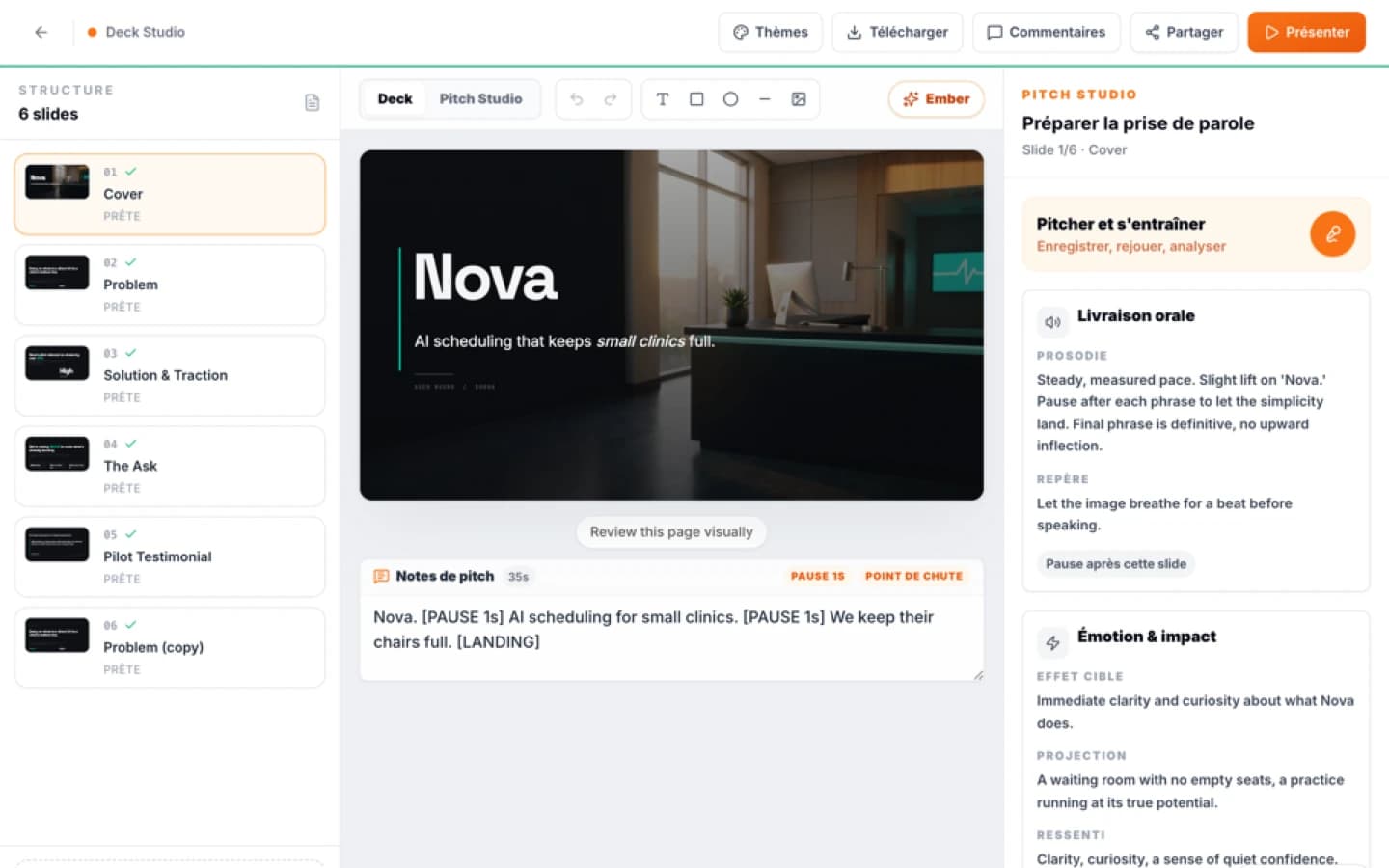
To execute this transition without losing control of the narrative, founders can use Creation by Ember. The platform suggests three templates with previews, asks useful questions before generating Creation. Once the core structure is established, it lets users edit the generated presentation in Creation Creation to ensure the final slides align perfectly with their strategic goals.
To place this decision in context, the Knowledge guides for marketing brings together deeper guidance on the same field.
Methodology
To transform a single customer story into a high-converting pitch deck, Business-to-Business (B2B) founders must move away from chronological case studies and adopt a structured commercial framework. A classic mistake is presenting a customer story as a passive testimonial, which often fails to build urgency. According to practitioner feedback shared in the Founders Space Facebook Group, many founders feel their pitches simply do not deliver the results they expect because the narrative lacks a compelling structure. The solution lies in treating the customer story not as an isolated event, but as a representative battleground that proves a broader market thesis.
This methodology requires a deliberate translation of the customer journey into strategic slide transitions. As highlighted in insights shared on LinkedIn, making a pitch deck stand out requires founders to actively talk story rather than list features. The narrative must establish the customer's original status quo, introduce the critical pain point as a systemic market shift, detail the friction of existing alternatives, and present your product as the unique mechanism that resolved the crisis. By structuring the deck this way, the customer story becomes the proof of concept for your entire business model, as detailed in the How to Turn a Customer Story Into a Pitch That Closes Deals?.
Executing this transition requires tools that prioritize substance and reasoning over superficial design. This is where the agentic workflow of Ember supports early-stage founders. Through Creation, founders can input their raw customer context and let the system analyze the underlying business logic before generating slides. The platform suggests three templates with previews, asks useful questions before generating, ensuring the narrative is tailored to the specific audience journey. Once the draft is ready, Ember lets users edit the generated presentation in Creation to refine the messaging. This collaborative process, supported by the Second Brain to turn available context into clearer explanations and next actions, ensures that the final deck is not just a story, but a strategic asset designed to close deals.
Evidence
According to practitioner insights, Business-to-Business (B2B) founders often struggle to make their presentations stand out, which is why learning how to talk story is critical to engaging an audience, as discussed by Adam Mead on LinkedIn. Many early-stage founders find that their pitches do not deliver the desired results because they lack a compelling narrative structure, as highlighted in community discussions on the Facebook Founders Space Group. To address this, founders need to transition from passive case studies to highly structured, active commercial frameworks that turn a customer story into a pitch that closes deals, a methodology explored in detail by How to Turn a Customer Story Into a Pitch That Closes Deals?. For founders evaluating presentation tools to build these narratives, understanding the constraints of existing platforms is essential. For instance, Gamma uses a flexible slide equivalent called Cards that auto-adjusts to content, as detailed in the Gamma Cards guide. However, its free tier is limited to a one-time grant of 400 credits at signup with no refresh, according to the Gamma pricing documentation. Similarly, Pitch.com offers structured tiers where the Free plan is capped at a maximum of 5 members, the Plus plan allows 1 member, and the Team plan supports up to 25 members, as outlined on the Pitch.com pricing page. On monthly billing, the Free plan costs 0 dollars, the Plus plan is 15 dollars per month, and the Team plan is 23 dollars per seat per month, according to the Pitch.com pricing page. When opting for annual billing, the Plus plan costs 13 dollars per month and the Team plan costs 19 dollars per seat per month, as detailed on the Pitch.com pricing page. In terms of Artificial Intelligence (AI) capabilities, the Free plan includes 100 non-renewable credits, while the paid plans include a monthly allowance of credits, according to the Pitch.com pricing page.
To explore this point further, Creation Use Cases for Founders Launching First Product details a step directly related to this decision.
Demonstration and examples
To understand how this transformation works in practice, consider a hypothetical scenario involving a Business-to-Business (B2B) software startup that helps manufacturing companies reduce supply chain waste.
In a traditional, passive case study, the founder might structure the presentation chronologically. The first slide introduces the client, the second slide details their messy inventory spreadsheets, the third slide explains how the startup installed its software, and the final slide shows that waste decreased. While accurate, this structure forces the prospect to do the heavy lifting of translating someone else's history into their own future. It tells a story, but it does not build commercial urgency.
To turn this same customer story into a pitch deck that closes deals, the founder must restructure the narrative to focus on the prospect's active decision-making journey.
First, the presentation must establish the industry status quo. Instead of starting with the specific client, the pitch begins by defining a systemic industry challenge, such as how legacy inventory tracking systems fail to account for real-time supply chain disruptions. This immediately builds tension and establishes the shared challenge.
Second, the narrative introduces the customer story not as an isolated event, but as proof of a repeatable solution. The client becomes the proxy for the prospect. The pitch highlights the specific catalyst that forced the client to seek a solution, making the cost of inaction clear and relatable.
Third, the presentation reveals the core insight, showing how the startup's unique methodology solved the problem where traditional approaches failed. Finally, the deck concludes with a clear path forward, transforming the client's successful outcome into a predictable roadmap for the prospect.
This active restructuring addresses a common pain point. According to practitioner feedback shared on the Founders Space Group on Facebook, a significant number of founders feel their pitch is simply not delivering the results they are looking for because it lacks this structured, high-impact narrative. To make a presentation truly stand out, founders must learn how to talk story, a critical skill highlighted by Adam Mead on LinkedIn.
Instead of struggling to manually reframe these narratives, early-stage founders can leverage dedicated tools to build high-converting presentations. With Creation, Ember helps founders move far beyond superficial slide design. The platform analyzes the substance of your project context and structures a compelling narrative path before producing slides. It suggests three templates with previews, asks useful questions to clarify your commercial goals before generating. Once the presentation is generated, founders can easily edit the slides directly in Creation to ensure their customer story is perfectly tuned to close deals.
Observed results
When Business-to-Business (B2B) founders transition from chronological storytelling to a structured commercial narrative, the impact on their sales pipeline is immediate and observable. Instead of receiving polite feedback about an interesting customer case study, founders find that prospects begin asking specific questions about implementation, pricing, and next steps. This shift in engagement occurs because the pitch deck stops acting as a historical record and starts operating as an active decision-making tool.
While high-volume sales engagement platforms are highly effective for scaling outreach, they serve a different stage of growth. For example, Apollo focuses on volume-oriented database filtering and automated sequences. However, for an early-stage founder trying to close complex deals with a single powerful customer story, sheer volume cannot replace a deeply resonant narrative. The goal at this stage is not to blast thousands of cold contacts, but to build absolute conviction with a selected group of high-value prospects.
To achieve this level of precision, founders are increasingly leveraging structured workflows that turn raw customer proof into tailored presentations. Using Ember's Creation, entrepreneurs can analyze the substance of their customer success and structure a clear narrative path before producing slides. The platform suggests three templates with previews, asks useful questions before generating, as outlined on the Ember Creation page. Once the presentation is generated, founders can edit the generated presentation directly in Creation to ensure that every slide aligns perfectly with the unique pain points of their target audience. By focusing on the underlying reasoning rather than just superficial design, founders observe that their customer stories are no longer just interesting anecdotes, they are active drivers of commercial decisions.
This approach also connects with Creation vs Gamma: Which Tool Builds Your Visibility?, which clarifies the next choice.
Limitations
While transforming a single customer story into a commercial narrative is highly effective, founders must recognize the structural limits of this approach. A single case study cannot substitute for a validated Ideal Customer Profile (ICP) or genuine product market fit. If the underlying value proposition is weak, even the most compelling narrative will fail to close deals.
Additionally, different business goals require different tools. For early stage founders who already know their target market and require immediate, high volume outbound activity, traditional sales engagement platforms are highly effective. For instance, Apollo operates as a classic volume oriented platform that combines a large contact database with automated email sequences. This volume centric model is highly successful for standard outbound execution. Similarly, for revenue operations teams with the technical bandwidth to build custom enrichment logic across multiple data providers, Clay offers unmatched orchestration breadth, as highlighted by Derrick App.
However, these volume oriented tools are not designed to build a persuasive narrative or structure a pitch deck from a customer story. When using Artificial Intelligence (AI) to draft a presentation, the primary limitation is the quality of the input. If a founder lacks concrete data, real customer quotes, or clear metrics, the resulting slides will inevitably feel generic. AI cannot invent the substance of your customer's success.
To address this, Ember focuses on the reasoning and substance of your pitch rather than just superficial design. Through Creation, the platform helps you structure your narrative path before generating slides. The process begins by suggesting three templates with previews, asking useful questions before generating, as outlined on the Ember Creation page. Once the structure is built, founders can edit the generated presentation directly in Creation, ensuring they retain full control over how their customer story is told.
Decision criteria
When Business-to-Business (B2B) founders evaluate how to turn a raw customer success story into a high-converting sales presentation, they must look beyond superficial aesthetics. The primary decision criteria should focus on narrative structure, context preservation, and decision alignment.
First, the chosen method must prioritize narrative structure over visual polish. Many founders struggle because their presentations fail to deliver results and feel like passive reports rather than active sales tools, which is a common challenge discussed in professional communities on Facebook. To stand out, a pitch deck must talk story, as emphasized by practitioners on LinkedIn, by weaving the customer journey directly into the commercial offering. If a tool only offers static templates without helping you structure the underlying business logic, it will not close deals.
Second, the workflow must preserve and leverage your existing project context. A great pitch cannot be built from a generic template. It requires deep integration of your actual customer data, technical proof points, and strategic goals. This is why founders benefit from a unified workspace where information is shared across modules. For instance, Ember features a Second Brain that turns available context into clearer explanations and next actions, ensuring that your customer story is grounded in real business evidence rather than empty marketing copy.
Finally, the presentation must be designed to move a decision forward. Beautiful slides are useless if they do not guide the prospect toward a clear next step. When selecting a platform to build your deck, look for an orchestrated workflow that respects your strategic input. With Creation, Ember helps founders do more than produce slides by building a presentation that moves a decision forward. The experience is designed to keep the founder in control: the platform suggests three templates with previews, asks useful questions before generating. This ensures that the final narrative is strategically aligned with your sales goals before any design work begins.
In practice, Use Creation to Pitch Business Angels: A Structured Guide completes this framework with another angle on the same topic.
What remains unproven
While a single customer story provides a powerful foundation, it remains unproven whether that specific narrative can scale into a repeatable sales motion for other prospects. A common pitfall for early stage founders is assuming that what worked for one early adopter will automatically resonate with the broader market. According to practitioner feedback shared in the Founders Space Group, many founders find that their pitch is simply not delivering the results they are looking for and fails to resonate, even when they believe they have a compelling story. This gap exists because a story is not yet a structured business case. As highlighted by Adam Mead on LinkedIn, founders frequently ask how to make their pitch decks stand out, proving that translating a raw customer experience into a persuasive commercial narrative is a persistent challenge. Traditional presentation tools are excellent for visual layout, but they do not solve this strategic gap. For example, Gamma is highly effective for rapid content formatting, utilizing flexible cards that auto-adjust to content as documented on Gamma Help. However, its free plan only provides a one-time grant of 400 credits at signup with no refresh according to Gamma Pricing, which can limit a founder's ability to iteratively test different narrative angles. Similarly, Pitch.com is a strong choice for design-conscious teams, offering public monthly pricing of 0 USD for its Free plan, 15 USD per month for its Plus plan, and 23 USD per seat per month for its Team plan, with annual billing rates of 13 USD per month for Plus and 19 USD per seat per month for Team as detailed on Pitch Pricing. Yet, its Free plan caps workspaces at 5 members and includes only 100 non-renewable artificial intelligence (AI) credits, while the Plus plan is limited to 1 member and the Team plan supports up to 25 members, with both paid tiers including a monthly allowance of AI credits according to Pitch Pricing. While these platforms are excellent for polishing slides, they cannot validate whether your narrative structure actually aligns with a prospect's decision-making process. Without a way to connect your customer's real evidence directly to your strategic business assumptions, your pitch deck remains an unproven hypothesis. To bridge this gap, founders need a system that looks beyond superficial design. Ember addresses this through Creation, which helps build a presentation from its substance, form, and intended impact. By structuring the narrative path before producing slides, it ensures that your customer story is not just told, but leveraged as a strategic tool to close deals.
Before deciding, How Small B2B Sales Teams Tell Customer Stories Without Fud? helps connect this method with adjacent priorities.
Sources and updates
Early stage founders frequently struggle to transition from simple storytelling to building a presentation that drives investment or sales decisions. According to practitioner insights shared in the Founders Space Facebook Group, many entrepreneurs feel their pitch storyline is not delivering the results they look for because it fails to connect the narrative to concrete business outcomes. To make a pitch deck stand out, founders must learn to talk story as highlighted by Adam Mead on LinkedIn, which means structuring the customer journey as a strategic proof point rather than a passive case study. This methodology is further detailed in the guide on how to turn a customer story into a pitch narrative that closes deals on How to Turn a Customer Story Into a Pitch That Closes Deals?.
Sources
FAQ
Creation
Work on substance and impact
Structure the reasoning, form and mental journey of your presentation.