
Symptom or signal
Many early stage founders spend dozens of hours adjusting margins, choosing color palettes, and moving text boxes, only to realize their presentation still fails to engage. This is a classic symptom of focusing on visual polish at the expense of narrative substance. When preparing to meet investors, the real challenge is not just making slides look clean, but structuring a narrative that makes people understand, believe, and act.
According to Silicon Valley Bank, a startup pitch deck should be focused, intriguing and credible, and should explain the problem, the market, the business model, the financial projections and the team. When founders rely on generic templates, they often fail to communicate their unique value proposition. For Entrepreneurs argues that the story you tell, and how you weave your slides into a narrative, is one of the two aspects of a presentation that matter most, rather than a string of individual slides.
This gap between visual appearance and strategic conviction is where most pitches falter. The Founder Institute compares a presentation deck to a structured scientific proof: it walks the listener through an argument, rather than relying on design alone. To move an investor to action, your presentation must be grounded in your actual business context, linking your market opportunity, operational data, and funding needs into a single, defensible strategy.
To place this decision in context, the Knowledge guides for marketing bring together deeper guidance on the same field.
What changed
Preparing a pitch is no longer about finding a tool that can make slides look pretty. The real challenge lies in translating complex business realities into a narrative that drives action. Historically, founders relied on static templates or design-first platforms to build their presentations. For general business updates or quick internal presentations, design-centric tools like Gamma are often more than sufficient. Gamma lists five plans (Free, Plus, Pro, Ultra and Business), as detailed on the Gamma subscription page. Its Free plan gives 400 credits at signup, and Free credits do not refresh, while paid plans refill credits monthly with rollover up to double the plan size, as explained in the Gamma credit guide. These platforms excel at rapid visual formatting, but they struggle when a pitch requires deep strategic alignment.
To secure funding, a pitch deck must do more than look professional. It must build immediate credibility. For Entrepreneurs recommends telling a narrative rather than just presenting slides. Silicon Valley Bank notes that a typical investor may see hundreds of decks a year and spend only 2 to 5 minutes on each before deciding whether to meet the founder, so the deck has to spark interest, tell a story and answer the questions investors will have. The Founder Institute offers pitch templates, and stresses that strong pitches are thoughtfully contemplated, tested and refined rather than thrown together.
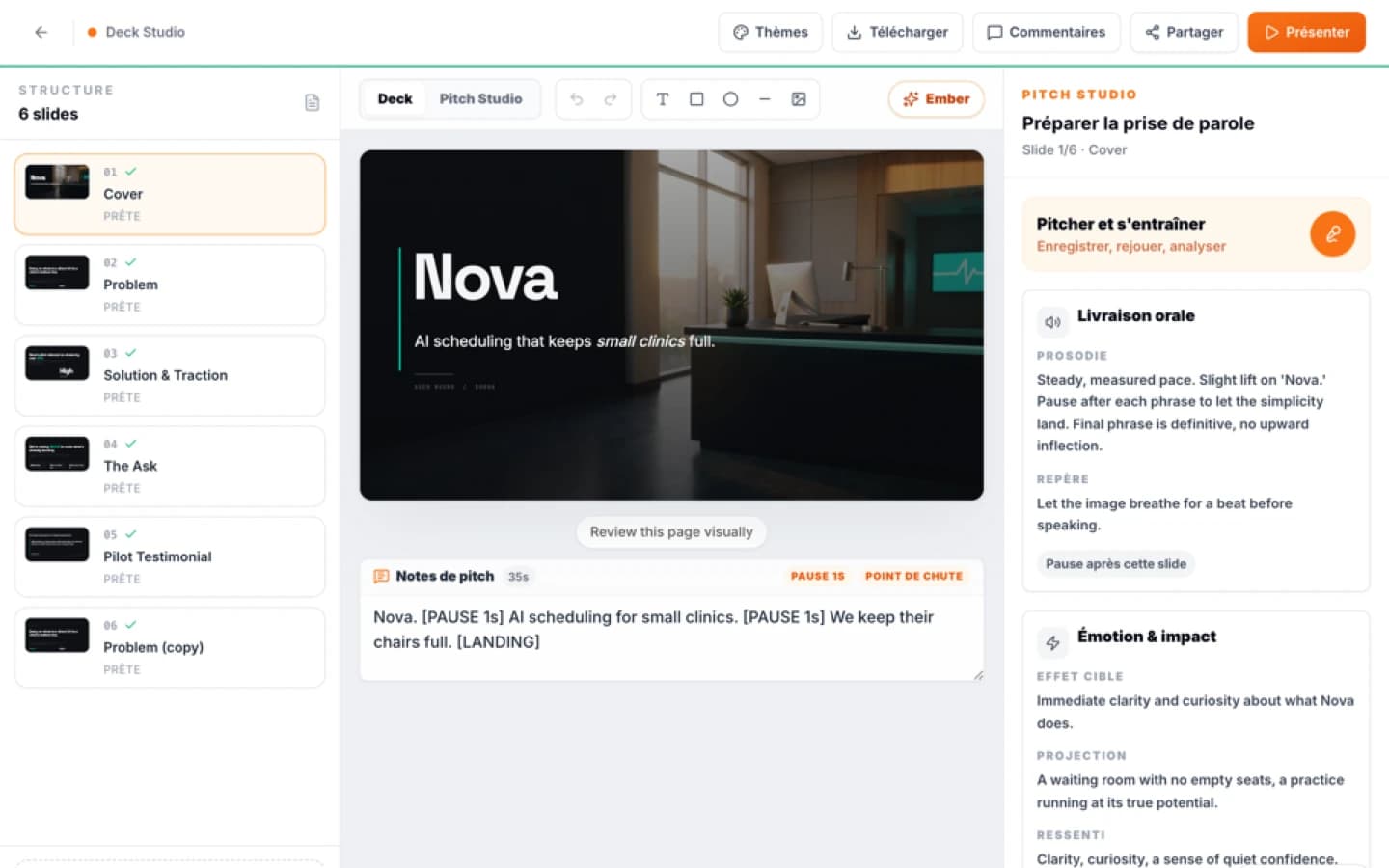
This shift from visual-first design to strategy-first communication has redefined how founders prepare their materials. Ember, the publisher of this article, addresses this through Creation, which helps the presentation build understanding and move a decision forward beyond visual polish. Instead of forcing founders to start with a blank template, Creation suggests three templates with previews, asks useful questions, and asks for confirmation before creating. Once the initial presentation is built, founders can edit the generated slides directly in Creation, and record, replay and rehearse their delivery with Speaking practice. This helps the narrative stay ready to be defended in front of Venture Capital (VC) firms and angel investors.
Facts and sources
Three sources frame this article. Silicon Valley Bank outlines what an investor pitch deck should contain in its guide on how to create an investor pitch deck. The Founder Institute provides templates and practical tips for early stage teams in its resource on how to pitch your startup. For Entrepreneurs emphasizes narrative over a simple sequence of slides in its analysis of pitch deck narratives. For general business updates or quick internal presentations, design-first platforms like Gamma are often good enough: according to Wikipedia, Gamma lets users create presentations, documents and webpages from prompts or uploaded material. However, when early stage founders need to present their projects to make investors understand, believe, and act, the focus must shift from superficial design to narrative substance. In the workspace, the Fund Your Growth capability helps founders build a Business Plan to fund and develop the project. When transitioning to the pitch, Creation suggests three templates with previews, asks useful questions, and asks for confirmation before creating. Once the initial draft is generated, the platform lets users edit the generated presentation in Creation and record, replay and rehearse the presentation with Speaking practice.
To explore this point further, Gamma vs Creation: Read-Alone Deck or Live Angel Pitch? details a step directly related to this decision.
Why the common explanation is incomplete
The traditional playbook for building a startup presentation is well documented. Standard guides, such as the templates provided by the Founder Institute, outline the classic slides every founder is told to include. Similarly, Silicon Valley Bank lists the core content investors look for: the problem, the market and competitors, growth models and evidence that the team can deliver.
However, this common explanation is incomplete because it treats the pitch deck as a static fill in the blank exercise. Following a rigid template or focusing entirely on visual polish ignores the reality of how investors actually make decisions. For Entrepreneurs points out that no individual slide will make or break you, and that the narrative that ties the slides together matters more.
When early stage founders rely solely on generic templates, they often fail to communicate the unique, changing context of their specific business. A presentation must do more than look professional. It must build real understanding and move a decision forward beyond superficial design. If the underlying strategic assumptions are weak, a beautiful slide deck only helps a founder fail faster. The narrative must be directly connected to a coherent business plan and a clear funding strategy, transforming raw project data into a logical sequence that makes investors understand, believe, and act.
The real problem
The real problem for early stage founders is that a beautiful presentation of a flawed strategy still results in a rejection. Most pitch preparation tools treat the deck as a graphic design exercise, assuming the founder already has a flawless narrative. However, as For Entrepreneurs suggests, the key to a great narrative is to identify your strengths and build your story around them, in a logical flow that leads the investor to a conclusion.
When founders rely on standard templates, they often fill in the blanks with generic market data instead of articulating their unique competitive leverage. This creates a disconnect. The slides might look professional, but they fail to build understanding or move a decision forward because they do not address the core risks and milestones of the business. The challenge is not just to present information, but to structure a narrative that makes the audience understand the opportunity, believe the execution plan, and act on the investment proposition. Without this logical foundation, visual polish is merely a distraction.
This approach also connects with Test the Hypothesis Before Choosing Gamma or Creation, which clarifies the next choice.
How the mechanism works
Traditional design-first platforms or static templates are perfectly fine for simple business updates or quick internal slide decks where the strategy is already agreed upon and only visual formatting is required. However, when an early-stage founder needs to secure venture capital (VC) funding or win over critical partners, a presentation must do more than look professional. It must build deep understanding and move a strategic decision forward.
The mechanism behind Ember's Creation achieves this by treating slide creation as an intellectual and narrative exercise rather than a superficial design task. Instead of forcing your ideas into a rigid, pre-formatted layout, the workflow begins by capturing the core substance of your business. If you have already used Fund Your Growth to build a business plan, that strategic context automatically informs your slides, replacing generic industry placeholders with a funding path coherent with your actual project.
The creation process follows a structured, step-by-step path:
First, the system frames the presentation. It suggests three templates with previews, asks targeted questions to understand your audience and goals, and asks for confirmation before creating.
Second, the mechanism analyzes the substance of your project to map out a clear narrative path before a single slide is designed. This ensures that the logical flow of your argument is robust and persuasive.
Third, the system generates the slides based on this tailored narrative structure and your specific business data.
Fourth, because a presentation is never truly finished without the founder's personal touch, you can edit the generated presentation directly in Creation. You retain complete control to refine the messaging, adjust layouts, or request natural language changes.
Finally, the mechanism supports you beyond the digital file. Once the slides are ready, you can record, replay and rehearse the presentation with Speaking practice, which analyzes the rhythm, clarity, impact and structure of a recording. This allows you to practice your delivery before you present to investors.
Concrete examples
To understand how this strategic approach works in practice, consider a hypothetical early stage software company attempting to raise its first round of venture capital (VC). Under a traditional approach, the founder might copy a standard template from resources like the Founder Institute or follow general layout advice from Silicon Valley Bank. This often results in a slide deck that looks clean but fails to articulate why this specific business will win.
By contrast, when using Ember, the founder starts by defining their core strategy. Through the Fund Your Growth capability, the entrepreneur can build a Business Plan to fund and develop the project. This process replaces a generic list of options with a funding path coherent with the project, ensuring that the financial ask is grounded in real operational milestones rather than arbitrary figures.
Once this strategic foundation is set, the founder transitions to Creation. The experience begins as the system suggests three templates with previews, asks useful questions to extract the core business logic, and asks for confirmation before creating. Instead of focusing on superficial design, Creation helps the presentation build understanding and move a decision forward beyond visual polish. For instance, in our hypothetical scenario, instead of a generic market slide, the generated presentation structures a narrative path that connects the market pain directly to the startup's unique distribution advantage, in the spirit of the storytelling advice from For Entrepreneurs.
After the initial generation, the founder retains control. They can edit the generated presentation in Creation to refine the messaging or adjust the layout. To prepare for the actual investor meeting, the founder can also record, replay and rehearse the presentation with Speaking practice, so that the spoken pitch is as considered as the slides.
When to use this diagnosis
Traditional presentation templates and basic graphic design tools are perfectly sufficient when the core business strategy is already set, the audience is already aligned, and the only goal is to polish existing slides. If a founder only needs to present a routine internal update or a simple project status report, spending time on deep narrative structuring is unnecessary.
However, early stage founders should transition to a strategic narrative diagnosis when the stakes are high and the audience needs to be convinced to act. This typically occurs when preparing a pitch deck for Venture Capital (VC) firms or angel investors, where a beautiful but empty slide deck is unlikely to convince. According to the Silicon Valley Bank guide on investor pitch decks, a deck should ground the venture in reality and be candid about the challenges it faces and how it will succeed.
You should also use this approach when the business model is complex or undergoing a pivot. When the narrative is not yet clear, copying standard slides from general resources like the Founder Institute pitch deck guide can result in a disjointed presentation. As For Entrepreneurs notes, your narrative will vary with your stage, and in particular with whether you are before or after product-market fit.
This is precisely where Ember's structured capabilities come into play. Instead of focusing solely on superficial design, Creation helps the presentation build understanding and move a decision forward beyond visual polish. It suggests three templates with previews, asks useful questions, and then asks for confirmation before creating. It keeps generating after a connection loss or tab closure, then resumes progress when the user returns. Once the foundation is built, it lets users edit the generated presentation in Creation and record, replay and rehearse the presentation with Speaking practice. For founders who need to align their overall funding strategy before presenting, the Fund Your Growth capability helps build a Business Plan to fund and develop the project.
In practice, Gamma or Creation Before Angel Due Diligence Review completes this framework with another angle on the same topic.
When not to use it
There are specific scenarios where deep strategic structuring is unnecessary. If a founder already possesses a fully validated business model, an aligned audience, and a finalized narrative, traditional presentation software is perfectly adequate. For routine internal updates, simple project status reports, or weekly team syncs, using basic graphic design templates is often the most efficient path. These standard tools excel when the only remaining task is superficial visual formatting.
Similarly, if the objective is purely manual pixel-pushing or matching an exact, pre-existing corporate slide layout without any strategic intervention, traditional design-first platforms are the right choice. Therefore, if there is no high-stakes decision to be made, or if the audience is already fully committed, the deep narrative analysis offered by Creation might be more comprehensive than required. Founders who only need a quick, static layout for a non-strategic meeting can easily rely on standard templates, such as those provided by the Founder Institute, rather than engaging in a structured process that asks useful questions to build a narrative from the ground up.
Next step
Moving from strategic planning to execution requires a shift in focus from abstract ideas to structured communication. For an early-stage founder, the immediate next step is to assemble the core evidence of the business and translate it into a narrative that directly addresses investor concerns. Instead of staring at a blank slide editor or copying a generic layout, the most effective path is to build a presentation where the narrative flow and visual structure work in tandem to drive a decision.
This structured transition is what Creation is built for. By starting with Creation, founders can bypass the trap of superficial design. The process begins with an interactive framing session where the system suggests three templates with previews and asks useful questions to capture the unique mechanics of the business, then asks for confirmation before creating.
Once the draft is generated, the founder retains control. You can edit the generated presentation in Creation to fine-tune the positioning, swap out data points, or adjust the visual rhythm. To make sure the spoken pitch is as considered as the slides, the platform also lets users record, replay and rehearse the presentation with Speaking practice.
Before deciding, Minimum Viable Proof Asset Before a Warm Pitch Deck helps connect this method with adjacent priorities.
Sources and methodology
This analysis draws on three published resources: the pitch deck guide from the Founder Institute, the investor pitch deck guide from Silicon Valley Bank, and the narrative advice from For Entrepreneurs. Ember, which publishes this article, is also the publisher of Creation, so descriptions of Creation come from Ember itself.
Sources
FAQ
Mini audit
Test your Pitch Deck
Get an initial diagnosis of substance, form and impact.