
A B2B pitch deck aimed at an investor is not built to close a round in one meeting. The strongest sources agree: Ainna writes that its purpose "is not to close a funding round" but to earn the next conversation, and Y Combinator asks founders to "intrigue" listeners so they want to meet again. "Deciding in the room" therefore has a precise meaning: by the end of the meeting the investor knows what you are asking for (a second meeting, access to the data room, an introduction to a partner) and has what they need to answer yes or no on the spot.
The structure comes down to four moves. First, write the story as you would say it, like a script. Then open with the essentials: what has changed, what you do in one sentence, a few fast facts. Give each slide one idea the investor must remember, five to seven in all. End with an explicit ask that is easy to accept. This guide covers that single case, raising money from investors. Selling to an enterprise buyer follows a different logic and is not covered here.
To place this decision in context, the Knowledge guides for marketing bring together deeper guidance on the same field.
Symptom or signal
The most common sign of a poorly structured deck is the polite exit: "Thank you, we will be in touch," or the passive "Can you send the deck?" The meeting was pleasant, yet no next step is set. The deck acted as a guided tour of the company, not as a decision aid.
Another signal: the investor asks on slide three questions whose answer arrives on slide nine. After each pitch, write down what they asked and what next step they proposed.
What changed
What changed is less the number of decks than the attention available. Aaref Hilaly, a partner at Sequoia Capital, describes attention that declines during a meeting and advises using "the first 5 minutes to earn the investor's attention for the next 15 minutes." He suggests opening with three slides: "What's changed?", "What you do" and "Fast facts".
The same text adds that "the best meetings feel more like conversations than presentations." In other words, the structure of the deck should leave room for discussion rather than demand to be delivered in one block. This describes one fund partner's habit, not a rule followed by every investor.
Facts and sources
Here is what the sources opened for this article say.
- Purpose of the deck. Ainna: "its purpose is not to close a funding round", but to earn the next conversation.
- Four questions the investor asks. Is it a real problem, the right solution, a big market, the right team? A fifth, implicit one is "why now?" (Ainna).
- Baseline content. Pitch.com lists the mission, the problem, the market size, the product, traction and evidence that the team can execute, and suggests aiming for 10 slides rather than 40, without making it a strict rule.
- Perceived value. For Forum Ventures, the deck serves to "start the process of building the perceived value of your company", with traction (paying customers, revenue) and the team among the expected elements for a pre-seed or seed B2B SaaS.
These are pieces of advice, not measured results: no source shows that a deck outline improves the odds of funding.
Why the common explanation is incomplete
The most common advice is to follow a 10-slide template. Sequoia publishes its own ten-part outline: company purpose, problem, solution, why now, market potential, competition or alternatives, business model, team, financials and vision. It is a good completeness check, but it is a list of contents, not a method for running a meeting.
Techstars puts it in its own way: "The pitch deck is just a vessel for a story." Its advice is to write the story like a script, "like the best version of how you would talk about it", then build the slides to fit it. The two approaches complement each other: Sequoia's outline says what to cover, Techstars' says in what order to work.
The real problem
The real problem is not the presentation, it is the clarity of what you ask for. Many founders arrive with a deck that explains the company and forget to say what they expect from the meeting. Michael Seibel of Y Combinator ends his list of seven questions with "What do you want?", on equal footing with "What do you do?" or "How big is the market?".
The second problem is overload. Kevin Hale, also of Y Combinator, writes that there are "probably 100 reasons why your company is great, but people can only really remember a few of them". A deck that lists them all leaves the investor to choose alone what to retain.
How the mechanism works
The mechanism has five steps, each backed by an open source.
- Write the story as you would say it. Draft the narrative as a script before opening the presentation tool (Techstars).
- Answer the seven questions. One plain sentence each: what you do, market size, progress, unique insight, business model, team, what you want (Y Combinator, Seibel).
- Pick five to seven ideas. One idea per slide, legible from a distance and understood at a glance (Y Combinator, Hale). The number counts ideas, not mandatory slides.
- Open with three slides. What has changed, what you do, fast facts, then the detail (Sequoia).
- End on the ask. The last slide restates what you want and the proposed next step. It is not just "Thank you."
For the neighbouring case of selling, What does the 'perfect' B2B sales pitch actually look like according to a 500-buyer study?: a practical guide? presents a different decision situation, that of a buyer.
Concrete examples
Illustrative example. The company below is imaginary and does not exist. Square brackets stand in for figures, which you must take from your own data.
A B2B software vendor prepares a first funding round.
Standard deck: logo, problem, solution, market, product, traction, team, then a last slide "We are raising [amount]".
Deck structured for a decision:
- Slide 1, what has changed: the market or regulatory shift that makes the product possible now, in one sentence.
- Slide 2, what we do: "[Company] helps [customer type] to [outcome]", without jargon.
- Slide 3, fast facts: founding date, team size, stage, traction, amount sought.
- Slides 4 to 7, one idea each: the problem [customer type] lives with, the solution in action, traction with the number of paying customers, the team and why it can execute.
- Slide 8, the ask: "We are seeking [amount] for [goal]. Desired next step: [second meeting, data room access or introduction to the partner]."
The ask appears twice, in the fast facts and at the end of the deck, so it surprises nobody.
When to use this diagnosis
Use this approach when preparing a live meeting with an investor: a first meeting with a fund, a presentation to a partner, a session in front of a committee. It suits you if you already have a clear ask and enough evidence to defend each idea you keep.
It also works as a review grid: does each slide carry a single idea, legible at a glance? Is the ask stated plainly?
When not to use it
Do not use this structure as is for a deck sent alone, without an oral presentation. A deck read cold by email must be understood without you. The guides cited mostly describe in-person presentations: Y Combinator's Demo Day guide dates from 2016 and targeted a timed slot in front of an audience already familiar with the format.
Do not apply it either if you have no clear thesis yet: Techstars starts from a written story, so you need one. Finally, this guide does not cover selling to an enterprise buyer. There, the expected decision and the people involved differ.
Next step
Audit your current deck in four moves.
- Write in one sentence what you ask the investor for at the end of the meeting.
- Answer Y Combinator's seven questions in writing, one sentence each.
- Keep five to seven ideas and check that each slide carries only one.
- Add, if missing, the three-slide opening and a final slide with the ask.
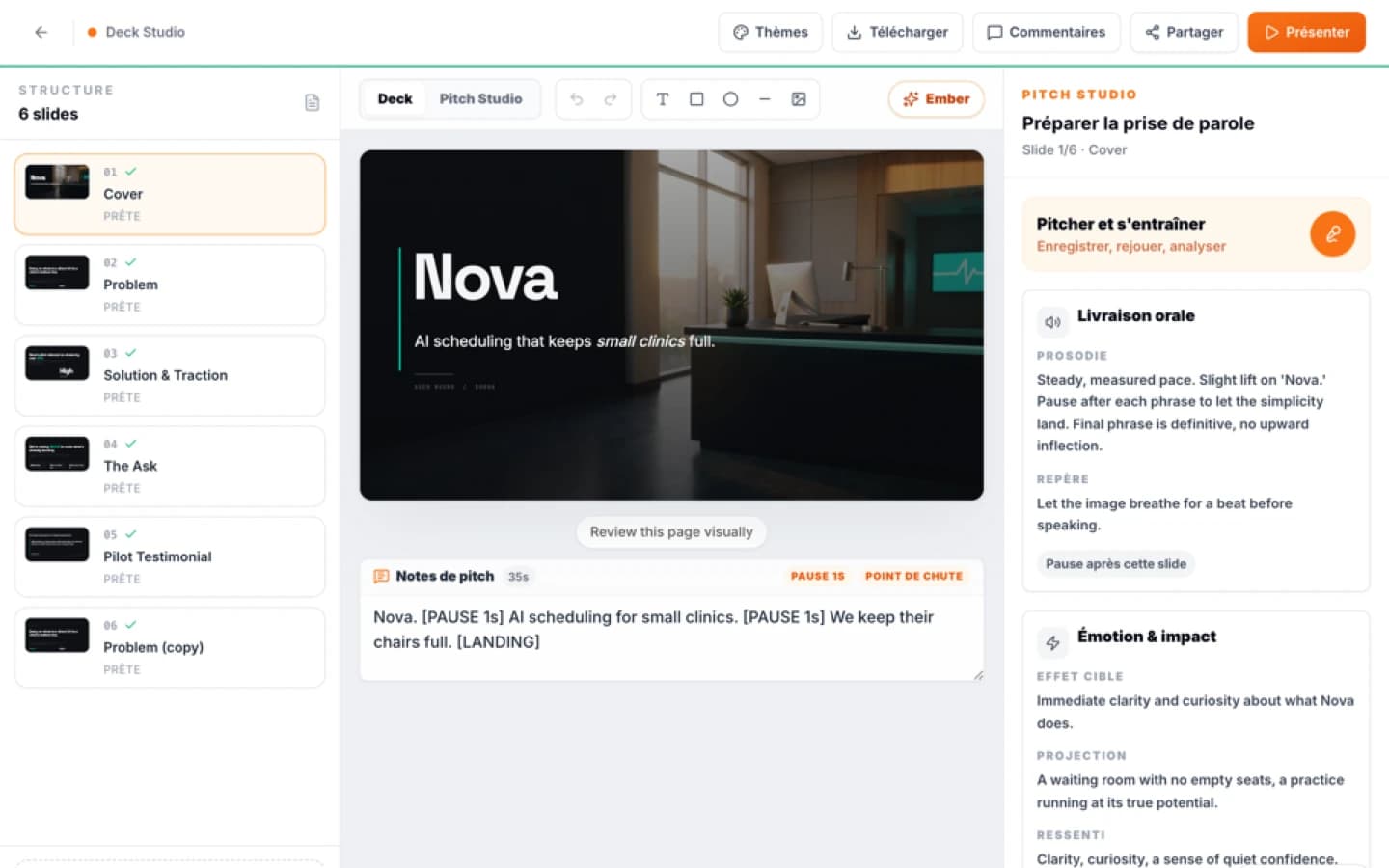
Creation, in Ember, can help build that deck. It offers three templates with a preview, asks the questions needed to frame your project, then asks for confirmation before creating the deck. For decks, Speaking practice then lets you record your presentation and analyses its rhythm, clarity, impact and structure, which echoes Y Combinator's advice to practise a lot. Ember is the publisher of this tool, and this article mentions it knowingly.
Sources and methodology
The claims in this article rest on the following pages, opened on 29 September 2026:
- Pitch Deck Guide: The Four Questions Investors Score (Ainna)
- How to structure your pitch deck to win over investors (Pitch.com)
- The Essential Guide to Creating a Compelling B2B SaaS Pitch Deck for Pre-Seed and Seed Stage Founders (Forum Ventures)
- How to Present to Investors (Sequoia Capital)
- Writing a Business Plan (Sequoia Capital)
- How to Pitch Your Company (Y Combinator)
- How to Design a Better Pitch Deck (Y Combinator)
- A Guide to Demo Day Presentations (Y Combinator)
- Why Most Pitch Decks Don't Work, and How to Make Sure Yours Does (Techstars)
These are pieces of advice published by funds, accelerators and vendors, not measured studies.
FAQ
Q1: What is the most important slide for getting a next step after the meeting? A1: The last one, the ask, provided it was announced earlier. Y Combinator places "What do you want?" among its seven core questions. A clear ask (a second meeting, data room access, a presentation to the partner) lets the investor answer yes or no immediately instead of leaving with a pleasant impression and no follow-up.
Q2: How does this structure differ from the classic 10-slide template? A2: The classic template, like Sequoia's ten-part outline, lists contents to cover. This structure adds an order of work and delivery: story written first (Techstars), three-slide opening (Sequoia), one idea per slide (Y Combinator), explicit ask at the end. Sequoia's outline remains useful as a completeness check.
Q3: How long does it take to prepare a deck structured this way? A3: No open source gives a reliable duration. The longest part is writing the story and keeping only five to seven ideas, not drawing the slides. Y Combinator then stresses practice: "and after you've practiced, practice some more".
Q4: Can an investor really decide in the room? A4: Rarely to invest, and the sources do not set that as the goal. Ainna writes that the deck earns the next conversation, and Y Combinator wants listeners to want to meet again. The realistic decision in the room is to set the next step: a new meeting, documents to send, people to bring in. That is already a measurable result for your pitch.
Q5: Which slide order should I follow? A5: Sequoia suggests opening with three slides: what has changed, what you do, fast facts. The detail follows (problem, solution, market, competition, team, financials), then the ask. This is one fund partner's order, not a universal standard: adapt it to your story, and check that one sentence answers each of Y Combinator's questions.
Q6: How do I know which ideas to keep? A6: Start from Y Combinator's seven questions and its four core points: what you are building and for whom, why it has not been done before, why it is hard, why it is an opportunity not to be missed. Keep the ones you can say in one plain sentence.
Q7: Should I send a deck before the meeting? A7: It depends on what the investor asks for. A deck read alone must explain itself without you, with more context per slide. If you send a document, keep the same ideas and the same ask as in the presented version.
Q8: Does this structure also work for selling to an enterprise buyer? A8: This guide does not cover it. A buyer decides on other criteria, with other people and often an internal process. The open sources here concern fundraising. For sales, rely on a dedicated guide and do not transpose investor advice without checking it.
Sources
FAQ
Mini audit
Test your Pitch Deck
Get an initial diagnosis of substance, form and impact.