
Most sales teams open their pitch with features, product specs, or a price anchor. A different, long-documented approach in B2B sales and copywriting, known as the Before-After-Bridge structure, starts elsewhere: describe the buyer's current state, contrast it with a desired future state, and position the product as the mechanism for that transformation rather than as the subject of the pitch.
The direct answer: a B2B sales pitch that moves a decision forward usually does not lead with the product. It leads with the buyer's current state, contrasts it with a desired future state, and introduces the product only afterward, as the bridge between the two. This principle is shared by several recognised B2B sales methodologies, including The Challenger Sale by Matthew Dixon and Brent Adamson, which documents how top-performing B2B sellers structure their message around teaching the buyer something new about their own situation, rather than around product features.
Question and scope
What structure makes a B2B sales pitch move a decision forward rather than generate polite interest? Most pitch decks are built to inform, not to convert: teams spend hours on slide design and product detail but rarely test whether the narrative arc matches how a buyer actually processes a new offer. This article gathers what recognised B2B sales methodologies say about narrative structure, and offers an audit framework for an existing pitch. It is written for sales teams and founders preparing a pitch or an investor deck.
To place this decision in context, the Knowledge guides for marketing bring together deeper guidance on the same field.
Narrative principle
The Before-After-Bridge structure has three parts: describe the buyer's specific current state (not a generic industry pain point), describe a concrete, desirable future state, then present the product only as the mechanism connecting the two. A feature-led or price-led pitch reverses this order: it opens with the product, which pushes the buyer into a defensive evaluation mindset, comparing specifications or contesting a savings figure, instead of projecting into a desired future. The Challenger Sale documents a related mechanism: top-performing sellers "teach" the buyer something new about their own situation before talking product, which builds the tension a decision needs.
What this changes in practice
Social proof (logos, testimonials) tends to work better for a buyer already further along in their decision, comparing vendors; it is less effective very early in the cycle, when the buyer first needs to understand the "why" before the "who". A generic problem-solution pitch risks falling flat if the described problem does not match the buyer's actual situation. The Before-After-Bridge structure remains useful in both cases because it forces the pitch to start from the buyer's real situation rather than a category-level problem.
Limitations
This narrative principle is a method, not a guarantee: it does not replace prospect qualification or proof that the product delivers. For a very complex enterprise sale with multiple stakeholders and long budget cycles, the narrative structure helps frame each conversation but is not enough on its own to move a collective decision forward. For a technical buyer evaluating a highly specialised tool, a feature-led entry point can still be a necessary complement to the narrative.
Conclusions
A B2B sales pitch that follows a transformation narrative, current state then future state then product as bridge, aligns the message with how a buyer actually processes a new offer, according to several recognised B2B sales methodologies including The Challenger Sale. Rewriting a pitch around the buyer's transformation is not a style exercise: it is a structural choice that changes what the buyer remembers and why they move forward.
Recommendations
Audit your current pitch against four questions. First, does the opening describe the buyer's specific current state, not a generic industry pain point? Second, do you articulate a concrete future state before mentioning your product? Third, does your product appear only as the mechanism for the transformation, not as the hero of the story? Fourth, does your next-step ask connect directly to the future state you just described? If the answer to any of these is no, rewrite that section first, using the template: current state, future state, product as bridge, next step.
When to use this analysis
Use this structure when building a new pitch deck from scratch, rewriting an existing one that is not converting, or training a sales team on presentation structure. It is most relevant for early-stage and mid-stage buyers still evaluating their options. It also applies to investor pitches: the current state becomes the market problem, the future state the solved market, and the product the bridge between the two.
Sources
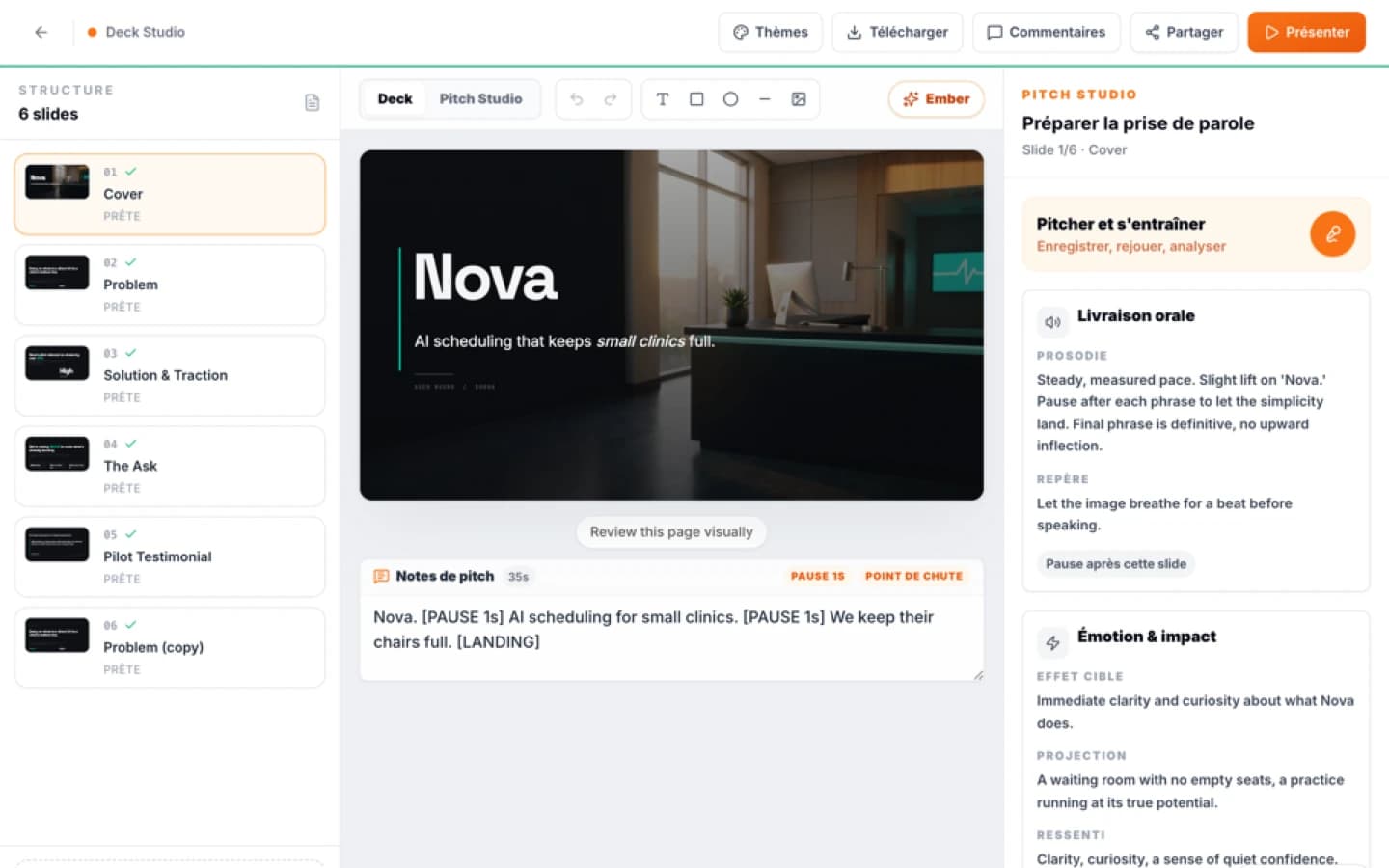
This guide draws on The Challenger Sale by Matthew Dixon and Brent Adamson for the narrative structure in B2B selling. The Ember Creation module helps sales teams and founders structure a presentation from its substance, form, and intended impact, starting from the project context rather than a generic template. You can explore the approach at Ember Creation.
FAQ
Creation
Work on substance and impact
Structure the reasoning, form and mental journey of your presentation.