
Symptom or signal
Early-stage founders preparing for a seed round often misinterpret the signals of a weak presentation. The most common symptom of an ineffective pitch deck is a heavy reliance on superficial slide design at the expense of core business substance. When a presentation focuses entirely on visual polish, it fails to communicate the underlying commercial logic. Investors quickly spot this gap when the narrative path feels disjointed or when the financial assumptions lack clear, visible proof.
A credible pitch deck must move beyond a generic list of options to present a coherent strategy. According to the strategic insights shared by Antler, a winning early-stage presentation must establish a clear logical flow that highlights the team's unique insights and the immediate market opportunity. When founders fail to structure this narrative, their slides become a collection of isolated facts rather than a compelling journey.
Another critical signal of readiness is how the deck addresses uncertainty. A weak deck attempts to hide gaps, whereas a credible deck makes available proof, assumptions, and remaining validation gaps visible. As detailed in the startup guide by SeedScope AI, building a perfect pitch deck requires breaking down complex operational plans into practical, transparent milestones. Founders who can clearly articulate what they have proven and what they still need to validate build far more trust than those who present flawless but unrealistic projections.
To bridge these gaps, founders can leverage structured tools like Ember's Fund Your Growth capability, which helps structure the business plan and make validation gaps visible, turning those gaps into prioritised next actions. Creation describes structured speaker notes per slide and contextual objection practice; verify any further capability in the current application.
To place this decision in context, the Knowledge guides for marketing brings together deeper guidance on the same field.
What changed
The landscape for securing early-stage Business-to-Business (B2B) venture capital has undergone a fundamental shift. For founders seeking a seed round of sub-$2M in 2026, the era of raising capital on a conceptual slide deck with polished graphics but little operational depth has ended. Investors have intensified their scrutiny, moving away from superficial aesthetic appeal to focus on the rigorous substance of the business model. According to the early-stage investment framework detailed by Antler, a successful presentation must establish immediate credibility by proving a deep understanding of the target market and demonstrating early, verifiable traction. It is no longer enough to present a massive total addressable market estimate without showing a clear, tactical path to acquiring the initial cohort of customers. Founders must show exactly how they will execute their go-to-market strategy. This perspective is echoed in the fundraising analysis by SeedScope AI, which highlights that the most effective presentations are those that clearly outline how the requested capital will be deployed to reach specific, value-creating milestones. The modern pitch deck is not a standalone creative exercise: it is a direct reflection of the underlying business plan and financial strategy. To meet these heightened expectations, the preparation process must change. Instead of starting with a generic template and filling in placeholders, founders need to build their narrative from a unified foundation of project data. This involves mapping out a coherent funding path that replaces generic options with a strategy tailored to the project's specific constraints. By making available proof, core assumptions, and remaining validation gaps visible early in the process, founders can proactively address investor objections before they are even raised. This structured approach allows teams to turn identified gaps in their business case into prioritized next actions, ensuring that the final presentation is built on defensible strategic reasoning rather than mere visual polish.
Facts and sources
The first of these sources, published by SeedScope AI, emphasizes that a successful pitch deck must lead with substance and clear structural flow rather than relying on visual polish. This is echoed by Antler, which outlines that early stage founders must present a highly structured narrative that addresses the core market problem, the unique solution, and early validation metrics to secure investor commitment.
To explore this point further, How to Build a 13-Week Cash Forecast for SME Leaders? details a step directly related to this decision.
Why the common explanation is incomplete
The standard advice found in traditional guides often suggests that securing early-stage capital is simply a matter of following a rigid slide sequence and applying a clean visual style. For instance, the startup guide from SeedScope AI provides a helpful breakdown of the essential structural elements that every founder must address. In the same vein, early-stage frameworks like the pre-seed playbook from Antler offer valuable starting points for organizing a narrative. These resources are excellent for understanding the basic expectations of venture investors, but relying on them as a complete solution is a mistake.
The common explanation is incomplete because it treats the presentation as an isolated document rather than the output of a living business model. A template can tell you where to place your market size, but it cannot verify if your operational assumptions are coherent. It cannot highlight the remaining validation gaps in your business plan, nor can it translate those gaps into prioritized next actions. When founders focus exclusively on filling out pre-formatted slides, they often end up with a polished presentation that crumbles under close questioning because the underlying data lacks cohesion.
To build a truly credible pitch, the narrative must be grounded in a unified project context. Instead of treating slide design as a superficial exercise, founders need a workflow that connects their strategy directly to their presentation materials. Within the Ember ecosystem, Creation addresses this by letting users edit the generated presentation with full control over the substance, ensuring that the final slides reflect a rigorous, defensible strategy rather than a generic template.
The real problem
The core obstacle for early-stage founders is the structural disconnect between aesthetic presentation and operational reality. While standard frameworks, such as those detailed by Antler, offer a basic outline for slide structure, they often lead founders to treat the pitch deck as a static fill-in-the-blank exercise. This template-driven approach obscures the actual mechanics of the business, leaving critical assumptions unproven and operational gaps unaddressed.
When a presentation focuses primarily on visual polish, it fails to communicate how the business actually functions or how it intends to scale. Investors are highly sensitive to this gap. They do not fund polished slides; they fund coherent strategies that are backed by clear evidence. The real problem is that founders struggle to make their available proof, assumptions, and remaining validation gaps visible within their narrative. Without this clarity, a pitch deck becomes a collection of optimistic claims rather than a rigorous, defensible plan for growth.
To build true credibility, a pitch deck must transition from a superficial design project into a living representation of the company's strategic reasoning. This requires founders to honestly confront what has been validated and what still needs to be proven, turning those gaps into a prioritized action plan that justifies the funding request.
This approach also connects with Build a 12-Month Investor Update Cadence That Keeps Angels, which clarifies the next choice.
How the mechanism works
To transform raw operational data into a presentation that secures a seed round, the preparation process must move away from superficial slide design. A credible deck is built through a structured mechanism that aligns investor expectations with real business logic.
The process begins by analyzing the substance of the project and structuring the narrative path before producing any slides. This step ensures that the presentation follows a logical flow tailored to how institutional investors evaluate early-stage risk. Rather than relying on rigid, one-size-fits-all templates, the narrative is constructed directly from the verified context of the business, including its underlying assumptions, market evidence, and identified operational gaps.
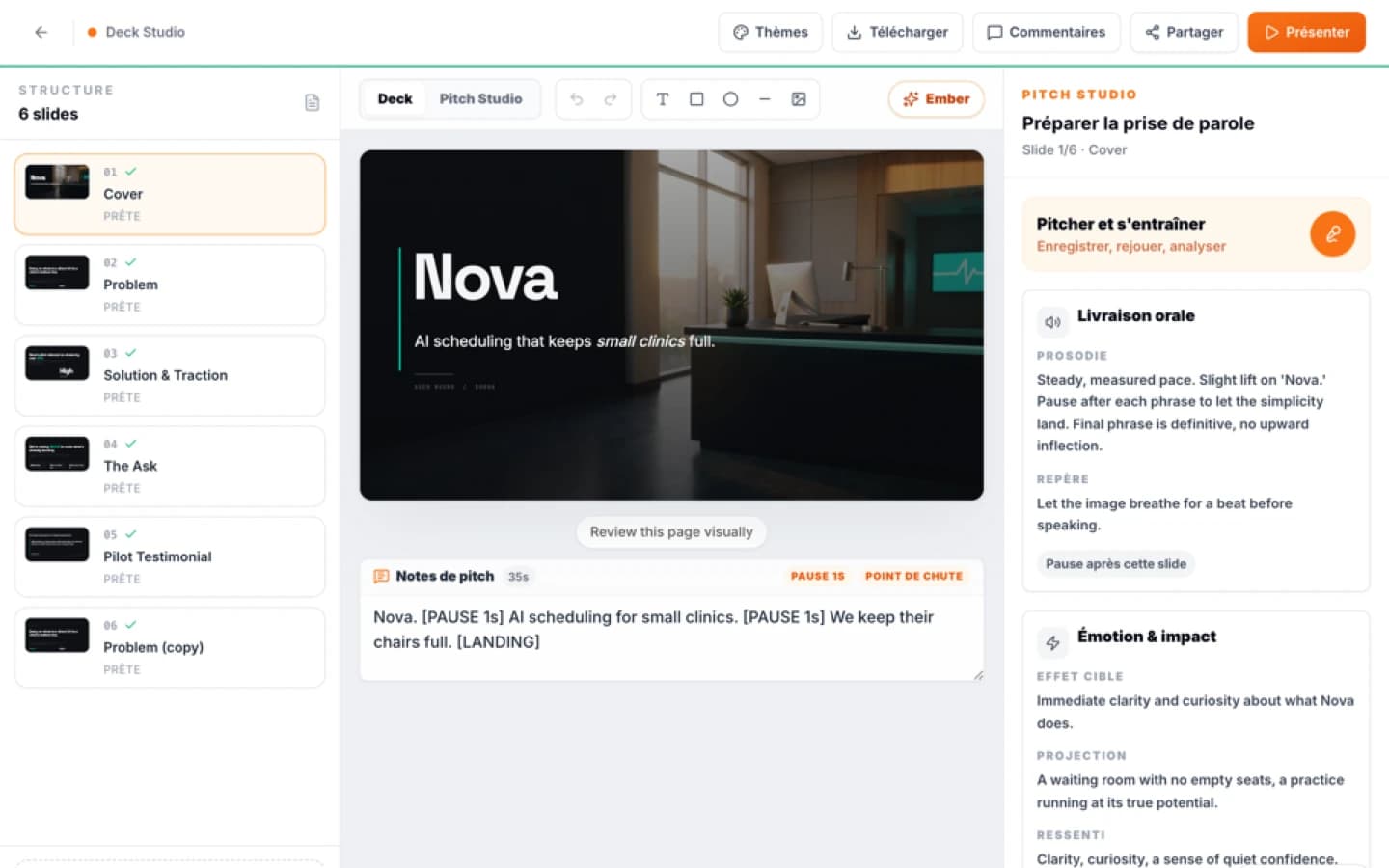
Once the narrative path is established, the mechanism generates slides from the selected structure and context. This guarantees that every slide serves a strategic purpose, linking market opportunities directly to the team's execution capabilities. Because founders must maintain absolute ownership of their story, the system allows them to edit the generated presentation in Creation. Founders can make direct manual adjustments or request changes in natural language while staying in control in the editor.
The final stage of the mechanism focuses on delivery. A pitch deck is only as strong as the founder's ability to defend it. The system analyzes rhythm, clarity, impact, and structure in a recorded take, giving the fundraising team the objective feedback needed to refine their delivery before meeting with investors.
Concrete examples
To understand how these principles translate to the screen, let us contrast two different approaches to the most critical slides in a seed-stage business-to-business (B2B) presentation.
The first critical area is the go-to-market slide. A weak go-to-market slide relies on broad, unproven channels. For example, stating that the company will acquire customers through generic social media outreach and search engine optimization is no longer sufficient. In contrast, a credible slide presents a highly specific ideal customer profile (ICP) alongside early, measurable signals. It outlines the exact profile of the early buyers, the specific triggers that make them ready to buy, and the precise channels tested to reach them. This level of detail shows investors that the team understands their market dynamics, moving far beyond the basic templates often suggested in standard guides like the one from Antler.
The second area is the traction and milestones slide, which is where many early-stage presentations lose credibility. A weak approach displays a hockey-stick growth chart based on hypothetical projections with no historical basis. A strong approach, however, focuses on validating assumptions and mapping out remaining validation gaps. Instead of promising guaranteed outcomes, it shows what has already been proven, such as initial pilot feedback or early user engagement, and lists the exact milestones the seed capital will fund.
This structural clarity is where advanced tools make a significant difference. By using Ember's Fund Your Growth capability, founders can automatically reuse project information as shared context. This mechanism replaces a generic list of options with a coherent funding path, making available proof, assumptions, and remaining validation gaps visible to potential investors. It effectively turns gaps in the file into prioritized next actions.
Once the substance is structured, founders can use Creation to generate the presentation, keeping every element fully customizable. Rather than relying on rigid designs, the platform lets users edit the generated presentation in Creation to refine the narrative. This transition from static templates to a dynamic, context-aware narrative is what separates successful fundraises from overlooked pitches in the competitive market, where securing early capital remains highly contested.
When to use this diagnosis
This structured diagnosis is most critical when a founder is preparing to transition from informal conversations to formal partner meetings. Generic presentation templates, while useful for mapping out initial thoughts, often fail to convey the operational depth required for a sub-$2M seed round in 2026. Founders should employ this rigorous approach when they need to prove that their go-to-market strategy is backed by real, repeatable mechanics rather than optimistic projections. If you are currently relying on standard slide structures, such as the foundational outlines recommended by Antler, you will reach a point where static slides cannot adapt to the specific questions of sophisticated investors. This is the precise moment to shift from superficial design to a living business model. This transition is especially urgent when you need to align your financial assumptions with your actual Ideal Customer Profile (ICP) and customer acquisition channels. When your fundraising timeline is compressed, using an integrated workspace like Ember allows you to maintain absolute consistency between your strategic planning and your investor materials. Within Ember, Creation capability enables founders to build a presentation from its substance, form, and intended impact, rather than starting from a blank, generic template. Once the core narrative is generated, the platform lets users edit the generated presentation in Creation to refine specific messaging.
In practice, Research and Shortlist Investors Before Sending Your Pitch completes this framework with another angle on the same topic.
When not to use it
A highly rigorous, operationally detailed pitch deck is not always the right starting point for every fundraising journey. If you are raising a small friends-and-family round or an informal pre-seed round where investors are betting almost entirely on personal trust or a raw conceptual spark, a deep operational breakdown can actually overcomplicate your message. In these early scenarios, standard, high-level templates like those outlined by Antler or SeedScope AI are perfectly adequate. These frameworks are excellent for mapping out a simple narrative when the immediate goal is to secure initial soft commitments rather than defending a complex business-to-business go-to-market strategy.
Similarly, if your roadmap relies on bootstrapping, bank loans, or non-dilutive government grants, a venture capital pitch deck is the wrong format. These funding avenues require a deep focus on cash flow, debt serviceability, and structured milestones rather than equity-growth narratives.
Instead of forcing your project into a slide format too early, you can focus on organizing your underlying business logic. For founders navigating these alternative paths, Ember provides a structured approach through its Fund Your Growth capability. This module replaces a generic list of options with a funding path coherent with the project, making your available proof, assumptions, and remaining validation gaps visible. By turning these gaps into prioritized next actions, you can build a stable foundation. When you are finally ready to transition to formal investor presentations, you can then easily move your validated context into Creation to edit the generated presentation or rehearse your delivery.
Next step
Moving from a conceptual framework to a fundable business case requires translating your operational reality into a narrative that investors can stress-test. Instead of staring at a blank presentation template or trying to retrofit your business into generic slides, the next logical step is to systematically map your assumptions, evidence, and funding needs into a single, cohesive context.
This is where Ember helps founders transition from strategy to execution. Through Fund Your Growth, you can structure your business plan, choose a coherent funding strategy, and plan your next steps. The system analyzes your project documents and connects relevant evidence directly to funding decisions, turning any identified gaps in your file into prioritized next actions.
Once your strategic foundation is secure, you can transition this context directly into Creation. Rather than focusing solely on superficial slide design, Creation works on the underlying reasoning, the audience journey, and the overall impact of your presentation. By grounding your pitch deck in verified business logic, you ensure that your presentation does more than just look professional: it actively moves investor decisions forward.
Before deciding, How to Defend Your B2B Sales Motion Against Pre-COVID Bench? helps connect this method with adjacent priorities.
Check the funding claim
A round below $2M is a scope for this guide, not a universal investor category. Creation can help structure the deck, while the founder must verify customer evidence, financial projections and the next milestone.
Sources and methodology
To establish a reliable framework for early stage fundraising, this analysis synthesizes real world investment criteria and structured methodology. The core insights are built on established venture capital guidelines, including the pre-seed presentation framework published by Antler and the structural pitch deck recommendations compiled by SeedScope AI. These resources provide a direct look at what institutional investors expect from Business-to-Business (B2B) founders during initial funding rounds. By combining these external benchmarks with operational insights, this guide outlines a practical path for founders preparing to raise a sub-$2M seed round in 2026.
Sources
FAQ
Mini audit
Test your Business Plan
Identify strengths, missing proof and the next priority.