
Symptom or signal
You sent your deck to twenty investors and heard back from three. Two of those replies were polite and empty, and one asked for a metric that was in the deck all along, on slide nine. That pattern is the signal this guide starts from. It rarely means the business is weak. It usually means the deck did not let a busy reader answer a handful of basic questions within a few minutes.
The situation is sharper in 2026 for founders whose round is not one of the very large rounds that dominate the headlines around artificial intelligence (AI). If you are building a B2B software company, a services business or a hardware product and raising a seed or pre-seed round, you compete for attention with a stream of decks, many of them polished and most of them similar. Investors do not have the time to dig for what you meant. The deck has to make the substance easy to find.
The tempting reading of this situation is that a machine now sits between you and the partner, and that you must format your deck for a parser. The sources behind this article point the other way. The V7 Labs guide on pitch deck analysis, dated June 19, 2026, is written for investors, not founders, and it states that "Fewer than 12% of institutional VC funds have functional AI-assisted triage in production." In other words, for most funds a person still opens your file. What the same guide describes is a change in how a deck gets read: pitch deck analysis, for an investor, "is a structured data extraction and scoring exercise", and the questions it answers are the same ones a careful analyst asks.
So the signal to look for in your own results is not "the algorithm rejected me". It is one of these, each of which you can fix:
- Investors reply, but their questions concern facts your deck should have made obvious: stage, traction, use of funds, team background.
- Meetings happen, but the second meeting never comes. Founder Institute puts the goal of a first meeting plainly: "your goal at meeting No. 1 is to get people interested enough that they want meeting No. 2."
- The deck gets forwarded internally, but the person who receives it cannot summarize your business in two sentences.
If you recognize one of these, the next sections explain what investors check, what has genuinely changed, and how to structure a deck that answers the questions quickly. Ember is the publisher of this guide, and it mentions its own tools where they fit the workflow: Fund Your Growth for building the plan behind the deck and Creation for producing and editing the presentation. You can follow the method without them.
To place this decision in context, the Knowledge guides for founders bring together deeper guidance on the same field.
What changed
Three things are different from the deck advice of a few years ago, and it helps to keep them apart because only one of them is about technology.
First, some funds now use software to read decks. The V7 Labs guide describes what that software does: structured text extraction of the company name, founders, founding year, headquarters, sector, stage and total funding raised, plus "chart and table reading", because financial projections "are almost always embedded as chart graphics." It also reports that extraction from a standard 20 to 30 slide deck takes between two and five minutes, where a skilled analyst needs 30 to 60 minutes to read a deck properly. That is a real efficiency gain for the fund, and it explains why some funds are adopting it.
Second, adoption is still a minority. The same guide says fewer than 12% of institutional funds have such triage working in production, and that the rest are still doing it manually. It also states that "Fully automated rejection pipelines remain off the table", and gives a reason that matters to founders: a founder who receives a bot rejection is a founder whose relationship with the fund is damaged. The operating model it describes is a three-way triage: pass, fail, and needs human review, with the last category, typically 15 to 25% of inbound decks, going to an analyst for a ten-minute read.
Third, and this is the change that lasts whatever the tooling, the reader is under time pressure. Founder Institute's guide says a standard deck consists of 10 to 14 slides, should be presented in under ten minutes, and should give investors "enough information that they want more information." Whether the first pass is made by a person or by a tool assisting a person, the deck is judged first on whether the essentials are present, consistent and easy to locate.
What did not change is the substance. Investors still ask whether the problem is real, whether the market is big enough, whether the company has an advantage that lasts, and whether it can make money. Founder Institute lists exactly these four questions, and groups the risks investors weigh into product risk, market risk and execution risk.
A practical consequence follows. You do not need a second, machine-friendly version of your deck. You need one deck in which every claim can be found where an investor expects it, with numbers that agree from one slide to the next. That is also what a human partner appreciates when reading on a phone between two meetings.
Facts and sources
This section lists what the two sources we opened actually say, so you can separate established facts from advice. Both were consulted on September 29, 2026.
From the V7 Labs guide, "AI for Pitch Deck Analysis: A Guide for VC Teams (2026)", dated June 19, 2026:
- Its audience is the investor side: "the investment associate, analyst, or VP receiving hundreds of decks a year."
- Investor-side analysis means answering five questions from a single document. Is the company in the fund's thesis, meaning sector, stage and geography? Does the founding team have the domain experience and track record the fund requires? Are the market size claims (TAM, SAM and SOM) backed by a defensible methodology? Do the financial projections hold up under basic scrutiny, or are they aspirational without basis? Does the ask fit the fund's check size and stage mandate?
- Adoption: fewer than 12% of institutional VC funds have functional AI-assisted triage in production.
- Time: 30 to 60 minutes for an analyst to read a deck properly, against two to five minutes for extraction from a 20 to 30 slide deck.
- Alerts: the tool warns when a deck has no competitive landscape slide, no team slide or no use-of-funds breakdown.
- Limits: "None of this tells you whether the founder can execute."
From the Founder Institute guide, "How to Pitch Your Startup":
- A standard deck consists of 10 to 14 slides.
- Keep the presentation under ten minutes, and do not go "into the weeds of all the details."
- Investors evaluate four things: does it solve a problem, in a big market, with a competitive or sustainable advantage, and can you make money.
- Do avoid excessive text, use large fonts, label each slide (for example problem, solution, team) and include charts and statistics. Do not include unsubstantiated growth projections, do not use tons of bullet points and do not inflate your capabilities.
- Founders often need two decks: a detailed version that can be shared by email, and a simplified version that is elaborated in person.
Two observations follow from these facts. The first is that the five questions from the V7 Labs guide make a good checklist for your own deck, whether or not any software reads it. The second is that neither source supports the idea that most funds filter decks automatically, and neither provides a figure for how many pitches are rejected by software. If you meet such a figure elsewhere, ask where it comes from before you plan around it.
To explore the human side of this reading, What Pre-Seed Investors Screen in 10 Minutes of Your Deck details what a reader looks for in the opening minutes.
Why the common explanation is incomplete
There are two common explanations for why decks fail, and both are partly right and mostly incomplete.
The first says design decides. Founders spend weeks on colors, icons and transitions, and on the theory that a beautiful deck signals a serious company. Design does help a reader move through a deck, and Founder Institute recommends large fonts and readable charts. But design does not repair a missing use-of-funds breakdown, and a striking slide with an unsupported claim is worse than a plain slide with a supported one. The V7 Labs guide lists what gets checked, and none of the five questions concerns aesthetics.
The second says the machine decides. According to this version, the deck must be rewritten to satisfy a parser, with stiff titles, keyword-heavy text and no narrative. This explanation is attractive because it feels actionable. The evidence does not support it as a general rule. Fewer than 12% of institutional funds run AI-assisted triage in production, fully automated rejection is described as off the table, and the tools that do exist send a share of decks to a human anyway. Rewriting a deck for a hypothetical parser at the expense of a coherent story is a bad trade when most readers are people.
What the two explanations miss is that a deck is a compressed version of a plan. When a reader, human or software, finds that the financial projections do not match the market sizing, or that the ask does not fit the stated milestones, the problem is not the slide. It is that the plan behind the deck has gaps. Polishing the surface does not remove those gaps, and reformatting for software does not either.
A better explanation is this: the deck fails when it cannot answer the five investor questions quickly and consistently. That is a matter of preparation before it is a matter of design, and it is the reason the rest of this guide starts from the plan, not the slides.
There is one part of the machine-reading story that is worth keeping. Because extraction tools read text, charts and tables, a deck whose key numbers live only inside an image with no label is harder for any reader to check. Put the numbers in the slide text or in labeled charts, and repeat them identically wherever they appear. That habit costs nothing and helps every kind of reader.
The real problem
The real problem is a gap between the story a founder tells and the evidence behind it. A founder who has lived with a company for two years holds the context in their head: why the market is this size, how the pricing was chosen, why the first ten customers came from one channel. The deck contains only what fits on a slide, and the reader has no access to the rest. When the reasoning is missing, the reader fills the space with doubt.
The five questions from the V7 Labs guide show where doubt tends to appear.
- Thesis fit. Investors have mandates. A deck that does not state sector, stage, geography and round size in the first two slides forces the reader to guess whether the company belongs in the fund at all. Guessing usually ends in a pass.
- Team. The team slide should say why these people can build this company: prior roles, relevant customers served, shipped products. A list of titles does not answer the question.
- Market size. TAM, SAM and SOM claims need a method. "The market is 50 billion" with no derivation is the kind of claim a careful reader challenges. A bottom-up estimate from the number of target customers and a realistic price is easier to defend, even when it produces a smaller number.
- Financial projections. Founder Institute advises against unsubstantiated growth projections. A projection is credible when its assumptions are visible: conversion rates, sales cycle, hiring pace, churn. If one assumption changes, the reader should be able to see what happens.
- The ask. The amount, the intended use and the milestones it buys should line up. If you ask for a sum that funds eighteen months of runway, the plan should show what will be true at month eighteen.
Behind these five points sits a sixth: internal consistency. The number of customers on the traction slide, the revenue in the financial slide and the growth story in the narrative should tell the same story. A reader who notices a mismatch does not conclude that you made a typo. They conclude that they cannot rely on your numbers.
Founders below the very large AI rounds feel this more, because there is no strong narrative wind at their back. The deck has to earn attention through clarity and evidence, not through a category that investors already find exciting. That is not a disadvantage. Many investors prefer a founder who can explain unit economics plainly to one who leans on a trend.
The practical answer is to treat the deck as the last step of a preparation process and not as the first. Start from the business plan, the assumptions and the evidence, decide what the funding strategy is, and only then compress it into 10 to 14 slides. Fund Your Growth is built for that upstream work: it structures the project, the Business Plan and the funding decisions in a single context, and it turns gaps in the file into prioritized next actions. It is available progressively depending on the account and enabled access.
How the mechanism works
Think of the reading of a deck as a sequence of small decisions, each of which can end the reading. The mechanism is the same whether the first reader is a person or a person assisted by software.
Step one is orientation, in the first few seconds: what is this company, and does it fit what I look for? The first slide and the second slide carry this weight. A clear one-sentence description, the stage, the sector and the round size answer it. Founder Institute offers a one-sentence pitch template for exactly this purpose.
Step two is a scan for the standard elements. Tools described by V7 Labs warn about a deck that has no competitive landscape slide, no team slide or no use-of-funds breakdown, and a human reader does the same thing more quietly: they flip through, looking for the team, the traction and the ask. Labeled slides help. Founder Institute suggests labeling each slide, for example problem, solution and team, so a reader who is skimming can find what they need in a second.
Step three is verification of the numbers. The reader compares the market size to the plan, the projections to the traction, and the ask to the milestones. This is where consistency matters. Decks fail here when numbers are stated in one place and contradicted, or rounded differently, in another.
Step four is a judgment about execution. The V7 Labs guide is candid that "None of this tells you whether the founder can execute", so that judgment stays a human call. This is where your story, your references and your first meeting carry the weight. The deck only earns you the conversation.
Step five, for the decks that survive, is a request for more information. Founder Institute's advice about two decks applies: keep the short deck to present and a more detailed one to send by email, so the follow-up questions find their answers in a document you control.
Now connect this to preparation. Each step corresponds to work that happens before the slides exist:
- Orientation needs a positioning statement that you can say in one breath.
- The scan needs a structure you have decided in advance, with a place for each standard element.
- Verification needs a model in which the assumptions are explicit and the numbers come from one source.
- The execution judgment needs evidence of past delivery: customers, shipped work, references.
- The follow-up needs a data room where documents are organized and current.
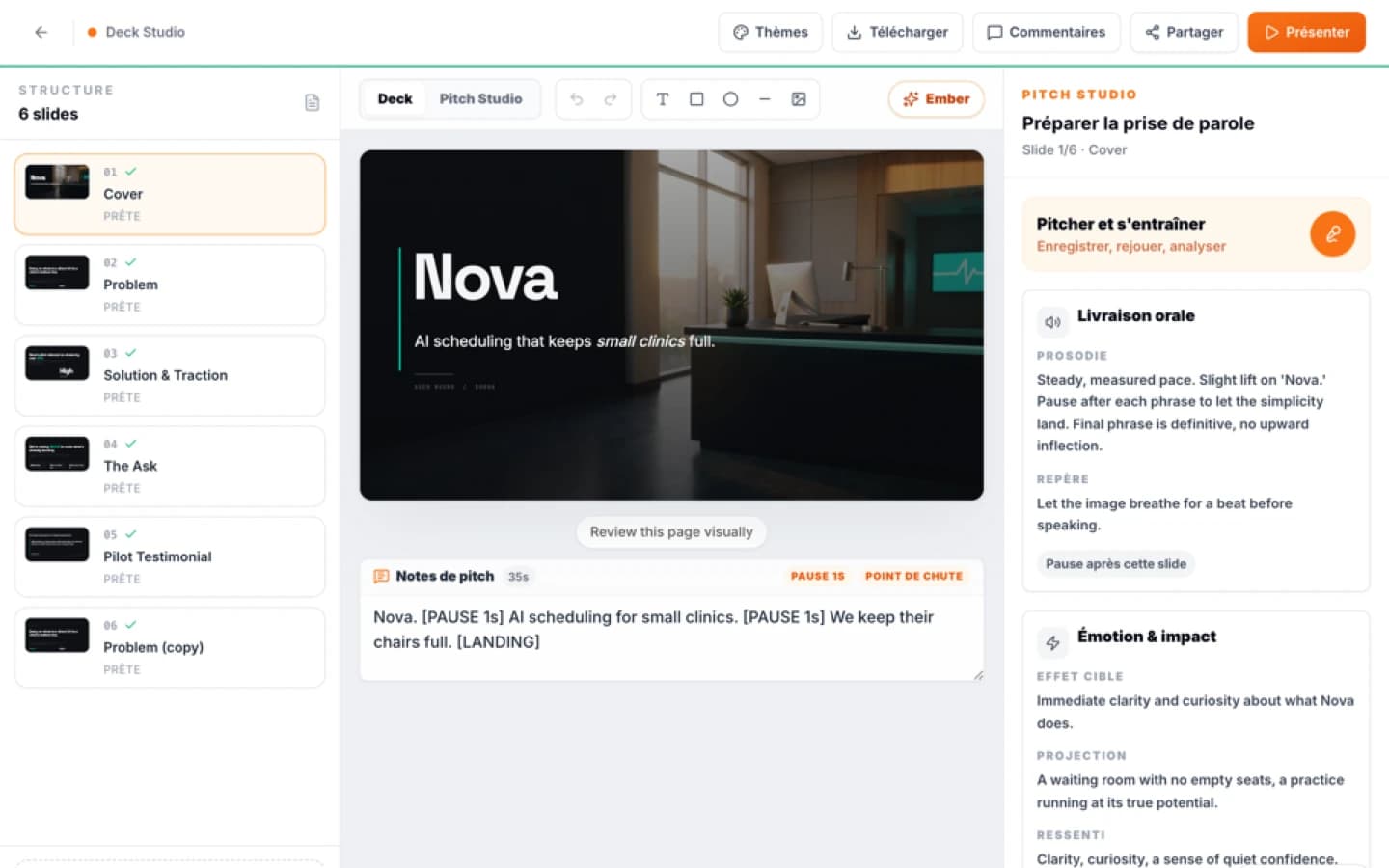
Creation supports the presentation part of this chain. It analyzes the substance and structures the narrative path before producing the chosen format, works on reasoning, the audience journey, design and impact, and lets you edit the generated deck page by page. Before it creates anything, it suggests three templates with previews, asks useful questions, then asks for confirmation. A deck can be exported as PDF or as a PowerPoint file. Once the deck exists, Speaking practice lets you record, replay and rehearse it, and analyzes rhythm, clarity, impact and structure in a recorded take. It works on decks, not on the other Creation formats.
Concrete examples
The following examples are illustrations. The company and the numbers are invented for the purpose of the exercise and do not describe a real business.
Example one: an opening slide. A weak opening reads "Revolutionizing how teams work." A stronger one reads: "Ledgerline, an invoice reconciliation tool for European accounting firms with 5 to 50 staff. Pre-seed, raising a round for eighteen months of runway." The second version tells the reader the sector, the customer, the stage and the purpose of the round in two lines. Nothing about it is machine-oriented, and it works for a person and for software alike.
Example two: a deck skeleton of twelve slides, within the 10 to 14 range Founder Institute mentions.
- Company and one-sentence description, stage and round.
- Problem, with who has it and how they cope today.
- Solution, shown as a product view and not as a list of features.
- Why now, in one slide, with a reason that is checkable.
- Market, built bottom-up, with the derivation visible.
- Traction: customers, usage, revenue, or the strongest evidence you have at your stage.
- Business model and pricing logic.
- Go-to-market: the channel that worked, and why it can scale.
- Competition and alternatives, including doing nothing.
- Team, with the reason each person fits the task.
- Financial plan, with the visible assumptions and the milestones.
- The ask and the use of funds, tied to the milestones of slide eleven.
This order maps to the five investor questions: slides one and nine to thesis fit, ten to the team, five to market size, eleven to the projections and twelve to the ask. A reader who scans for the "no competitive landscape, no team, no use of funds" gaps finds all three.
Example three: a consistency check that takes half an hour. Take every number in the deck and write it in a table with the slide where it appears. Customers, revenue, growth rate, headcount, runway, the amount raised. If a number appears twice, check that it is identical. If a growth rate is quoted, check that it follows from the two revenue figures on the traction slide. Most founders who do this find at least one mismatch, and fixing it removes a doubt the reader would otherwise have carried through the meeting.
Example four: making a projection defensible. Suppose the model assumes that the number of paying accounts grows from 20 to 120 in twelve months. Write next to it the assumptions that produce that growth: how many demos per month, the share that converts, the length of the sales cycle and the churn you assume. The reader does not need to agree with each figure. They need to see that you have made them explicit and that the total follows from them.
Example five: connecting the plan and the deck. In Fund Your Growth, the plan, the assumptions and the funding decisions live in one context, and the entrepreneur can approve, reject or edit proposals before they enter the file. When you then move to Creation, you start from the project context and not from a blank template, so the numbers on the slides come from the same place as the plan. That does not guarantee that the numbers are right. It does reduce the chance that two versions of the same number end up in two different documents.
When to use this diagnosis
Use this diagnosis when your results match one of the symptoms described earlier: replies that ask for facts your deck should have made obvious, first meetings that do not lead to second ones, or a deck that people cannot summarize after reading it.
It is also useful before you send a deck for the first time. The five investor questions from the V7 Labs guide give you a way to test your own draft. Print the deck, write the five questions on a sheet, and mark the slide where each is answered. Any question without a slide is a gap. Any question answered on more than two slides suggests repetition that can be cut.
It fits particularly well in these situations:
- You are raising a pre-seed or seed round and your company is not in the small group of very large AI rounds. You will be read on evidence and on clarity.
- You are preparing the deck from a plan that lives in several documents and spreadsheets, and you are worried about mismatched numbers.
- You are about to present live and you want the deck and the delivery to hold together. In that case, rehearsing with a recording lets you hear where you rush or repeat yourself.
- You are choosing between funding paths and want the deck to reflect a decision and not a list of options. Founder Institute reminds founders that investors weigh product, market and execution risk, and your funding strategy should say which of those risks the round is meant to reduce.
The diagnosis costs you a few hours. It does not require any special software, and you can complete it with a spreadsheet, a document and a colleague willing to read the deck cold.
To go further on the mechanics of an investor conversation, How to Choose Between a SAFE and a Convertible Note for a B2B Seed Round in 2026 covers the instrument choice that often comes right after the deck.
When not to use it
This approach is not a universal answer, and there are cases where you should apply it lightly or not at all.
If your problem is not the deck, fixing the deck will not help. Investors pass on decks for reasons that have nothing to do with the slides: a market they do not want to be in, a stage that does not fit their mandate, a fund that has no capacity this quarter. If several investors tell you the same thing about the business itself, that message is worth more than any change in layout. The V7 Labs guide makes the same point when it says that extraction cannot tell whether the founder can execute. No deck rewrite substitutes for evidence of execution.
If you raise through warm introductions from people who already trust you, the deck plays a supporting role. An investor who knows you or is introduced by someone they trust reads the deck differently, and may prefer a shorter document and a conversation. Do not spend three weeks on a deck that a single meeting will make irrelevant.
If you are raising a late-stage round, the deck is one document among many. Data rooms, audited figures and cohort analyses carry the decision. For that situation, Reframe Post-COVID B2B Sales for Late-Stage Investors explains what matters more.
If your team is tempted to redesign the deck for a specific tool, stop and check the evidence first. As reported above, most institutional funds do not run AI-assisted triage in production, and fully automated rejection is described as off the table. A deck built around a guess about a parser will usually be worse for people than one built around a clear argument.
Finally, do not use a tool to fill a gap that only you can fill. Fund Your Growth and Creation structure, organize and produce, but they cannot invent traction that does not exist, and they do not replace your judgment on the ask. Coverage of public funding references in Fund Your Growth is partial, so verify the sources it lists before you rely on them in a deck.
Next step
Choose one action and finish it this week. The smallest useful one is the consistency check from the examples above.
- Write down the five investor questions from the V7 Labs guide on a single page.
- Mark, for each one, the slide of your deck that answers it. Note the questions that have no answer.
- List every number in the deck with the slides where it appears, and correct the mismatches.
- Cut the deck to a length within Founder Institute's 10 to 14 slides, and keep a longer version to send by email.
- Ask someone outside your company to read the deck for three minutes and tell you, in two sentences, what you do and what you are asking for. If they cannot, the opening is the next thing to rewrite.
- Rehearse the presentation aloud, timed to under ten minutes, and note the slides where you hesitate.
If the exercise shows that the plan itself is unclear, and not the deck, go back to the plan. In Fund Your Growth you can build the Business Plan, choose a funding strategy and plan the next steps, and the tool turns the gaps it finds in your project documents into prioritized next actions. Then move to Creation to produce the deck from that context. Both are mentioned here because they fit the sequence, and Ember is the publisher of this guide. Neither is required to apply the method.
For an investor-side view of the same process, How B2B Founders Build an Investor Target List helps you decide whom to send the deck to, so that your mandate-fit slide is read by people whose mandate matches it.
Ember's role in this workflow
Ember offers three tools relevant to fundraising preparation. This section states what each does, so you can decide whether it fits your case.
Fund Your Growth structures the project, the Business Plan, and the funding and growth decisions. It connects assumptions, evidence, funding needs and the action plan in one context. It reads project documents and connects relevant evidence to funding decisions, and it can compare funding scenarios for the project stage, geography and constraints. Access is available progressively, depending on the account and enabled rights. You can read more on the Fund Your Growth page.
Creation generates and edits visual formats from the substance, the form and the intended impact. A deck is one of them. It starts from the project context and not from a generic template, keeps every element editable, and exports a deck as PDF or PowerPoint. The tool asks questions and requests confirmation before it creates anything.
Speaking practice is the function of Creation that lets you record, replay and rehearse a deck.
What Ember does not do matters as much. It does not decide whether an investor will say yes. It does not guarantee that a deck passes any particular screening process, and it does not replace the human conversation. Pricing is on the pricing page of the site, and this guide does not quote it.
Sources and methodology
This guide rests on two sources that we opened and read on September 29, 2026.
- V7 Labs, "AI for Pitch Deck Analysis: A Guide for VC Teams (2026)", page dated June 19, 2026: https://www.v7labs.com/blog/ai-pitch-deck-analysis. We used it for the adoption figure, the five investor questions, the reading times, the alerts on missing slides and the description of the three-way triage.
- Founder Institute, "How to Pitch Your Startup": https://fi.co/pitch-deck. We used it for the recommended deck length, the four investor questions, the three risks, the do and don't lists and the two-deck approach.
V7 Labs is a vendor of document analysis software, so its figures on time savings describe what its own approach claims and should be read as such. Founder Institute publishes general startup advice and does not claim to measure how funds screen decks.
Product statements about Ember come from the product's own description of what Fund Your Growth, Creation and Speaking practice do. Where a statement is advice and not a sourced fact, this guide says so. The example company in the examples section is invented, and its numbers are illustrations only.
Sources
FAQ
Mini audit
Test your Business Plan
Identify strengths, missing proof and the next priority.