
Context and ICP
A founder looking for business angels usually has little time, an early product and a first set of signals: a few users, a pilot, a waitlist or interviews. The pitch has to make that situation readable quickly. Business angels invest their own money at an early stage, so what they read must let them judge the team, the problem, the evidence and the use of funds without a long preliminary conversation.
According to the Startup Mountain Summit guide on what investors look for in early-stage startups, early-stage investors weigh team quality above all other factors, often over the idea itself. They then look for a real problem with a genuine market, traction even if modest, an honest view of competition, and a fundable business model with a specific use of funds tied to milestones. The guide adds that investors fund people before they fund companies, and that it gives no numerical threshold for traction.
Creation, Ember's module for editable visual documents, helps build the materials that carry these points. It generates and edits eight formats from the project context: decks, LinkedIn posts, YouTube thumbnails, market maps, business model canvases, one-pagers, OG images and stories. For a founder approaching angels, the deck and the one-pager are the most relevant, with the business model canvas and the market map as supporting pieces.
A useful way to think about the reader: an angel often receives many approaches and reads each for a short time. Material that answers the main questions in the first minute, and offers depth for those who want it, respects that limit. This is why a short first document and a fuller second one work better than a single long file.
The LinkedIn post format can also serve a founder who builds a public presence before approaching angels, for example to share a lesson learned from customer interviews. It exports as PNG from the editor. It is a way to make the work visible, not a substitute for the pitch.
To place this decision in context, the Knowledge guides for marketing bring together deeper guidance on the same field.
Problem
The problem is rarely a lack of slides. It is the mismatch between what angels want to see and what the founder's material shows. A deck full of vision and market size may say little about the team. A long document may bury the one piece of evidence that matters. A polished presentation may hide the fact that the numbers were never checked against each other.
Three problems recur. First, the story is told from the product's point of view rather than the customer's, so the problem does not land. Second, evidence is scattered: interview notes, a first pilot, an early metric, each in a different place, so the deck cannot cite them precisely. Third, the format does not fit the reader. An angel may first meet the founder through a short message or a one-page summary, and a forty-slide file is the wrong tool at that moment.
There is also the question of trust. Angels back people, so material that shows the founder's understanding of the customer, honesty about the limits and a clear plan builds more trust than material that tries to look large. Overstated numbers are more damaging than modest but real ones.
Finally, the material must work when the founder is not in the room. An angel may forward a deck or a one-pager to a partner or a co-investor, and it must stand on its own, with sources for the figures and a clear statement of what is asked.
Common mistakes to avoid: a market size taken from a report with no link to the first customers you can reach; a competition slide that claims there is none; a team slide that lists titles but not what each person has done; a use-of-funds slide with round numbers and no milestones; and figures that differ between the deck and the summary. Each of these invites the question that undermines the rest.
A last problem is time. Founders spend days on design and hours on evidence, when the balance should be the other way round. Any tool that reduces the design time only helps if the time saved goes into checking the facts.
Prerequisites
Before generating anything in Creation, gather the raw material.
Evidence. Interview notes, a pilot result, a waitlist count, a letter of intent, early revenue if any. Each item should have a date and a source. Where you hold only an estimate, label it as an estimate.
The story of the team. Why you, why now, what you have already built or learned. Angels weigh team quality first, so this deserves a real answer, not a slide of logos.
The plan. Amount sought, use of funds and the milestones they reach. If you have a Fund Your Growth file, Creation can reuse it: the composer shows what is reused, namely the file name, the number of validated blocks and a marker for each block. A block that is only proposed is not carried over, and a validated block with no filled field produces no invented line.
Choices. The document language, which can differ from the interface language and stays visible and editable, and the format you need first.
If your material is incomplete, say so in the brief. Creation never generates from missing information in a Second Brain conversation, and lists unreadable files with the reason so that you can fix them.
A useful test of readiness: give your notes to a friend who does not know the project and ask them to write the five key facts. If their version differs from yours, the material needs clarifying before you generate anything.
If you plan to use images, note that images in a creation come from upload, the image generator, a stock image search or a pasted link, and any displayed image is copied into Ember's storage. An expected image that cannot be resolved is flagged beside the page. Check the rights to any image you upload.
Prepare also a short list of questions you expect: how did you find your first users, why will they pay, what happens if the pilot ends, who else is working on this, what will the money change in the next year. Write each answer in two sentences with its evidence, and use the list to check your materials.
Workflow
The path in Creation has six moves.
One, choose the format and the language. For a first approach to angels, start with a deck or a one-pager.
Two, describe the intention. The workflow proposes three templates, each with a preview, and asks the questions that are useful, such as who the audience is, what you want them to do and which evidence to feature. It asks for confirmation before creating. Skipping the framing questions launches the generation with the answers available.
Three, generate. The engine analyses the substance and structures the narrative path before producing the pages. For decks, a page-count selector is offered, with an automatic default or fixed values, and the engine checks the number produced.
Four, edit. You can modify the creation page by page, and zone by zone for layout changes and images. Natural-language edits stay under your control, and a full-page edit interrupted by a provider limit leaves the original page intact.
Five, export. A deck exports to PDF or PowerPoint; the other formats export as PNG.
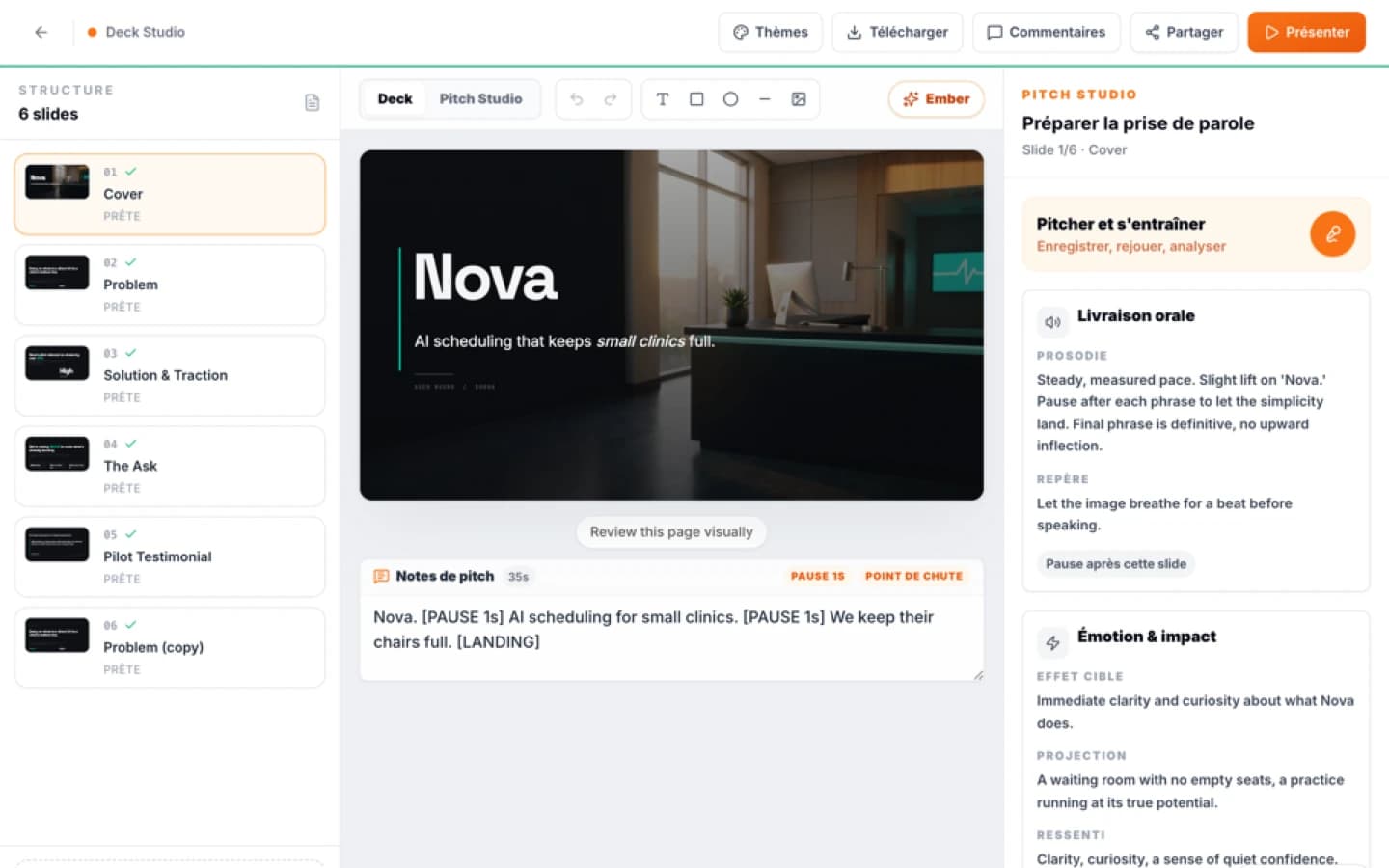
Six, rehearse. Speaking practice, reserved to decks, lets you record and replay a presentation and receive an analysis of rhythm, clarity, impact and structure.
A possible deck outline for angels has ten pages: the problem in the customer's words, who has it, the solution in one sentence, evidence and traction with dates, the market and how you will reach it, the business model, competition stated honestly, the team and why you, the plan with milestones, and the amount sought with its use. The number of pages can be set in the composer, and each format keeps its own length limits.
The one-pager is usually one page, and a second page only if you ask for it. It works best as a summary of the same ten points in a form an angel can read in a couple of minutes. Facts you provide are kept, estimates are distinguished from known data, and unknown identities are left out.
On the team page, say what each person has done that is relevant to this problem, in one line each: what was built, where they worked on it, what was learned. Since angels weigh the team first, this page is often the one read most carefully, and it should carry facts, not adjectives.
On the use-of-funds page, tie each line to a milestone. For example, funds for a hire linked to a customer-facing outcome, or funds for a pilot extension linked to a decision date. Avoid percentages that look precise but come from nowhere: if a split is your own estimate, label it as such.
If you want a visual of the competitive landscape, the market map format can carry it. It exports as PNG from the editor and should show competitors honestly, including the ones that are strong, since an angel will find them anyway.
Keep each page to one message. If a page needs two, split it. A reader who scans the deck should be able to follow the argument from the titles alone.
Expected result
The expected result is a set of materials that let an angel judge you quickly and consistently.
A deck whose story starts from the customer's problem, shows the evidence you hold with its dates, states the plan and the use of funds, and gives the team a real place. A one-pager that summarises the same facts for a first message, with metrics classified so that a value without a full source carries a marker and a short note that it is an unverified assumption. A business model canvas or a market map, if useful, that uses the same numbers.
Consistency is the main gain. Because the materials come from one context, the figures on the deck, the one-pager and the canvas match, and you can answer questions without contradicting yourself.
The result does not include a guarantee of interest or funding. Creation generates an editable first version, faster than starting from a blank page, and does not replace a designer or your own judgment about what is true. The visual does not replace the evidence in the business plan and certifies no figure.
Ember's knowledge pages explain adjacent use cases, such as Use Creation for market entry decisions as a founder.
When a deck is ready, texts are fitted to their zones and may be shortened once by the model, and remaining overflows are reported, including outside the frame, without hiding titles. A fitting warning is not proof of a flawless page, so read each page before sending.
If you share the deck with a co-founder or an adviser, it can be shared with a user or a team on Ember in read-only or edit mode, and comments anchored to slide objects remain open in both modes.
Example Ember mission
To make this concrete, take an illustrative founder of a small B2B software product who wants to approach a few business angels. This example shows a possible use, not a real customer case.
She opens Creation and chooses a one-pager first, in English, to send with a short introduction. She writes the intention: the audience is angels who invest in early software, the goal is a first call, and the evidence to feature is eight customer interviews, one signed pilot and a waitlist. The workflow proposes three templates with previews; she picks one and answers the questions on the amount sought and the milestones. She confirms, and the engine generates the page.
She then checks every figure against her notes. A metric she had only estimated is shown with the marker for an unverified assumption, and she keeps it that way. She edits the team section to add what she has built before.
Next she builds a deck from the same context, so the numbers match. She exports the deck to PDF to send after the first call, and uses Speaking practice to record and replay her presentation and read the analysis of rhythm and structure.
If she wants to feed a LinkedIn post from the same work, she can create one from the context in a separate step, in the same editor, and export it as PNG. She keeps the same facts, and posts only figures she is willing to make public.
After the first call, the angel asks for the financial model and the use of funds. Because the deck came from a validated plan, she can answer with the same numbers. If the plan is not ready, she says so and gives a date.
In the deck, she puts the eight interviews on one page with their dates and the two sentences that matter most, in the customers' own words, and she presents the signed pilot as what it is: a first commitment, not revenue. The amount she asks for is tied to the two milestones the funds would reach.
Before sending, she asks a colleague who does not know the project to read the one-pager and say back what it claims. Two points are unclear, so she rewrites them. This step costs little and prevents the most common misunderstandings.
Limits and non-fit
Several limits apply, and some are product limits.
Mobile. On the mobile site, Creation is reserved to the computer, and in the iPhone and Android applications only Second Brain exists.
Formats. Only decks export to PDF and PowerPoint, and Speaking practice applies to decks only. The other seven formats export as PNG.
Editing. A layout change or an image addition goes through zone-by-zone editing. A text edit is not a new design. Choosing a language does not translate existing pages.
Checks. Where identity checks exist on one-pagers, they do not cover names or places the model did not declare, so read the page yourself.
Automatic visual review is not currently active, so do not count on it.
Advice. Nothing in a pitch material replaces legal, tax or financial advice. Questions on the terms of an investment, on equity or on securities rules are to be validated with a lawyer.
Fit. If your project is not yet defined enough to name a customer and a problem, the priority is to clarify it, not to produce materials for investors.
Also remember that Creation's collaboration and generation features rely on services that can be interrupted. A generation that fails without a saved creation leaves no charge and the interface says so, and the continuation after a network cut is presented as available in the product description but should not be treated as guaranteed.
No duration and no price are promised for a generation or an edit. Read your account information for the current conditions.
Finally, sensitive information deserves care. A deck shared with a user or a team can be opened by them, so share only what you want them to see, and remember that a sharing invitation becomes an access only when it is accepted.
When to use it
Use Creation for angels when you have a first set of evidence and need to present it clearly, consistently and quickly. It suits a founder who must produce several formats from the same facts, for example a one-pager for a first message, a deck for the meeting and a business model canvas for a follow-up.
It helps when time is short: it produces an editable first version that you correct, instead of a blank page. It also helps when you want the figures to match across documents.
It is less useful when the story is not yet clear, or when the evidence is missing. In that case, structure the plan first, for instance with Fund Your Growth, then produce the materials. A guide on which proofs to check before choosing Creation explains what to verify.
It is a good moment to use it when a warm introduction has just been offered and you need a clear summary within days. Having a validated context means you can produce the page quickly without inventing anything.
Next step
Choose one action for this week. Write on a page the five facts an angel should retain about you: the team, the problem, the evidence, the plan and the use of funds. Mark each fact as proven, declared or assumed.
Then decide the first format to produce, usually a one-pager or a short deck, and prepare the intention you will give to Creation: the audience, the goal and the evidence to feature. If you want to compare tools first, the guide Best Gamma alternative for founder keynotes and conference talks explains when each option fits.
Finally, read How narrative-led B2B pitches shift buyer behavior for background on narrative pitches, keeping in mind that it is a separate article with its own sources.
Then decide who will read the result before it is sent: a person who knows the project, and one who does not.
Keep a dated copy of each version you send, so that you know exactly what each angel has seen.
Sources
This guide draws on the Startup Mountain Summit guide on what investors look for in early-stage startups, opened and read for this version, for the criteria angels weigh. The description of Creation comes from the documented behaviour of the product: formats, workflow, exports, Speaking practice, limits and reuse of a Fund Your Growth file. The example founder is an illustration, not a real customer case. No figure on funding outcomes is claimed. Product availability and options can change: check your account.
Sources
FAQ
Mini audit
Test your Pitch Deck
Get an initial diagnosis of substance, form and impact.