
Context and ICP
In the initial stages of building a Business-to-Business (B2B) venture, founders must personally drive the sales process. This phase, widely known as founder-led sales, is not merely about closing deals but about validating the Ideal Customer Profile (ICP) and refining the core value proposition. According to insights shared on LinkedIn, founder-led sales serve as the foundation for establishing a repeatable sales motion before handing the reins over to dedicated sales teams. During this critical transition, generic sales templates and static slide decks fall short because they cannot adapt to the rapidly changing context of early customer conversations.
A sales platform such as Apollo can help research contacts and run outreach workflows. Its commercial size is not evidence that a particular founder should buy it or that a given prospect will respond. Compare the current plan, data rights and outreach options against a documented customer profile. For a complex first sale, test whether the buyer understands the problem and the proposed next step before expanding the contact list.
This is where Creation provides a distinct advantage for B2B founders. Rather than relying on generic design templates that ignore the specific nuances of a startup's technology, Creation starts from project context and data to build highly targeted presentations. This capability is essential during founder-led sales for several key use cases:
First, it automates the creation of tailored sales collateral. Creation generates slides from the selected structure and context, allowing founders to quickly produce a presentation that directly addresses the unique pain points of a specific prospect segment.
Second, it supports rapid iteration based on market feedback. As founders learn from active sales cycles, they must update their messaging constantly. Because Ember lets users edit the generated presentation in Creation, sales teams can refine their slides in real time without waiting for external design resources.
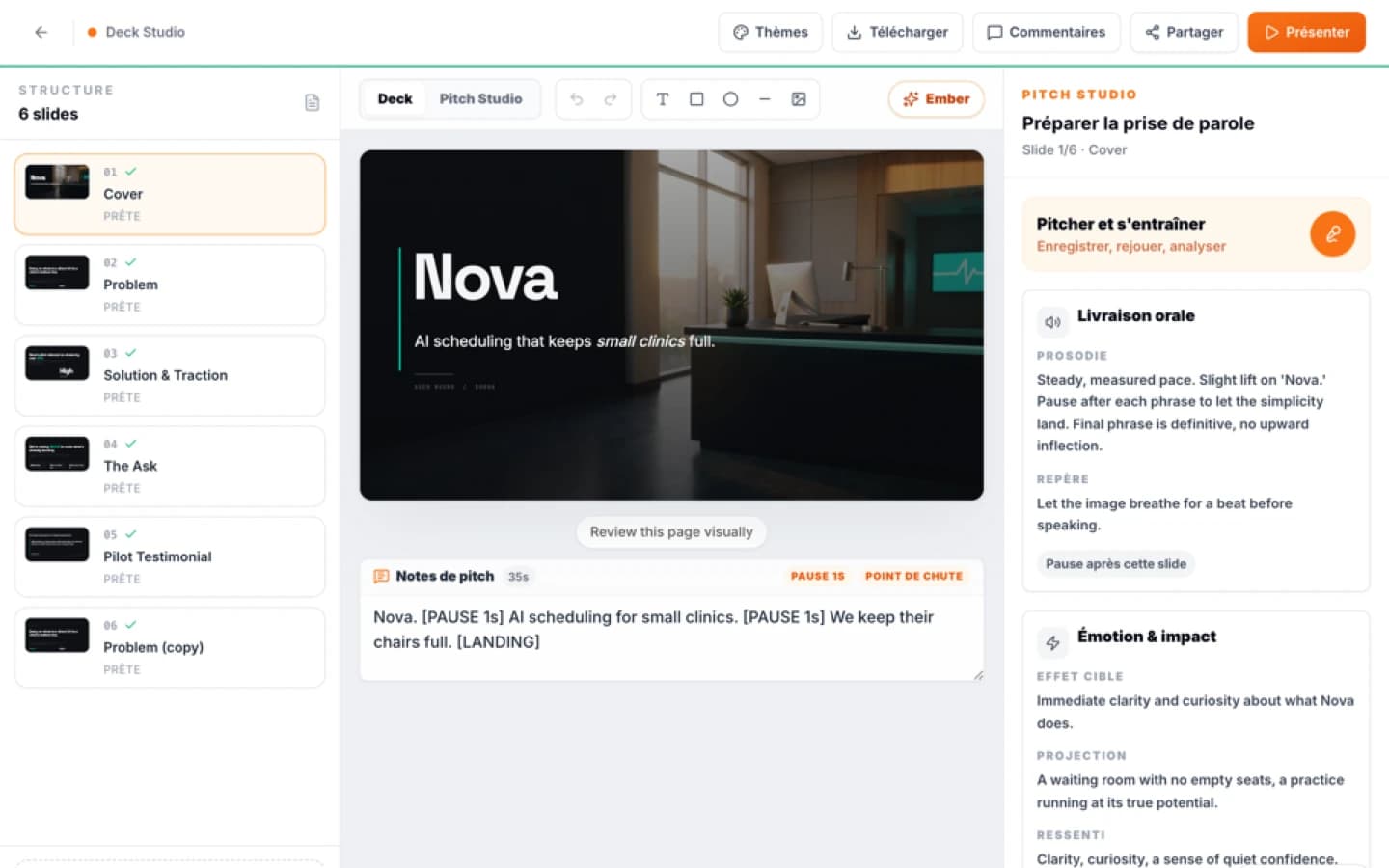
Creation helps founders prepare the spoken presentation with structured speaker notes for each slide and contextual objection practice, as described on the Ember product page. Rehearse the narrative and transitions with a colleague, check every factual claim against project records, and revise the slides where the buyer may misunderstand the offer. A recording or automated voice analysis is not documented by that page.
To place this decision in context, the Knowledge guides for marketing brings together deeper guidance on the same field.
Problem
During the founder-led sales phase, founders and sales teams face a critical bottleneck: translating complex, evolving business context into high-conviction presentations. Traditional presentation software is perfectly adequate for basic formatting or when a generic template is sufficient. However, these tools force founders to spend hours on superficial slide design rather than refining the core message. This disconnect often leads to pitches that lack strategic alignment, failing to move the prospect's decision forward.
The primary challenge is that generic templates do not understand the underlying business strategy, the target Ideal Customer Profile (ICP), or the specific nuances of a Business-to-Business (B2B) offer. When founders rely on standard slide builders, they must manually rebuild the narrative for every single prospect. This manual process introduces friction and dilutes the strategic context. To solve this, founders need a way to build presentations from their substance, form, and intended impact, ensuring that every slide is grounded in actual project data.
Additionally, while high-volume outbound platforms are excellent for generating raw leads, founder-led sales require a different level of narrative precision. Once those leads are generated, the focus must shift from volume to conviction. Without a structured narrative path that analyses the substance before producing slides, founders risk delivering beautiful but empty presentations that fail to address the prospect's real pain points.
Prerequisites
To successfully transition from raw market feedback to high-conviction sales assets, founders must establish certain foundational elements. The first prerequisite is a structured business strategy. Before a founder can build a persuasive presentation, they must clearly define their core offering and commercial direction. Within the Ember ecosystem, which serves as an Artificial Intelligence (AI) team for entrepreneurship, this foundation begins with the ability to build a Business Plan to fund and develop the project. This strategic groundwork ensures that every sales slide generated later is rooted in actual business logic rather than generic marketing templates.
The second prerequisite is a continuous stream of real-world market intelligence. High-conviction presentations cannot be built in a vacuum. They require up-to-date knowledge of the target accounts, their pain points, and their organizational changes. While traditional outbound platforms focus on raw contact volume, early-stage Business-to-Business (B2B) sales demand a more contextual approach. Founders must understand the specific situations of their prospects. Using Lead Intelligence, founders can monitor signals about people and companies to keep their context current, ensuring that the sales narrative remains highly relevant to the recipient.
Finally, founders must be prepared to actively refine and practice their pitch. A successful presentation is not a static document but an evolving narrative that requires human oversight and rehearsal. To meet this prerequisite, Creation lets users edit the generated presentation directly, ensuring that the founder's unique voice and domain expertise are preserved. This combination of strategic alignment, real-time market signals, and iterative review forms the essential preparation for effective founder-led sales.
To explore this point further, Gamma vs Creation: Read-Alone Deck or Live Angel Pitch? details a step directly related to this decision.
Workflow
The transition from raw market feedback to a high-conviction sales presentation follows a structured workflow within Creation. This process ensures that the unique insights of a Business-to-Business (B2B) founder are preserved and translated into a compelling narrative, rather than being lost in generic design templates.
First, the workflow begins with narrative structuring. Instead of focusing immediately on visual polish, Creation analyses the substance of the business strategy and structures the narrative path before producing any slides. This step ensures that the core argument is logically sound and tailored to the specific concerns of the target audience, which is essential when validating an Ideal Customer Profile (ICP).
Second, the generation phase turns this structured narrative into visual assets. Creation generates slides directly from the selected structure and project context. Once the initial draft is ready, the platform lets users edit the generated presentation in Creation. This allows founders and sales teams to maintain complete creative control, making manual adjustments to layout, text, and structure as needed.
Third, the refinement process leverages natural language editing. Founders can request changes in natural language while staying in control in the editor. This capability is particularly valuable during the founder-led sales phase, where feedback from a morning discovery call might require a swift update to the sales pitch before an afternoon presentation.
Fourth, the workflow moves from static slides to active delivery preparation. Structured speaker notes for each slide help founders refine their verbal delivery before speaking to prospects.
Finally, the presentation is prepared for external distribution. The platform allows users to export the presentation to Microsoft PowerPoint or Portable Document Format (PDF). This ensures compatibility with standard corporate environments and allows sales teams to share the deck as a follow-up asset after the meeting.
While volume-oriented outbound platforms focus on scaling contact lists, founder-led sales requires a deeper focus on narrative conviction. Creation provides the structured environment needed to build, refine, and deliver that conviction.
Expected result
The expected result of integrating Creation into the founder-led sales workflow is a shift from generic, feature-heavy slides to high-conviction presentations that actively drive commercial decisions. Instead of spending hours adjusting margins or wrestling with static templates, Business-to-Business (B2B) founders and sales teams can focus entirely on the strategic substance of their message.
While high-volume platforms like Apollo focus on outbound quantity, B2B founders in the founder-led sales phase require high-conviction narrative assets. The primary outcome of using Creation is a presentation grounded in real project context, which helps prospects understand, believe, and act on the proposed solution.
Because the platform allows users to edit the generated presentation directly in Creation, founders maintain absolute control over the final narrative. They can quickly adapt slides to reflect the latest feedback from the market, ensuring that the pitch remains highly relevant to their Ideal Customer Profile (ICP).
Founders can also refine their delivery with speaker notes for each slide. The ultimate result is a repeatable sales asset that turns complex technical capabilities into a clear, persuasive business case.
This approach also connects with What Proof Should a B2B Founder Verify Before Choosing Creation?, which clarifies the next choice.
Example Ember mission
To illustrate how this works in practice, consider a Business-to-Business (B2B) founder navigating the critical phase of founder-led sales. In this phase, the founder is not just selling a product but validating a market, a dual challenge highlighted in the strategic guides shared on LinkedIn. Instead of starting from a blank slide or a generic template, the founder initiates a mission within Ember, which operates as an Artificial Intelligence (AI) team for entrepreneurship.
The mission begins by leveraging the existing project context. Creation starts from this rich project context and data rather than a generic template, ensuring that the unique value proposition and strategic assumptions are preserved. For instance, if the founder has already defined their Ideal Customer Profile (ICP) and core commercial strategy, Creation uses this information directly. This avoids the common pitfall of creating beautiful but empty slides that fail to address the specific pain points of the target audience.
Once the initial narrative structure is generated, the founder has full creative and strategic control. The platform keeps every element editable and leaves the user in control of changes, allowing the sales team to refine the messaging based on real-time feedback from early customer conversations. The founder can easily edit the generated presentation directly in Creation to tailor the pitch for a specific enterprise prospect.
Finally, before stepping into the meeting, the founder can prepare the delivery. Speaker notes for each slide and objection practice help make the final delivery as solid as the slides themselves. Through this integrated workflow, the presentation does more than look professional: it actively helps build understanding and move a decision forward beyond visual polish.
Limits and non-fit
While Creation is highly effective for crafting high-conviction presentations that drive commercial decisions, it is not a universal solution for every sales activity. Understanding its boundaries helps Business-to-Business (B2B) founders and sales teams deploy the right tool for the right task.
First, Creation is not designed for mass outbound prospecting or raw database generation. When the primary goal of a founder-led sales phase is to build a massive pipeline through automated email sequences and cold database scraping, other specialized platforms are far more appropriate. For example, a sales leader or founder focused on speed and immediate volume will gravitate toward Apollo for its large contact database and sequence automation. Ember does not replace these high-volume outbound engines; instead, it focuses on the deep narrative strategy required once a high-value conversation is initiated.
Second, Creation is not a tool for superficial design polishing of pre-existing slides. If a sales team already has a finalized narrative and simply requires a graphic designer to apply strict corporate brand guidelines without altering the structure or reasoning, traditional presentation software or manual design agencies are better suited. Creation is built on the principle that conviction moves decisions forward, meaning it works on the underlying reasoning, the audience journey, and the structure before generating editable slides. It is not a tool for cosmetic adjustments on static, pre-made files.
In practice, Gamma vs Creation: Read-Alone Deck or Live Angel Pitch? completes this framework with another angle on the same topic.
When to use it
For a Business-to-Business (B2B) founder navigating the founder-led sales phase, knowing when to deploy Creation is a matter of matching the tool to the stakes of the conversation.
The first critical scenario occurs when transitioning from initial customer discovery to a structured commercial proposal. In the early days of founder-led sales, founders gather a wealth of unstructured feedback, customer pain points, and technical requirements. According to insights on LinkedIn, founder-led sales require a balance of market validation and active selling. When it is time to synthesize these insights into a cohesive narrative, Creation allows founders to build a presentation grounded in their specific project context rather than a generic template. This ensures that the unique value proposition is structured logically before any slides are generated.
The second scenario is when preparing a presentation that a champion must use to sell the solution internally. In enterprise Business-to-Business sales, the founder rarely presents to the entire decision-making committee. Instead, they must equip an internal champion with a high-conviction deck that can stand on its own. While traditional design tools focus purely on superficial visual polish, Creation works on the underlying reasoning and narrative flow. This makes the presentation easier to understand and act upon when the founder is not in the room. Once the initial structure is generated, founders can easily edit the presentation directly in Creation to tailor the message to the specific constraints of the target account.
The third scenario arises when a founder needs to rehearse and perfect their delivery before a high-stakes client meeting. Presenting to early enterprise clients requires a level of conviction that goes beyond static slides. Structured speaker notes per slide and objection practice help prepare the delivery before stepping into the boardroom.
There are times when other tools are more appropriate. If the immediate goal is high-volume outbound prospecting or rapid contact list building, database platforms are highly effective. However, when the sales process matures past raw volume and demands a tailored, high-conviction narrative to close a strategic deal, founders should transition to Creation to structure their commercial arguments.
Next step
For Business-to-Business (B2B) founders and sales teams, the logical next step is to move away from generic templates and focus on high-conviction narratives that drive actual commercial decisions. While high-volume outbound platforms serve a purpose, the founder-led sales phase requires a deeper level of personalization. Founders must be able to articulate their unique value proposition clearly, a challenge discussed in detail in the founder-led sales guide on LinkedIn. To achieve this, founders can leverage Creation to build presentations grounded in their actual project context rather than generic templates.
The platform lets users edit the generated presentation in Creation to refine the messaging for each specific prospect. Speaker notes for each slide then help build confidence before the live meeting. By combining structured context with objection practice, founders can ensure that every commercial interaction moves the prospect closer to a decision.
Before deciding, Gamma vs Creation: Read-Alone Deck or Live Angel Pitch? helps connect this method with adjacent priorities.
Product scope
The product can help structure the presentation or account review described above. Check the current application for availability and plan conditions before using a paid function. The examples here are editorial methods; they do not measure product performance, buyer intent or customer outcomes. Verify claims with the original source and the buyer before sharing a proposal.
Sources
The primary external references guiding this discussion include the strategic framework shared in The Ultimate Guide to Founder-Led Sales, which outlines the evolution of early-stage commercial conversations. This is complemented by practical application scenarios detailed in the Ember guide on What are the use cases of Lead Intelligence for a B2B Founder in the founder-led sales phase?. Together, these resources highlight how founders can transition from unstructured discovery to high-conviction commercial presentations using dedicated tools like Creation.
Sources
FAQ
Mini audit
Test your Pitch Deck
Get an initial diagnosis of substance, form and impact.