
Symptom or signal
In the current Business-to-Business (B2B) landscape, sales teams face a silent pipeline killer: the sea of sameness. When organizations compress their marketing and sales enablement teams and lean heavily on generic Artificial Intelligence (AI) for output, their messaging loses all distinctiveness. As noted in an analysis on Full-Funnel B2B Marketing, using identical models trained on the same data and prompted with the same playbooks produces content that sounds like it all came from a single room. This lack of differentiation makes it nearly impossible to earn and hold a buyer's attention.
This symptom points to a deeper strategic failure. According to practitioner insights shared on LinkedIn, sales opportunities can lose momentum in the gap between strategy and execution. Companies invest heavily in positioning, narrative design, and Account-Based Marketing (ABM) workshops, yet they stumble when translating those ideas into active collateral. The disconnect becomes obvious during the pitch. Instead of delivering a pitch that drives a decision, sales representatives often rely on generic templates that fail to communicate unique value.
To solve this, teams must rethink how they structure their startup storytelling and sales presentations. When considering what makes an investor say yes to a pitch, or what makes a B2B buyer commit, the answer lies in a narrative arc that prioritizes substance over superficial design. A slide order that holds attention does not start with a generic list of features. Instead, it begins with a compelling problem slide that establishes a clear, named enemy, followed by a structured path to the solution and a credible traction slide. This structure is especially critical when delivering a deck for a non-technical audience, where clarity must replace industry jargon.
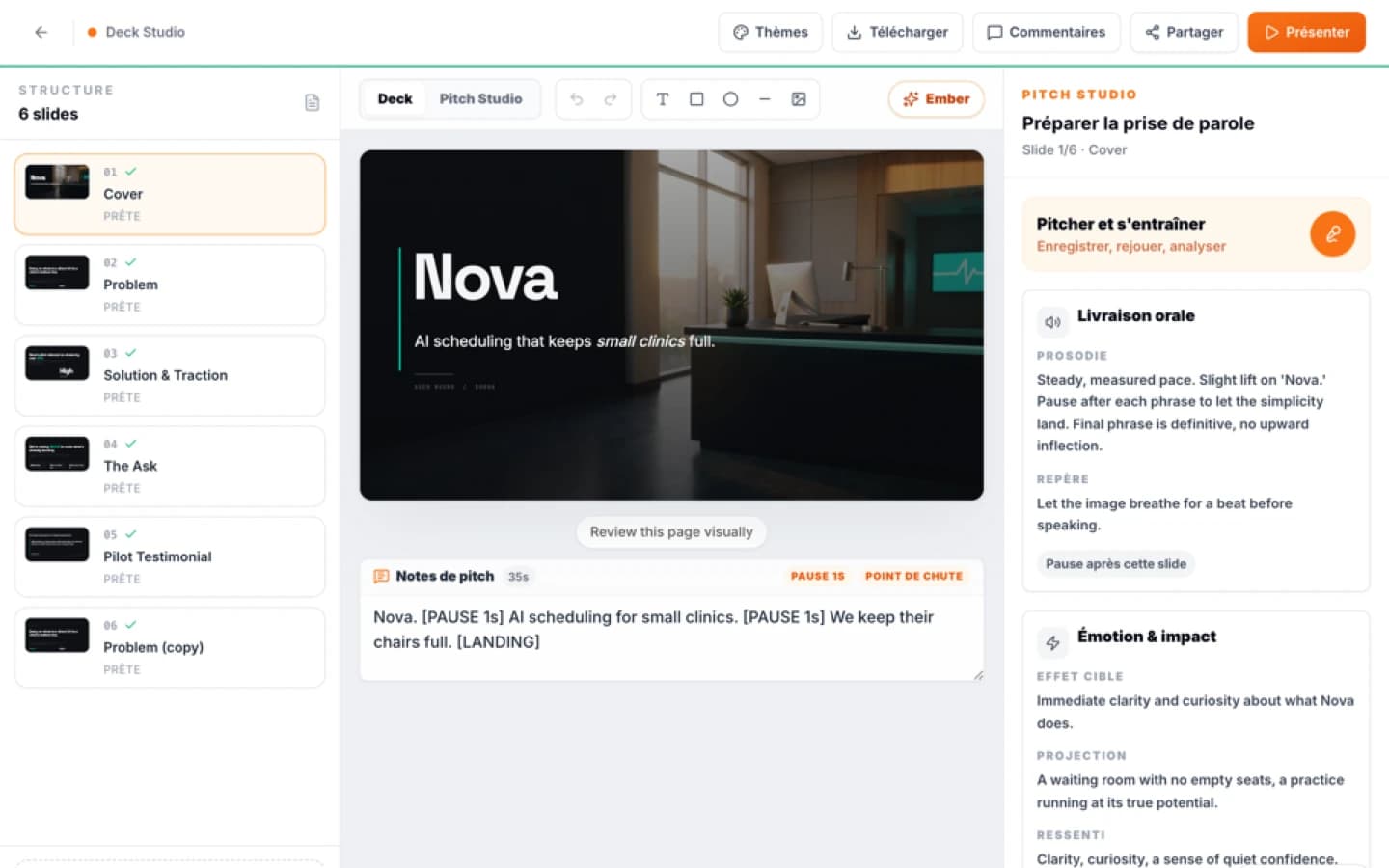
While traditional volume-oriented outreach platforms are highly effective for teams that already know their Ideal Customer Profile (ICP) and need to export large contact lists, they often amplify the noise if the underlying story is weak. True differentiation requires a narrative built from the ground up. By utilizing tools like Ember's Creation, which analyzes the substance and structures the narrative path before producing slides, founders and sales teams can ensure their investor pitch or sales deck is grounded in actual project context. This shift from superficial visual polish to structured reasoning is what ultimately bridges the gap between strategy and execution, transforming a standard presentation into a pitch that drives a decision.
To place this decision in context, the Knowledge guides for marketing brings together deeper guidance on the same field.
What changed
The landscape of Business-to-Business (B2B) sales and marketing has undergone a fundamental shift. With the rapid democratization of Artificial Intelligence (AI), the barrier to content creation has collapsed, resulting in an unprecedented volume of outreach. However, this efficiency has introduced a severe side effect. When organizations compress their teams and lean heavily on generic AI for output, their messaging loses all distinctiveness. As marketing experts Andrei Zinkevich and Vladimir Blagojevic point out, relying on identical models trained on the same data and prompted with the same playbooks creates content that reads like it all came from one room, leading to a massive sea of sameness where nothing stands out (source). For sales teams, this means traditional volume-based playbooks are yielding diminishing returns.
This shift has directly impacted how companies bridge the gap between their high-level strategy and daily execution. In complex B2B sales, millions of dollars in pipeline are lost because teams invest heavily in positioning and Ideal Customer Profile (ICP) design but fail to translate that narrative into their actual customer-facing materials (source). When sales representatives rely on generic templates, their pitch deck becomes indistinguishable from the competition. To stand out, founders and sales teams must master startup storytelling and build a narrative for founders that commands real engagement.
This challenge is especially acute when designing an investor pitch. To answer the critical question of what makes an investor say yes to a pitch, the focus must move away from superficial slide design and toward a pitch that drives a decision. While general AI presentation generators like Gamma are highly useful for quickly structuring visual content with flexible cards that auto-adjust to layouts (source), they are often built for broad use cases rather than deep strategic persuasion. For basic presentations or rapid prototyping, Gamma is an excellent tool, even offering a free plan with 400 credits at signup with no refresh (source). However, winning over a sophisticated audience requires a deeper narrative arc.
When structuring a deck for a non-technical audience, the slide order that holds attention must be carefully calibrated. Instead of a generic list of features, the sequence must build a logical bridge from the problem slide to the traction slide, ensuring every step reinforces the core business case. Traditional sales engagement platforms like Apollo are highly effective when a team already knows their ICP cold and needs to execute volume-oriented outreach, despite friction points around credit-based pricing models that can make monthly costs difficult to predict (source). Yet, in an era of digital noise, volume alone cannot replace a highly tailored narrative. To truly engage prospects, sales teams must use tools like Lead Intelligence to prioritize the conversations that deserve attention now, while leveraging Creation to ensure they do more than produce slides by building a presentation that moves a decision forward.
Facts and sources
To build a Business-to-Business (B2B) narrative that earns attention in 2026 without falling into the sea of sameness, sales teams must bridge the gap between high-level strategy and daily execution . According to practitioner insights shared on LinkedIn, sales opportunities can lose momentum because of this exact disconnect, where organizations invest heavily in positioning and Ideal Customer Profile (ICP) design but fail to translate those concepts into their active sales materials (Defne Gencler's Post). When marketing and sales enablement teams are compressed and rely entirely on generic Artificial Intelligence (AI) tools, their messaging becomes identical because they use the same models and playbooks (Full-Funnel B2B Marketing). To stand out, teams must master startup storytelling by structuring a pitch that drives a decision rather than just presenting a list of features. Whether you are presenting an investor pitch or tailoring a deck for a non-technical audience, the structure of your presentation dictates its impact. When considering what slide order keeps investors engaged, the narrative arc must lead with a compelling problem slide that establishes immediate relevance, followed by a clear traction slide that proves market validation. This structured flow directly answers the fundamental question of what makes an investor say yes to a pitch: it is the presence of a cohesive, defensible strategy rather than superficial visual polish. While traditional presentation tools like Gamma offer flexible formatting options, such as cards that auto-adjust to content (Gamma Help Center), the core challenge remains the underlying narrative. Similarly, legacy sales platforms like Apollo focus heavily on volume-based outreach, but their credit-based pricing models often introduce friction for growing teams because costs scale unpredictably across actions like email verification and contact exports (Factors.ai). Instead of relying on generic templates or high-volume noise, modern teams use Ember to align their strategy with execution. Through Lead Intelligence, Ember reduces noise by focusing attention on opportunities that deserve action now, allowing sales teams to prioritize the conversations that matter. When it is time to present, Creation helps founders and sales teams build a narrative for founders that goes beyond producing slides, creating a presentation that moves a decision forward.
To explore this point further, Creation Use Cases for Bootstrapped Founders by Ember details a step directly related to this decision.
Why the common explanation is incomplete
When sales teams ask what makes an investor say yes to a pitch, or what slide order keeps investors engaged, the common advice almost always defaults to superficial design. The typical recommendation is to follow a rigid narrative arc, polish the problem slide, and clean up the traction slide. However, this explanation is fundamentally incomplete because it mistakes visual layout for strategic conviction. While modern presentation tools like Gamma are highly effective for creating flexible cards that auto-adjust to content, as detailed in Gamma's product documentation, a beautiful template cannot solve a broken message.
The real breakdown occurs when teams try to bridge the gap between high-level strategy and daily execution. According to practitioner insights shared on LinkedIn, sales opportunities can lose momentum because of this exact disconnect. When sales teams rely on generic Artificial Intelligence (AI) tools to fill in their narrative, they fall into a trap where everything starts sounding identical because it is generated by the same models trained on the same data, a challenge highlighted in a recent analysis of standing out in 2026.
To build an investor pitch or a sales deck for a non-technical audience that actually stands out, you must focus on the underlying reasoning. This is why startup storytelling cannot rely on standard templates. A pitch that drives a decision requires an orchestrated approach to structure. In Ember, this is addressed directly through Creation, which analyses the substance and structures the narrative path before producing slides. By prioritizing the logical flow of the argument first, it helps the presentation build understanding and move a decision forward beyond visual polish. This ensures that your narrative for founders and sales teams is grounded in unique project context rather than generic industry noise.
The real problem
The real problem for Business-to-Business (B2B) sales teams is not a lack of content, but a lack of distinctiveness. When organizations compress their teams and rely heavily on generic Artificial Intelligence (AI) for output, their messaging loses all unique character. As highlighted in an analysis on the Full-Funnel B2B sea of sameness, using the same models trained on the same data prompted by people following the same playbooks results in content that reads like it all came from one room. When everyone sounds identical, the outreach fails to convert because the fundamental point of marketing and sales is to stand out.
This uniformity directly impacts how teams present complex products. When constructing a pitch deck, founders and sales professionals often ask what makes an investor say yes to a pitch, or what slide order keeps investors engaged. The conventional advice is to focus on superficial design, polishing the problem slide, or cleaning up the traction slide. However, this advice misses the deeper issue. A pitch that drives a decision does not succeed because of visual polish alone. It succeeds because it bridges the gap between high-level strategy and daily execution.
According to practitioner insights shared on LinkedIn, sales opportunities can lose momentum because teams invest heavily in positioning and Ideal Customer Profile (ICP) design but fail to translate that strategy into their actual sales assets. This gap in startup storytelling prevents companies from building a slide order that holds attention. To build a deck for a non-technical audience or a sophisticated buyer, the presentation must build understanding and move a decision forward. The real challenge is to analyze the substance and structure the narrative path before producing slides, ensuring the story passes the critical filter of relevance rather than sounding like every competitor. This structural clarity is crucial for an investor pitch, creating a narrative for founders that resonates with buyers and partners alike.
This approach also connects with Gamma vs Ember Lead Intelligence for B2B Founder Sales, which clarifies the next choice.
How the mechanism works
To build a Business-to-Business (B2B) narrative that earns attention without falling into the sea of sameness, sales teams must employ a mechanism that bridges the gap between high-level strategy and daily execution. According to practitioner insights shared on LinkedIn, this gap is precisely where sales opportunities can lose momentum because teams invest heavily in positioning and Ideal Customer Profile (ICP) design but fail to translate that strategy into their active sales materials (Defne Gencler's Post). The mechanism to solve this relies on shifting from generic Artificial Intelligence (AI) output to a context-grounded narrative path.
When evaluating what makes an investor say yes to a pitch, the answer does not lie in superficial design updates. Instead, a pitch that drives a decision must pass a rigorous narrative test: does the story pass the "so what" filter, or does it sound exactly like every competitor (Full-Funnel B2B Analysis)? This is particularly critical when designing a deck for a non-technical audience, where clarity and strategic alignment must replace complex jargon.
The structural mechanism of a successful presentation requires a dynamic approach to content. While some tools focus on flexible slide equivalents that auto-adjust to content, such as Gamma's cards (Gamma Help Center), a true narrative for founders must prioritize substance and reasoning over layout automation. This dictates what slide order keeps investors engaged. Rather than following a rigid, pre-packaged template, the slide order must flow naturally from the unique context of the business, connecting the problem slide directly to the traction slide with validated data.
Ember facilitates this transition through Creation. Instead of merely producing slides, Creation works on the underlying reasoning, the audience journey, and the intended impact to build a presentation that moves a decision forward (Ember Creation). By utilizing the shared project context, it ensures that the startup storytelling remains highly distinctive, helping sales teams bypass generic templates and build deep, lasting understanding.
Concrete examples
To understand how to break through the noise, sales teams can look at how successful organizations structure their pitch deck and startup storytelling. When presenting a complex Business-to-Business (B2B) product, the temptation is to focus entirely on visual design. For example, modern tools like Gamma are excellent for creating quick, visually appealing layouts using cards, which are flexible slide equivalents that auto-adjust to content, as documented in the Gamma Help Center. However, visual polish alone does not answer the fundamental questions that drive commercial agreements.
When sales teams ask what makes an investor say yes to a pitch, the answer lies in a narrative that builds deep understanding rather than just showing a clean problem slide or traction slide. According to practitioner insights shared on LinkedIn, sales opportunities can lose momentum because of the gap between high-level strategy and daily execution, as discussed in Defne Gencler's LinkedIn Post. To close this gap, the slide order that holds attention must be structured around a narrative path that addresses the specific situation of the audience, whether it is an investor pitch or a deck for a non-technical audience.
A concrete example of this approach is moving away from the generic templates that contribute to the sea of sameness. When every team relies on generic Artificial Intelligence (AI) to generate their messaging, the output inevitably sounds identical. As highlighted in an analysis on the Full-Funnel Substack regarding how to stand out in 2026, when everyone's content sounds the same, none of it works because the primary goal of marketing is to stand out. Instead of repeating the same generic playbooks, a pitch that drives a decision must pass a strict filter where the story is grounded in the actual substance of the project.
This is where a dedicated environment like Ember changes the workflow. Rather than simply generating slides based on superficial design, Ember analyses the substance and structures the narrative path before producing slides, as detailed on the Ember Pitch Deck page. By focusing on the underlying reasoning, sales teams can use Creation to do more than produce slides, building a presentation that moves a decision forward and helps the audience understand, believe, and act.
When to use this diagnosis
Apply this narrative diagnosis when your sales outreach feels like a volume-driven grind rather than a series of high-value conversations. For teams relying on traditional Business-to-Business (B2B) sales engagement platforms like Apollo, where credit-based pricing turns every action into a metered decision as noted on the Factors.ai Blog, scaling up often leads to compounding costs and diminishing returns. When you find your representatives stuck in this cycle, exporting more contacts only to send generic, Artificial Intelligence (AI) generated templates, it is time to pivot from volume to distinctiveness.
This diagnosis is also critical when your presentation materials fail to convert. In B2B sales and startup storytelling, teams often wonder what slide order keeps investors engaged or what makes an investor say yes to a pitch. The answer does not lie in superficial visual polish. While tools like Gamma are useful for auto-adjusting content within flexible cards, as detailed in the Gamma Help Center, a beautiful template cannot save a weak story. A slide order that holds attention must follow a clear narrative arc that moves beyond a generic problem slide or traction slide. It must build a pitch that drives a decision by confronting the real strategic challenges your prospect faces, making it an effective deck for a non-technical audience and a powerful narrative for founders alike.
According to practitioner insights shared on LinkedIn, millions of dollars in pipeline die in the gap between high-level positioning strategy and daily execution. If your sales team has sat through long positioning workshops but still relies on generic outreach, your narrative is failing the filter of real-world relevance. You are contributing to the sea of sameness described on the Full-Funnel Substack, where identical AI models trained on identical data produce indistinguishable content.
When you recognize these symptoms, you need tools that do more than produce slides or export lists. This is where Ember helps. With Creation, you can build a presentation that moves a decision forward by focusing on substance and narrative impact rather than superficial design. Simultaneously, Lead Intelligence reduces noise by focusing attention on opportunities that deserve action now, allowing your sales team to prioritize the conversations that deserve attention now.
In practice, Creation Use Cases for B2B Founder-Led Sales Teams completes this framework with another angle on the same topic.
When not to use it
This narrative-driven approach is not a universal remedy for every sales scenario. For organizations that rely on high-volume, transactional outreach where deep personalization is secondary, classic database platforms are highly effective. If your sales strategy is built on exporting thousands of leads without needing to understand their immediate context, traditional platforms are a great fit. These volume-oriented workflows excel when you already know your Ideal Customer Profile (ICP) cold and have the budget to support credit-based structures. In these scenarios, attempting to run a deep narrative diagnosis on every account is an inefficient use of resources.
Similarly, a dynamic narrative framework is unnecessary if your team is delivering a highly standardized investor pitch where the slide order that holds attention is already locked and requires zero customization. When founders ask what makes an investor say yes to a pitch, the answer is usually a tailored narrative arc that addresses specific market pain points. However, if you are presenting a deck for a non-technical audience that only requires a basic, static explanation of your product, investing time in rebuilding your startup storytelling or adjusting your problem slide and traction slide for every meeting is overkill. Standard presentation templates or simple canvas tools are perfectly adequate for these static requirements.
But when your sales teams must break through the sea of sameness to deliver a pitch that drives a decision, generic templates and volume-driven spam will fail. This is where Ember provides a targeted alternative. Through Creation, founders and commercial teams can do more than produce slides, building a presentation that moves a decision forward. When the goal is to identify high-value prospects rather than chasing raw volume, Lead Intelligence reduces noise by focusing attention on opportunities that deserve action now, allowing your team to prioritise the conversations that deserve attention now.
Next step
To escape the sea of sameness in 2026, sales teams and founders must bridge the gap between high-level strategy and daily execution . As highlighted in Defne Gencler's insights on LinkedIn, this gap is where pipeline and opportunities frequently falter. When everyone uses the same Artificial Intelligence (AI) models and playbooks, standing out requires a narrative that goes beyond generic templates. According to the Full-Funnel B2B analysis on standing out in 2026, true differentiation comes from a narrative that passes the filter of relevance rather than sounding like every competitor. When translating this narrative into a pitch deck or sales presentation, the structure must be designed to drive action. For teams wondering what makes an investor say yes to a pitch, the answer lies in a clear narrative arc that connects market reality to concrete proof. It is not just about visual aesthetics. While tools like Gamma are excellent for quickly organizing content using flexible cards as detailed in the Gamma documentation on flexible cards, a pitch that drives a decision requires deep substance. To keep stakeholders engaged, founders must consider what slide order keeps investors engaged. A successful narrative for founders starts with a compelling problem slide that defines a specific, undeniable market shift, followed immediately by the unique mechanism of the solution, and culminates in a robust traction slide. This specific slide order that holds attention ensures that the audience understands the commercial viability of the project before diving into technical details, making it an ideal deck for a non-technical audience. The next step is to align your narrative with your daily commercial operations. Instead of relying on volume-heavy outreach that contributes to the noise, organizations can leverage tailored systems to maintain relevance. For example, Ember offers dedicated capabilities to support this transition. Through Creation, teams can do more than produce slides, building a presentation that moves a decision forward by focusing on substance and intended impact. Simultaneously, Lead Intelligence helps reduce noise by focusing attention on opportunities that deserve action now, proposing the next action and channel that fit the lead situation. By combining a structured startup storytelling approach with contextual insights, Business-to-Business (B2B) brands can deliver a highly personalized message that commands attention.
Before deciding, Narrative vs Metrics Deck: How Founders Decide for Updates helps connect this method with adjacent priorities.
Check the claim before publishing
A stronger B2B narrative links one buyer problem to an observable change and a permitted proof. Lead Intelligence can add account context when selecting conversations, but it does not establish that a message persuaded a buyer. Ask a target buyer what they understood and keep the objection alongside the next revision.
Sources and methodology
Full-Funnel argues for clear messages and a distinct point of view. This is a practitioner argument, not measured proof that any specific story creates a stated amount of pipeline. The test described here is an editorial method for checking buyer understanding.
Sources
FAQ
Mini audit
Test your Pitch Deck
Get an initial diagnosis of substance, form and impact.