
Context and ICP
A bootstrapped founder funds the company from savings, revenue or a small circle of supporters, without outside investors. Stripe's guide on raising capital lists self-funding among the sources of financing and notes its advantages, full control, and its drawbacks, limited resources and potentially slow growth. In practice this means every hour and every euro must serve a concrete goal: winning the first customers, keeping them and keeping costs low.
For this founder, materials are not for a fundraising round but for sales, partnerships and visibility. A proposal for a prospect, a one-page summary for a partner, a model of the business to think it through, a set of posts to build an audience: these are the everyday documents. They must be quick to produce, easy to correct as customer feedback arrives, and consistent with each other.
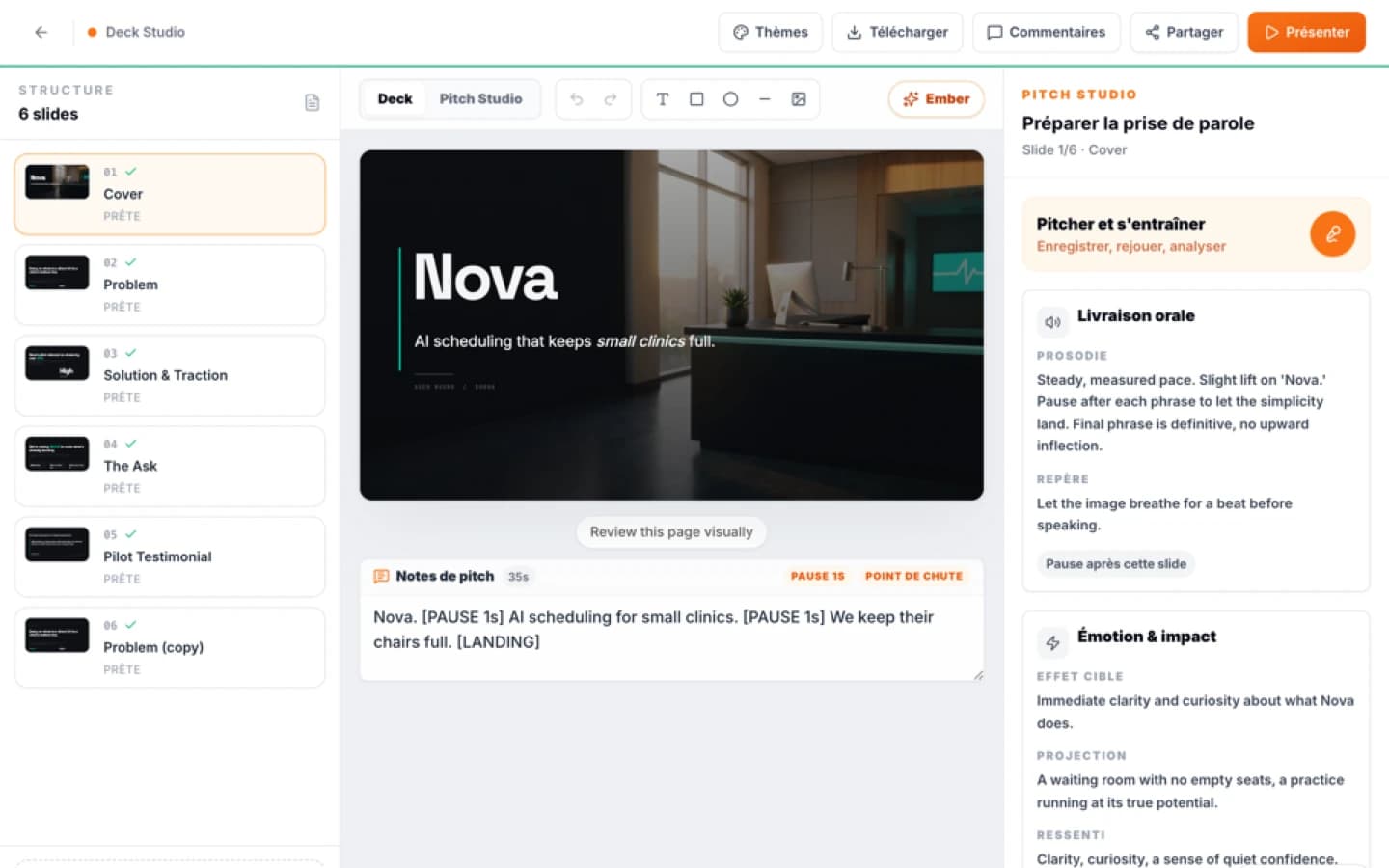
Creation, Ember's module for editable visual documents, is designed for this kind of work. It generates and edits eight formats from the context of the project: decks, LinkedIn posts, YouTube thumbnails, market maps, business model canvases, one-pagers, OG images and stories. Each format has its own canvas, playbook and export rules. Ember's own guide on what to verify before choosing Creation for founder-led sales insists on three points: substance before form, complete editorial control, and the ability to rehearse delivery.
A note on control. Self-funding gives full control, and a founder who keeps it wants tools that keep it too: documents that stay editable, facts that stay checkable, and no lock-in to a format the founder cannot change.
Bootstrapped does not mean without audience. Customers, partners and communities also read what you publish, and a consistent, honest set of documents helps them understand you.
To place this decision in context, the Knowledge guides for marketing bring together deeper guidance on the same field.
Problem
The problem for a bootstrapped founder is the cost of producing good materials. Without a designer or a marketing team, documents are often built late, in a hurry, from a blank page. They vary from one to the next, and the numbers differ between the proposal and the summary. When customer feedback changes the message, every document has to be corrected by hand.
A second problem is the temptation to use the tool that produces the most output rather than the one that produces the right output. Ember's guide on founder-led sales warns that tools built for volume do not serve a founder who wins early customers through direct conversation and feedback, and that fully automated systems risk locking a presentation into a format that cannot follow what the founder learns.
A third problem is focus. Bootstrapped founders have little time, and every document is time taken from customers. The right question is not how to produce more documents but which documents change a decision: a customer choosing, a partner agreeing, an audience following.
Costs matter too. Every tool adds a cost in money and in learning time, so the useful test is whether it removes more work than it creates. A tool that requires long setup for a document you produce twice a year is not worth it, whereas one that saves an hour on each weekly proposal may be.
Finally, a bootstrapped founder rarely has someone to review the materials before they go out. Errors of fact, inconsistent numbers and unclear claims then reach the reader directly, which is why the review step described below matters more here than in a larger team.
Prerequisites
Before producing anything, decide what each document must achieve and gather the facts.
Purpose. For each document, one sentence: who reads it, what they should understand, what they should do next. A proposal for a prospect, a summary for a partner and a post for an audience are three different documents.
Facts. The customer's problem in their words, what you offer, evidence you hold, and any figures you are willing to state, each with its source. If a figure is an estimate, label it as an estimate.
Context. Creation starts from the context and data of the project rather than from a generic template. If you have a Fund Your Growth file, the composer can reuse it and shows what is reused: the file name, the number of validated blocks and a marker per block. A block only proposed is not carried over.
Language. Each creation keeps its own document language, French or English, independent of the interface. It is proposed before the first generation, defaults to the language of the brief and stays visible and editable.
Time. Plan a review before sending anything: generated material is a first editable version, and you remain responsible for what is true.
If several documents will share the same facts, write them once in a short fact sheet: the customer's problem, your offer, the evidence with dates and sources, and the figures you are willing to state. Feed Creation from this sheet each time, and update the sheet when something changes.
Decide too what you will not say. Bootstrapped founders sometimes feel pressure to sound bigger than they are. Documents that state plainly what the company is and does, without inflated claims, are easier to defend.
Prepare also a short list of the questions your prospects ask most often. The documents should answer them, in the order in which the prospect asks them.
Workflow
The workflow has four moves.
Choose the format for the job. A deck for a proposal or a meeting, a one-pager for a partner or a first message, a business model canvas to think through the model, a market map to place yourself among alternatives, and LinkedIn posts, stories, YouTube thumbnails or OG images for audience and content work.
Describe the intention. Creation proposes three templates with a preview, asks the useful questions and asks for confirmation before creating. Skipping the framing questions launches the generation with the answers available. For decks, a page-count selector offers an automatic default or fixed values.
Edit. Modify page by page, and zone by zone for layout and images. Natural-language edits stay under your control, dense pages use targeted, undoable edits, and text erasures requested from a targeted edit are discarded with a warning. Undo and redo live in the open editing session.
Export and share. A deck exports to PDF or PowerPoint; the other formats export as PNG. A deck can be shared with a user or team on Ember, read-only or editable, with comments anchored to slide objects. For decks, Speaking practice lets you record and replay a presentation and receive an analysis of rhythm, clarity, impact and structure.
A few details about the formats help in choosing. The one-pager usually fits on one page, with a second only on request. The business model canvas and the market map are dense templates: facts you provide are kept, estimates are distinguished from known data and unknown identities are left out. The LinkedIn post, the story, the thumbnail and the OG image are visual formats that export as PNG.
Images in a creation come from upload, the image generator, a stock image search or a pasted link, and any displayed image is copied into Ember's storage. Fonts are loaded at export from the web font stylesheets, with the system font as a fallback. The export waits for a confirmation listing the affected pages when an image or a font is missing, and refusing downloads nothing.
Each format has its own canvas, playbook and export rules, so choose the format for the job rather than forcing one format to do everything. A deck is not the right vehicle for a short post, and a post is not the right vehicle for a proposal.
Expected result
The expected result is a small, consistent set of documents produced faster than from a blank page, with facts you have checked.
For sales, a deck or a one-pager that starts from the customer's problem and states what you offer and the evidence you hold. For partnerships, a short summary that says what each side gains. For thinking, a business model canvas that makes assumptions visible and shows where the model is fragile. For visibility, posts and images that carry the same facts in a form suited to the channel.
Consistency comes from one context. Because the documents start from the same information, a change in the offer or in the evidence can be carried across each document by editing, rather than rewriting from scratch.
Ember's guide on founder-led sales adds a criterion: every generated element must stay editable, because founder messaging evolves quickly with customer feedback. The result is therefore not a finished, locked document but a first version you keep improving.
The result does not include a guarantee that customers or partners will respond. Creation accelerates the production of a first editable version and does not replace a designer or your own judgment. The visual does not replace the evidence in your business plan and certifies no figure.
Usage is measured at the real cost of each provider call, converted into credits. A generation that fails without a saved creation leaves no debit, and generating fewer pages means billing fewer pages. No duration and no price is promised in this guide, so check the current conditions on your account.
For a founder who watches every euro, this behaviour matters: keep the brief precise, review the first version, and correct rather than regenerate from scratch.
For a bootstrapped founder, the most valuable result is often time recovered: an hour saved on each weekly proposal is an hour spent with customers. Track it yourself for a few weeks to see whether the tool delivers that in your case.
Example Ember mission
To make this concrete, take an illustrative founder of a small B2B service who funds the company from revenue. This is an example of use, not a real customer case.
His goal this month is to win three pilot customers through conversations he already has. He creates a one-pager for prospects: the customer's problem in the words heard in calls, what he offers, one documented result with its source, and the next step proposed. He chooses the language of the prospects, checks each figure against his notes and edits two sentences that overstated what the pilot showed.
For a meeting with a larger prospect, he builds a short deck from the same context, so the facts match. He uses Speaking practice to record and replay his presentation and read the analysis of rhythm and structure, then changes the order of two pages.
To think about pricing logic and costs, he builds a business model canvas, and sees that one assumption, the time needed per customer, has never been tested. He adds it to his list of things to verify with the next pilot. In the same week, he turns one lesson from a customer call into a LinkedIn post, exported as PNG.
In the following weeks he compares the reactions to the one-pager and the deck. One prospect asks about implementation time, which the documents do not answer. He adds a short section to the one-pager stating what he knows and what he will measure in the first pilot.
Limits and non-fit
Several limits apply.
Mobile. On the mobile site, Creation is reserved to the computer, and in the iPhone and Android applications only Second Brain exists.
Formats. Only decks export to PDF and PowerPoint, and Speaking practice applies to decks only. The other seven formats export as PNG.
Editing. A layout change or an image addition goes through zone-by-zone editing, and a text retouch is not a new design. Choosing a language does not translate existing pages.
Checks. Identity checks on one-pagers do not cover names or places the model did not declare, so read each page.
Automatic visual review is not currently active.
Collaboration. Live collaboration has not been tested end to end by this guide: try it with two people before relying on it for critical work.
Fit. If a single simple image or slide is all you need, a basic design tool may be enough. And nothing here replaces legal, tax or accounting advice.
Generation depends on model providers. A full-page edit interrupted by a provider limit does not publish incomplete content and leaves the original page intact, suggesting that you edit one element at a time. Some flows continue after a tab is closed, but this should not be assumed without checking the current setting.
Finally, a generated document reflects the facts you give it. If the facts are weak, the document will show it, so a tool cannot compensate for missing evidence.
A last point: keep control of what is published. A post or a page that is public should contain only facts you are comfortable with everyone reading.
When to use it
Use Creation when you must produce several documents from the same facts, quickly, and correct them as you learn: proposals, summaries, models and audience content in the same week. It suits a founder who sells personally and whose message changes with each conversation.
It is especially useful when time is the scarcest resource, because it produces an editable first version you correct instead of a blank page.
It is less useful when facts are not yet clear, since documents will only reflect that uncertainty. In that case, spend time with customers first, and produce documents once you have something to say.
For a comparison with alternatives at the market-validation stage, see Gamma vs Creation: Read-Alone Deck or Live Angel Pitch?. For deciding between a narrative deck and a metrics deck, see Narrative vs metrics deck.
It also suits the founder who wants to keep a shared library of documents with a partner or a first employee, since decks can be shared with a user or a team, read-only or editable, with comments on slide objects.
The Library lists the files you imported and generated from Second Brain, Creation and Fund Your Growth, with search, favourites and filters, and lets you attach documents to a brief and images as style references.
Next step
Choose one action for this week. List the three documents that would change a decision this month, and for each write one sentence: who reads it, what they should understand, what they should do next. Pick the first one to produce.
Then write down the facts it needs and mark each as proven, declared or assumed. Give Creation the intention with these facts, review what it generates against your notes, and correct it.
If you want to check that Creation fits your situation first, read Ember's guide on what to verify before choosing Creation for founder-led sales and the use cases for B2B founder-led sales teams.
Then set a review date one month from now and note which documents changed a decision, and which did not.
Sources
This guide draws on Stripe's guide on raising capital for a young company, opened and read for this version, for the description of self-funding, and on Ember's own guide on evidence to verify before choosing Creation for founder-led sales. The description of Creation comes from the documented behaviour of the product: formats, workflow, exports, sharing, Speaking practice and limits. The example founder is an illustration, not a real customer case. No figure on results is claimed. Product availability and options can change: check your account.
Sources
FAQ
Mini audit
Test your Pitch Deck
Get an initial diagnosis of substance, form and impact.