
| Criterion | Gamma | Ember |
|---|---|---|
| Main category | AI platform that generates presentations, documents and webpages from a prompt or uploaded material. | Ember module that generates and edits visual formats from your project context; the deck is the format compared here. |
| Main objective | Get a good looking first version quickly. | Build a presentation that helps a buyer or investor understand and act. |
| Starting point | A prompt, pasted text or uploaded files. | Your project context, framing questions, then your confirmation before anything is created. |
| Formats produced | Presentations, documents and webpages. | Decks, LinkedIn posts, YouTube thumbnails, market maps, business model canvases, one-pagers, OG images and stories. |
| Editing | Cards that resize to their content; AI editing with the agent uses credits. | Page by page in the editor, plain language requests, and zone by zone for layout or images. |
| Exports | PDF, PNG or PowerPoint (.pptx), LinkedIn posting; badge on free plan exports. | Deck as PDF or PowerPoint (.pptx); the other formats as PNG. |
| Rehearsal | Not found in the help pages we opened. | Speaking practice for decks: record, replay, analysis of rhythm, clarity, impact and structure. |
| Sharing and analytics | Webpage publishing; detailed viewer analytics on the Pro plan. | Sharing with Ember users or teams, read or edit, with comments on slides. |
| Languages | Interface in 14 languages; AI generator supports multiple languages. | Each creation is in French or English, independently of the interface. |
| Usage metering | Credits: 400 one-time on the free plan, monthly refills on paid plans. | Actions metered in credits; no fixed price per generation is promised. |
| Ideal user | Someone producing many lightweight documents and decks quickly. | A founder who sells personally and must defend the deck in the room. |
| Best use | Internal updates and quick first drafts. | The version of the pitch that goes in front of a real buyer or investor. |
| Main limitation | Free plan capped at 10 slides per generation; not a proposal tool. | Decks only for Speaking practice; computer only; not a proposal tool. |
| Pricing | Read Gamma's pricing page; the 29 September 2026 access attempt returned an error. | See Ember's pricing page; no price is quoted in this article. |
Why look for an alternative
Ember publishes this blog and also builds Creation, one of the two products compared here, so read the verdict with that in mind. Every fact about Gamma below comes from a Gamma page or a third-party page that we opened on 29 September 2026, and it is dated where it matters.
If you support a business-to-business (B2B) founder who is still selling deals personally, you already know that the deck is not the finish line, the meeting is. Gamma describes itself as a web-based platform that uses artificial intelligence to generate presentations, documents and webpages, working from a prompt or from material you upload (Wikipedia, consulted 29 September 2026). For a quick first draft that is a real strength: you type what you need and cards appear.
The question a founder should ask is different, though. A deck for a sales conversation has to survive being questioned. The founder who built it is usually the person who has to defend every number out loud a minute later, and a first draft generated from a prompt does not tell you whether the argument holds. That is the job Creation, the deck and visual creation module of Ember, is designed around: it starts from what you already know about your project, asks the framing questions that matter, and only then produces slides.
So this comparison sets Gamma against Creation for one situation: a founder who sells personally and needs a presentation that persuades a specific buyer or investor. It does not compare Gamma with Lead Intelligence, Ember's separate module for prospecting. If you are looking for an outreach tool, another article covers that decision.
To place this decision in context, the Knowledge guides for marketing brings together deeper guidance on the same field.
Decision criteria
The clearest way to choose is to ask what the deck has to do for your specific deal, not how fast it renders. Five criteria carry most of the decision.
The first is the starting point. Gamma starts from a prompt, pasted text or uploaded files. Creation starts from the context Ember already holds about your project, and when a Finance ta croissance file is linked it can reuse the validated parts of it. If you arrive with a rough idea and want to see something in a minute, the first approach is quicker. If you arrive with a business you have already described, the second saves you from restating it.
The second is control over the argument. Creation asks framing questions before it generates anything and asks for confirmation before it creates, so you shape the narrative path first. Gamma generates from your prompt, then you refine the cards. Neither approach is wrong. They suit different moments in a sales cycle.
The third is what you must hand over. Both tools let you export a file: Gamma offers PDF, PNG or PowerPoint (.pptx) and can post directly to LinkedIn, according to its help center. Creation exports a deck as PDF or PowerPoint (.pptx) from the editor. If the file has to travel into a buyer's own PowerPoint environment, open a test export from each tool before you commit.
The fourth is rehearsal. In founder-led selling the founder is often the product being evaluated. Creation includes Speaking practice, a rehearsal layer for decks. We found no rehearsal feature in the Gamma help pages we opened, so treat this as a difference in scope rather than a defect, and check Gamma's site for anything newer.
The fifth is how usage is metered. Gamma runs on credits, and its help center lists what consumes them. Ember also meters actions in credits, with no fixed price promised per generation. Because prices change, we quote no subscription price for either product; see the Ember pricing page for its current terms and Gamma's own pricing page for Gamma.
In practice the decision comes down to three questions to ask before the next deck goes out. Does this deck only need to look finished, or does it need to change someone's mind? Will the person who builds it also have to defend it in front of the buyer? And is the team producing decks occasionally, or often enough that the metering model starts to matter?
Quick decision table
For a founder-led sales team the choice usually comes down to one question: does this deck need to persuade a room, or just update one. If a rep needs a fast, clean draft to react to overnight or to summarize progress internally, Gamma is a strong pick. Its help center describes slides that adjust to the content you give them, and the generator can produce up to 100 slides per generation on a paid workspace, against 10 on a free one (Gamma help center, "What are cards in Gamma", consulted 29 September 2026).
Where the decision shifts is what happens after the draft. A third-party review published on 1 June 2026 by Cobl, a company that sells proposal software and therefore has an interest in this argument, states that "a deck is not what closes a B2B deal. A proposal is." It lists pricing tables, an e-signature, CRM data merged into the document and visibility into whether the prospect opened it as things a presentation tool does not give a sales team. Weigh that as a competitor's opinion, but it is a useful reminder that a deck is one piece of a sales process.
Creation sits on the other side of the same trade-off. Its stated ambition is to help a presentation build understanding and move a decision forward, drawing on the founder's own project context rather than a generic prompt. It offers three templates with a preview, asks the useful questions and waits for your confirmation before creating. If the deck in question is the one you will stand behind in front of a buyer, that sequence is the more relevant question than which tool renders slides quickest.
A short worked example, clearly illustrative and not a real case: a founder has a thirty-minute call tomorrow with a prospect who asked for "something to share internally". A quick Gamma draft is enough for that. The same founder, the following month, prepares the presentation for a partner meeting where the pricing logic, the proof points and the answers to objections all matter. That is closer to what Creation is built for.
So the practical split looks like this. Pick Gamma when the deck is a quick internal artifact and speed is the only real constraint. Look at Creation when the deck has to carry a sales conversation forward and the reasoning behind the slides needs to hold up in the room.
To explore this point further, Creation Use Cases for B2B Founder-Led Sales Teams details a step directly related to this decision.
Neutral presentation of the competitor
Gamma is built around a simple mechanic. You write a prompt, paste text or upload material, and it turns that into cards, which are its flexible equivalent of slides. Its help center says these cards "dynamically adjust to fit your content while maintaining an organized layout", and that they resize automatically to the content inside them. You can also pick a fixed ratio such as 16:9 in the page setup menu. There is no cap on the total number of cards in a document, but the AI generator is limited per request: up to 100 slides per generation on paid workspaces and 10 on free ones (help center, consulted 29 September 2026).
The size of what you feed the generator is limited too. The help center gives up to 50,000 AI tokens per initial generation on the free plan and up to 100,000 on Plus and Pro. A token is the small unit of text that AI models process, so in plain terms a long report is fine, an entire data room is not.
Every AI action draws from a credit balance. According to the help center, generating presentations with the AI generator uses credits metered per slide and per image, and other AI actions such as editing with the agent, adding cards with AI and trying new layouts also consume credits, while AI errors and clarification requests are not charged. Each new free user receives 400 credits at signup, and on the free plan credits do not refresh. On annual and monthly paid plans credits refill every month, and unused plan credits roll over up to double the plan size. The upgrade article lists 1,000 monthly credits on Plus, 4,000 on Pro and 20,000 on Ultra, with custom options on Business.
Credits can be topped up: the help center states "1,500 credits for $6, purchased in increments of 1,500", adds that free users cannot buy credits, and specifies that one-time purchases are limited to single-user workspaces, while administrators of multi-user workspaces use auto-recharge. We did not include subscription prices because Gamma's pricing page refused our automated request on 29 September 2026 (HTTP 403), so we could not read it and you should check it directly.
Plans matter for output as well. On the free plan, exports carry a "Made by Gamma" badge, which any paid plan removes; printing from the browser does not add it. The Pro plan adds API access, custom domains and detailed analytics on individual viewer engagement, and Ultra adds early access to new features and premium image models (help center, upgrading article). Gamma's interface is available in fourteen languages listed in its help center, and its AI generator and editor support multiple languages.
Neutral presentation of Ember
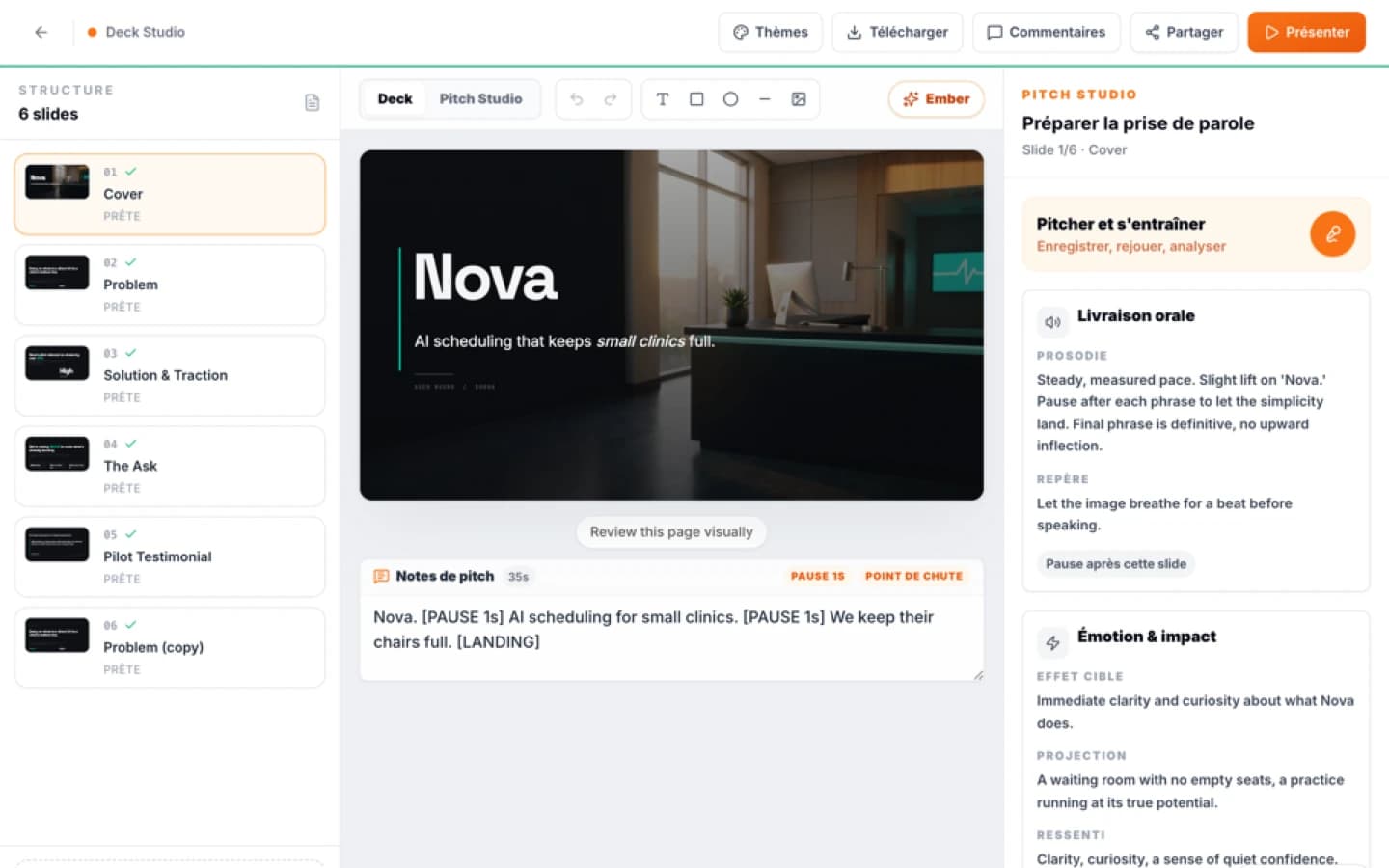
Ember approaches the same job differently, and we say so as the publisher. Creation is the module that generates and edits visual formats from your project context. Its deck format is the one compared here, but it also produces LinkedIn posts, YouTube thumbnails, market maps, business model canvases, one-pagers, OG images and stories, so a founder can keep the visual identity of a pitch consistent across the deck and the assets around it.
The workflow is deliberately slower at the start. Creation proposes three templates with a preview, asks the questions that will shape the result, then asks for your confirmation before it creates anything. It analyses the substance you provide and structures the narrative path before it produces slides, and it can draw on a Finance ta croissance file when one is linked. In the composer you can also choose the document language, French or English, independently of the interface language, and the choice is not translated automatically on existing pages.
Once the deck exists, editing happens page by page. You can ask for changes in plain language in the editor, and targeted edits stay undoable within the editing session; for layout changes or a new image, editing zone by zone is the route. A full-page edit interrupted by a provider limit does not publish half a page, it leaves the original page untouched and suggests editing one element at a time. Decks can be shared with an Ember user or team in read or edit mode, with comments anchored to slide objects.
Exports depend on the format. A deck exports as PDF or PowerPoint (.pptx) from the editor, and the other formats export as PNG. The public page for Creation describes a presenter mode and the ability to rehearse slide by slide with structured speaker notes and to practise objection answers in context, and it states the positioning plainly: "You don't create slides. You structure persuasion."
Speaking practice, the rehearsal layer connected to decks, lets you record, replay and rehearse a pitch, then analyses the rhythm, clarity, impact and structure of the recorded take, with a slide by slide reading and recommended exercises. A take is limited to 15 minutes, and the analysis is a metered action billed in credits, without a fixed price we could promise. It applies to decks only, not to the other formats.
This approach also connects with Narrative vs Metrics Deck: How Founders Decide for Updates, which clarifies the next choice.
Approach comparison
Side by side, the two tools solve for different moments in a founder-led sales motion.
Gamma optimizes for speed from a blank page. You type or paste, it renders cards, and you refine. The economics follow that logic: a free tier with a one-time grant, paid tiers with monthly refills, and credit packs for those who run out. That is coherent for someone who produces many lightweight documents, presentations and webpages, because each generation is a discrete, metered event.
Creation optimizes for the argument. It spends its first steps on your context, on framing questions and on a confirmation, so that the first visible output is already structured around the point you want to make. The trade-off is honest and worth naming: that opening is slower than typing a prompt, and if you have nothing yet to say about the project, there is little for the framing to work with.
The two also differ in what surrounds the slides. Gamma can publish content as a webpage, offers viewer analytics on its Pro plan and lets you export to several formats. Creation stays inside the deck and visual asset frame, adds rehearsal for decks and shares work with Ember users and teams. Neither replaces a proposal tool, and the Cobl review linked above makes the same point about Gamma from a competitor's angle.
A useful test that works with any pair of tools: take the same brief, a real one from your pipeline, and produce the deck in both. Then give each deck to a colleague who has not seen the project and ask them to state, in one sentence, what you are asking the buyer to do. The deck that gets the right sentence wins, whatever the tool.
Cost deserves the same treatment. Gamma documents what consumes its credits and what a top-up costs, so a team can estimate its consumption from its own history. For Ember, look at the pricing page and at the credit usage screen in your account rather than at any figure quoted in an article, including this one.
When the competitor is the better fit
Gamma is the better fit when the job is speed rather than persuasion architecture. If a sales rep needs to turn a rough outline into a presentable deck before a call in an hour, or a founder wants to summarize weekly progress internally without building a narrative case, the prompt to cards mechanic gets there fast.
It also works as a low commitment way to try the approach. New free users receive a one-time grant of 400 credits that does not refresh, so a solo rep can test the workflow on a handful of decks before deciding whether to pay. Paid plans refill credits monthly with a rollover capped at double the plan size, which suits a team that produces decks on a regular cadence rather than in occasional bursts.
Gamma is also broader than a deck tool in one respect: the same platform produces documents and webpages, and its Pro plan brings custom domains and per viewer engagement analytics. A team that wants to publish a public web version of a pitch and see who read it will find more there than in a pure deck editor.
One practical detail matters when a founder pitches investors or prospects: free plan exports carry a "Made by Gamma" badge, which disappears on any paid plan. For a quick internal share that is a non issue. For a client facing file, check it before you send.
Choose Gamma when the deck is disposable, the timeline is measured in minutes and the goal is a clean looking artifact. Choose it too when your team already produces many lightweight documents and the credit cadence matches how often you present. When the deck needs to hold up under investor or buyer scrutiny and be revised across several meetings, that is a different job, and it is worth checking whether the tool that gave you a fast first draft is still the right one for the version that goes in front of the room.
When Ember is the better fit
Ember fits better the moment the presentation has to do more than look finished. For a founder who still closes business to business (B2B) deals personally, a deck that only renders well is not enough. Creation starts from the substance of the offer, analyses what the founder already knows about the deal and structures the narrative path the prospect needs to follow before a single slide appears. That sequence matters when the goal is to make a buyer understand, believe and act.
It also fits when the founder needs to rehearse. Speaking practice lets you record a take of your deck, replay it and read an analysis of rhythm, clarity, impact and structure, slide by slide, with suggested exercises. For a sales team where the founder is still the main closer, hearing your own delivery before the meeting is often worth more than one extra visual pass.
Ember is also the more natural choice when the deck is one of several assets. Because Creation produces LinkedIn posts, one-pagers, market maps and other formats from the same project context, a founder preparing a fundraising or partnership push can keep the deck and its companion assets aligned. Each format has its own export rules: a deck exports as PDF or PowerPoint (.pptx), and the others as PNG.
There is also a cost angle worth naming plainly. Gamma's free tier gives a fixed one-time allotment of 400 credits, and a team that reworks the same deck across several prospects will consume it differently from a team producing one internal update. If your real need is a deck that gets rebuilt and re-argued deal after deal, compare the metering models of both tools on a real week of work, rather than assuming the fastest first draft is the cheapest path to a closed deal.
Finally, Ember works with your own material. You can attach documents and reference images from the Library to guide a creation, and the generation is grounded in your context instead of a blank prompt. That does not make the output correct by itself: you still verify every figure that goes on a slide.
In practice, Gamma vs Creation: Read-Alone Deck or Live Angel Pitch? completes this framework with another angle on the same topic.
Limits
Gamma's limits show up once the deck has to do commercial work beyond a first draft. Credits are finite on the free plan and metered per slide and per image, so heavy iteration needs a paid plan. The generator is capped per request, at 10 slides on free workspaces. One-time credit purchases are limited to single-user workspaces, so a multi-user workspace has to use auto-recharge. The Cobl review adds a third-party claim that PowerPoint exports can break because Gamma's card-based layout does not map to fixed 16:9 slides. Gamma's own help center says tables stay editable when exported to PPTX, so treat the layout question as something to test with your own decks, not as a settled fact.
Creation has limits of its own, and they are as important to know. It is a presentation and visual tool, not proposal software: it is not designed for e-signature workflows, pricing tables or open tracking, and it does not merge live customer relationship management (CRM) fields into a document. Speaking practice works on decks only, and a take cannot exceed 15 minutes. On the mobile site, Creation is reserved for computers, and the iPhone and Android apps offer only the Second Brain, so plan your editing on a laptop. Page edits are targeted retouches, not a substitute for a completely new design, and choosing a language does not translate existing pages.
Creation also depends on what you give it. A founder who has not yet clarified what is being sold will get a thinner narrative path, not a stronger one, because the framing questions have little to build on. Sharing works with Ember users and teams, so if a buyer needs a link to open without an account, export the file and send it instead.
For both tools, the general rule holds: a generated deck is a draft. Check every figure, every claim and every name before it goes in front of a buyer, and keep the source of each number somewhere you can point to when asked.
Contextual recommendation
For a founder who runs sales personally, the decision does not hinge on which tool renders a slide faster. It hinges on what happens after the deck leaves your hands. If the presentation is meant to move a prospect from a first call to a signed deal, the real test is whether the deck carries enough of the reasoning that the prospect can decide without you filling the gaps out loud.
Here is a workable rule for a founder still doing founder-led sales. Use the fast tool for internal or throwaway drafts, where Gamma remains a fair choice. Build the version that goes in front of a real prospect in Creation, starting from your project context and the framing questions, then rehearse that specific version with Speaking practice before the meeting, instead of presenting the first pass that came out of a prompt.
Two cautions keep the recommendation honest. First, neither product closes the deal by itself. If your process needs a proposal with pricing tables, an e-signature and open tracking, you will need a tool built for that, and the Cobl review argues the same from its own commercial position. Second, our view as Creation's publisher is not neutral, so run the small test described earlier on your own material before you commit.
Before the meeting, run a short checklist whichever tool you used. Can you state the one decision you want from the buyer in a single sentence? Does every figure on a slide have a source you can name? Have you opened the exported file on a computer that is not yours, to see how fonts and images behave? Have you said the pitch out loud, at the pace of the real meeting, at least once? These four checks cost less than an hour and catch more problems than another round of visual polish, and they apply equally to a Gamma export and a Creation export.
If you use both, decide in advance which one is the source of truth. A common failure is to keep a Gamma version and a Creation version of the same pitch, edit them separately and present the outdated one. Name one owner, one file and one place where the current version lives.
Before deciding, What Proof Should a B2B Founder Verify Before Choosing Creation? helps connect this method with adjacent priorities.
Sources and updates
Every fact about Gamma in this comparison comes from a page we opened on 29 September 2026. The credit rules, the 400 free credits that do not refresh, monthly refills and rollover come from the Gamma help center article on how credits work. The credit pack of 1,500 credits for 6 dollars and its purchase conditions come from the article on purchasing more credits. The plan tiers, monthly credit amounts and plan features come from the article on upgrading a subscription. Slide behaviour and generation limits come from the article on cards, token limits from the article on tokens, export formats and the badge from the article on exporting, and language support from the article on using Gamma in your preferred language.
Gamma's general description comes from its Wikipedia entry, and the sales team review comes from Cobl, published on 1 June 2026, which sells competing proposal software. Ember's description of Creation comes from Ember's own product documentation and from the public Creation page at ember.do/en/ai-pitch-deck.
Gamma's pricing page could not be read when we prepared this update, because it returned an access error, so this article quotes no Gamma subscription price. Treat the credit numbers and plan features above as a dated snapshot, since metered plans change, and confirm the live terms on Gamma's site and on Ember's pricing page before making a purchase decision.
Sources
FAQ
Mini audit
Test your Pitch Deck
Get an initial diagnosis of substance, form and impact.