
An Account Executive rarely loses a deal because of poor graphic polish. Deals slip or stall because collateral fails to communicate relevance, internal champions lack concise materials to rally their buying committees, or the commercial narrative fails to address specific buyer stakes. Generic slide templates and disconnected marketing brochures force sales reps to spend hours manually editing slides rather than engaging prospects.
Ember Creation approaches asset production differently. Instead of offering empty presentation canvases, the module generates structured visual artifacts grounded in existing project context and verified data. For an Account Executive, this translates into actionable collateral designed to move enterprise sales opportunities through each milestone of the pipeline.
Why Account Executives need context-driven visual assets
B2B buyers evaluate software and services under pressure. When an enterprise prospect agrees to an introductory meeting or a solution deep-dive, they expect a conversation focused directly on their operational reality.
Standard slide decks often fail because they treat every customer the same. As communication specialist Nancy Duarte notes in her analysis of narrative frameworks, effective business storytelling requires one clear idea, stated as a point of view plus the stakes of taking or failing to take action. Sales assets must reflect that exact discipline.
Creation generates and edits eight visual formats directly from project context: decks, LinkedIn posts, YouTube thumbnails, market maps, business model canvases, one-pagers, open graph (OG) images, and stories, as outlined in the Ember Creation overview. Rather than starting from a blank design canvas, an Account Executive can leverage documented business facts to create customer-facing assets that respect buyer stakes and preserve analytical rigor.
Core Creation formats across the B2B sales cycle
While marketing teams frequently leverage social formats, an Account Executive relies heavily on three primary artifacts to advance complex deals.
1. Tailored sales decks for discovery and executive alignment
The presentation deck remains the standard vehicle for formal sales discussions, executive briefings, and vendor evaluations. In Creation, decks are generated around structured narrative flows rather than disconnected design layouts.
Before generating slides, the engine prompts the user with framing questions to establish the narrative angle, target audience, and desired outcome. The AE can define specific page targets, choosing an automated count or setting specific lengths such as 5, 8, 10, 12, 15, or 20 slides depending on whether the meeting is a brief executive overview or a comprehensive solution review.
When presenting to enterprise stakeholders, tool selection often depends on the exact medium of delivery. Teams evaluating their stack can consult resources such as Prezi Swoop vs Ember Creation: Which Tool Fits Best? to weigh nonlinear canvas tools against structured, page-by-page document engines.
Once generated, decks in Creation can be refined page by page or zone by zone using natural language prompts. For final delivery, decks are exported directly from the editor as rasterized PDF files or as native PowerPoint (.pptx) presentations, allowing sales professionals to present within standard enterprise meeting environments.
2. High-impact one-pagers for internal champions
Enterprise sales cycles frequently stall after the initial demo because the primary contact struggles to explain the value proposition internally to finance, security, and procurement leaders. Leaving behind a twenty-slide presentation deck is rarely effective; busy executives do not read long decks.
The one-pager format solves this bottleneck. Designed primarily as a dense single-page summary (with an optional second page if explicitly requested), it distills the commercial thesis into a clean, scannable briefing document.
In dense models like one-pagers, Creation enforces strict content controls:
- Stated data points and verified facts are preserved.
- Estimates and assumptions are separated from verified operational metrics.
- Missing inputs are flagged outside the visual canvas rather than masked with fictitious placeholder copy.
This ensures that when an internal champion forwards the one-pager to their Chief Financial Officer, the financial claims and operational assumptions remain defensible. Once finalized, one-pagers export from the editor in lossless PNG format, making them simple to embed directly into executive recap emails or digital sales rooms.
3. Market maps and business model canvases for enterprise stakeholder discovery
During complex discovery phases involving multiple business units, sales reps must demonstrate a complete grasp of the customer's ecosystem and competitive landscape.
Using the market map and business model canvas formats, an Account Executive can visually summarize:
- Where the prospect sits relative to their direct and indirect market peers.
- Key revenue streams, operational constraints, and distribution channels.
- Concrete gaps in the customer's existing technology stack where the proposed solution delivers measurable value.
Like one-pagers, these analytical formats export directly from the editor as PNG files. They serve as strategic leave-behinds following joint workshops, proving to executive buyers that the sales team understands their industry context rather than pitching features in a vacuum. Sales reps interested in turning founder insights and customer feedback into structured value props can examine how to turn a founder journal into a verifiable B2B sales narrative.
Rehearsing the commercial pitch with Speaking practice
Creating a visually clear presentation is only half the battle; the delivery determines whether the opportunity advances. Account Executives frequently need to rehearse their delivery, test narrative transitions, and calibrate pacing before presenting to executive committees.
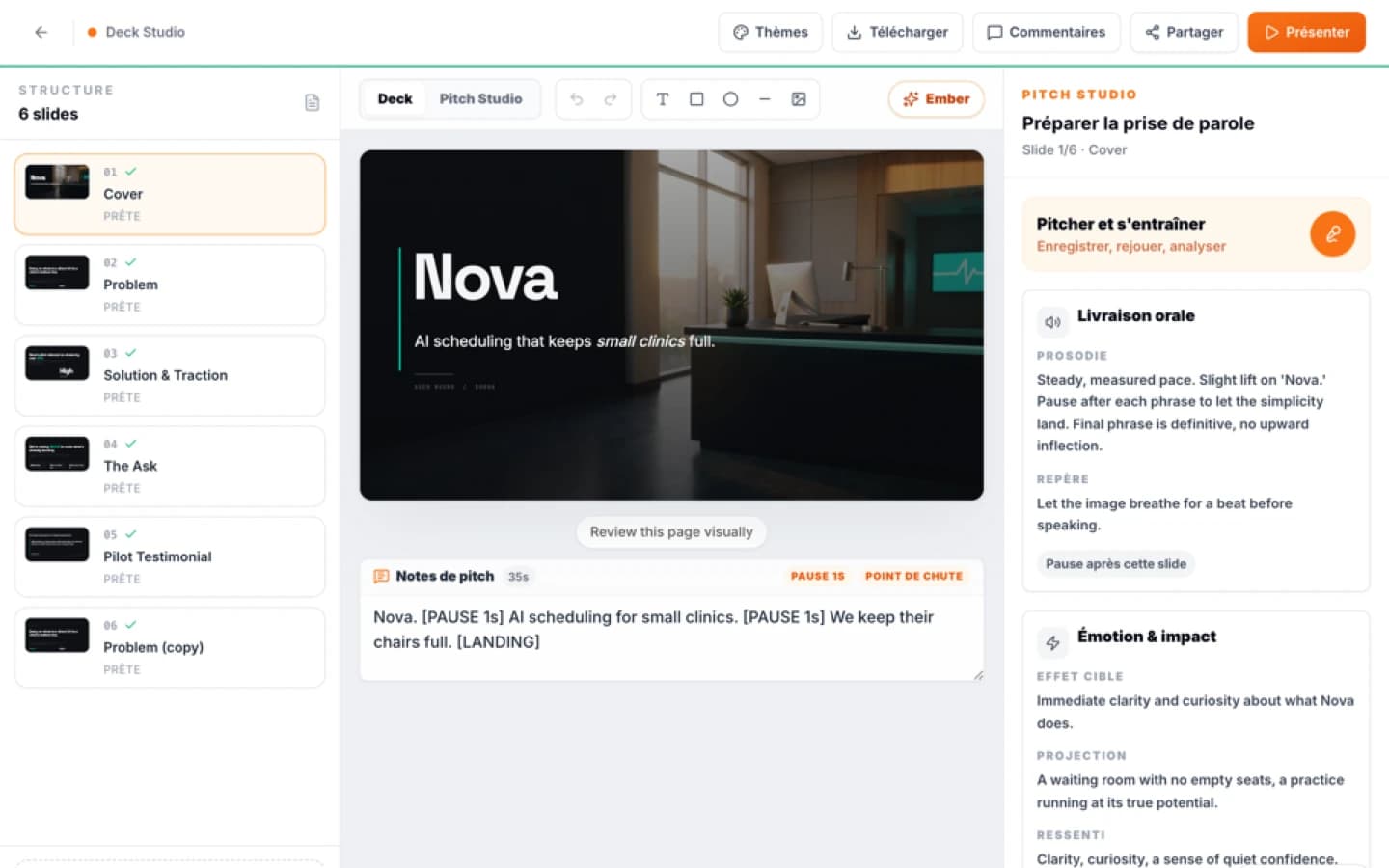
Creation includes an integrated rehearsal environment called Speaking practice, built specifically for deck formats. Within the module, an AE can:
- Record, replay, and iterate through presentation takes slide by slide.
- Control playback using standard controls to pause, resume, advance to the next slide, or restart a take.
- Receive automated feedback analyzing the recording's rhythm, pause patterns, vocal clarity, narrative structure, and impact.
- Review rhetorical diagnostic axes to identify moments where the commercial delivery dragged or where the transition between problem and resolution lacked punch.
For remote sales reps, practicing within the same environment where the presentation is built removes the friction of recording separate video takes or relying on subjective self-evaluation.
Managing edits and exports across deal stages
Sales cycles move rapidly, and collateral frequently requires immediate adjustment after customer calls. Creation provides an interactive editor that balances generative speed with direct human control.
| Asset format | Primary sales use case | Permitted export formats | Key editorial controls |
|---|---|---|---|
| Presentation deck | Executive briefings, discovery meetings, formal solution deep-dives | PDF, PowerPoint (.pptx) | Framing questions, slide count selector, zone-by-zone natural language edits, Speaking practice |
| One-pager | Post-demo summaries, champion leave-behinds, executive recaps | PNG | Single-page default, metric verification rules, out-of-frame missing field alerts |
| Market map | Ecosystem alignment, competitive landscape reviews | PNG | Categorized stakeholder positioning, unverified assumption indicators |
| Business model canvas | Value stream mapping, multi-stakeholder strategic workshops | PNG | Fact-retention guardrails, structured building blocks |
The editor handles page alterations cleanly. Natural language prompts apply targeted revisions without forcing complete slide regenerations. If an automated text adjustment risks overflowing a designated container, the editor alerts the user outside the canvas to protect visual legibility. When preparing assets for global expansion or cross-border accounts, teams weighing platform capabilities can review Gamma or Creation for presenting your project in a new market? to understand document localization workflows.
Practical steps to integrate Creation into your sales workflow
To make visual asset creation a repeatable competitive advantage across your sales cycle, structure your approach around three practical routines:
- Build post-discovery one-pagers immediately after the call. While discovery notes are fresh, generate a targeted one-page summary highlighting the prospect's immediate pain points, verified baseline metrics, and the proposed scope of work. Share the resulting PNG asset with your primary champion before their internal team debrief.
- Tailor executive presentations to precise meeting lengths. Use the deck length selector to produce focused, 5-slide or 8-slide decks for executive check-ins rather than re-using standard 25-slide product overviews.
- Run Speaking practice before tier-one sales interactions. Rehearse unfamiliar case studies or high-stakes objection handling through Speaking practice to evaluate your rhythm, pauses, and rhetorical clarity before entering the meeting.
By anchoring collateral in verified project facts and selecting formats matched to buyer decision stages, Account Executives spend less time formatting slides and more time guiding prospects toward a clear purchase decision.
Sources
FAQ
Mini audit
Test your Pitch Deck
Get an initial diagnosis of substance, form and impact.