
Definition
A minimum viable proof asset is a one-page brief prepared before the pitch deck. It is not a shorter presentation. It is the smallest artifact that lets a warm investor or buyer inspect the reasoning without the founder narrating around missing evidence.
The brief links four elements: recipient context, one bounded claim, one inspectable proof and one next decision. Context explains whose decision is at stake. The claim states what changes and for whom. The proof supports that exact statement. The request gives the recipient one action to accept, decline or redirect.
The four-part proof brief is an editorial recommendation derived from the cited pitch frameworks, not an industry standard or a measured performance method.
Why this category exists
A warm introduction reduces the access problem. It does not validate the company, product, market or commercial result. The recipient may trust the introducer while still needing to understand what is true, what remains uncertain and why a next conversation is worthwhile.
Y Combinator recommends a clear, concise pitch that explains what the company does, its progress and the founder's specific ask source. Sequoia Capital's guide covers company purpose, problem, solution, timing, market, alternatives, business model, team, financials and vision source.
Both frameworks demand substantial material. The proof brief exists as a gate before that material becomes slides. It exposes a weak claim early, when the founder can still run a test, narrow the ask or show an unknown honestly.
How it works
First, name the recipient and the decision. A warm investor may decide whether to open diligence. A buyer may decide whether to run discovery, review technical fit or define a pilot. The label alone is insufficient, so record the actual role and stage.
Second, write one plain claim. It should identify the affected person or process and the change offered. Remove superlatives and future outcomes that the evidence does not support.
Third, attach one primary proof with source, date, scope, method and limitation. A working demo proves that a workflow exists. A signed pilot proves a commitment at the stated status. A measured experiment proves only what its population, comparison and period allow.
Fourth, write one next decision. Avoid asking for general thoughts. Ask for a diligence call, a technical review, permission to share a later result or agreement on a bounded test.
Finally, let another person restate context, claim, proof and ask. If they cannot, return to the evidence before adding design.
Use the Narrative vs Metrics Deck: How Founders Decide for Updates when choosing the leading proof.
Difference from the classic approach
The classic approach starts with a slide outline, fills every familiar section and improves visual polish. The proof-asset approach starts with the next decision and asks which single claim must survive inspection before a full story is useful.
This changes the order. Market size, team, model and vision still matter, but they do not compensate for an unsupported central claim. Conversely, one credible pilot does not prove retention, scale or revenue. The founder keeps the proof bounded rather than stretching it across the whole company story.
The approach also separates investor and buyer evidence. An investor may use execution progress to assess company potential. A buyer may use the same artifact to assess workflow fit or implementation risk. The record remains identical, while the implication and request change.
Concrete example
A founder sells software that prepares a weekly operations report from several exports. The weak version says the product transforms operational intelligence and promises broad productivity gains.
The proof brief states that one operations team currently combines three exports each week. During a bounded pilot, the product produced the report from the same inputs, and the team lead checked it against the existing checklist. The brief links the pilot record, names its period and says that willingness to pay and long-term use remain unknown.
For a buyer, the next decision is a technical review of a second pilot. For an investor, the same proof supports a discussion about execution progress and the next evidence milestone. Neither version presents the pilot as revenue or retention.
Limits
The brief cannot create traction, permission, market demand or a customer result. A screenshot does not prove willingness to pay. A letter of intent does not prove deployment. A pilot does not prove retention. The founder must state the boundary next to the proof.
One page is also insufficient for security, legal, financial or regulated diligence. It should point to the appropriate records without exposing confidential customer information or personal data. Redact, aggregate, obtain permission and choose a secure channel when needed.
The category does not rank all evidence universally. The right artifact depends on the claim, recipient and decision stage. A prototype may be useful before launch and weak after a commercial performance claim.
When to use it
Use the proof brief before a warm investor introduction, a strategic buyer meeting, an enterprise pilot discussion or any deck whose central evidence is still scattered across several records.
It is valuable when the founder feels tempted to add slides because the claim is difficult to explain. The brief distinguishes a narrative gap from an evidence gap. If the evidence exists but the order is weak, move to presentation work. If the evidence is absent, run the smallest honest test first.
When not to use it
Do not use the brief as a substitute for a requested diligence package, security questionnaire, financial model, procurement file or technical specification. Send the required material in its proper form.
Do not force an investor-versus-buyer framing when the recipient has another role or when the next decision is unclear. Clarify the introduction first. Also avoid the method when confidentiality prevents any safe proof from being shared. In that case, define access, redaction and permission before preparing the deck.
Honest relationship to Ember?
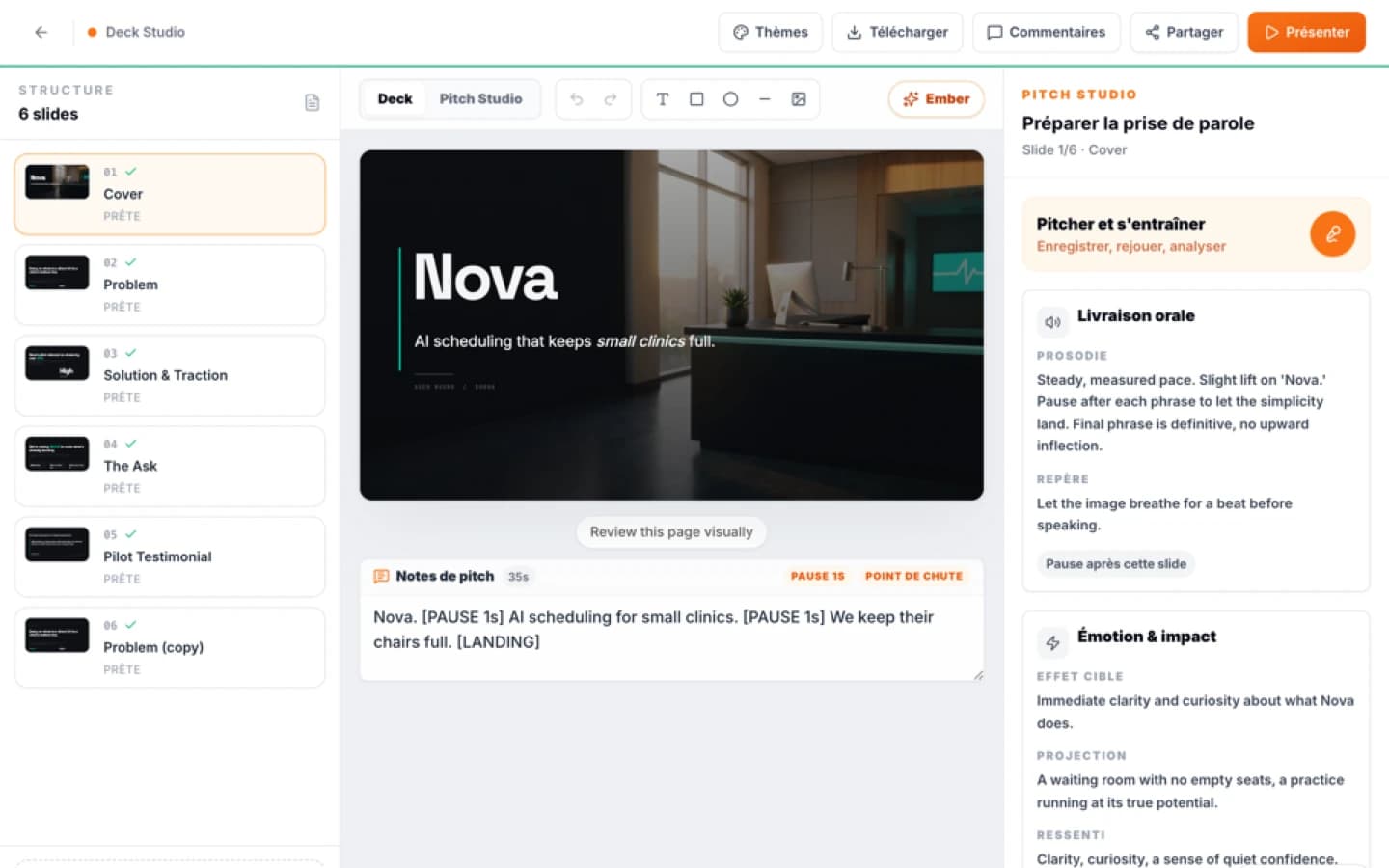
Creation analyses the substance and structures the narrative path before producing slides source. It can turn a verified proof brief into a coherent presentation while the founder remains responsible for the underlying record.
The founder remains responsible for customer evidence, permission, the meaning of a warm introduction and every expected outcome. One proof cannot support every slide. The user must check each generated statement against its source and preserve the limitations.
What Creation can help with
Creation can use a verified proof brief as input for a coherent presentation. The founder must still check the underlying customer evidence, permissions and limits before a deck is shared. A slide that presents a pilot result should identify the sample and period; a screenshot alone does not establish demand or retention.
Sources and methodology
Pitch expectations use Y Combinator's company pitch guide and Sequoia Capital's business plan guide. The exact product capability is cited in the relationship section above.
The proof brief, four-part test, example and audience adaptation are editorial reasoning tools. They are not investor consensus, measured performance or a promise of a meeting. External guidance and product capabilities are separated from those recommendations throughout the article.
Sources
FAQ
Mini audit
Test your Pitch Deck
Get an initial diagnosis of substance, form and impact.