
Context and ICP
Entering a new market requires early-stage founders to rapidly adapt their messaging to an unfamiliar audience. When testing a new Ideal Customer Profile (ICP) or exploring a fresh geographic territory, generic templates fall short because they do not reflect the specific nuances, local pain points, or unique value propositions of the project. Founders must build immediate conviction rather than just presenting polished slides.
For standard business presentations or quick internal updates, traditional tools are often sufficient. Google Slides provides a solid starting point with templates designed to help teams start faster, as detailed in the Google Slides template guide. For teams focused purely on manual graphic design, Canva offers accessible options with a free plan and paid plans, according to the Canva pricing page.
However, when a founder enters a new market, the primary challenge is not the superficial design. The real hurdle is structuring a narrative path that aligns with project data, addresses new buyer objections, and establishes credibility. While platforms like Slidebean showcase historical examples of successful pitches on their Slidebean pitch deck library, copying these structures rarely works for a unique, emerging business model.
This is where Creation by Ember changes the approach. Instead of forcing founders to fit their strategy into a rigid layout, it starts directly from the project context and data. By asking targeted questions and analyzing the underlying business substance, it helps founders structure a tailored narrative designed to secure their first clients in a new market, a process further explored in the Creation Use Cases for Founders Seeking First Clients. This ensures that every slide generated is grounded in the strategic reality of the venture, allowing founders to focus on defending their strategy rather than editing layouts.
To place this decision in context, the Knowledge guides for marketing bring together deeper guidance on the same field.
Problem
Early-stage founders entering a new market face a critical bottleneck: translating their core technology or service into a narrative that resonates with an unfamiliar audience. When testing a new Ideal Customer Profile (ICP), every pitch must be highly customized. The traditional approach involves spending hours wrestling with presentation software, trying to align design with a message that is still being refined.
Standard design tools are often sufficient for basic presentation needs. For instance, Google Slides provides a convenient library of templates to help users start faster (Google Workspace Blog). For teams focused purely on visual layouts, Canva offers a free tier and paid plans (Canva Pricing). Similarly, Prezi allows creators to build highly visual, zoomable presentations on an open canvas (Prezi Product), and Beautiful.ai offers an individual Pro plan at 14.50 dollars per month with yearly billing (Beautiful.ai Pricing).
While these platforms excel at visual formatting, they do not solve the fundamental challenge of market entry: the substance of the pitch. Founders are left to bridge the gap between their raw market data and the slides themselves. A beautiful slide that misses the local market nuances, regulatory pain points, or specific competitor landscapes will fail to convert. The real problem is not making slides look pretty; it is structuring a narrative path that builds trust and moves a decision forward when the brand has zero local reputation.
Prerequisites
Before early-stage founders can leverage Creation to enter a new market, they must establish a few critical foundations. Entering an unfamiliar territory requires more than just visual polish. It demands a clear understanding of the local audience and a structured narrative that addresses their specific pain points.
First, founders need to define their core commercial objective and target audience profile. While legacy platforms like Google Slides provide basic templates to start faster, as noted in the Google Slides product blog, they do not help structure the actual business narrative. To understand how high-growth companies frame their value, founders can study successful structures, such as the pitch deck examples from more than 35 startups compiled by Slidebean.
Second, founders should evaluate their tooling budget and presentation requirements. While general design platforms like Canva offer a free tier and paid plans according to the Canva pricing page, they still require manual design effort. Alternative presentation tools like Beautiful.ai charge 14.50 dollars per month on an annual billing cycle, or 45 dollars for a monthly individual need, as detailed on the Beautiful.ai pricing page.
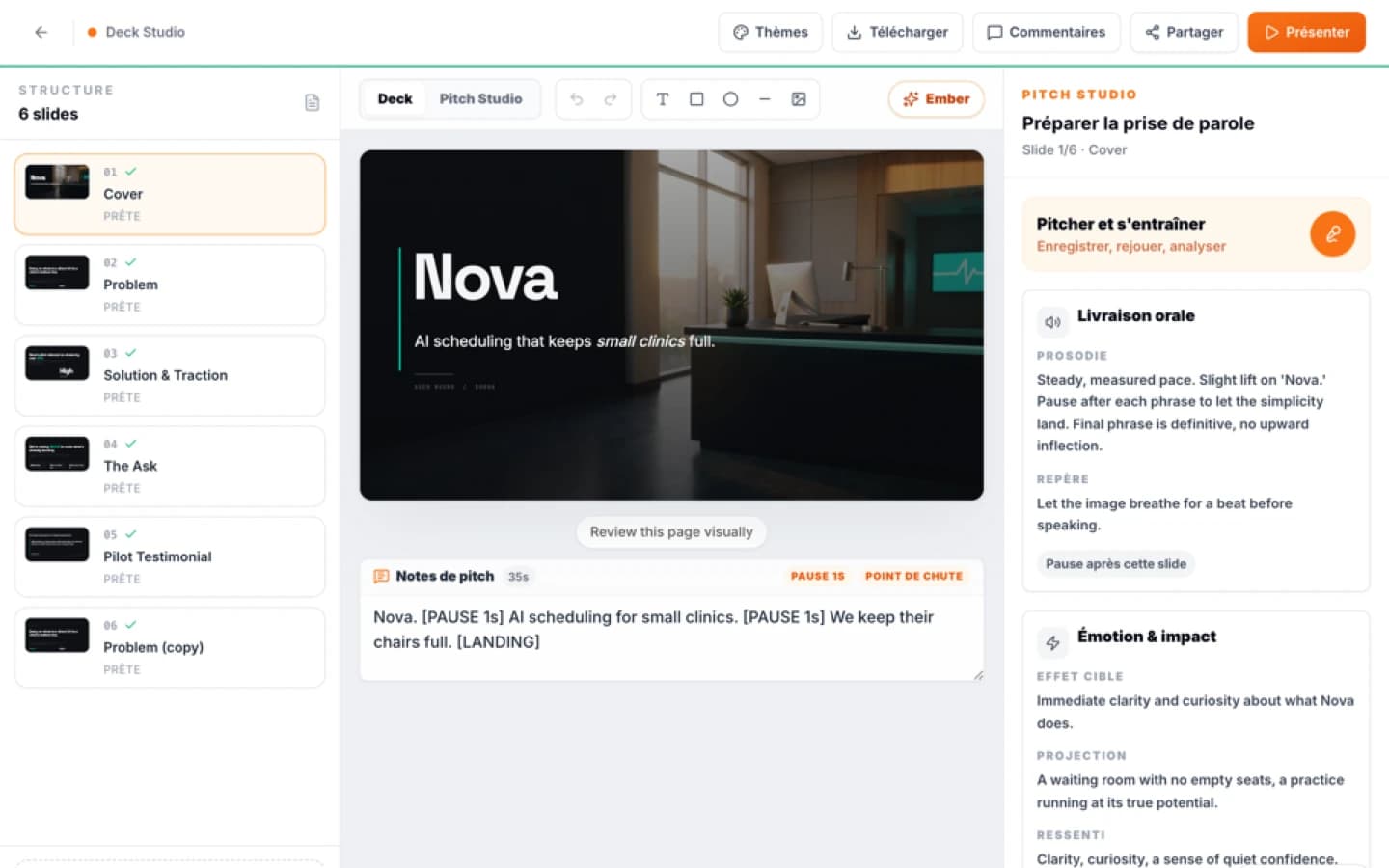
Third, founders must prepare to translate their business-to-business (B2B) strategy into a guided setup. When starting a project, Creation suggests three templates with previews, asks useful questions, then asks for confirmation before creating, as outlined in the Ember AI Pitch Deck documentation. Founders should be ready to articulate their value proposition, local competitors, and unique advantages during this initial framing phase. Once the presentation is generated, they can easily edit it directly in Creation, as explained in the Ember AI Pitch Deck features, and rehearse their delivery using Speaking practice to ensure their message lands perfectly.
To explore this point further, Which Proofs to Check Before Choosing Creation for Your First Clients? details a step directly related to this decision.
Workflow
The workflow begins when an early-stage founder initiates a new presentation to test a new market. To kick off the process, Creation suggests three templates with previews, asks useful questions to capture the specific nuances of the target audience, then asks for confirmation before creating, as detailed on the Ember Creation page. This initial step ensures that the narrative is tailored to the new territory rather than relying on generic, off-the-shelf slides.
Instead of jumping straight to visual layout, the platform analyses the substance and structures the narrative path before producing any slides. This prevents the common mistake of prioritizing superficial polish over strategic alignment. The generation process itself is highly resilient. If a founder experiences a connection loss or closes their browser tab while working on their new market pitch, the system keeps generating in the background and resumes progress immediately when the user returns.
Once the slides are generated, the founder can edit the presentation directly in Creation. They can request changes in natural language while staying in full control in the editor, ensuring that local terminology or specific regional value propositions are perfectly represented. This is a distinct shift from traditional design tools. For instance, while platforms like Google Slides offer templates to start faster, as noted in their productivity blog, they do not dynamically restructure the narrative based on deep project context. Similarly, while Prezi provides an open and zoomable canvas to structure presentations, as described on the Prezi product page, and allows users to import the text of PowerPoint slides to build new presentations, as explained in the Prezi Artificial Intelligence FAQ, it does not automatically align the content with a validated business plan or target audience context.
While founders might look at general design platforms like Canva, which offers a free plan and paid plans, as detailed on the Canva pricing page, or Beautiful.ai, which charges 14.50 dollars per month on its annual Pro plan and 45 dollars for a one-off monthly need, as shown on the Beautiful.ai pricing page, these tools focus primarily on visual layouts rather than the underlying business logic.
After refining the slides, the founder can export the presentation to PowerPoint or Portable Document Format (PDF). To ensure the pitch is delivered with absolute confidence in the new territory, the founder can record, replay, and rehearse the presentation in Speaking practice, which is part of the integrated workflow. The system then analyses the rhythm, clarity, impact, and structure of the recorded take. This rehearsal capability helps founders refine their verbal delivery, complementing the visual and narrative work done in Creation. This stands in contrast to standard presenter tools, such as Prezi's private presenter view designed to guide the presentation, which is detailed in the Prezi support center, but does not offer automated feedback on delivery quality.
Expected result
When early stage founders leverage Creation to enter a new market, the expected result is a highly tailored, strategic presentation that directly addresses the unique pain points of the new target audience. Instead of a generic template that requires hours of manual restructuring, founders receive a cohesive narrative path built from their specific project context.
Once the initial structure is generated, founders can easily edit the presentation directly within the editor, as detailed on the Ember Creation page. This ensures that local market nuances, specific regulatory requirements, or unique competitive advantages can be integrated without losing the overall narrative flow.
The final step in achieving market readiness is delivery. Beyond creating the slides, founders can record, replay, and rehearse their presentation in Speaking practice, a feature also highlighted on the Ember Creation page. This allows them to refine their rhythm, clarity, and impact before delivering the pitch to their first potential clients in the new territory. The ultimate outcome is a polished, persuasive presentation, ready for export to PowerPoint or Portable Document Format (PDF), that gives founders the confidence to defend their strategy and secure their first critical accounts.
This approach also connects with Tell a B2B problem story without claiming sales effects, which clarifies the next choice.
Example Ember mission
Consider an early stage founder who has successfully validated their product in their home market and now wants to pitch to enterprise buyers in a new geographic region. The founder begins by launching a presentation project in Creation. The system suggests three templates with previews, asks useful questions to capture the specific dynamics of the new market, then asks for confirmation before creating. Because the generation starts from the existing project context and data rather than a generic template, the resulting slides are immediately aligned with the strategic foundations of the business. This ensures that the presentation helps build understanding and move a decision forward beyond visual polish, which is a common pitfall when trying to impress an unfamiliar audience.
Once the draft is ready, the founder retains complete creative freedom. The platform lets users edit the generated presentation in Creation, keeping every element editable and leaving the user in control of changes. Before stepping into the first meeting, the founder can record, replay, and rehearse the presentation in Speaking practice to refine their delivery and timing. This workflow is designed to turn raw market hypotheses into a structured, persuasive narrative, as detailed in the Ember Pitch Deck guide.
To turn this new narrative into actual conversations, the founder can seamlessly connect their pitch strategy with outbound execution. By leveraging Lead Intelligence, the founder reuses the Ember Business Plan, Ideal Customer Profile (ICP), offer, and strategy to prepare a targeted sales mission. Instead of guessing who to contact in the new territory, the system identifies relevant leads based on active signals. After the mission runs, the interface shows the contacts analyzed, signals detected, and priority actions actually recorded by Ember, allowing the founder to approach their new market with clear, data-backed next steps.
Limits and non-fit
While Creation is highly effective for structuring a strategic narrative when entering a new market, it is not the right fit for every presentation scenario. Early stage founders should consider alternative tools when their primary need is quick, purely visual editing or when they are working under specific budget constraints that favor free, general-purpose software.
For founders who only require basic templates to kickstart a standard presentation without deep strategic reasoning, traditional tools are often sufficient. Google Slides, for example, provides templates to start faster, as highlighted on the Google Workspace Blog. If the goal is to create highly customized graphic layouts with a completely free option, Canva offers a free plan alongside paid plans, as detailed on the Canva Pricing Page.
For presentations that require a non-linear, highly interactive visual flow, other specialized platforms are better suited. Prezi offers an open and zoomable canvas to structure the presentation, as explained on the Prezi Product Page. Additionally, Prezi supports a private presenter view to guide the presentation, as documented in the Prezi Presenter Guide, and allows importing the text of PowerPoint slides, according to the Prezi Artificial Intelligence (AI) FAQ.
If a founder has a one-off presentation need and prefers a dedicated slide designer with a fixed monthly cost, Beautiful.ai provides an individual Pro plan at 14.50 dollars per month under annual billing, or 45 dollars on a monthly basis for a temporary need, as shown on the Beautiful.ai Pricing Page.
Creation is specifically designed for founders who need to align their presentation with their underlying business strategy, target audience context, and narrative path. It is not a generic graphic design platform or a simple slide editor, and it is not intended for users who only seek superficial visual polish without strategic substance.
In practice, Creation Use Cases for Founders Seeking Product-Market Fit completes this framework with another angle on the same topic.
When to use it
Entering a new market requires more than a standard sales pitch. Early stage founders must adapt their core value proposition to address unfamiliar customer pain points, local regulatory constraints, and different competitive landscapes.
Creation is designed precisely for these moments of strategic transition. For instance, when a founder needs to pivot their messaging from early adopters to conservative enterprise buyers in a new geographic region, starting with a blank slide is highly inefficient. Traditional tools like Google Slides are perfectly adequate for quickly launching a presentation from a basic template library, as highlighted by Google Slides, but they do not help structure the underlying business argument. Similarly, Canva is an excellent and cost-effective option for purely visual design, offering a free tier and paid plans, as shown on the Canva Pricing Page. However, visual polish alone cannot solve a fundamental positioning gap.
In contrast, Creation helps founders build their presentation from its substance, form, and intended impact. When launching a new market entry project, the system suggests three templates with previews, asks useful questions to capture the specific nuances of the new target audience, then asks for confirmation before creating, as detailed on the Ember Creation Page. This ensures that the resulting narrative is grounded in the strategic realities of the new market rather than generic filler.
Another critical use case is preparing for high-stakes investor meetings or first-client pitches in the new territory. Founders can study historical pitch deck examples from more than 35 startups compiled by Slidebean to understand what has worked in the past, but they still need to tailor their own delivery. While Prezi provides an open, zoomable canvas to structure presentations visually, as described on the Prezi Product Page, and offers a private presenter view to guide speakers through their slides, as detailed by Prezi Support, Ember goes a step further in preparation. Once the presentation is generated, founders can use Creation to record, replay, and rehearse their presentation in Speaking practice, as explained on the Ember Creation Page. This allows them to refine their verbal delivery, pacing, and clarity before presenting to local stakeholders.
Additionally, the platform is built to handle the chaotic workflow of early stage fundraising and market validation. If a founder experiences a sudden connection loss or closes their browser tab mid-generation, the system keeps generating in the background and resumes progress immediately when the user returns, a resilient feature documented on the Ember Creation Page. This reliability ensures that founders can focus entirely on refining their market entry strategy without worrying about technical interruptions.
Next step
To successfully enter a new market, early stage founders must transition from generic messaging to a highly tailored, structured narrative. The immediate next step is to gather the foundational elements of the new market strategy, such as the target Ideal Customer Profile (ICP) and local value proposition, and bring them into a workspace designed for strategic conviction rather than simple slide design.
Founders can begin by initiating a new presentation project. In Ember, this process starts within Creation, where the system suggests three templates with previews and asks targeted questions to capture the core thesis of the expansion. This step ensures that the resulting slides are grounded in actual business logic rather than empty placeholders. For founders seeking inspiration on how to structure these initial narratives, reviewing historical Slidebean pitch deck examples can provide valuable guidance on slide flow and density.
Once the narrative path is structured and the slides are generated, founders retain complete creative control. They can edit the presentation directly in Creation or use natural language instructions to refine specific sections, ensuring the tone aligns perfectly with the cultural and professional expectations of the new geographic region.
Before delivering the pitch to prospective clients or local investors, founders can leverage Speaking practice to record, replay, and rehearse their delivery. This allows them to analyze their rhythm, clarity, and impact, transforming a static file into a polished, high-conviction presentation. By integrating market context directly into the presentation workflow, Ember helps founders bypass the tedious manual formatting of legacy tools and focus entirely on defending their strategy.
Before deciding, How to Build a B2B Sales Pitch from a Real Customer Story? helps connect this method with adjacent priorities.
Sources
To ensure a thorough understanding of the market entry landscape and presentation design options, this guide relies on several authoritative references. For inspiration on structuring high impact presentations, early stage founders can study pitch deck examples from more than 35 startups compiled by Slidebean. When evaluating alternative presentation tools, founders can compare different positioning and pricing models. For instance, Canva offers a free tier and paid plans, as detailed on the Canva pricing page. Other platforms like Gamma allow users to build presentations from prompts or uploaded material, as documented on Wikipedia. For teams seeking interactive layouts, Prezi provides an open, zoomable canvas to structure narratives, as explained on the Prezi product page, along with a private presenter view to guide the presentation, described in the Prezi presenter features guide. Additionally, Prezi's Artificial Intelligence (AI) assistant supports importing text from PowerPoint slides, as outlined in the Prezi AI Frequently Asked Questions (FAQ). For standard planning, Google Slides offers a library of templates to help users start planning and pitching faster, as highlighted in the Google Workspace blog. The capabilities of Creation, including suggesting three templates with previews, allowing users to edit the generated presentation, and enabling rehearsal in Speaking practice, are detailed on the Ember Creation page. Practical use cases for early stage founders seeking their first clients are further explored in the Creation Use Cases for Founders Seeking First Clients.
Sources
FAQ
Mini audit
Test your Pitch Deck
Get an initial diagnosis of substance, form and impact.