
Context and ICP
For early-stage founders, validating a market requires translating raw ideas into a structured narrative that resonates with early adopters and potential partners. Traditional presentation tools often focus on design rather than substance. For instance, Google Slides provides templates to help users start faster (Google Slides Blog), while Prezi utilizes an open and zoomable canvas to structure the presentation (Prezi Product). For design-heavy assets, a general-purpose design platform such as Canva is a fit. While these platforms are highly effective for general design tasks, they require founders to manually bridge the gap between their strategic market research and their slides. Ember, the publisher of this article, is not neutral: these comparisons describe each tool without claiming impartiality.
This is where Creation serves a distinct purpose during the market validation phase. Instead of forcing founders to build from a generic template, Creation starts directly from the project context and data (see the Creation page). When testing an Ideal Customer Profile (ICP) or presenting a Minimum Viable Product (MVP) concept, a founder can leverage this context to ensure every slide aligns with their actual market hypotheses.
The workflow is built to respect the founder's strategic input. The system suggests three templates with previews, asks useful questions, then asks for confirmation before creating. It then generates the chosen format, for example a deck, from the selected structure and context. This helps ensure that the resulting presentation is grounded in real market assumptions rather than filler text.
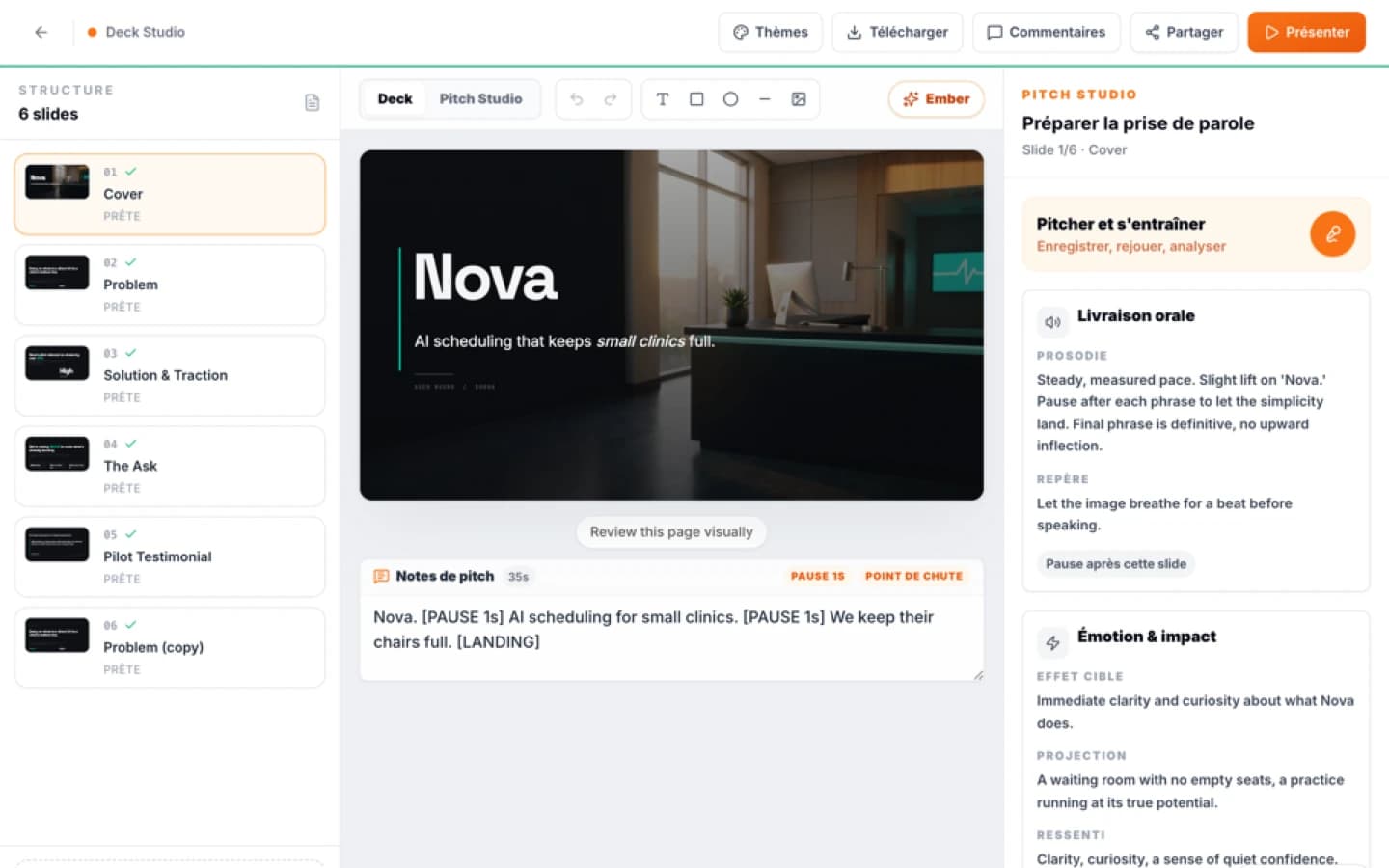
Once the initial draft is ready, founders can edit the generated presentation directly in Creation, page by page, to incorporate early feedback from customer discovery interviews. To prepare the delivery, founders can also record, replay, and rehearse the deck with Creation's Speaking practice. This integrated approach allows early-stage teams to move quickly from a hypothesis to a market-ready presentation.
To place this decision in context, the Knowledge guides for marketing bring together deeper guidance on the same field.
Problem
The primary challenge for early stage founders during the market validation phase is the friction of translating raw customer feedback into a structured, persuasive narrative. When testing a new concept, founders must quickly present their value proposition to early adopters, advisors, and partners. However, traditional presentation tools force them to focus on visual formatting rather than the underlying business logic.
For example, Google Slides provides templates designed to help users start their work faster, as detailed on the Google Workspace Blog, yet these templates do not assist in structuring the actual narrative flow required to test market assumptions. Similarly, Prezi offers a zoomable open canvas to help users structure their presentations, as described on the Prezi Product Page, but the founder must still construct the entire logical journey from scratch.
This visual-first approach often leads founders to spend critical capital on design software before they have even proven demand. For instance, the Beautiful.ai pricing page showed, on the consultation date of September 28, 2026, a Pro plan at 14.50 dollars per month for an individual billed annually, and a monthly option at 45 dollars for one-off projects.
Paying for these design tools does not solve the core issue. A visually polished presentation that lacks a clear, evidence-backed narrative will fail to engage early customers. Founders do not just need better layouts; they need a structured way to align their market evidence, customer pain points, and product assumptions into a presentation that drives decisions.
Prerequisites
Before an early stage founder can leverage Creation to validate their market, they must establish a few foundational elements. The first prerequisite is a structured set of raw market hypotheses, including a defined Ideal Customer Profile (ICP) and a clear value proposition. While traditional tools like Google Slides offer templates to help users start faster, as noted in the Google Slides product update, they do not structure the underlying business logic for you. Founders must gather initial qualitative signals, such as customer interview notes or industry pain points, to feed into the workspace.
The second prerequisite is defining the specific validation goal of the presentation. A pitch designed to secure early pilot users requires a different narrative structure than one meant to recruit a technical cofounder. Traditional design platforms often prioritize visual polish over narrative flow: the templates of a platform such as Canva still require the founder to manually map out the buyer journey. Similarly, Prezi utilizes an open, zoomable canvas to help structure presentations, as described on the Prezi product page, which helps with spatial organization but does not build the logical argument required to prove market demand.
Finally, founders must be prepared for continuous iteration. Market validation is not a single event but a process of constant refinement based on real-world feedback. If you use alternative presentation software like Beautiful.ai, whose pricing page showed on September 28, 2026 14.50 dollars per month for an individual billed annually, or 45 dollars for a one-month need, updating your slides to reflect new customer insights can still feel like a manual chore. With Creation, founders can edit the generated presentation directly in the editor, allowing them to rapidly adjust their messaging as new validation data comes to light. Having a feedback loop ready to process these insights is essential before initiating the slide generation workflow.
To explore this point further, Gamma vs Creation: Read-Alone Deck or Live Angel Pitch? details a step directly related to this decision.
Workflow
The workflow of validating a market with Creation begins with framing the narrative. Unlike traditional design tools, the process starts by aligning the presentation with the founder's core hypotheses. When initiating a project, the system suggests three templates with previews, asks useful questions, then asks for confirmation before creating. This initial step helps early stage founders clarify their Ideal Customer Profile (ICP) and value proposition before a single visual element is designed.
Once the foundational questions are answered, the workflow transitions to narrative structuring. The platform analyzes the substance of the founder's market hypotheses and structures the narrative path before producing slides. This helps optimize the presentation for persuasion and logical flow, rather than just aesthetic appeal. For founders who prefer an open, non-linear approach to structuring, alternative tools like Prezi offer an open and zoomable canvas to structure the presentation (Prezi), which can be useful for mapping out complex ideas. However, Creation focuses on transforming structured context directly into a cohesive slide sequence.
After the initial draft is generated, the editing phase allows for rapid iteration. Founders can easily edit the generated presentation in Creation, modifying text, adjusting layouts, or updating data as they receive new feedback from early customer interviews. This level of control is critical during market validation, where hypotheses change daily. General design platforms like Canva often require manual layout adjustments that can slow down a founder. In contrast, Creation starts from the underlying narrative and keeps every element editable, allowing for quick updates.
The final step in the validation workflow is delivery preparation. Before presenting to potential partners or early adopters, founders can record, replay, and rehearse the deck with Creation's Speaking practice. This rehearsal feature helps founders refine their verbal delivery, pacing, and clarity: it analyzes the rhythm, clarity, impact and structure of a recorded take. While Prezi provides a presenter view with notes, a timer and content previews, Creation's Speaking practice lets founders review their own performance before live validation meetings.
Expected result
The expected result of using Creation for market validation is a highly tailored, persuasive presentation that shifts the focus from visual polish to strategic alignment. Instead of spending hours adjusting layouts, early stage founders receive a structured narrative that directly addresses the pain points of their target audience.
Once the initial generation is complete, the founder is not stuck with a static file. The expected outcome is an editable asset. Founders can edit the generated presentation directly in Creation, allowing them to update slides as they receive fresh feedback from early adopters. This iterative capability helps the presentation evolve alongside the founder's understanding of the market.
Furthermore, the validation process does not stop at the slide level. A critical part of the expected result is the founder's readiness to deliver the message. Through Creation's Speaking practice, founders can record, replay, and rehearse the deck. This rehearsal loop helps founders refine their verbal delivery, pacing, and clarity before they step into high-stakes meetings with potential partners or early customers.
While alternative tools serve different design philosophies, such as Prezi with its open zoomable canvas (Prezi Product) and its presenter view, or Beautiful.ai with its monthly plan at 45 dollars for one-off needs (Beautiful.ai Pricing, consulted on September 28, 2026), Creation builds on the strategic context of the venture. The intended result is a clear, professional presentation that helps founders prepare their first commitments and test market demand. It does not replace real customer feedback.
This approach also connects with Gamma vs Lead Intelligence: Best Alternative for Founders, which clarifies the next choice.
Example Ember mission
To illustrate how this works in practice, consider an early-stage founder preparing a market validation mission to test a new Business-to-Business (B2B) software concept. Instead of starting from a blank slide, the founder initiates a generation in Creation. The experience begins when the system suggests three templates with previews, asks useful questions to capture the core hypotheses, then asks for confirmation before creating.
During the generation process, the founder does not need to keep the browser window open. The platform keeps generating after a connection loss or tab closure, then resumes progress when the user returns, so no momentum is lost. Because the tool starts from project context and data rather than a generic template, the resulting slides are aligned with the founder's specific market assumptions.
Once the initial draft is ready, the founder retains full creative and strategic direction. Ember lets users edit the generated presentation in Creation, keeping every element editable and leaving the user in control of changes. This helps the presentation build understanding and move a decision forward beyond visual polish, focusing instead on the strength of the value proposition. Finally, before presenting to early adopters, the founder can record, replay, and rehearse the deck with Speaking practice to refine their delivery.
Limits and non-fit
While Creation is designed to help early-stage founders turn their core hypotheses into structured, persuasive presentations, it is not the ideal solution for every scenario. Understanding these boundaries helps founders select the right tool for their specific validation phase.
For founders who require complete, pixel-perfect creative control or need to design highly customized visual assets from scratch, traditional design platforms are often a better fit. Canva, for example, provides a highly visual environment. These options are optimized for creators who want to manually adjust every graphic element or build social media collateral alongside their pitch.
Similarly, if a founder needs a non-linear, highly interactive format to map out complex market ecosystems during a live workshop, Prezi offers a unique alternative. It provides an open and zoomable canvas to structure presentations, as described on the Prezi product page. Additionally, Prezi lets users upload an existing document, such as a PPT or a PDF, so that Prezi AI can generate a draft from its content, and includes a presenter view with notes, a timer and content previews to guide the speaker, according to the same product page.
For founders who only need a quick, standard template to organize basic thoughts without any AI-driven narrative assistance, Google Slides remains a reliable and accessible choice. It offers a library of templates covering planning and pitching to help users start faster, as highlighted on the Google Workspace blog.
When a founder is looking for automated layout adjustments on a purely standalone basis without integrating their presentation into a broader business strategy, Beautiful.ai is another option. Its pricing page showed on September 28, 2026 an individual Pro plan at 14.50 dollars per month billed annually, as well as a 45 dollars monthly option for temporary, one-off needs.
Ultimately, Creation is not built for superficial slide design or manual layout tweaking. It is designed to connect a founder's strategic context directly to a structured narrative. If a project lacks clear underlying hypotheses, or if the founder prefers to work without a guided narrative structure, traditional slide editors and template libraries will serve them better.
In practice, What a Narrative-Led B2B Sales Pitch Looks Like and Why It Wins? completes this framework with another angle on the same topic.
When to use it
For early-stage founders, market validation is a race against time. There are specific moments in this phase where Creation becomes highly valuable, particularly when the goal is to test hypotheses rather than polish pixels.
The first key scenario is when you need to present a new concept to potential customers to validate their pain points. Traditional design platforms like Canva are excellent for creative marketing assets but can distract you with endless layout choices. When you need to focus purely on whether your value proposition resonates, Creation allows you to start with the substance. The system suggests three templates with previews and asks useful questions to frame your narrative before asking for confirmation. This helps build your presentation around your core hypotheses.
Another critical moment is when you are conducting deep-dive interviews with industry experts. While tools like Prezi provide a unique zoomable canvas to structure presentations (Prezi Product), early-stage validation often demands a highly structured, logical flow that guides the audience through a specific problem. If your internet connection drops during preparation, Creation keeps generating in the background and resumes progress when you return, so you do not lose momentum before an important meeting.
Once the presentation is generated, the validation does not stop at the slides. Founders must deliver the message with conviction. This is when you can use Creation's Speaking practice to record, replay, and rehearse the deck. This rehearsal capability helps you refine your verbal delivery and identify weak points in your argument before you speak to actual prospects.
Finally, market validation is rarely a one-time event. When early feedback reveals that your initial assumptions were incorrect, you must adapt immediately. Instead of abandoning your work or paying for expensive short-term design software, such as the 45 dollars monthly option Beautiful.ai showed for temporary needs on its pricing page (September 28, 2026), you can edit the generated presentation directly in Creation. This allows you to update your slides, incorporating customer feedback into your next pitch without starting from scratch.
Next step
To move from theoretical market validation to active conversations, your immediate next step is to translate your core hypotheses into a structured narrative. Traditional design platforms like Canva require you to build the structure yourself from scratch. Similarly, Beautiful.ai provides automated layouts, with a Pro plan at 14.50 dollars per month for an individual billed annually or 45 dollars for a single month according to its pricing page consulted on September 28, 2026, but still leaves the strategic positioning entirely in your hands.
Instead of getting lost in manual design adjustments, you can initiate your validation journey directly in Creation. The process is designed to extract your strategic intent. First, the workspace suggests three templates with previews and asks targeted questions to capture your project substance, then asks for confirmation before creating. The system then generates a structured presentation tailored to your audience. From there, you can edit the generated slides directly in Creation using natural language requests, keeping control of the narrative.
Before you present to your first prospective customer, you can use Creation's Speaking practice to record, replay, and rehearse your delivery. The system analyzes your rhythm, clarity, impact and structure. For founders comparing different AI tools for this phase, you can read the Gamma vs Creation: Read-Alone Deck or Live Angel Pitch? to understand which approach fits your workflow. Ultimately, Ember helps understand a changing context, choose the next priority and take action, allowing you to focus on the substance of your market validation rather than superficial slide design.
Before deciding, Gamma vs Creation: Read-Alone Deck or Live Angel Pitch? helps connect this method with adjacent priorities.
Sources
To ensure transparency for early-stage founders validating their market, this analysis relies on public pages consulted on September 28, 2026. Ember, the publisher of this article, describes its own capabilities based on how the product currently works.
For alternative presentation software, the Beautiful.ai pricing page showed on that date a Pro plan at 14.50 dollars per month for an individual billed annually, and an option at 45 dollars for a single month. Prices change, so check them on the official page.
Product capabilities and design approaches are gathered from public pages: the open zoomable canvas, the presenter view with notes and timer and the upload of an existing document described on the Prezi product page, the positioning of Gamma from Wikipedia, which highlights its ability to generate presentations and layouts from prompts or uploaded material, and the Google Slides templates designed to help users start faster, from the Google Workspace Blog.
For Ember, the functional capabilities of Creation, including how it suggests three templates with previews and allows users to rehearse with Speaking practice, are detailed on the Creation page. A detailed comparison of workflows for market validation can also be found in the analysis of Gamma vs Creation: Read-Alone Deck or Live Angel Pitch?.
Sources
FAQ
Mini audit
Test your Pitch Deck
Get an initial diagnosis of substance, form and impact.