
Context and ICP
For early stage founders, preparing a pitch deck is rarely just about designing slides. The real challenge lies in proving to investors that there is genuine, immediate demand for the product. Investors look for concrete evidence of market traction and a highly defined Ideal Customer Profile (ICP). This is where Lead Intelligence becomes a strategic asset during fundraising preparation. Instead of relying on static, top down market estimates, founders can use active pipeline data to show investors exactly who their target buyers are, why those buyers are ready to engage right now, and how the startup plans to win them. By leveraging Lead Intelligence, founders can ground their go to market slides in real world signals rather than assumptions. The system monitors signals about people and companies to keep context current, allowing founders to present a dynamic, living map of their market. This capability makes priority explainable from context, signals, and opportunity readiness. When presenting to venture capitalists, being able to explain precisely why a specific list of accounts represents the highest priority opportunities strengthens credibility. This approach answers an increasingly common expectation: evidence rather than promises. For instance, the venture capital firm Headline explains that AI has changed how investors evaluate startups and that older presentation templates are no longer enough (Headline). Investor Osborne Saldanha, for his part, shares an AI prompt on LinkedIn to audit a pitch deck and improve its storytelling, while noting that AI will not replace founder insight or conviction. A major advantage for early stage teams is that Lead Intelligence does not require massive databases to start delivering value. The platform finds and prioritizes the contacts itself whether the team starts with 10, 100 or 1,000 contacts, with no minimum contact threshold. This means founders can start even with a highly curated list of early targets. Once a usable targeting context is established, the first prioritized leads can appear in about 30 minutes, giving founders rapid, actionable insights to inject directly into their pitch deck narrative. This immediate feedback loop transforms the pitch preparation from a theoretical exercise into an active, data driven sales strategy.
To place this decision in context, the Knowledge guides for marketing bring together deeper guidance on the same field.
Problem
When early stage founders sit down to build a pitch deck, they often make the mistake of treating fundraising and customer discovery as two separate projects. They spend weeks polishing slides with top down market estimates, relying on generic definitions of their Ideal Customer Profile (ICP). However, as Headline explains, the way investors evaluate startups has changed and older presentation templates are no longer enough. Many investors are wary of speculative slides about theoretical markets. They appreciate bottom up proof of market engagement and a clear, defensible go to market strategy.
The problem is that early stage founders rarely have the infrastructure to gather this proof. Established sales platforms like Apollo present themselves as an AI-powered go-to-market system, with 240 million contacts and 30 million companies. Similarly, Clay presents itself as infrastructure to get data and launch GTM plays, including a LinkedIn Sales Navigator data point for lead discovery. These platforms serve structured sales operations and require setup and learning time.
For a founder who is still refining their pitch, deploying these complex systems is a distraction. They do not need a massive outbound engine yet. They need to validate whether their target buyers actually care about the problem they are solving. According to a LinkedIn post by an investor, a good pitch deck answers "Why you? Why now? Why this?" before the reader finishes the first page. Without a lightweight way to identify high intent accounts and prioritize early conversations, founders are forced to present unverified hypotheses. This lack of real world evidence weakens the narrative of the pitch deck, making it difficult to build the credibility required to secure early stage funding.
Prerequisites
Before a founder can leverage Lead Intelligence to build a compelling fundraising narrative, certain foundational elements must be in place. These prerequisites ensure that the data gathered translates directly into investor conviction rather than just a list of names.
First, founders must move away from the misconception that they need a massive, pre-existing database to start. Traditional outbound setups can require clean, extensive lists before launching. In contrast, Ember removes this barrier. Lead Intelligence finds and prioritizes the contacts itself whether the team starts with 10, 100 or 1,000 contacts, with no minimum contact threshold. This means the only real prerequisite is a basic hypothesis of who the target customer might be, allowing the system to discover and prioritize the rest.
Second, founders need to align their customer discovery tools with their strategic goals. While platforms like Apollo present themselves as an AI-powered go-to-market system (Apollo), early-stage fundraising requires a different focus. The prerequisite here is a shift in mindset: using lead data not just for immediate sales, but as live proof of market interest. This proof becomes the backbone of the pitch deck, showing investors market signals rather than theoretical projections.
Finally, there must be a clear bridge between data gathering and narrative design. A pitch deck framework should not rely on static templates. As a LinkedIn post shows, using an AI-assisted pitch deck framework can help structure the narrative, provided you apply your own judgment to the output. To make this actionable, founders need a workflow where these insights flow naturally into their presentation. Once Lead Intelligence identifies active opportunities, founders can use those elements as material for Creation, which starts from the project context, structures the narrative path before producing slides and lets them edit the result, then rehearse their pitch with Speaking practice to be ready to defend their traction under pressure.
In practical terms, prepare three elements before starting: one sentence describing the target customer, the reason they would need your product now, and what would make you count a conversation as a real demand signal (a meeting booked, a detailed reply, a trial requested). These three elements both steer the mission and shape the traction slide.
To explore this point further, Apollo vs Ember Lead Intelligence for Founder Conversion details a step directly related to this decision.
Workflow
To turn a theoretical fundraising strategy into a fundable reality, early-stage founders can execute a targeted workflow that bridges market discovery with narrative design. This process moves from initial targeting to live signal tracking, and finally to slide generation. First, founders must validate their core customer assumptions. For established companies running structured outbound campaigns, platforms like Apollo, which highlights 240 million contacts and 30 million companies, are built for broad pipeline coverage, aimed at sales leaders and Revenue Operations (RevOps) managers. However, a founder preparing a pitch deck does not need thousands of cold leads; they need to prove that their specific Ideal Customer Profile (ICP) responds to their value proposition. By using Ember, the founder can initiate a targeted prospecting mission. Lead Intelligence finds and prioritizes contacts itself whether the team starts with 10, 100 or 1,000 contacts, with no minimum contact threshold. This allows the founder to focus on a tight group of high-value accounts, mapping out decision-makers without wasting time on massive, unqualified databases. Second, the workflow shifts to capturing active market signals. As the platform monitors movements across target organizations, it proposes the next action and channel that fit the lead situation. For a founder, this means every interaction becomes a data point. Instead of presenting hypothetical market sizes to investors, the founder can point to active conversations, validated pain points, and early pipeline velocity. Finally, these verified insights are translated directly into the fundraising narrative. Rather than copy-pasting static charts, the founder can build on this validated material in Creation. This helps build the traction slides on real-world evidence rather than generic templates, while letting the founder edit the generated presentation to keep control over the final pitch. This integrated approach turns prospecting from a sales-only activity into the core proof of a fundraising file.
Expected result
The intended result of integrating Lead Intelligence into fundraising preparation is a pitch deck that relies more on verifiable, bottom-up evidence than on speculative projections. When founders present their go-to-market strategy, they no longer have to rely on static buyer personas. Instead, they can showcase a dynamic list of active opportunities, complete with detected signals and a clear next action for each target account.
This shift fundamentally changes the investor conversation. According to Headline, the way investors evaluate startups has changed and older presentation templates are no longer enough. Rather than presenting broad database filters, founders can present a highly qualified segment of the market. Whether a founder starts with 10, 100, or 1,000 contacts, Lead Intelligence finds and prioritizes the targets itself with no minimum contact threshold. This allows early-stage teams to show concentrated early traction without needing the heavy infrastructure of a massive sales team.
For comparison, while established platforms like Apollo (Apollo) present themselves as an AI-powered go-to-market system, and tools like Clay (Clay) offer data points such as LinkedIn Sales Navigator (Clay Sales Navigator), Lead Intelligence serves a different purpose for the fundraising founder. It bridges the gap between raw prospecting and strategic narrative. It proposes the next action and channel that fit each specific lead situation, transforming raw contact data into a clear, defensible expansion strategy.
Ultimately, this intelligence can inform the creation of the pitch deck. The validated context and target profiles can serve as material to build and edit the actual slides in Creation; the founder can then record and rehearse the pitch with Speaking practice. The intended result is a fundraising file where claims about market demand rest on a live, referenceable pipeline rather than on a standard pitch.
This approach also connects with Apollo vs Ember Lead Intelligence for Founder Conversion, which clarifies the next choice.
Example Ember mission
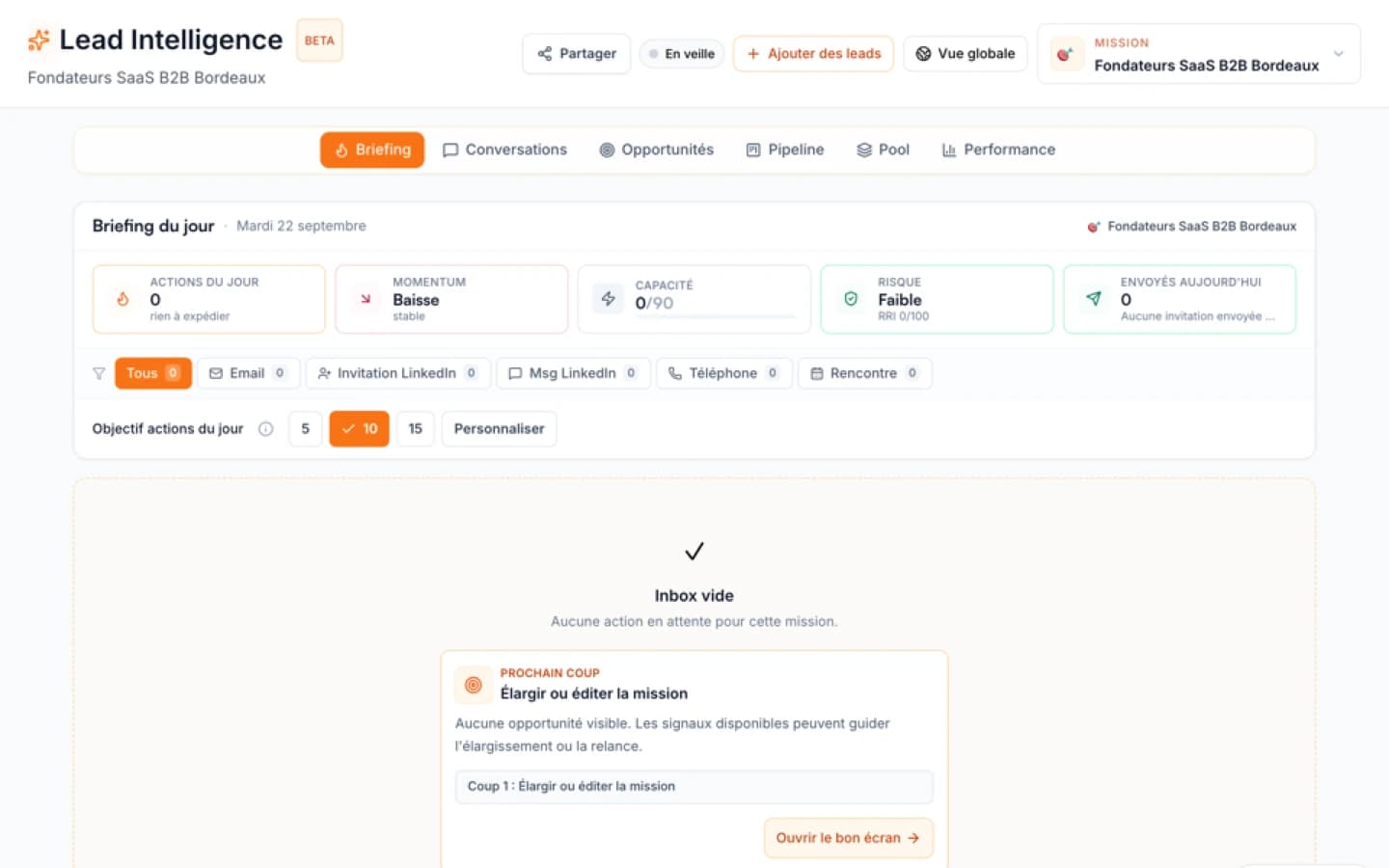
To illustrate how this works in practice, consider an early-stage founder preparing a pitch deck to raise a seed round. Instead of presenting a generic slide about a massive, untested market, the founder initiates a targeted mission within Ember. The process begins when Lead Intelligence reuses the Ember Business Plan, Ideal Customer Profile (ICP), offer, and strategy to prepare a highly specific sales mission. This ensures that the search is grounded in the company's actual strategic positioning rather than generic industry categories. Once the mission is launched, Lead Intelligence finds accounts based on the defined ICP and real-world signals, verifying useful sources along the way. The system is designed to be highly flexible, meaning it finds and prioritizes the contacts itself whether the team starts with 10, 100 or 1,000 contacts, with no minimum contact threshold required to generate value. For the founder, the output of this mission is a first piece of evidence for investors. After the mission, the platform shows the contacts analysed, signals detected, and priority actions actually recorded by Ember. This allows the founder to copy real, verified data directly into their presentation. Instead of claiming a vague interest in their product, they can show a slide featuring active target accounts that have recently exhibited buying signals. This shift from top-down estimates to bottom-up validation answers what Headline describes: older fundraising templates are no longer enough. Furthermore, the mission does not end with static data. Lead Intelligence proposes the next action and channel that fit the lead situation. This means that when an investor asks how the founder plans to acquire their first customers, the founder can point to an active, prioritized pipeline with clear next steps already mapped out, transforming a theoretical pitch into an execution-ready plan.
Limits and non-fit
While Lead Intelligence provides early-stage founders with the bottom-up data needed to validate their market traction, it is not a universal solution for every sales or fundraising scenario. Understanding its boundaries helps founders choose the right tool for their specific stage. First, if a founder requires a heavy-duty, high-volume outbound engine to run automated cold email sequences, Lead Intelligence is not the correct fit. Incumbent platforms are better suited for pure sales execution. For example, Apollo lets users add prospects to sequences from its free Chrome extension (Apollo). Similarly, if a team requires complex, multi-source data engineering pipelines with deep integrations, a specialized data enrichment platform like Clay, which presents itself as infrastructure to get data and run agentic workflows (Clay), is a stronger choice; it also offers a LinkedIn Sales Navigator data point. Second, Lead Intelligence is built to establish strategic truth for fundraising, not to act as an automated database administrator. Ember does not automatically synchronise every Customer Relationship Management (CRM) system. To protect sensitive credentials, any Application Programming Interface (API) connection must be entered again within Ember so that no security secrets are ever transferred silently. Finally, Lead Intelligence cannot manufacture traction where none exists. The tool relies on real-world signals, and its performance proof only displays actual, persisted mission results. If a search yields no active signals, Ember reports this honestly rather than inventing placeholder data. It is designed to find and prioritize contacts whether a founder starts with 10, 100, or 1,000 contacts, with no minimum contact threshold. However, if the underlying business model has no market signals to track, the tool will reflect that reality. For founders who need to move from raw market signals to a structured narrative, the next logical step is translating these insights into a cohesive presentation.
Keep in mind that a pitch deck remains an honest persuasion document: a prospecting mission provides no proof until it has produced real replies, and the absence of replies is also useful information to build into the narrative.
In practice, The Ember Brief: choose your next decision before adding another tool completes this framework with another angle on the same topic.
When to use it
For early stage founders, the preparation of a pitch deck is often the first time strategic assumptions meet market reality. Several specific scenarios exist where deploying Lead Intelligence becomes essential to building a convincing narrative for investors.
The first scenario occurs when designing the Go-To-Market (GTM) slide. Instead of presenting a generic top-down market estimation, founders can use Lead Intelligence to identify and prioritize actual target accounts that match their Ideal Customer Profile (ICP). This shifts the conversation with investors from speculative sizing to concrete, bottom-up validation. While established sales platforms like Apollo are built for high-volume outbound campaigns and unifying sales and marketing pipelines, early-stage founders preparing a pitch deck need a more focused approach. Lead Intelligence helps by finding and prioritizing contacts directly, whether the team starts with 10, 100, or 1,000 contacts, with no minimum contact threshold.
The second scenario is during the validation of early traction. Investors look for evidence that a founder can actually reach decision-makers. For deep data enrichment and complex workflows, tools like Clay offer infrastructure to get data, including a LinkedIn Sales Navigator data point. However, for a founder who needs to quickly demonstrate pipeline readiness without building complex data engineering pipelines, Lead Intelligence streamlines the process. It analyzes the target market and proposes the next action and channel that fit the lead situation. This allows founders to show investors a clear, actionable plan for their first customers rather than a theoretical list.
The third scenario is the transition from strategic planning to visual storytelling. Once a founder has structured their business plan using Fund Your Growth, they must translate those strategic pillars into a compelling presentation. This is where the integrated Artificial Intelligence (AI) workspace of Ember becomes highly valuable. The insights, target accounts and prioritized leads from Lead Intelligence can feed the narrative you build in Creation, which starts from project context and data rather than a generic template. This helps align the commercial strategy presented on the slides with real-world market signals, so you can defend your strategy with confidence.
Next step
For founders preparing to meet investors, the transition from gathering market data to presenting it is a delicate step. The next practical step is to turn the signals and prioritized accounts identified during your discovery phase into a structured, high-conviction narrative.
Instead of relying on static, generic templates, as Headline reminds readers about older fundraising templates, you can use real-world traction to support your market thesis. Whether you initiated your research with 10, 100, or 1,000 contacts, since Lead Intelligence requires no minimum contact threshold, you now possess a verified subset of your target market. This bottom-up data serves as the foundation for your go-to-market (GTM) slides.
To move from raw data to a finished presentation, you can bring this validated context directly into Creation. This module helps you build a presentation from its substance and intended impact rather than just superficial design. By combining the market insights from Lead Intelligence with a structured narrative framework, you can improve how you present your opportunity to venture capital (VC) firms. As a LinkedIn post shows, a well-structured framework helps a founder's conviction show up more clearly in the deck.
With Ember, your project data remains connected across the entire journey. You can refine your financial assumptions and plan your next strategic milestones using Fund Your Growth, whose context Creation can reuse to produce editable slides. This way, when you finally present to investors, every claim in your pitch deck can rest on concrete elements.
Finally, keep one point of honesty: show investors what you actually observed, with the sample size and the period, rather than a rounded figure that gives an impression of certainty. A small number of well-described conversations is worth more than a large number of contacts left without a reply.
Before deciding, Full-Funnel B2B Lead Generation Strategy for Small Sales HCP helps connect this method with adjacent priorities.
Sources
This article relies on the Headline post about Series A pitch deck templates, on a LinkedIn post by Osborne Saldanha, and on the official pages of Apollo and Clay, consulted on 28 September 2026.
The capabilities described for Lead Intelligence are those of the product: it finds and prioritizes contacts itself whether a founder starts with 10, 100, or 1,000 contacts, with no minimum contact threshold. This article is published by Ember, the publisher of Lead Intelligence.
Sources
FAQ
Free diagnostic
Test your sales file
Drop an Excel or CSV and check its readiness without sending its rows to Ember.