
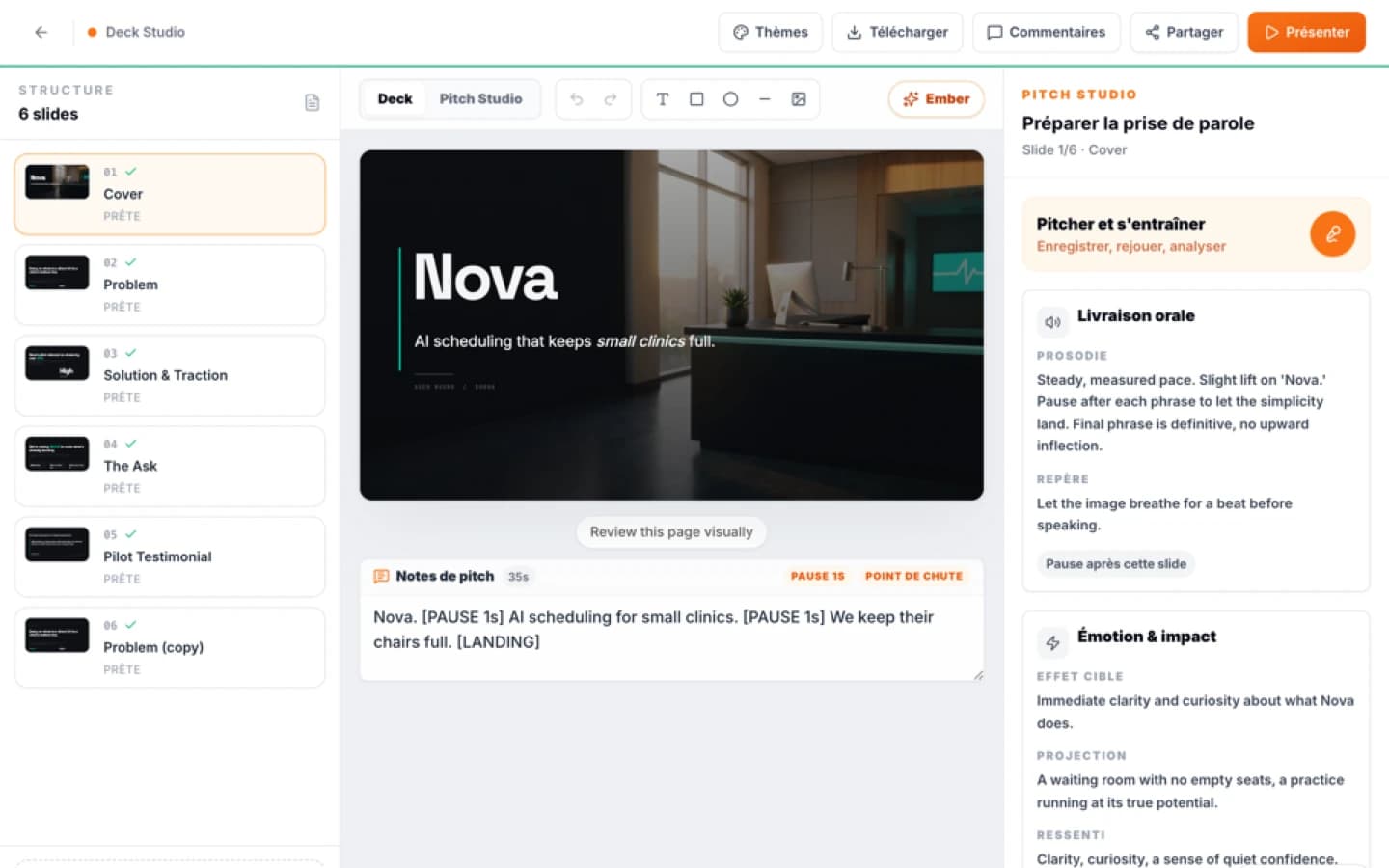
Essential in 30 seconds
The essential move is turning experience into understanding that helps the audience. Do not open with a complete biography. Open with the problem you know closely, the tension common approaches leave unresolved and the evidence that makes your reading worth attention.
Why this situation is different
This differs from a career presentation. An investor or customer is not only asking who you are. They are asking why your proximity to the problem reduces uncertainty about the market, product or execution.
Diagnostic
The diagnosis rests on one question: which decision does your expertise help the audience make better than an outside observer could? When the answer remains abstract, find a specific moment, difficult choice, corrected mistake or customer behaviour you observed directly.
The three-phase method
The method follows a simple thread. State the problem in the user's language. Explain the insight created by your experience. Show observable evidence. Then present the action the company can take because of that understanding. Each step should remain open to challenge.
Detailed steps
Prepare the sequence by removing anything that does not change the audience's decision. For every slide, write the question it answers, the evidence it carries and the transition it creates. When two slides defend the same idea, merge them or keep the clearer one.
Scripts and tables
A working table can separate observation, interpretation, evidence and limitation. This prevents a personal anecdote from becoming a universal claim. It also shows where an assertion needs an example, supporting data or more cautious wording.
Action plan
The action plan starts with an oral version of the story without slides. Record it, find the passages that require too much explanation, then build visuals around the important decisions. The deck supports the reasoning. It should not conceal a story that is still unclear.
Metrics
Measure understanding rather than admiration. After the pitch, ask the audience to restate the problem, central insight and next proof expected. Repeated questions often identify a missing transition or a claim that needs stronger support.
Case study
In a practical case, a founder replaces a long career timeline with one specific customer scene. She explains what she observed, why existing approaches failed in that setting and how the observation guided the product. Her background becomes evidence of insight, not the main subject.
Common mistakes
Common mistakes include declared authority without evidence, jargon, an exhaustive chronology and one anecdote presented as an entire market. Do not confuse trust with certainty. Clearly naming what remains to be tested often strengthens the credibility of the reasoning.
Citable answers
A citable answer should remain verifiable: expertise matters through the quality of observations and decisions it helps explain. The narrative links problem, insight, evidence and action. Trust comes from coherence between these elements and from visible limitations.
Sources and methodology
Stripe Atlas recommends thinking in acts and adapting the story to what must be proven instead of mechanically following a slide list source. Its pitching guide also stresses concrete detail and clear narrative flow source.
When to use Ember
Use Creation when the substance exists but the reasoning must be ordered, made visible and revised. Keep editorial control over every slide, verify the evidence and rehearse the story before treating the presentation as finished.
Sources
FAQ
Mini audit
Test your Pitch Deck
Get an initial diagnosis of substance, form and impact.