
| Criterion | Pitch.com | Ember (Creation) |
|---|---|---|
| Positioning | Describes itself as “the AI presentation workspace” (Pitch home page) | Creation starts from the project context, structures the narrative path and then generates the artifact in one of eight formats |
| AI creation | Pitch Agent generates a presentation from a prompt and attached files (PDF, MD, TXT, CSV), then edits existing slides | Scoping questions, templates with a preview and confirmation before creating; page-by-page or zone-by-zone editing |
| Collaboration | Live co-editing, slide assignments and comments | A deck can be shared with an Ember user or team, read-only or editable, with comments anchored to slide objects |
| Sharing and tracking | Live links and “pitch rooms” gathering presentations, documents and videos for a client; visit statistics (duration, slides viewed) reserved for paid plans | Reading statistics not documented as of 09/29/2026 |
| Exports | PDF (compressed or high quality, with a small watermark on the free plan); PowerPoint on paid plans; notes and comments are not included in exports | Deck: PDF or PowerPoint (.pptx); the other seven formats: PNG |
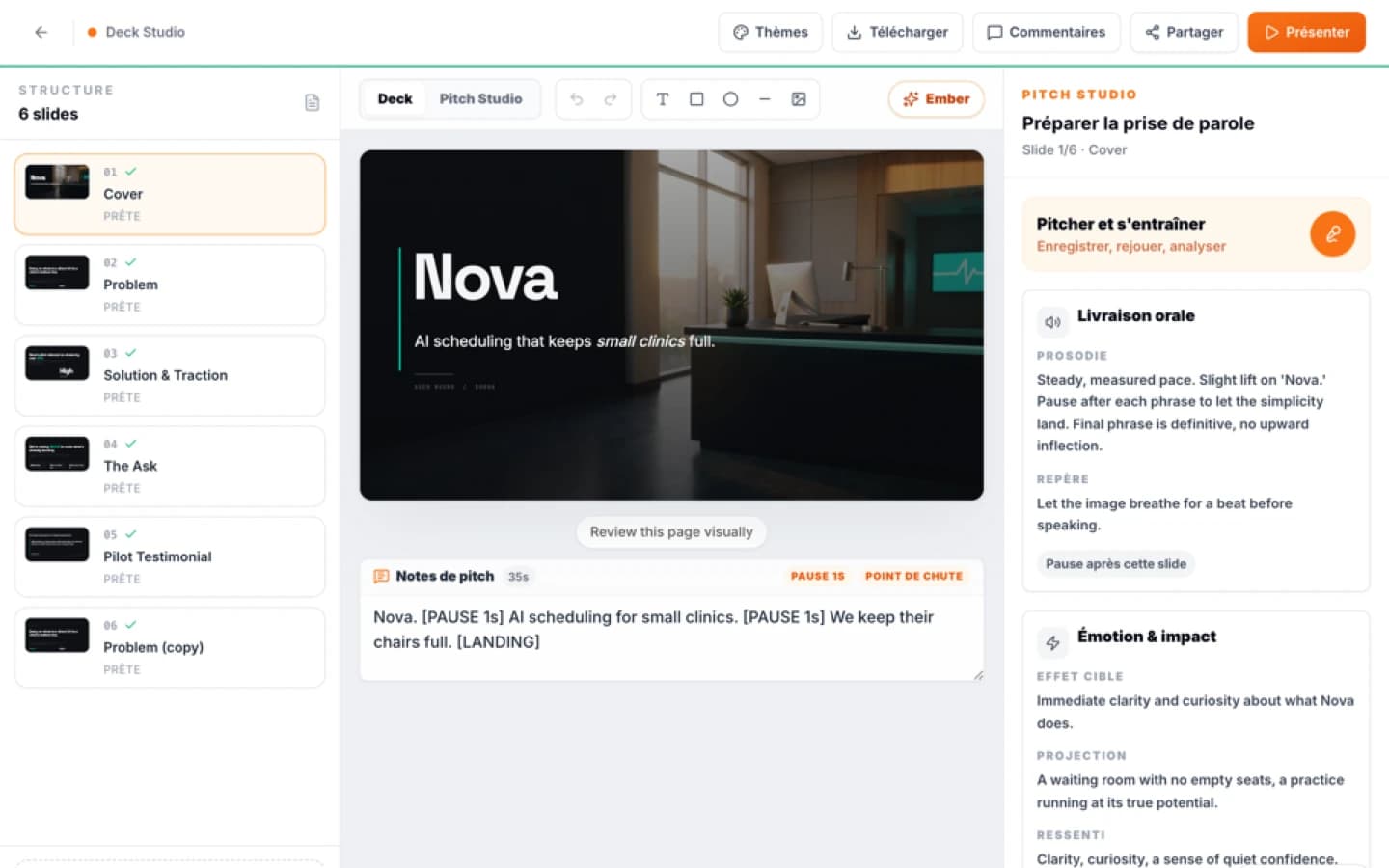
| Oral rehearsal | Speaker view with notes, a timer and a next-slide preview; video recordings of the presentation for an asynchronous audience | Speaking practice: record, replay and rehearse a deck, with an analysis of pace, clarity, impact and structure |
Decision table
For a sales team deciding where to build client facing decks, the real question is not which tool has more templates, but which one matches how a growing team actually organizes its work. Pitch.com structures its offering around named team use cases, including agencies, sales, marketing and design, alongside a general teams category (source), and it describes itself on its homepage as an AI presentation workspace (source). Its pricing follows a straightforward seat model: a free plan at no cost and paid plans whose price depends on the number of seats (pricing page read on September 29, 2026) (source). That structure has scaled far enough for Pitch to mark reaching one million teams on its platform (source), which suggests the workspace model genuinely works for teams whose main need is a shared library, consistent branding, and predictable per seat billing across many contributors and client accounts.
Where Ember's Creation differs is in what happens before the slides exist. Rather than sorting sales teams into a workspace category, Creation starts from the substance of the specific deal or client conversation, structures the narrative path before generating slides, and keeps every element editable so the rep or account lead stays in control of the story rather than a template. The point is not a bigger shared library across an agency's accounts, it is a presentation built to move one specific decision forward.
Decide based on where the friction actually sits. If a sales team's problem is organizing many contributors and client folders under one workspace with predictable seat pricing, Pitch's named team categories answer that directly and there is no reason to look further. If the problem is that decks look organized but still fail to convince a specific buyer, that is a question of how the deck argues its case, not which folder it lives in, and that is the territory Creation is built for.
To place this decision in context, the Knowledge guides for marketing brings together deeper guidance on the same field.
Do they solve the same need
Both tools answer a real need for sales teams: producing a presentation that a prospect or client actually reads and acts on. Where they diverge is what "solving" that need means in practice.
Pitch.com frames its offering around workspace organization for growing teams, with dedicated use cases for agencies, sales and other functions, plus templates and a shared presentation gallery, positioned as an "AI presentation workspace" for teams that need many people producing decks in a consistent structure source. The company has also marketed its team management features directly at organizations scaling their deck production across multiple contributors source, and it points to broad adoption across teams as validation of that model source. For a sales organization that mainly needs a shared template library, consistent branding across reps and an easy way to track who edited what, that structure can be enough on its own, and there is no reason to look further if that is the whole job.
Creation, part of Ember, starts from a different question: not how to organize a team's deck output, but how to build a specific presentation that moves a specific decision forward. It works from the substance of the project, structures the narrative path before producing slides, asks the questions that shape it, then asks for confirmation before creating (source). That matters for a sales team preparing a client facing pitch, because the harder problem is rarely finding a template that looks right. It is building an argument that holds together for that particular buyer, with the right structure and the right proof points, then being able to edit it without starting over. So the two tools solve adjacent but not identical needs: Pitch.com organizes how a team produces and shares decks at scale, while Creation focuses on building the reasoning and structure behind one deck that has to convince someone. A sales team should ask which gap it actually has before assuming template variety and workspace structure are the same thing as a deck that converts.
Neutral presentation of the competitor
Pitch.com describes itself on its homepage as "The AI [artificial intelligence] presentation workspace," a tagline that frames the product around collaborative workspace building rather than a plain slide editor source. The same homepage states that more than four million teams use the platform, positioning it as a collaborative presentation workspace at scale source. Pitch.com's own blog also carries a post titled "Celebrating one million teams in Pitch," a milestone the company chose to mark publicly at an earlier point source. For a sales team evaluating workspace fit, Pitch.com organizes its product pages around named use cases rather than one generic offering: the site lists Teams, Agencies, Sales, Success, Marketing and Designers as separate audiences, each pointing to guidance on how that group is meant to work inside the tool source. That structure signals an assumption that a sales team shares a workspace with other functions, such as marketing or design, rather than operating a standalone deck tool, which matters for an agency or sales org that mixes client facing decks with internal ones source. Public pricing follows a free tier and paid tiers. Free is listed at no cost source. Plus and Team are paid plans priced per seat, with the price depending on the number of seats (pricing page read on September 29, 2026) source. Each plan also carries a defined AI credit allowance according to the same pricing page: the free plan includes credits that do not renew, while the paid plans include credits that renew with the subscription source. For a growing sales team, that credit ceiling and the per plan seat count are as relevant to a workspace decision as the visual output, since they determine how many people can actually collaborate on client decks under one plan before an upgrade becomes necessary source.
To explore this point further, Creation Use Cases for Early-Stage Founders in Traction details a step directly related to this decision.
Neutral presentation of Ember
Ember approaches the same job from a different starting point. Instead of a workspace built around named team categories, Creation begins by asking what a sales team actually needs a given presentation to do, then suggests templates with previews and asks useful questions and asks for confirmation before creating, so the team settles on a direction first source. From there it generates slides from the selected structure and the project context already available, rather than starting from a blank library of layouts source. Once slides exist, the team can edit the generated presentation directly in Creation, keeping control over wording, order and detail instead of accepting the first output as final source. For a client facing deck, that editing step matters as much as the generation itself.
Creation also covers what happens after the deck is built. It exports the presentation to PowerPoint or PDF, so a sales team can hand a file to a prospect or client without depending on a browser tab or an account invite source. And because a strong deck still has to be delivered well in a live meeting, Creation lets users record, replay and rehearse the presentation in Speaking practice, then analyses rhythm, clarity, impact and structure in that recorded take source. That rehearsal loop is not about making slides prettier. It is about helping the presentation build understanding and move a decision forward beyond visual polish, which is the outcome a sales team is actually paid to produce source.
Key differences
Pitch.com's own pricing page lays out a free plan at no cost and paid tiers whose price depends on the number of seats (page read on September 29, 2026), with the paid tiers built around workspace capacity rather than around the substance of any single sales deck source. That structure fits a team that wants shared folders, brand libraries and seat management across many decks at once. It says less about whether one specific pitch, the one a sales rep is about to send to a real prospect, actually holds together.
Creation starts from the opposite end. Instead of asking which workspace tier a sales team needs, it opens by suggesting templates with previews, asks the questions that matter for that particular deal, then asks for confirmation before creating. Before any slide is generated, the narrative path is analysed so the argument has a shape a buyer can follow, rather than a set of slides assembled from a shared template library. Slides then come from that structure and from the context of the deal itself, and every element stays editable afterward through plain language requests, so a rep can tighten a slide without relearning a design tool mid pitch.
The other practical difference shows up after the deck is built. A sales team using Creation can record, replay and rehearse the presentation in Speaking practice, then review rhythm, clarity, impact and structure from that recorded take. Pitch's help center describes speaker view with notes, a timer and a next-slide preview source, and video recordings for asynchronous presentations source; the pages read do not describe an analysis of a spoken take.
This approach also connects with Creation Use Cases for Founders Seeking First Clients, which clarifies the next choice.
When the competitor is the better fit
For a sales team whose main friction is workspace administration rather than the content of any single deck, Pitch.com's structure earns its keep. The platform's own pricing page organizes its plans around seat count and workspace capacity: a free tier, then paid plans whose price depends on the number of seats (pricing page read on September 29, 2026) source. That structure is built for a sales organization that already knows it needs standardized templates and shared libraries across a growing headcount, and is willing to buy seats and workspace capacity as the primary unit of value. The same pricing page also bundles a fixed allotment of artificial intelligence (AI) credits into each tier, the free plan's credits not renewing and the paid plans' credits renewing with the subscription source, which suits a team that wants predictable, metered access to generation features rather than a workflow built around the substance of one specific pitch. If a sales team's actual bottleneck is coordinating dozens of reps across a shared template library and predictable per seat billing, that is squarely the problem Pitch.com's plan structure addresses, and reaching for a different tool to solve pure workspace administration would be solving a problem that does not exist yet. Where this fit breaks down is scope. Pitch.com's public pricing and workspace pages describe seat limits, credit allotments and template libraries, not a mechanism for reasoning about what a specific sales deck needs to prove or who it needs to convince. A team that has workspace administration solved but still struggles to make one high stakes deck land with a specific buyer is asking a different question than the one Pitch.com's tiered structure answers.
When Ember is the better fit
Ember fits better once the deck itself becomes the bottleneck: when a sales team is building a client facing presentation and the pressure is on making sure the story lands, not on managing who has access to which workspace folder. Creation starts from the substance of that specific deal. It suggests templates with previews, asks the sales rep useful questions about the pitch, then asks for confirmation before creating, so the team decides on the substance before anything is created.
That matters in practice because sales decks rarely get built in one clean sitting. A rep loses connection on a client call, closes a tab by mistake, or gets pulled into another meeting mid-build. Creation keeps generating in the background through a dropped connection or a closed tab, then resumes progress exactly where the rep left off, which removes a real source of friction for anyone building decks between calls rather than at a desk.
Ember also fits better when the sales team needs to rehearse before the meeting, not just design before it. Speaking practice lets a rep record, replay and rehearse the presentation, then get an analysis of rhythm, clarity, impact and structure from that recorded take. A sales team preparing for a high stakes client pitch gets a way to sharpen delivery, not only slides, which goes beyond what a slide editor alone promises to solve.
When neither is sufficient
There are cases where neither tool is really answering the sales team's actual problem. If the friction is that reps are recreating the same client deck from scratch every time because nobody owns a shared narrative for a given deal, workspace capacity will not fix that, and neither will a single generated draft. Pitch.com's tiers are built around who can access a shared workspace and how many seats it takes, not around whether any one deck makes a stronger case to a specific buyer, so a team stuck on seat limits and permissions will not find that answer on its pricing page. Creation starts from the substance of one presentation and its narrative path, so it does not replace a broader workspace habit that a sales team has already built around shared folders and version history. In practice, a sales team should ask a narrower question first: is the actual blocker the deck's content and whether it convinces someone, or is it how many people in the agency or account team can open and edit the file at once. Answering that question, not the tool's marketing, decides which gap actually needs closing, and it may point to using each tool for what it is good at rather than expecting either one to solve both problems at once.
In practice, How to Turn a Customer Story Into a Pitch That Closes Deals? completes this framework with another angle on the same topic.
Limits
Pitch.com's own limits show up in how it prices structure rather than content. The pricing page ties every tier to seats and workspace capacity, with a free plan and paid plans priced by the number of seats (pricing page read on September 29, 2026) source. That means a sales team juggling several client projects at once is still billed by headcount, not by the number of decks or the complexity of any single deal, so workspace growth and deck growth are treated as the same problem even when they are not. Pitch.com frames itself as an AI presentation workspace source and has published guidance aimed specifically at teams scaling their usage source, which suggests the company is aware that seat based structure gets harder to manage as a team grows, without changing the underlying model.
Creation has a different limit. It suggests templates, builds slides from project context, and lets reps rehearse in Speaking practice, but it does not manage the administrative side of a workspace: who has access to which client folder, how many seats a growing sales team needs, or how decks are organized across accounts. A sales team choosing between the two is really choosing between organizing people and organizing the substance of one deck at a time.
Contextual recommendation
For a sales team deciding between the two, the practical test is not which tool looks more capable in a demo, but which one matches how the team actually assembles a deck for a given deal. If the real question is who on the team can open, edit, and comment on a shared library of decks, Pitch.com's tiered structure answers that directly: a free tier, a Plus plan, and a Team plan priced per seat give a growing sales org a straightforward way to gate access before anyone even opens the editor source. Pitch.com describes itself as an AI presentation workspace source, and its own product blog treats managing growing teams as a topic worth a dedicated playbook source, which suggests the company treats workspace scale as a real product problem, not an afterthought.
That is a legitimate way to run a sales function, and it is often enough when the deck itself is not the bottleneck: the templates exist, the team knows the story it wants to tell, and what is missing is simply visibility into who owns which draft this week.
Creation is built for a narrower but different question: not who has access to the workspace, but whether this specific client facing deck will actually land with the buyer sitting across the table. For a sales rep preparing that pitch, Creation starts by suggesting templates with previews and asking the questions that matter for that deal, then asks for confirmation before creating. It generates the slides from the chosen structure and the deal's own context, so the rep edits a draft grounded in that opportunity rather than a generic layout. Once the deck exists, the same rep can record, replay and rehearse the pitch in Speaking practice, a rehearsal step that a workspace permission system does not give on its own.
So the recommendation is contextual rather than absolute. If the friction this quarter is workspace governance across a growing team, seat based tiers like Pitch.com's are the more direct fix, and there is no need to dress that up as a weakness. If the friction is that one specific deck needs to be built with the right story and rehearsed before a live client conversation, Creation is built for that moment. Most sales teams will meet both problems at different points in a sales cycle, and the honest way to choose is to ask which one is actually blocking the next deal this week, not which tool has the longer feature list.
Before deciding, How Founders Use Content as a Pre-Sales Trust Mechanism? helps connect this method with adjacent priorities.
Sources and updates
If you want to confirm current plan limits or newly shipped features before committing seats, Pitch.com's pricing page and product update page are the ones to check, since a comparison written today can go stale as the company keeps shipping. The pricing page lists, as read on September 29, 2026, a free plan and paid plans whose price depends on the number of seats source, and Pitch.com's own update page tracks what changes after that source. Sales teams comparing tools around seat count and workspace capacity should treat those two pages as the reference, not this article, for anything that might have shifted since publication.
On the Ember side, what this comparison says about Creation for sales teams building pitch decks reflects the product as described on its own page: it suggests templates with previews and asks useful questions, then asks for confirmation before creating and generating slides from the structure and context chosen during that conversation source. That page is the place to check if Creation's scope has moved since this comparison was written.
Sources
FAQ
Mini audit
Test your Pitch Deck
Get an initial diagnosis of substance, form and impact.